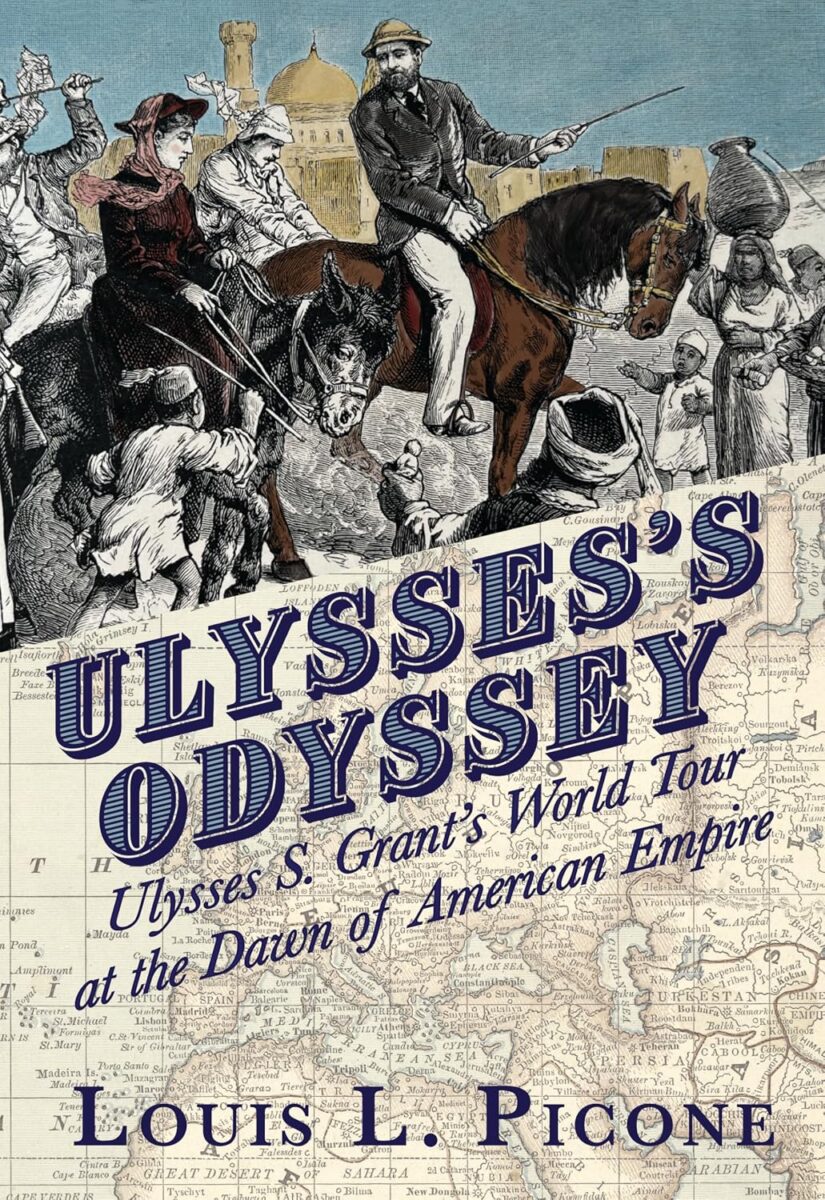
Filmmaker Christopher Nolan’s The Odyssey is hardly the only work examining an epic world tour to debut this summer. Veteran author and presidential historian Louis L. Picone’s latest book, Ulysses’s Odyssey: Ulysses S. Grant’s World Tour at the Dawn of American Empire, recalls the eighteenth president’s tour around the globe following his two terms in office. Using firsthand accounts of Grant’s globetrotting—including personal correspondence written by the president, his family, and the journalists who covered them—Picone examines how simple wanderlust was unwittingly transformed into meaningful diplomacy at the dawn of American Empire. Specifically, it is Picone’s thesis that the former general in chief of Union armies was a reluctant ambassador who intended little more than tourism. But Grant’s heroic status as a peacemaker uniquely positioned him to wield great influence with world leaders. This enabled Grant to shape the future of United States foreign policy—and eventually regain enough political capital to seek what was then an unprecedented third term as president.
Picone argues that it was President Grant’s decision to use international arbitration in resolving the “Alabama Claims” that first burnished his reputation on the world’s stage. According to the author, the “Alabama Claims” was the greatest foreign policy achievement of the Grant administration—not to mention a milestone for world peace. Coupled with his battlefield triumphs and efforts to protect and enfranchise the formerly enslaved during Reconstruction, the former president was uniquely positioned to serve as an ambassador for the emerging American Empire.
World leaders and the citizens of nations abroad revered the former general in a manner typically reserved for royalty or heads of state. Grant enjoyed audiences with Queen Victoria, King Leopold, and Viceroy Li Hung Chang of China’s Middle Kingdom. Grant’s celebrity status allowed him to gain critical foreign policy perspectives that he shared with Republican Party leaders upon his return to the United States.
Grant may have desired to be nothing more than a world tourist, but the author plies readers with compelling examples of how the former president used his standing to promote American interests abroad. This was particularly true in the victor of Vicksburg’s advocacy for immigration to the United States. “Urging immigration from foreign countries was a common theme throughout Grant’s journey,” Picone writes. “Industrious immigrants could both bolster sparsely settled areas and restore depleted populations of established areas whose citizens had moved West.”
Picone succeeds in reminding readers of the importance of President Grant’s world tour, finding in this remarkable journey a true reflection of Grant’s genius as a statesman and his standing as an international peacekeeper. The author’s rich and descriptive prose transports readers to the many destinations Grant visited. Picone successfully argues that Grant was more than the sum of his failures, contributing meaningfully to recent reassessments of his presidential legacy from the pens of Brooks D. Simpson, Ron Chernow, Charles Calhoun, and others. In sum, Ulysses’s Odyssey is a most worthy entry to the Grant bibliography. It provides a truly fresh vantage point on Grant’s contributions to the nation—and the world.
Ariel Hernandez is a graduate student in the Department of History at Sam Houston State University.