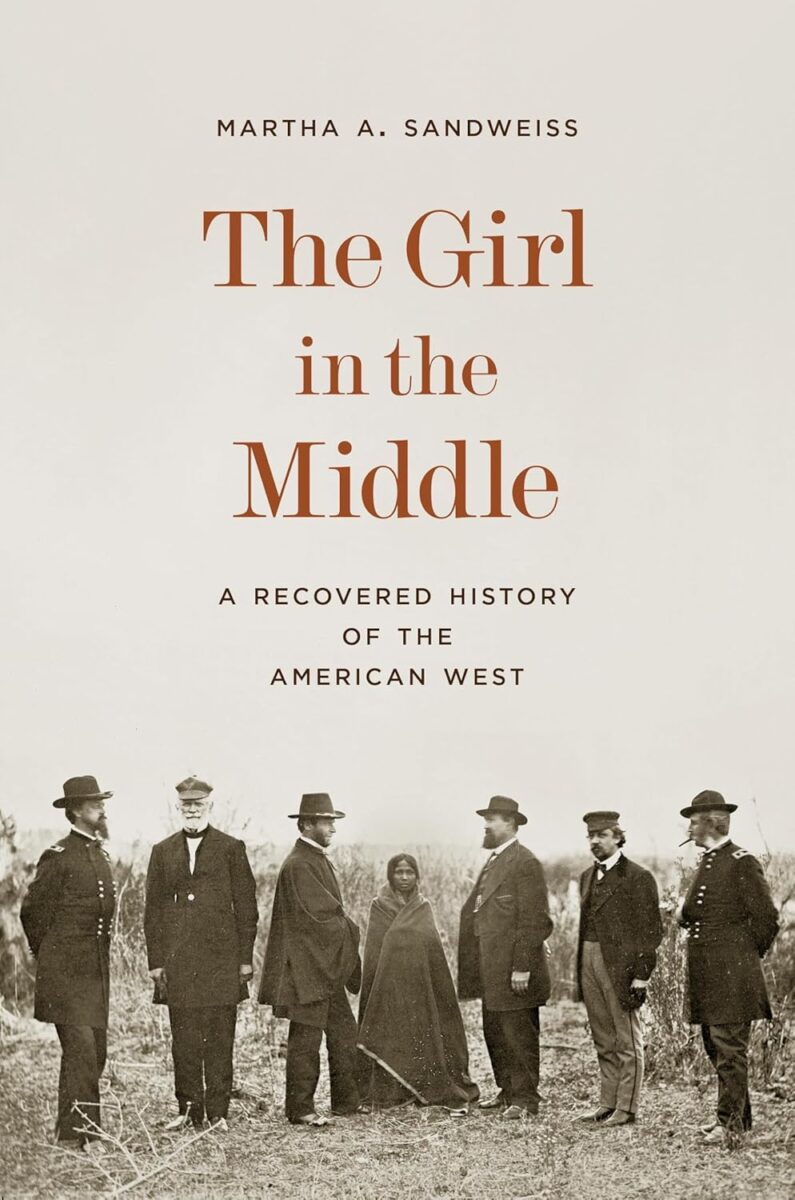
Historian Martha A. Sandweiss begins by gazing at an 1868 Alexander Gardner photograph of six peace commissioners and a Native American girl wrapped in a blanket. The identities of the six men are known: Alfred H. Terry, William S. Harney, William Tecumseh Sherman, John B. Sanborn, Samuel F. Tappan, and Christopher C. Augur. But the identity of the girl has long eluded scholars. It took Sandweiss a long time to discover a possible name for the girl, but, once she had a name, Sandweiss found “her story—buried deep in legal files, memoirs, government records, and fading family memories” (1-2). The Girl in the Middle skillfully uses a single photograph as a “springboard into a sprawling century of American history” (2).
Although there are seven people in the actual photograph, Alexander Gardner, the photographer, plays an important role in this story. Many people know that Gardner took haunting, evocative photographs of battlefields and dead soldiers during the U.S. Civil War. Fascinatingly, despite Gardner’s long-standing fame as a photographer, “how or when he became a photographer remains a mystery” (25).
Sandweiss offers an extended discussion of the technical aspects of photography and what Gardner’s trip to Fort Laramie in 1868 would have entailed for the photographer and his cameras and equipment. This information will be of particular interest to readers who do not know much about nineteenth century photography and are interested in learning more.
Of the six peace commissioners, some come into better focus than others. General William S. Harney receives the most attention. As Sandweiss notes, “no living army officer had as much experience in Indian affairs as he did; in that regard his appointment to the Peace Commission made sense. Yet he rarely looked for the peaceful way out of anything. His presence hinted that should words fail, the peace commissioners would consider force” (26). The Lakotas called Harney “Woman Killer,” and Sandweiss examines Harney’s “personal history of cruelty and abuse” (27). She considers his relationship with Kezeko (or Keshoko) at Fort Winnebago. Charlotte, as she was called by the U.S. soldiers, was the mother of Harney’s daughter, Mary Caroline Harney. Although Harney never married Charlotte, he made sure that, in the treaty negotiated with the Winnebago, Caroline Harney received 640 acres of land, “an extraordinary gift” that was “more generous than anything the military office would later give his legitimate children” (35). Sandweiss also discusses Harney’s murder of Hannah, an enslaved woman, in St. Louis in 1834.
Sandweiss considers Sanborn in his dual role as a peace commissioner and an attorney who helped clients (including M.A. Mousseau) press claims for Indian depredations against the federal government. Tappan, his spiritualist wife, Cora L. V. Scott Hatch Daniels Tappan, and Tappan’s ward Minnie, a survivor of the Sand Creek Massacre, allow Sandweiss to analyze debates about Native American assimilation through the lens of the Tappan household. Sherman appears less than one might think, especially given his outsized role during the U.S. Civil War and Reconstruction. Terry and Augur never really come into focus at all. Perhaps this is fitting since they stand at the edges of the photograph.
What about the girl in the middle? Sandweiss believes she is Sophie Mousseau, the daughter of Sanborn’s client M.A. Mousseau. Sophie, Sandweiss asserts, “stands at the center of a sprawling family tale that stretches from Quebec to Wyoming to Washington DC – and in the middle of a sweeping story about the transformation of the West in the decades after the Civil War” (96). Sophie’s family included Joseph-Alfred Mousseau, who was premier of Quebec in the 1880s. Sophie married twice and had thirteen children. Her first husband broke up their marriage (likely a common-law marriage) after becoming infatuated with another woman (who was also married). He kept their five children and abandoned Sophie on Great Sioux Reservation at Pine Ridge. It was, Sandweiss noted, “akin to a parental kidnapping, except no laws protected Sophie’s rights and he broke no legal rules” (236). Decades later, Sophie’s former husband killed the woman he abandoned Sophie for. Sophie remarried and bore eight more children.
At the end of this fascinating story about Sophie Mousseau’s life, Sandweiss admits that there is a chance that Sophie was not the girl in the photograph. However, Sandweiss contends that the evidence strongly suggests that Sophie was indeed the “girl in the middle.”
In many respects, this book is a model of historical detective work that could easily be assigned in undergraduate and graduate courses on historical methods. However, it is also accessible and eminently readable. Whether the girl in the photograph is Sophie Mousseau is not entirely certain. Sandweiss certainly has the preponderance of the evidence on her side, but readers will have to weigh her conclusions and decide for themselves. This smart, sensible book will appeal to both academic and popular audiences.
Evan C. Rothera is Assistant Professor of History and Director of Graduate Studies in History at Sam Houston State University.