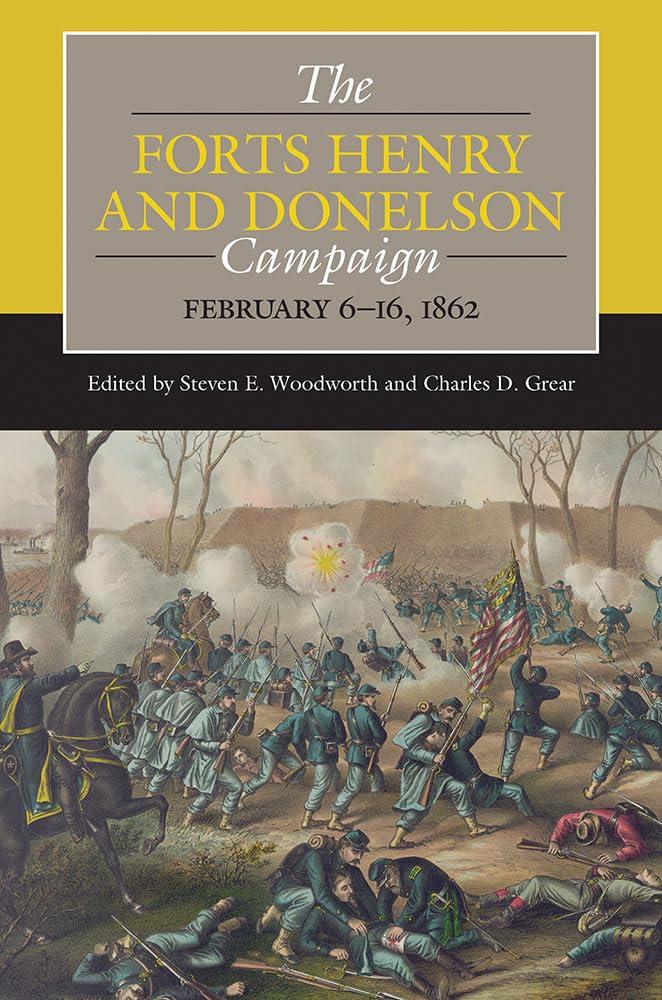
When February 1862 dawned, fortune seemed to smile on the Confederacy. Ten days later, the rebels had given up Kentucky, western Tennessee, and more than thirteen thousand men in the largest surrender in U.S. military history to that point.
The latest entry in Southern Illinois University Press’s Civil War Campaigns in the West series assembles seven essays on that reversal. Editors Steven E. Woodworth and Charles D. Grear argue that after February 1862, every Confederate move west of the Appalachians was reactive, designed to reverse the loss of the Cumberland and Tennessee Rivers. Anyone who has read the editors’ Vicksburg collections will know the format: short, specialized essays on discrete pieces of the campaign.
Woodworth’s introduction earns its keep, laying out the historiographical terrain from Benjamin Franklin Cooling’s Forts Henry and Donelson (1987) through Kendall D. Gott’s Where the South Lost the War (2003). Woodworth highlights where the seven essays that follow push against that literature.
For this reviewer, the highlight of the volume was Michael Burns’s “Natural Chaos,” an environmental history that reads the flooded Tennessee, the February mud, and freezing temperatures not as background but as active participants in the campaign. Burns shows that Fort Henry was vanquished less by Foote’s gunboats than by its siting on ground where “the river reclaimed its own each February” (18). The weather worked on both armies. Muddy roads that gummed up Grant’s infantry also clogged the Confederate line of retreat. No other essay in the collection uses more innovative evidence or resets the campaign in quite the same way.
The other essays stay closer to the ground. Blakeney K. Hill’s “Joint Command: The Union Gunboats at Forts Henry and Donelson” treats the Grant-Foote partnership as an improvisation that worked better than the divided Confederate command it faced; the essay is at its best on the unglamorous business of getting army and navy to move together. Brian S. Wills has written extensively on Nathan Bedford Forrest, and his account of Forrest’s dilemmas at Fort Donelson covers familiar ground—though he is right to deflate the legend that Forrest alone spotted the escape route. Jonathan M. Steplyk makes the best use of soldiers’ letters and diaries of any essay in the volume. Steplyk reconstructs what men on both sides could perceive in the confusion of February 15, and he argues that the breakout’s early success owed more to Union inattention than to Confederate design.
Woodworth’s own contribution, on C. F. Smith’s attack against the Confederate right, credits Smith with the stroke that doomed the fort. Sheilah R. Elwardani’s “Justifying Surrender” is the sharpest source of criticism in the book, tracing how Colonel Gabriel C. Wharton reworked his own conduct after the fact; in her reading, Wharton “never once conceded error” (97). Grear closes the volume with a piece on Texans’ reaction to the defeat, arguing that the loss of the forts taught Texans that the war to preserve the enslaved South would cost them far more than they had imagined.
Clocking in at just 164 pages, this is a slender book. Readers who want a continuous narrative of the ten-day campaign will want Timothy B. Smith’s Grant Invades Tennessee (2016) nearby. But this is a worthwhile collection that will repay novice students of the war and seasoned scholars alike.
Lisa M. Chavez is an MA candidate in the Department of History at Sam Houston State University.