According to Henry Adams, Ulysses S. Grant was incompetent, naïve, and surrounded himself with corrupt cronies. For his part, Grant did not particularly care for the Adams family. As he wrote to Adam Badeau, “the Adams’ do not possess one noble trait of character that I have heard of from old John Adams down to the last of all of them” (69). Nevertheless, for generations, historians largely accepted Henry Adams’s view of Grant’s presidency. In recent years, Grant has experienced significant scholarly reassessment. Much of this reappraisal was animated by Grant’s heretofore unappreciated record on civil rights. Ryan Semmes, currently professor and director of research at the Ulysses S. Grant Presidential Library, continues the reassessment of Grant’s presidency by analyzing Grant as an active and engaged president who had an intertwined set of ideas about race, citizenship, overseas expansion, and the U.S. West.
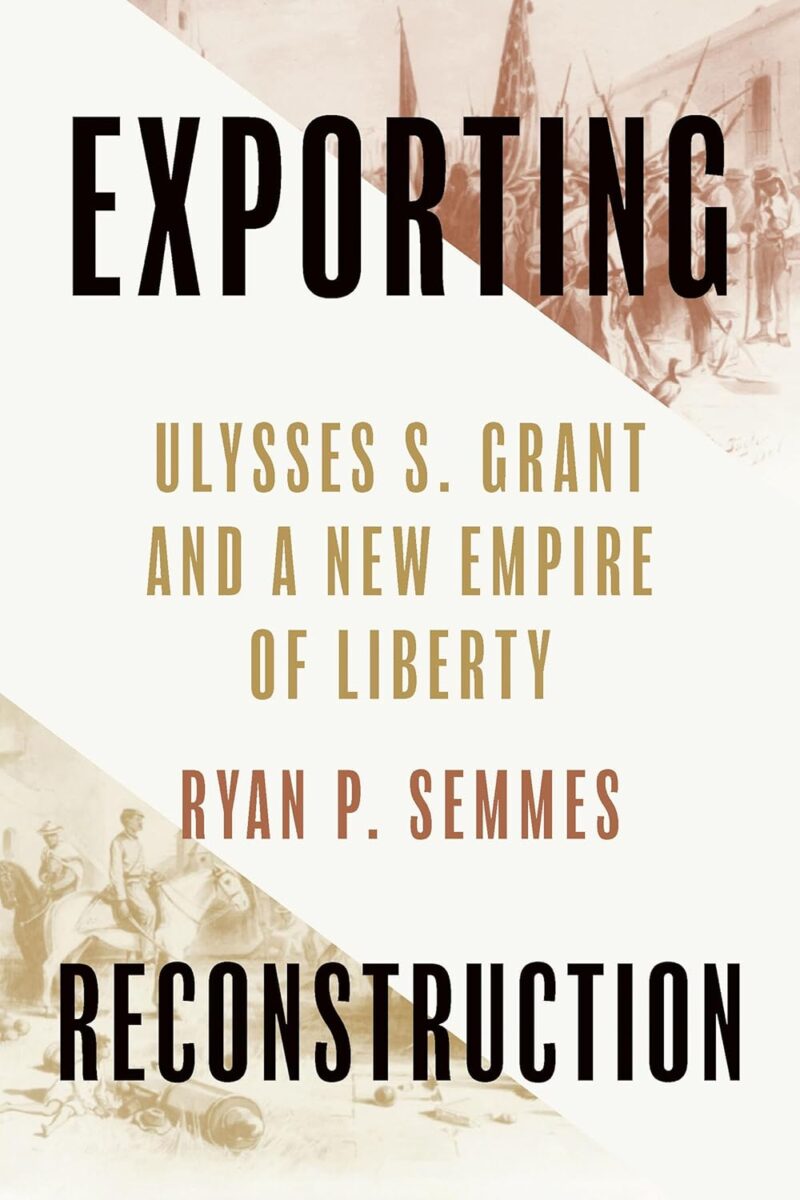
Exporting Reconstruction uses citizenship as the lens through which to analyze Grant’s foreign policy—specifically toward the Dominican Republic—and his Peace Policy toward Native Americans. Semmes is particularly interested in how both contributed to Grant’s overall desire to establish “a new empire that exported republican liberty” (2). Indeed, Grant’s policy “envisioned an exceptional United States as the arbiter of freedom and democracy in the World, exporting this ideology through expansion and reorganization of territories” (8). This “Grant Doctrine,” as Semmes calls it, illustrates that Grant was not just an affable fool, but that he thought deeply about foreign policy, race, and citizenship.
Part I, “Reconstruction on the Global Stage,” examines Grant’s Caribbean policy. Scholars have discussed Grant’s attempt to annex the Dominican Republic before, but Semmes drills deeper into the story. In attempting to bring the Dominican Republic into the Union, Grant believed it would be possible to “export American republicanism to the Dominican people” (26). But it was more than simply exporting republicanism. Grant saw a direct relationship between the acquisition of the Dominican Republic and strengthening the Union: “The influx of over one hundred thousand new citizens of Hispanic, Africa, and indigenous origin into the United States would, Grant hoped, encourage racial reconciliation in the South, or, failing that, provide an American territory where non-white citizens could enjoy the fruits of their own labor and the blessings of republican liberty” (27).
Dominican annexation was not well-received in many quarters. Nevertheless, Grant persisted, even in the face of opposition from leading Republicans. The Grant Doctrine, Semmes contends, “envisioned an American sphere of influence in the Western Hemisphere that erased the economic and cultural influences of Europe, by which Grant meant the continuation of slavery in Cuba, Puerto Rico, and Brazil” (50). Many people in the Dominican Republic, remembering the U.S. War with Mexico and filibustering, were skeptical, but Semmes notes that Grant proposed something very different. “Unlike other imperial expansion attempts by the United States either before or after, annexation of the Dominican Republic would mean the overseas expansion of the rights and privileges of the US Constitution as well as the cultural and economic benefits of American influence to non-whites in the territory” (61). In Grant’s eyes, the Dominican Republic could become nothing less than a “beacon of freedom in the Caribbean” (62). Ironically, Grant insisted on the Dominican Republic, which many people in the U.S. did not support, and refused to intervene in Cuba, which many of his contemporaries would have supported. Semmes notes that Cuba’s Ten Years’ War “was a perfect opportunity for Grant to test the viability of his doctrine” (67), though Grant declined to do so, leaving scholars with unanswered questions about what might have occurred. Annexation, of course, ultimately failed. Still, despite annexation’s failure, “the attempt reaffirmed the principles of American hegemony in the Western Hemisphere as expressed in the Grant Doctrine” (95).
Part II, “Reconstruction in the American West,” explores Grant’s Peace Policy and his ideas about Native Americans, civilization, and citizenship. Grant, Semmes contends, “saw the Reconstruction era as a time when people long left out of the republican experiment could finally enjoy the blessings of liberty” (101). The U.S. West became nothing less than a new frontier for exporting Reconstruction. The Peace Policy sought to “define who could and could not be a citizen of the United State sand what was required of a civilized citizen” (120). By the time Grant left the presidency, the Peace Policy was defunct (mirroring the fate of Dominican annexation). Still, despite the failures, Semmes concludes, Grant’s attempts “show that had others shared his understanding of the changing nature of citizenship, it might have meant that the American people would not have had to wait nearly a century for the civil rights movement to complete the work of Reconstruction” (153).
Exporting Reconstruction is part of a growing body of scholarship that broadens the study of Reconstruction beyond the U.S. South. By discussing the Caribbean and the U.S. West, and by analyzing the Grant Doctrine, Semmes reminds readers that the story of Reconstruction is far more expansive than what occurred in the Southern states. He also illustrates that it is a mistake to unquestioningly accept the Henry Adams view of Grant’s presidency and not consider how Grant understood the post-U.S. Civil War world. Anyone interested in the U.S. Civil War and Reconstruction should read this book and think carefully about the arguments Semmes advances.
Evan C. Rothera is Assistant Professor of History and Director of Graduate Studies in History at Sam Houston State University.