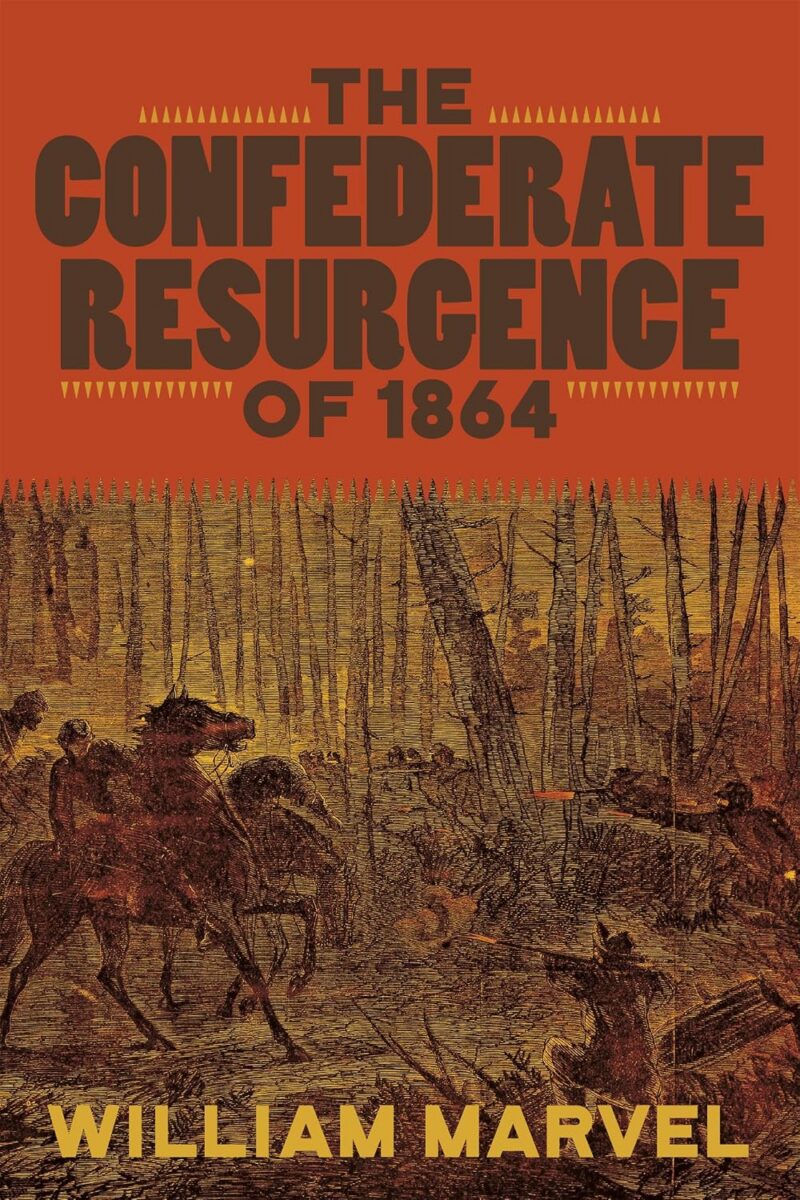
William Marvel has written extensively about the U.S. Civil War era. In The Confederate Resurgence of 1864, he examines “an assortment of major and minor military operations from the eastern seaboard to the Texas border during 1864” (1). These operations included the sinking of the U.S.S. Housatonic by the Hunley, the battle of Olustee, the Kilpatrick-Dahlgren raid on Richmond, the Red River Campaign, Nathan Bedford Forrest’s battles in Kentucky and Tennessee, and the capture of Plymouth, North Carolina. “More by their number and their uninterrupted succession than by their strategic importance,” Marvel argues, they “wrought a telling recovery of Confederate morale and a reciprocal decline in Union morale, in and out of the armies” (2). Marvel navigates readers through the twists and turns of these campaigns and operations, which, he notes, have “attracted little attention in the renaissance of Civil War history that began around 1950” (2). This is a fair assessment of some of the operations Marvel studies, but others, like Fort Pillow and the Red River Campaign, have received significant attention from scholars.
“The cumulative impact on the Confederate psyche of ten weeks of unbroken good fortune between Olustee and the end of April,” Marvel asserts, “has been all but ignored” (2). He seeks to rectify this omission by assessing the broader impact of the individual rebel victories. In his overview of morale in the Confederacy in the beginning of 1864, which sets up the rest of the book, Marvel finds rebel morale depressed. “Solons and citizens, as well as soldiers,” he asserts, “betrayed doubt of ultimate success that winter” (23). The ten weeks of victories in 1864 changed this situation, and Marvel does not pull punches in his assessment. “Their principal collective fruits consisted of a restoration of southern spirit that may have prolonged the war into the bitter episodes of its closing months” (2). Furthermore, he continues, “the Confederate confidence of springtime bred stubborn summer resistance, feeding Rebel resilience and Yankee fatigue alike” (4). Readers will have to consider whether Marvel’s claims stand up to strict scrutiny.
In January 1864, the Army of Tennessee was still reeling from its rout at Chattanooga. Thus, it would make sense to find examples of soldiers with low morale in this army. However, does it follow that, because the Army of Tennessee suffered a crushing defeat, morale was depressed across the Confederacy? Scholars have found morale in the Army of Northern Virginia, not to mention throughout the Confederacy, in better shape that Marvel suggests. As all students of the U.S. Civil War know, morale on both sides ebbed and flowed. After notching a series of victories in summer and fall 1862, rebel morale was high and Union morale was extremely low. A year later, the situation flipped. Does Marvel overstate the collapse of rebel morale in the winter of 1864? This is an important question because the crux of his argument is that victories (or perceived victories) in the campaigns and operations listed above revitalized the rebels and prolonged the war.
Marvel repeatedly makes his case that the outcomes of these campaigns prolonged the war. “Had the dejection suffered in the Confederacy’s Army of Tennessee after the resounding defeat at Chattanooga been allowed to ferment untreated through the unusually cold winter of 1864,” he contends “the spring campaign might have found that oft-defeated Rebel army far less confident” (3). Sherman would have been stronger and Johnston would have been weaker, and this “should have brought their contest to an even earlier conclusion” (3). He restates this point later in the book: “with Smith in Georgia and Polk remaining in Alabama, Johnston’s already unenviable odds would have substantially exceeded two-to-one, leaving little chance that he could have resisted nearly as long as he did” (216-217). His argument goes well beyond the Army of Tennessee. If Union armies had gone into winter quarters and denied rebels opportunities for victories, which wrought “a diametric reversal in their sinking military fortunes,” then the situation would have been very different because the “restored spirit among the Rebels spawned resistance as fierce as any the Federals had faced in the summer of 1862” (7). Indeed, “fierce resistance to the spring offensives in Virginia and Georgia would have been more difficult to mount” (226).
Marvel misses two important points here about the rebel armies and politics. First, is his argument that the Army of Northern Virginia would have had a difficult time resisting the Army of the Potomac in May and June 1864 absent the series of victories he charts in this book reasonable? Was the Army of Northern Virginia that dispirited by Chattanooga? Is it fair to suggest that the Army of Tennessee would have also put up much less resistance absent these victories? Second, Marvel’s relative lack of attention to politics is striking. Rebels knew Lincoln faced a reelection campaign in 1864 and that this was a critical chance to reshape northern politics in a substantive way. Is it reasonable to suggest that Jefferson Davis, the rebel government, Robert E. Lee, the Army of Northern Virginia, and even the bloodied Army of Tennessee would have given up without a serious fight and abdicated any chance of influencing the election in their favor? Moreover, is the argument that the rebels fought so hard because of a series of small victories in late winter and early spring 1864, rather than their analysis of the role they might play in the election of 1864, convincing?
There is another problematic element of Marvel’s argument that merits notice. The book’s central thesis is that rebel morale was in the basement in January 1864 and that a series of victories reinvigorated it. Marvel places much of the blame for the rebel resurgence at Lincoln’s feet. He believes Lincoln should not have pushed forward any attempts at reconstruction. As he notes—again, very bluntly—“the more spectacular of these Union reverses ended campaigns that had been launched in part to satisfy President Lincoln’s ambition for expedited reconstruction. Forays designed around his wish to establish loyal governments in the seceded states led to a surprising defeat of Federals in Florida and the near-rout of two successive Union armies in Louisiana and Arkansas” (3). Marvel also decries Lincoln’s “reconstruction reverie” (3). Lincoln, in other words, was obsessed with the pipe dream of Reconstruction to the Union’s detriment. Flipping the coin around, if Marvel is right that morale was in shambles across the Confederacy, would this not have been the perfect time to make overtures and emphasize the benefits of abandoning the rebels and returning to the old Union to rebels who had become (per Marvel’s analysis) deeply dispirited and demoralized?
The material in The Confederate Resurgence of 1864 also raises two additional points Marvel ought to have considered. First, wishful thinking and the power of the press. Everyone has heard of the power of positive thinking. This book gives readers an excellent case study into the power of wishful thinking by the rebels. This is not a new point. Scholars have illustrated how rebels became proficient at convincing themselves of just about anything and of turning defeats into victories. Nor was wishful thinking just a rebel phenomenon; it is a human phenomenon. Marvel correctly notes that some newspapers portrayed George Pickett’s failed attack on New Bern as a success. In addition to this display of wishful thinking, rebels also convinced themselves that Forrest checking William Sooy Smith’s cavalry raid caused Sherman to abandon his Meridian campaign, which was incorrect. The fact that rebels celebrated some of these events, particularly Fort Pillow (where Forrest had at least 1,500 soldiers against the 600 defenders of the fort and where the rebels an inhuman massacre after the fort’s capture), reveals something important about rebel willingness to seize on the most tarnished events and claim them as victories. In addition to illustrating the rebel proclivity for wishful thinking, this book also shows the power of the press in shaping people’s understandings of events. It demonstrates how newspapers could and did transmogrify defeats, like Pickett’s failure to capture New Bern, into victories as well as amplify and distort other events.
Second, racial atrocities. Olustee, Fort Pillow, Plymouth, and Poison Spring all featured rebels butchering African American soldiers. Indeed, racial atrocities occurred again and again throughout the events featured in this book. Marvel does not offer any comment about the frequency of racial atrocities and the role they might have played in the rebel resurgence. He does note, of Olustee, that “some scattered instances of murder very likely followed Olustee, but no widespread massacre” (254n40). The Confederate resurgence during this period, therefore, was a resurgence fueled by rebel hatred of their foes and, especially, by racism and fury about Black soldiers. Reading this book, one can hear the lurid apocalyptic language the secession commissioners utilized in 1860-1861 that Charles B. Dew quoted in Apostles of Disunion.
The Confederate Resurgence of 1864 does a good job presenting overviews of a series of campaigns and operations in early 1864. Readers will likely know a bit about each of them, but it is good to have a relatively detailed overview in one book. Readers will need to assess for themselves whether Marvel’s larger argument about the effect of these campaigns is convincing.
Evan C. Rothera is Assistant Professor of History, Director of Graduate Studies in History, and Co-Director of the Civil War Consortium at Sam Houston State University.