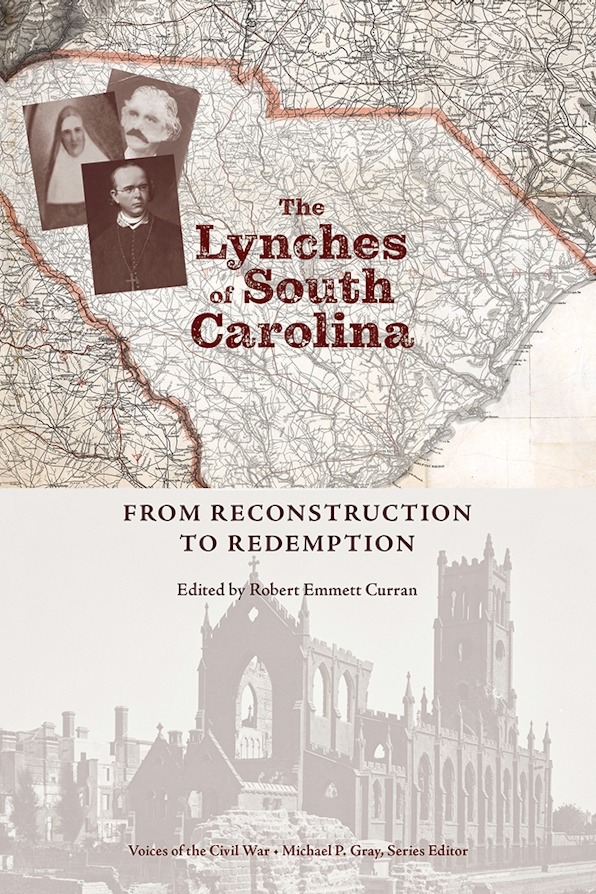
In 1818, Conlaw Peter Lynch, Eleanor McMahon Neison, and their one-year-old son, Patrick, left Ireland for the United States, where they sought “the opportunity to regain the status and fortune which British occupiers had stripped from their distinguished Irish families” (1). The Lynches settled in Cheraw, South Carolina, where Conlaw became a “major contributor to the town’s development” (1). The Lynches eventually had a dozen children. Patrick, the eldest, was the best-known Lynch of his generation. He was appointed Bishop of Charleston in 1858 and served in that capacity until his death in 1882.
This is the second volume of Lynch family correspondence that Robert Emmett Curran, professor emeritus of history at Georgetown, has edited. His For Church and Confederacy: The Lynches of South Carolina [University of South Carolina Press, 2019] presented the correspondence and writings of the Lynches from 1858 through December 1865. The current volume covers the Lynch family correspondence from January 1866 through 1882. As Curran explains, the volume begins with Patrick Lynch and his siblings facing “the gargantuan challenge of rebuilding their lives from the physical, financial, and emotional wreckage that the war had left” (4). The volume ends with Patrick’s death in 1882 and a brief epilogue about the Lynch family descendants.
The most prominent correspondents in The Lynches of South Carolina are Ellen (Mother Baptista), Francis, and John, three of Patrick’s siblings, as well as various other members of his family such as Henrietta Lynch (Patrick’s sister-in-law), and Patrick’s various nieces and nephews. Although Patrick received many letters from his siblings—Mother Baptista in particular—there are very few letters and documents written by him in this volume because, as Curran notes, the Lynch family correspondence with Patrick tended to be one-sided. That said, although Patrick did not often reply to the letters his family members sent, he was unfailingly generous to his family. Many of the letters contained various requests for help and for money, and Patrick took out loans to provide for his extended family. This correspondence demonstrates the deep family bonds among the Lynches as well as how they navigated Reconstruction and the period known as “Redemption” (when terrorists overthrew duly-elected Republican governments in South Carolina and elsewhere).
Readers will appreciate the humor, complaints, and offhand remarks that provide insight into the Lynches and their world throughout the letters. On July 16, 1866, Mother Baptista wrote to Patrick about her preferences for lay sisters: “small in person—healthy and between 18 and 21 years of age. (I feel like adding—light brown hair and blue eyes—but that sounds ridiculous)” (40). On November 9, 1867, she informed Patrick that Captain Keitt “is one of those who believes the ‘war of races’ is approaching and that all property will greatly depreciate—Then he ought not to ask $25 per acre for his land” (71). On March 8, 1868, she wrote to Patrick, who made annual trips to the northern states to fundraise for his diocese, “has no old sinner left you a legacy for us and died yet?!!!” (82). “What does the ‘Gazette’ mean by calling you the Old Bishop,” she complained several months later. “Hurumph! If it had said ‘venerable Bishop that would do very well and respectably’—but ‘old’ to a man in the prime of his life and just fifty—I like the tone of the ‘News’ better” (84). In 1874, she groused to Patrick that “Mrs Caldwell and family, must belong to the Victor Emmanuel sort of Catholics, to summon a convent and you, her bishop, on such terms as these into open Court” (208).
Curran draws on 532 letters in this book. He is very forthright in stating that readers will notice an “abundance of ellipses” because “the much greater volume of the postwar letters necessitated a comparable abridgement of the text” (15-16). Curran notes, again forthrightly but also problematically, that editing this volume involved “a great deal of rigorous pruning, not only of mundane details but also of much material that was interesting, but, to my judgment, of less importance than that which survived” (16). Abridging letters in primary source collections is always tricky, and it is fair to ask if readers are best served by this decision. Case in point, Curran includes material from a letter Henrietta Lynch wrote to Patrick Lynch on July 25, 1880 (299) in Chapter 30. In the epilogue, he includes a block quote from the same letter featuring Henrietta Lynch’s description of her daughters (317), but this material did not appear in Chapter 30. This is one example of how material perceived to be less important nevertheless is quite important. Clearly, one person’s ideas about what is and what is not important might not align with other people’s ideas. Creating a companion website for the book and making the full letters available to readers could alleviate this problem. Finally, at different times throughout this volume, it feels as though Curran expects people to have read the previous volume and be familiar with the material. Readers would do well to read both volumes of The Lynches of South Carolina in sequence.
These critiques aside, this is an interesting collection of primary sources. The Lynches, Curran explains, “never managed to come remotely close to recovering in America the riches that had been wrested from them in Ireland” (318). However, they nonetheless made “singular contributions to church and state which would long outlive them” (318). The letters in this volume help readers understand the nature of those contributions and provide a snapshot of a Catholic family seeking to make their way in the postbellum United States.
Evan C. Rothera is Co-Director of the SHSU Civil War Consortium and the author or editor of three books on the Civil War era.