 Library of Congress
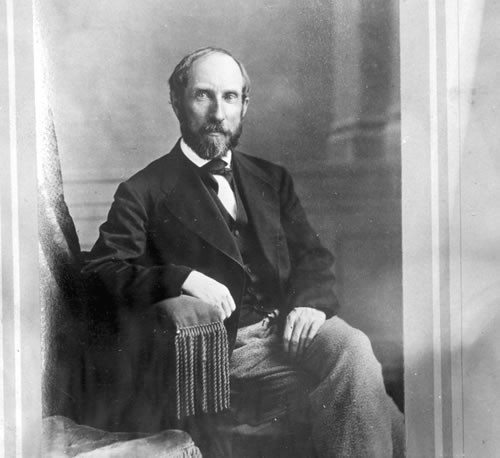
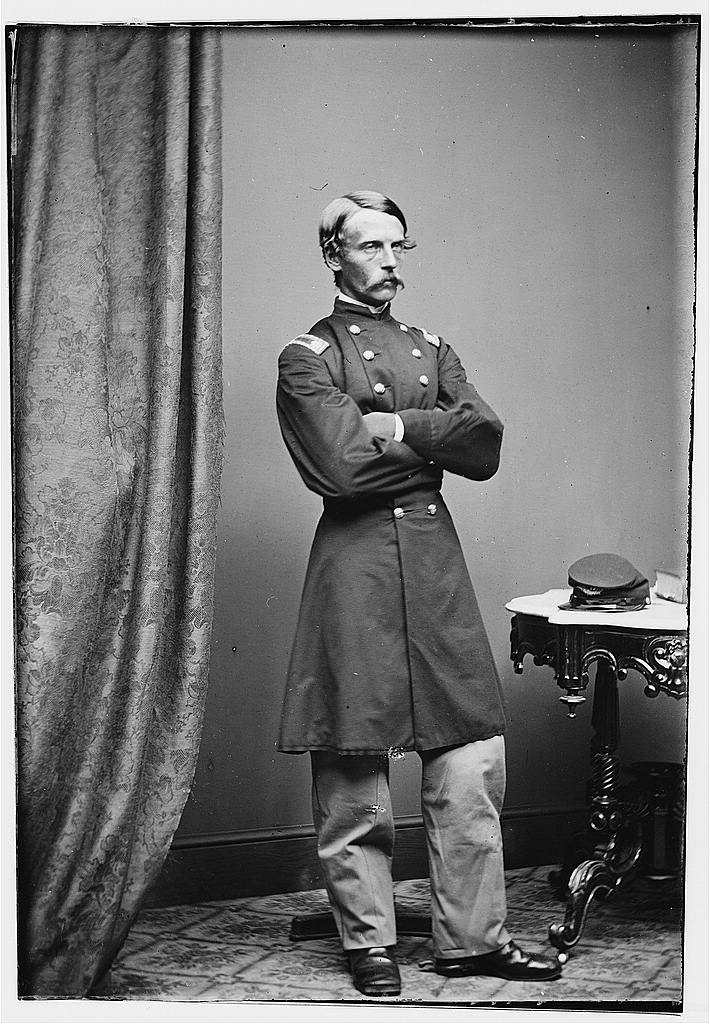
Colonel Francis Heath, 19th Maine Infantry
The 19th Maine Infantry was organized at Bath, Maine, in the summer of 1862 and mustered into federal service for a 3-year term on August 25. Raised as part of President Lincoln’s call for an additional 300,00 men to suppress the rebellion, the regiment—which consisted of back woodsmen, small farmers, tradesmen, fishermen, and college students—would be present at the Battle of Fredericksburg, participate in Ambrose Burnside’s “Mud March” in January 1863, and be slightly engaged at the Battle of Chancellorsville.
On June 15, 1863, the 19th Maine, part of Winfield Scott Hancock’s II Corps, Army of the Potomac, began the march in pursuit of Robert E. Lee’s Army of Northern Virginia, which had begun its second invasion of the North. On June 29, the 19th Maine made its longest march, covering 32 miles, to arrive near Gettysburg. a small crossroads town in south-central Pennsylvania. The regiment comprised 439 men under the command of Colonel Francis E. Heath, 25. The looming battle would be the 19th’s first taste of combat.
Rumors of the fighting at Gettysburg began to circulate through the ranks of the 19th Maine, but it wasn’t until midafternoon on July 1 that the soldiers heard the report of guns. The regiment marched until 9 p.m. to make camp on Taneytown Road, just south of what were called the Round Tops. The next morning, July 2, the regiment awakened early and made a short march north to settle into a position on a ridgeline called Cemetery Ridge, just south of the town. As one member of the regiment, Charles Nash, remembered, “The thought that some of our number would occupy ambulances, mangled and bleeding, before the night, could not be repressed. The certainty was too apparent.”
That afternoon, the men watched as the Union army’s III Corps, under the command of Daniel Sickles, advanced to a position well in advance of his assigned spot and far forward of the line of defense designated by army commander George Meade. Near 4 p.m., Confederate general James Longstreet launched a powerful attack on the Union left flank and the exposed men of Sickles’ corps. Quickly, parts of Sickles’ advanced line began to collapse. The 19th’s soldiers took note that the Union line on Cemetery Ridge was being stripped of troops to support Sickles’ beleaguered men, leaving the Maine soldiers feeling increasingly isolated.
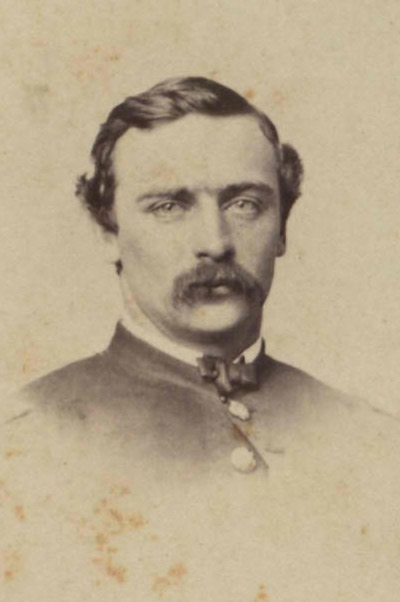
Finally, in the early evening, the 19th Maine received orders to move forward from Cemetery Ridge. Hancock rode up to personally reposition the men, directing them to support Lieutenant Gulian Weir’s Battery C, 5th U.S. Artillery. As the Maine men advanced under Hancock’s watchful eye, another Union battery crashed through its ranks, causing havoc. Colonel Heath recalled that Hancock, witnessing the disruption, directed his wrath on the battery: “General Hancock spoke in a good deal of passion to the battery officer saying, ‘If I commanded this regiment I’d be God damned if I wouldn’t charge bayonets on you.’”
 National Park Service
Lieutenant Gulian Weir, Battery C, 5th U.S. Artillery
The altercation over, the 19th re-formed and approached Weir’s battery. Hancock then vaulted from his horse, grabbed the first man on the left of the regiment’s front, and led him several paces forward. He placed the soldier, Private George Durgin, firmly on the spot and shouted, “Will you stay here?” Durgin shouted back, “I’ll stay here, General, until Hell freezes over.” Hancock, evidently pleased, ordered the regiment’s colors to align alongside Durgin.
The officers and soldiers of the 19th were then ordered to ground by Heath and as they peered through the smoke of battle, they heard the din of Confederates fast approaching. Mainer Silas Adams recalled, “[The battle] was moving our way, and it was plain to be seen it was to surge over us, and we would soon be caught in the vortex.” Another Mainer remembered, “On they came like a great billow, rushing with an irresistible force that no troops could check….” To add to the confusion, beaten soldiers from the III Corps were hastily retreating toward the 19th’s line looking, in the words of Adams, “a hopeless and disorganized mass.”
Heath walked to the front of the regimental line, cautioning the men to lie still on the ground and let the fleeing III Corps troops pass over them. However, many of those soldiers were not so careful where they stepped and a Mainer recalled that there was “no regard to dignity or military order….” Many of the retreating III Corps men said they were whipped and that the Maine men should get out. Others however yelled, “Hang on, boys! We will form in your rear.”
As the panic-stricken III Corps soldiers reached Heath’s line, an officer, perhaps III Corps division commander Brigadier General Andrew Humphreys, rode up and ordered Heath to have his men stand and stop the fugitives at bayonet point. Heath refused, fearing that his men might very well be infected by the disorder and swept away. He told the general that if his men could be gotten out of the way, the 19th would stop the pursuing Confederate attackers, and Humphreys’ men could re-form to their rear. Humphreys, in no mood to debate a colonel, rode along the Maine line and ordered the men to stand. Heath, who would not permit his authority to be challenged by a III Corps officer, followed the general and ordered the men to lie back down. Sharp words ensued but Heath refused to budge. He reportedly said to Humphreys, “I was placed here by an officer of higher rank (General Hancock) for a purpose, and I do not intend to go to the rear. Let your troops form in the rear and we will take care of the enemy in front.”
Heath was a man of his word. As soon as his regiment’s front was clear, he ordered the men of the 19th to their feet. Weir, who was positioned to their front with his battery, saw the Confederate juggernaut approaching and ordered his gun crews to limber up and fall back. However, as the Mainers stood and fired, Weir wheeled the guns back into line and reopened fire. Heath shouted, “Give it to them.” Maine lieutenant Edgar Burpee recalled, “We gave the Rebs a few pills that made their heads and stomachs ache….” The Mainers’ fire temporarily halted a brigade of Floridians, but the respite was short lived. A brigade of Georgians burst onto the scene with overwhelming strength and swarmed Weir’s battery, capturing three of its guns.
Then the Floridians and Georgians moved on the 19th Maine. As the Maine men stood, they saw a Confederate color-bearer through the smoke. Heath shouted, “Drop that color-bearer”; a soldier fired and brought down the enemy flag. The 19th brought the Rebels’ advance to a halt, exchanging as many as eight volleys with the enemy at 30 yards. But as dusk approached, the 19th’s Captain Isaac Starbird reported the Confederates were outflanking them on their right and left. Heath, fearing encirclement, withdrew a short distance until his flanks were secure, then about-faced the regiment’s line and gave the order to charge. The 19th, in company with rallied soldiers from the III Corps and reinforcements from nearby Vermont and Pennsylvania troops, swept the Rebels back. As they pursued the retreating soldiers, a staff officer rode up and asked Heath where the 19th was going. Heath replied, “We are chasing the Rebs.” The officer advised Heath to go no farther. The 19th Maine, with little fanfare, had stood the test of battle. They had held their ground, refusing to give way. They had executed an organized withdrawal only to face about and charge at the enemy. They would assist in the recapture of Weir’s three guns and several other pieces of artillery. The men had “seen the elephant” and prevailed. However, the cost was high. Their dogged determination in the face of the Confederate assault had cost them 130 men killed or wounded. Heath later wrote, “Of the conduct of the officers and men of my regiment, I cannot speak too highly, I would gladly particularize, but any distinction would be invidious, for all did nobly.”
Larry Korczyk has been a licensed battlefield guide at Gettysburg National Military Park for 13 years. He has conducted hundreds of tours on the battlefield (with a specific focus on the leadership of army commanders George Meade and Robert E. Lee), is a regular speaker at Civil War round tables, and coauthor of the book Top Ten at Gettysburg (2017).