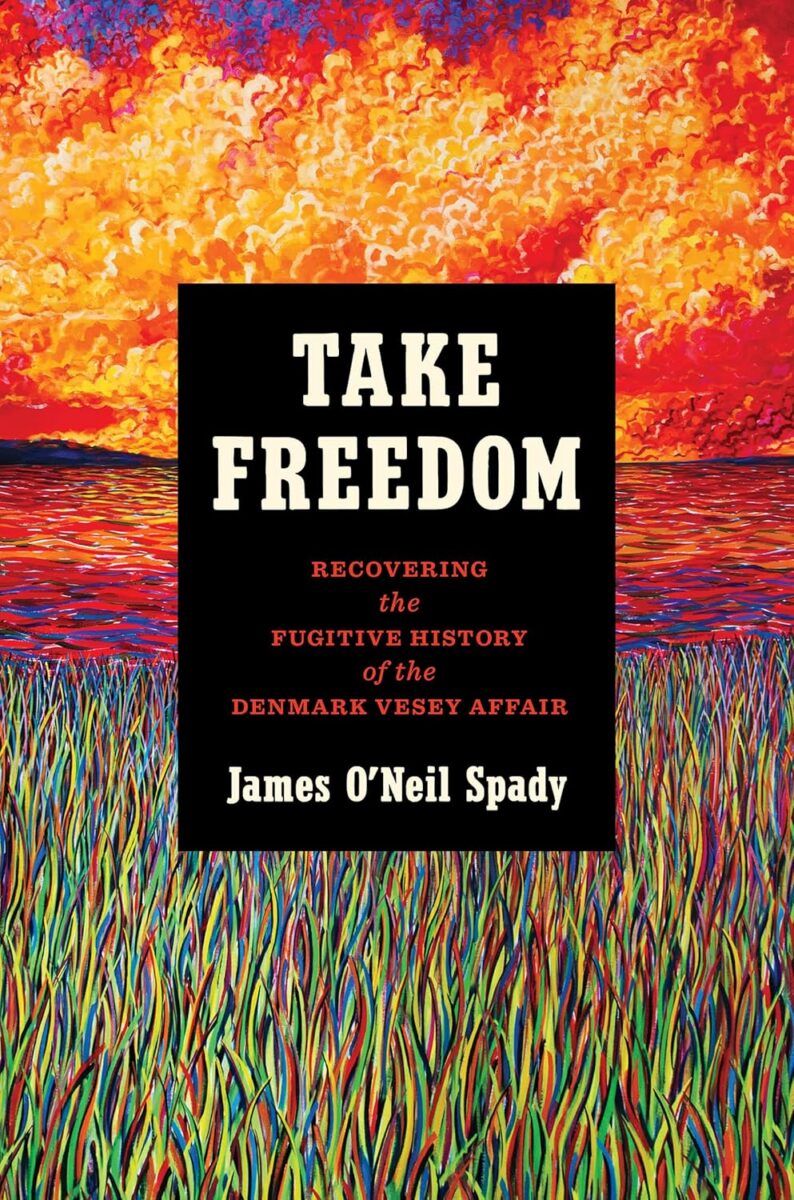
In 1822, white authorities in Charleston, South Carolina, responded harshly to a reported slave revolt before it could be executed. The Black preacher Denmark Vesey was seen as the revolt’s primary leader by the contemporary white tribunal—and by many subsequent historians. Scholars have debated the authenticity of the surviving tribunal records, which are copies of the original documents. James O’Neil Spady’s Take Freedom revises our understanding of the Denmark Vesey Affair by reading new evidence against the grain.
Spady’s contribution is twofold. First, he interrogates the tribunal report as material evidence to show that it is a reliable copy of the initial inquiry. Second, he shifts the focus from Denmark Vesey to the free and enslaved African community in Charleston, South Carolina. He argues that this community “devised fugitive strategies to safeguard relationships, protect places of solace, and conserve available resources to try to thrive” even as white Charlestonians sought to dissolve their communal bonds (2). This African and African American fugitive community was a wellspring of resistance and revolution.
This community-based resistance to white power is well argued throughout Take Freedom’s four roughly chronological chapters. Chapter one examines the “social networks and affinities [among free and enslaved African and African Americans] that provided the relative safety, logistical resources, and sense of power and possibility that attempting to escape or revolution required” (38). Free and enslaved Black Charlestonians hailed from diverse African regions, tribes, and social statuses. Spady shows that work and daily life allowed Charleston’s diverse African and African American inhabitants to form relationships. These relationships created a community that fugitive slaves could rely on. An ethos of silence developed to protect the community and fugitives from white enslavers who could sell or punish them with impunity. Peaceful resistance did not resolve this threat, and fleeing or emigration to Liberia would only separate them from loved ones.
Chapter two explores how several leaders in Charleston’s Black community, discussed as equals with Denmark Vesey, meticulously planned to seize Charleston’s weapon supplies and take the country before fleeing to Haiti (80). They recognized this as the only way to liberate the entire enslaved community. Yet Peter Prioleau, a slave not part of the movement, foiled these plans by reporting them in the hope of protecting the Black community from white counterviolence.
Chapters three and four discuss Black community resistance after the plot was discovered by white authorities. Chapter three recovers the agency of Charleston’s Black community in resisting and augmenting the investigation into the plotted revolt. The community’s ethos of silence resisted the white tribunal’s inquiries. The tribunal attributed the plot to Denmark Vesey, the Black church, and the supposed barbarity of the African race. The Black community shaped the official narrative by playing to white prejudice and selectively sharing the truth. Chapter four argues that white authorities shaped the nation’s memory of the planned revolt by writing the official narrative. They tried to silence the Black perspective by burying the revolutionaries in unmarked graves and assaulting the Black church and community. Yet the Black community remembered. Spady argues that we, too, should remember through monuments “the diversity of the Black community whose resistance and survival birthed the uprising movement” (140).
The “Afterword” validates the confidence that Spady takes in interrogating the surviving “South Carolina House and Senate copies of the tribunal proceedings” (142). Spady analyzes the tribunal records as material evidence. By comparing handwriting samples, he names Christopher Jeannerett as the clerk hired by Governor Thomas Bennett to sort and copy the likely disorderly tribunal records. Spady concludes, based on copy edits to the surviving documents and on addresses from Governor Bennett, that the tribunal records were not fake (143-144, 153).
The endnotes provide a detailed discussion of Spady’s method and sources. As a public-facing work, Take Freedom discusses its novel method and interpretation of sources in the Afterword and endnotes, while the body of the book interweaves analysis and narrative.
Take Freedom poignantly demonstrates that scholars have erroneously accepted the narrative from white authorities that Denmark Vesey led the foiled insurrection in 1822. Community and relationships were the undercurrents of Black resistance and insurrection. At the same time, Spady shows the authenticity of the tribunal report. One wonders whether Spady’s reading of community might be usefully replicated in studies of other slave revolts.
Joel Criswell is a doctoral student in the Department of History at Texas A&M University.