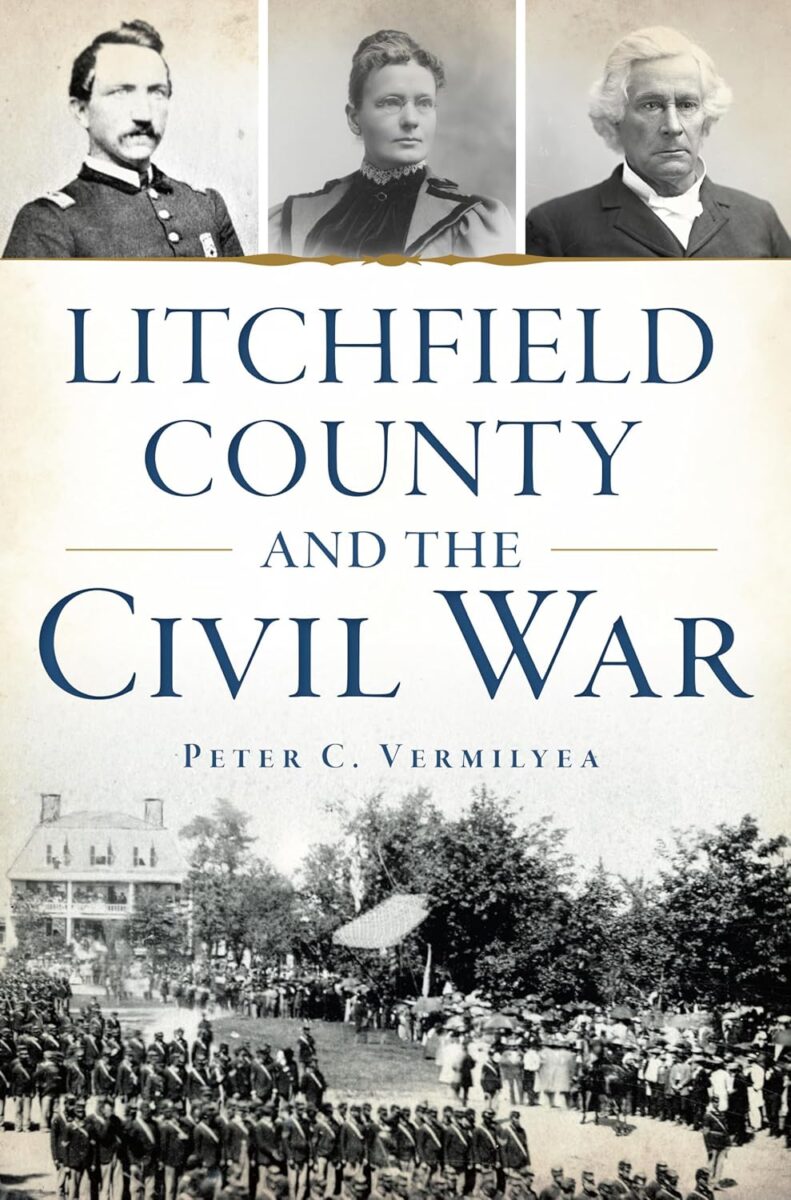
Peter C. Vermilyea’s Litchfield County and the Civil War offers an in-depth analysis of the how the mobilization of a Civil War regiment—in this case, the 19th Connecticut Infantry—elicited both patriotism and dissent in a New England community.
Relying heavily on primary source documents, Vermilyea, who teaches history at both Housatonic Valley Regional High School and Western Connecticut State University, highlights the Civil War story from a crucial corner of the Nutmeg State. His account considers the political and economic motivations behind soldiers’ decision to enlist; the roles women assumed while their husbands, sons, fathers, and sweethearts were mustered into service; and the function of the local newspapers, which became both a tool for recruitment and a source of information, enabling the community and families left behind to stay abreast on the soldiers daily activities and war campaigns they participated in. Vermilyea also uncovers tales of corrupt medical examiners who traded exemptions for service in exchange for money.
All the same, the author addresses how fervent supporters of the Union war effort dealt with Confederate sympathizers in the county. Vermilyea’s localized approach in his research allows for a more intimate connection to the past—and foregrounds the personal stories of Litchfield County citizens and families who sent their young men off to war.
Vermilyea supplies an interesting analysis of how women stepped up to ensure their soldiers were adequately supplied with blankets, socks, and other necessities of soldiering, all while remaining steadfast to societal expectations and the “cult of domesticity.” Women fundraised, yet they were unable to physically collect money; instead, the men of the community acted as trustees over any currency raised and donated to the cause. Society demanded that women maintain their roles in the home and provide care to the children.
Yet Vermilyea makes clear that the roles of women expanded significantly in the absence of men called off to war. Women now had to oversee farms, manage businesses, and participate in Ladies’ Aid Societies. They also found ways to express political views. The ladies of Kent, while preparing boxes of “luxury and comfort” for the soldiers, included a ragged pair of socks designated for Jeff Davis to “freely dance”—in other words, to hang for the crime of treason (57).
Another interesting aspect of Vermilya’s study is analysis of how Litchfield County used the power of the press as a means of recruitment, a method to promote patriotism, and as a conduit for information. With the fear of a draft imminent, newspaper advertisements, the Ladies’ Aid Societies, and recruitment posters all broadcast messages imploring recruits to sign up and collect their bounties. Vermilya weaves the subject of bounties throughout his work, revealing the significance of monetary inducements to military service for the poor and wealthy alike.
Similar studies of individual military units are available for historians and scholars, but what sets Vermilya’s study apart from other works is his use of never-before-seen primary documents and illustrations. Vermilya skillfully navigates a difficult and tumultuous, yet patriotic and proud moment in Litchfield County during the Civil War. His book supplies a complex yet engaging account of a northern regiment and its community.
Sabrina L. As’ous is a graduate student in the Department of History at Arkansas Tech University.