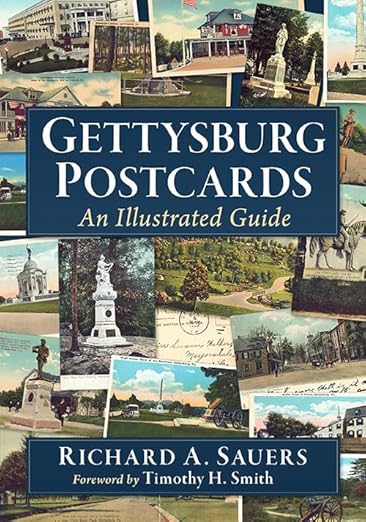
Richard A. Sauers is well known to students of the Civil War, having edited multiple letter collections, a comprehensive bibliography of the Gettysburg campaign, and, more recently, a three-volume index to The National Tribune, the leading periodical for Union veterans. To that impressive list of publications, he adds this unique book: an inventory and well-illustrated guide to more than 2,500 Gettysburg postcards produced over the last century and a quarter.
Sauers introduces the book with a “capsule history” of postcards in the United States. Readers learn that the government issued the first copyright for a “postal card” only five months after the first battle of Bull Run. Even so, postcards did not gain currency until after the war. The dazzling expositions of Gilded Age America buoyed the popularity of postcards, supplying events they could depict and venues where they could be hawked. Likewise, Congress boosted the emerging industry by fixing postal costs for the novel cards at just a “penny.” By the turn of the century—and, significantly, just as the Gettysburg National Military Park was established—the nation was in the throes of a postcard “craze” (7).
Sauers sorts Gettysburg postcards by their publishers and distributors, cataloging cards that span the various eras of postcard history and design. He divides the book into two parts: one that inventories the work of “major” publishers and distributors (like American News Company, Americana Souvenirs and Gifts, Colourpicture, and Eastern National Parks & Monuments Association) and one that tallies the products of “smaller” outfits (like Beal’s Lithograph, A.H. Shields, Alfred J. Hahne, and Chisolm Brothers).
This book will appeal most immediately to collectors of postcards and Gettysburg souvenirs. But it will also repay anyone interested in the history of the Gettysburg battlefield—or the place of the war’s bloodiest engagement in American historical memory. As Sauers notes, “deltiology,” or the study of postcards and postcard collecting, is an “evolving discipline” now “beginning to be recognized as a valuable tool for learning about the past” (3). The postcards included here not only document the various Gettysburg attractions and tourist traps (think “Fantasyland” and the “Price of Peace Museum”) that have come and gone over the years; they also depict both “the development of the national military park” and how a seemingly inert landscape has changed dramatically over time across various eras of care, stewardship, and preservation (14).
It must also be said that historians of Civil War memory have hardly exploited the potential of postcards as key texts. This is somewhat surprising, given the spate of recent work on the “commodification” and material culture of Civil War memory. Sauers’ book supplies a starting point for anyone seeking to understand how the relative importance of battlefield landmarks changed over time. Postcards can also help to document the evolution of the battle’s popular historiography, demonstrating which commanders, which episodes, and even which regiments appealed most powerfully at any given moment. So it is that students of Gettysburg—especially the history of the battlefield—are once more indebted to Richard A. Sauers for a handsome and handy reference.
Brian Matthew Jordan is Associate Professor and Chair of the History Department at Sam Houston State University, where he also co-directs the Civil War Consortium. He is the author or editor of many books on the Civil War and its era.