 Library of Congress
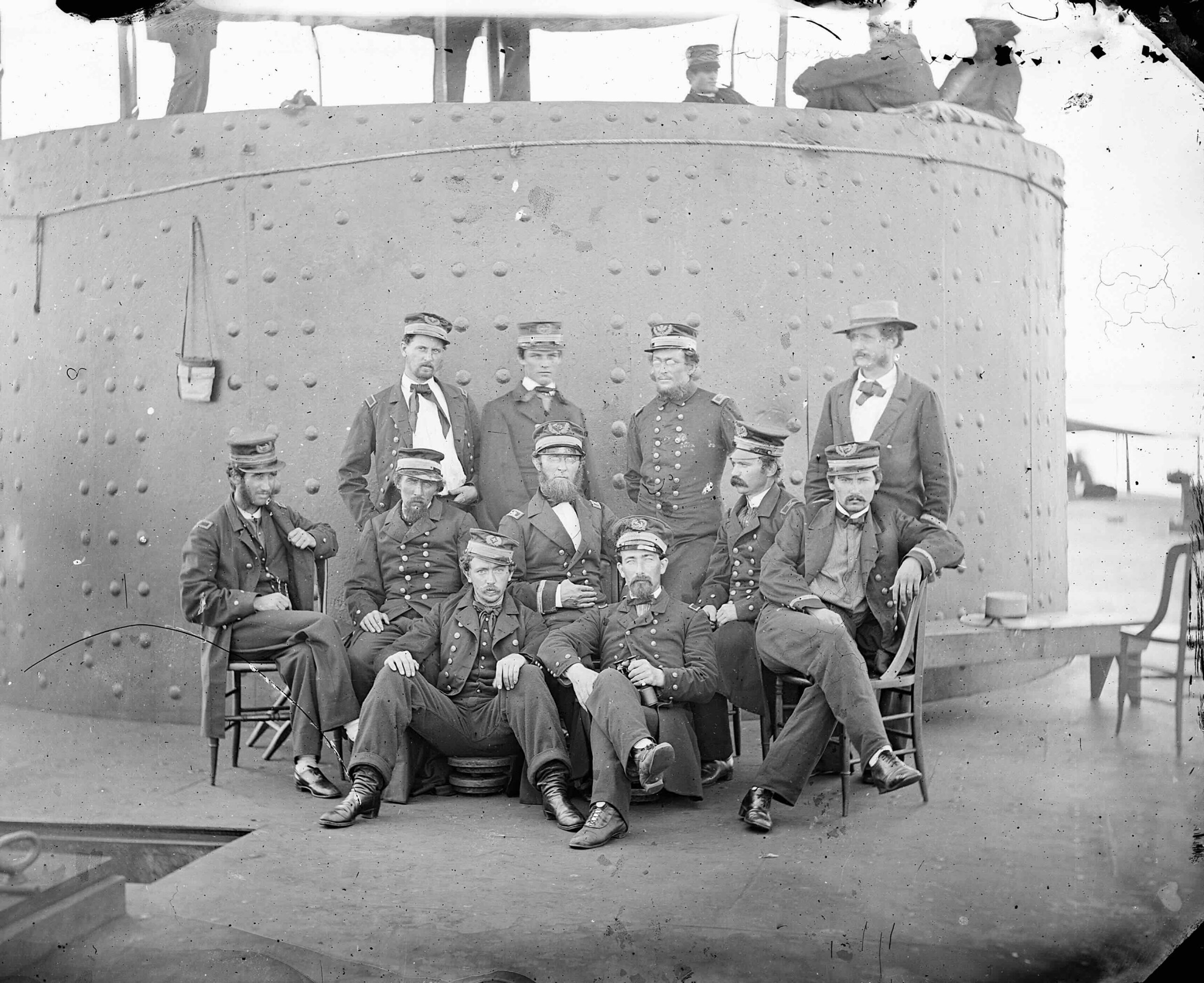
Officers on deck of USS Monitor on the James River on July 9, 1862, photographed by James Gibson. Two men in the group would not survive the year: 3rd Assistant Engineer Robinson Hands (front row, left) and Acting Ensign George Frederickson (second row, second from left, directly behind Hands) drowned in the storm that sank their ironclad off Cape Hatteras.
What do the Civil War vessels USS Pocahontas, USS Monitor, and USS R.B. Forbes have in common? Each was an entirely different type of military craft (a wooden sidewheeler transport, a cheesebox on a raft, a screw steamer) and each served a different function for the Union navy during the war. Their commonality was their fates—each was lost in a violent winter storm in 1862. USS Pocahontas was an antiquated cargo ship carrying horses for Ambrose Burnside’s North Carolina Expedition when it was caught in a gale in January. Of the 113 horses on board, only 24 managed to swim to shore. A month later R.B. Forbes was caught in a storm off Nags Head, North Carolina, while steaming to join the Mortar Flotilla near New Orleans. The famous Monitor sank after being caught in a nor’easter on the last day of the year.1
These three casualties, all destroyed during winter gales, were among more than 500 ships lost by both sides during the war. What is remarkable about their sinkings is the cause: meteorology. The period from 1861 to 1865 was probably the safest five-year period to be at sea in the history of the United States—with respect to the weather. What a fortunate time to send a vast fleet to blockade 3,000 miles of enemy shoreline.
The Federal navy controlled about 90% of all warships during the Civil War, and General-in-Chief Winfield Scott’s Anaconda Plan meant that several hundred of these ships would be at sea year-round. Despite this, the Confederacy probably had more vessels sent to the bottom by tropical cyclones than did the Union. The reason behind this surprising statistic is not related to the seaworthiness of the ships or the skill of the captains and crews; there were so few ships lost in violent tropical storms because there were so few such storms over this period.
According to the Hurricane Research Division of the National Oceanic and Atmospheric Administration (NOAA), there have only been six times since 1850 that the United States went two consecutive years without a major hurricane landfall (most recently in 2009–2010), and there has been only one three-year interval in which there were no major strikes: 1862–1864. That same interval a decade prior (1852–1854) and a decade later (1872–1874) recorded 10 and five hurricane strikes, respectively. How fortunate were the blockading Federal ships that hurricane activity largely ceased along the shoreline of the Confederacy between November 1861 (when a Category 1 hurricane crossed North Carolina) and September 1865 (when a Category 2 hurricane made landfall in Texas).
Tropical severe-weather meteorology was in its infancy in the second half of the 19th century, and nearly every major storm that was recorded was described in the newspapers and historical accounts as being either the greatest hurricane ever or the storm of the century. Recently, NOAA conducted a thorough reanalysis project to categorize all storm activity from 1850 to the present day in a new database (HURDAT). This work incorporates historical accounts and measurements of barometric pressure, wind direction, and velocity to provide a more accurate account of hurricane activity from a century ago.
NOAA also calculates an Accumulated Cyclone Energy (ACE) index for each hurricane season.2 The ACE index is an excellent tool for assessing the ship-killing intensity of storms for a given season; the more cyclone energy, the stronger the sustained winds and hull–crushing waves. Every year of the Civil War is quantified as “below normal” on the ACE index, with 1864 being one of the quietest years ever.
The years 1863 and 1864 saw a peak in the number of Federal ships employed in the blockade, nearly 500, and a resulting substantial decline in the number of enemy vessels captured as the blockade tightened. These two hurricane seasons have ACE index scores of 50.4 and 26.6. By comparison, the average ACE index score is around 104, indicating just how calm the coastal waters were during the blockade. Imagine what might have happened to the navy had a hurricane season like 2005 (ACE index 245.3) occurred 140 years earlier: The Gulf Blockading Squadron would have been hit with three catastrophic hurricanes in consecutive months, each of which had the combined energy of the entire 1864 season, and all arriving with little if any warning.
The most significant impact of tropical storms on naval operations occurred late in the 1861 hurricane season. The Hatteras Campaign represents one of the first significant victories by Federal forces in the war. The entire combined-forces operation was conducted during hurricane season in the waters of the Carolinas, so potential interference from storms should have been anticipated.
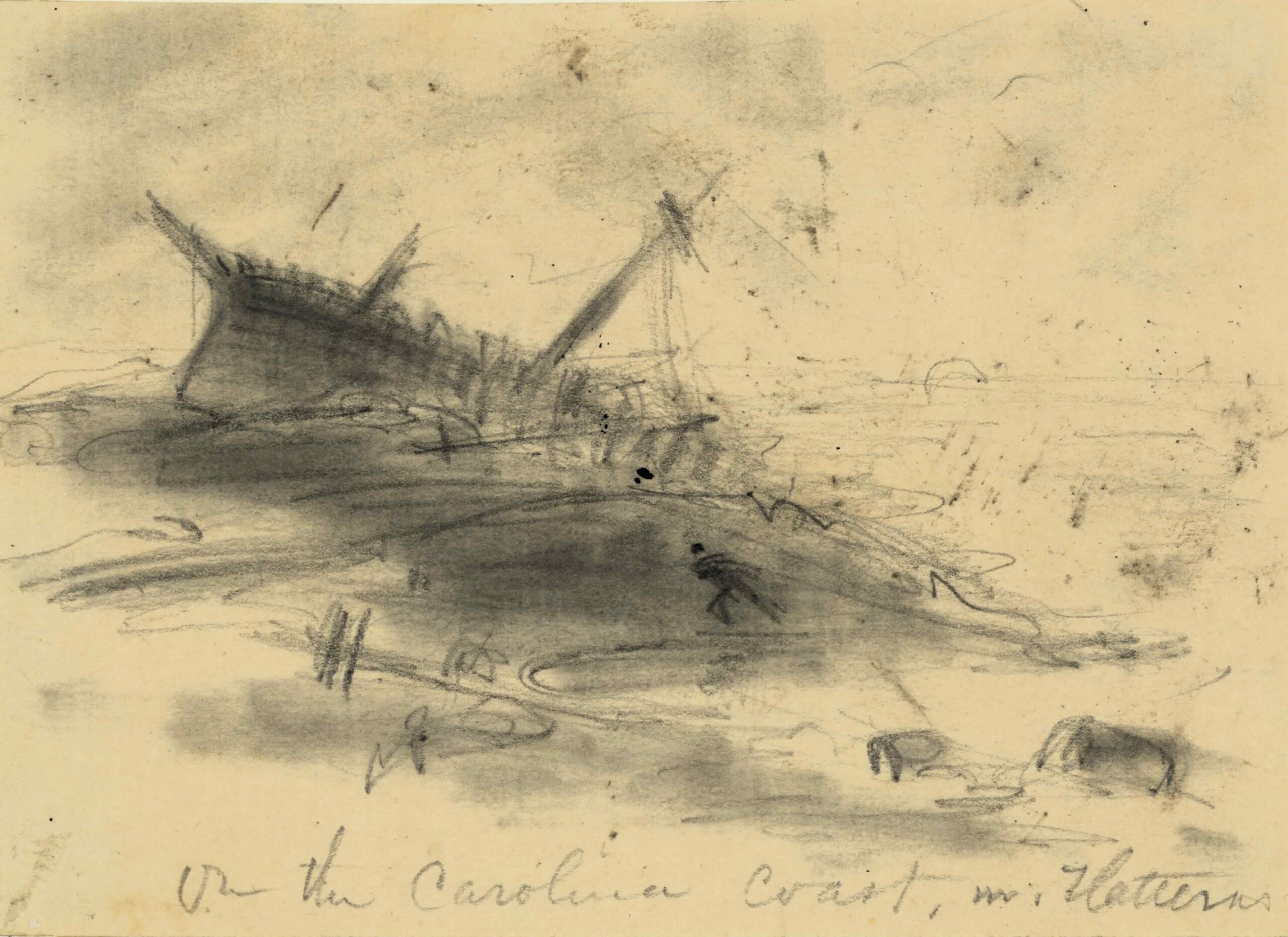 Library of Congress
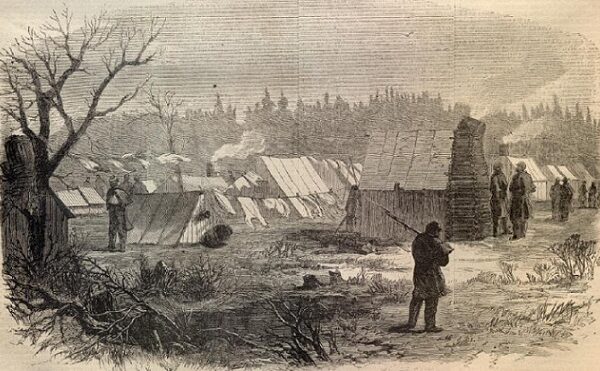
This 1861 sketch by Alfred Waud shows a military vessel foundering in a storm off the North Carolina coast near Hatteras.
Fort Hatteras and Fort Clark fell on August 29 and the Federal forces hoped to repeat their success again at an even more suitable and stable deepwater port to the south along the South Carolina shoreline at Port Royal. To capture this potential future coaling station, Flag Officer Samuel DuPont and Brigadier General Thomas Sherman assembled a force of 75 ships and 12,000 infantry. On October 29 the ship-borne strike force left Hampton Roads, Virginia. Three days later the flotilla was off the Outer Banks when it encountered what was probably a diminishing Category 1 hurricane. Warships and transports were scattered across the continental shelf, with some ships driven to the beach or grounded and destroyed by pounding waves. Others lost valuable cargo and matériel as waves scoured their decks.
When the weather finally cleared the battered fleet was in poor condition, with many vessels damaged, key supplies lost, and everyone involved either ill or exhausted. Despite this, after two days of recuperation the combined forces overwhelmed Forts Walker and Beaureguard to give the South Atlantic Blockading Squadron the ideal launching point for operations against Savannah and, later, Charleston and Wilmington.
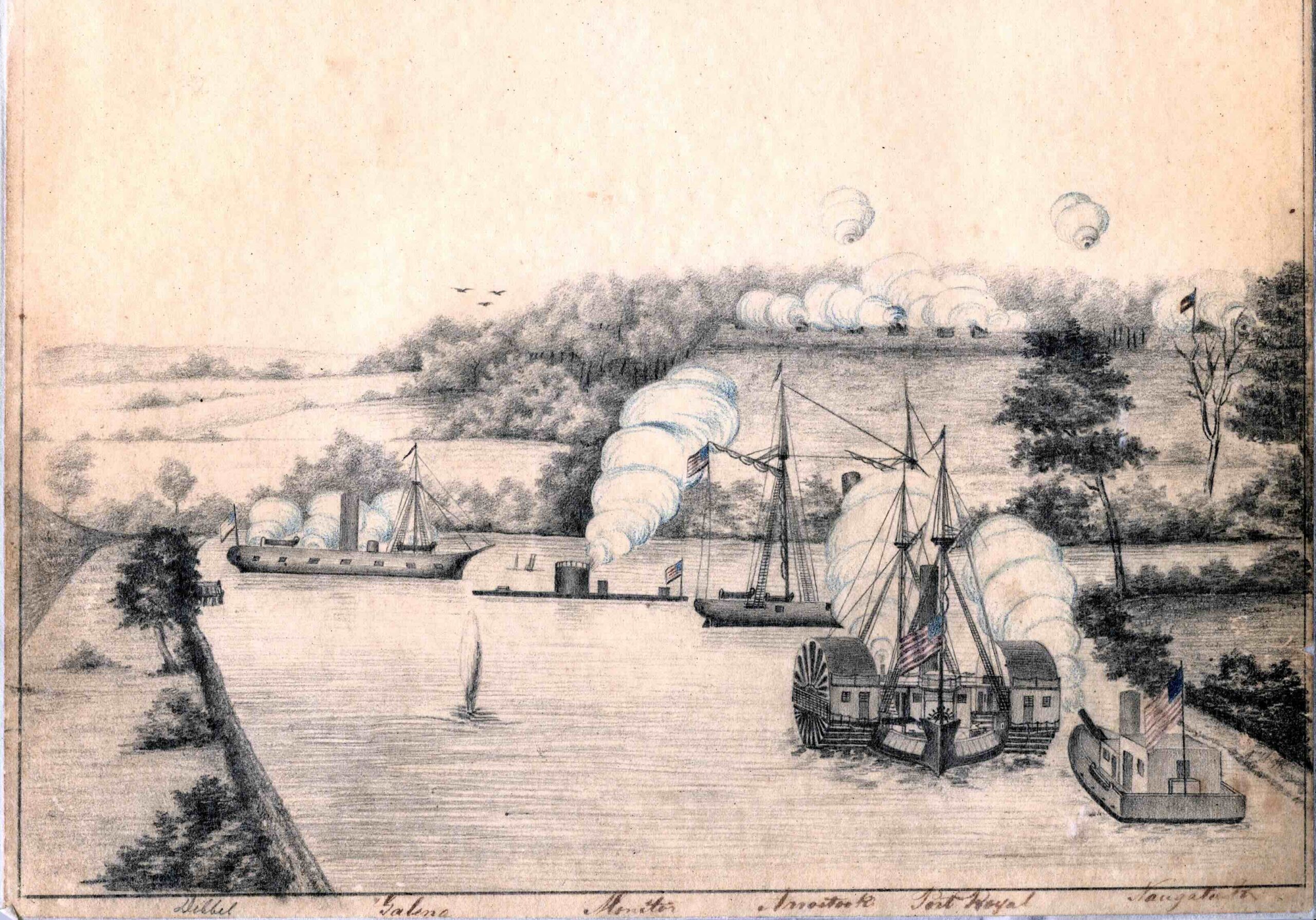 Naval History and Heritage Command
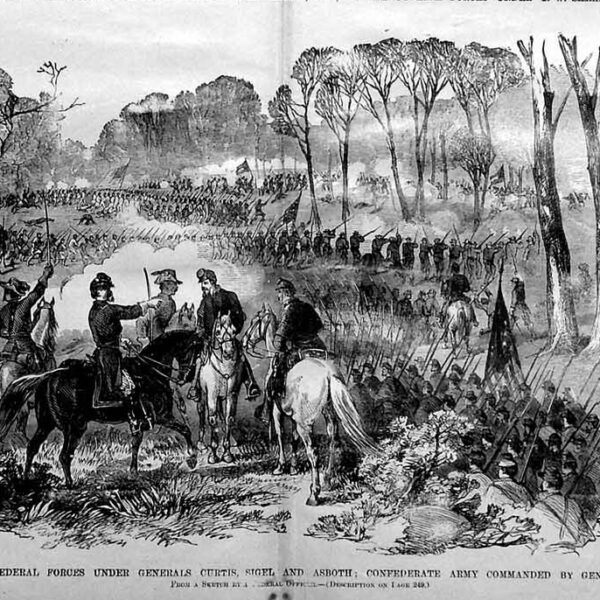
Two of the ships depicted here attacking Drewry’s Bluff would later encounter a severe storm at sea. USS Monitor, second from left, would sink. USS Port Royal, second from right, would survive.
A month after the Battle of Port Royal a new wooden sidewheeler gunboat, USS Port Royal, was launched at the New York Naval Yard. This 800-ton vessel would go on to have an interesting career, fighting alongside USS Monitor at the Battle of Drewry’s Bluff in May 1862, with David Farragut at Mobile Bay in August, and in the action at Kinston, North Carolina, in December. Port Royal also experienced one of the most unusual meteorological events of the war. In May 1863, the gunboat joined USS Amanda as part of the East Gulf Blockading Squadron deployed to guard St. Georges Sound on the Florida Panhandle. On May 27 there was a tremendous drop in barometric pressure and increase in windspeed. Soon, the two ships found themselves in the direct path of a Category 1 hurricane, the earliest in the year—in all of recorded history—that a tropical storm of this size has ever struck the U.S. mainland. Port Royal would survive the ordeal but Amanda would not, as it was driven ashore on Dog Island, where the crew set fire to the hull to prevent capture.
The loss of Amanda to an extremely rare out-of-season hurricane remained a bit of a mystery until only a few years ago, and the record of a destructive hurricane so early in the year serves as a warning to coastal communities about the unpredictable nature of hurricane hazards. So too, of course, do the ever-increasing ACE index scores for hurricane seasons from the last two decades: Nine of the last 10 years have been above normal with respect to hurricane energy, and every single year has had more storms than made landfall during the entire Civil War.3
Scott Hippensteel is professor of Earth sciences at the University of North Carolina at Charlotte, where he focuses on coastal geology, geoarchaeology, and environmental micropaleontology. He has written four books about using science to illuminate military history: Sand, Science, and the Civil War: Sedimentary Geology and Combat (University of Georgia Press, 2023), Myths of the Civil War: The Fact, Fiction, and Science behind the Civil War’s Most-Told Stories (Rowman & Littlefield, 2021), and Rocks and Rifles: The Influence of Geology on Combat and Tactics during the American Civil War (Springer Nature, 2018). His latest book, Civil War Photo Forensics: Investigating Battlefield Photographs through a Critical Lens, was just released by the University of Tennessee Press.
Notes
1. All three wreck sites are within about 50 miles of each other, all part of the “Graveyard of the Atlantic.”
2. ACE is calculated using the estimated maximum sustained velocity of tropical cyclone wind, recorded at 6-hour intervals for any storm that exceeds 33 knots (39 mph). One unit of ACE equals 10-4 kt2. In other words, a powerful, long-lasting, ship-killing hurricane will have an ACE of around 50 and a small, short-lived tropical storm will have an ACE of only 0.2.
3. For the last 30 years, 20 have been either “above normal” or “extremely active” in terms of Accumulated Cyclone Energy, while only six are classified as “below normal.” From the three decades from 1851 to 1881, there was a single year that was classified as “above average” and another as “extremely active,” while there were 23 that were classified as “below normal.” The 2025 Atlantic Hurricane Season was above average in terms of ACE (133), despite having fewer named storms (13) than average. Most of the ACE came from several very strong, long-lived hurricanes that (fortunately) did not strike the U.S. However, Tropical Storm Chantal tracked across Florida and shifted north before making landfall in South Carolina with 60 mph winds, tornadoes, and heavy rain.