Robert James
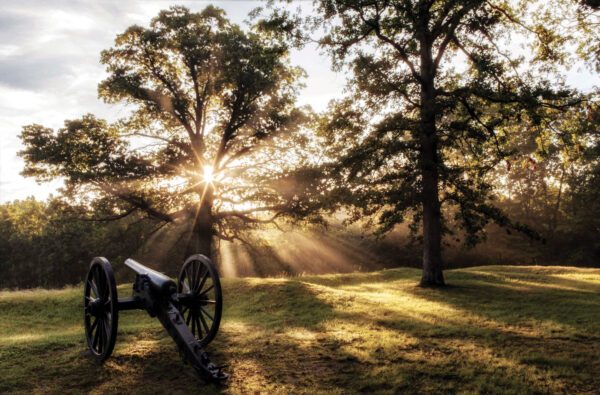
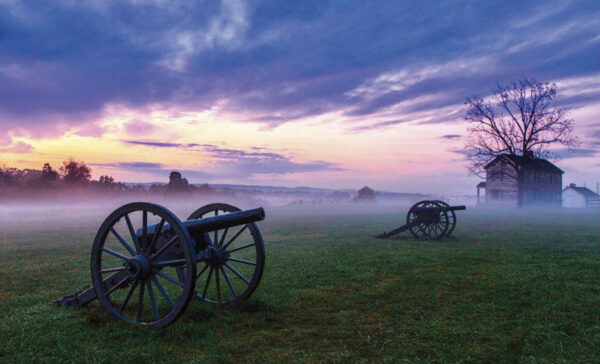
Between 2012 and 2015, the American Battlefield Trust worked to restore 427 acres of land at the Breakthrough at Petersburg—including the ground shown here—to their wartime appearance.
The Third Battle of Petersburg, known as the Fall of Petersburg or the Breakthrough at Petersburg, was fought on April 2, 1865. That fateful day—the end of the 292-day campaign for Richmond and Petersburg—would be critical in clinching the Civil War.
Following the Union victory at Five Forks on April 1, Lieutenant General Ulysses S. Grant and Major General George Meade determined to make a frontal assault on the Confederate defenses at Petersburg with four corps of infantry. In the predawn hours of April 2, the men of Major General Horatio Wright’s VI Corps crept out of their trenches and charged across no man’s land, punching a hole in the Confederate line. Elements of the II and IX Corps made similar assaults elsewhere along the siege line. A handful of Confederates at Fort Gregg staved off the Union XXIV Corps’ assault, preventing the Federals from entering the city that night.
But the Federals’ main objective—breaking the Confederate line—had been achieved. The Union army now had access to the Appomattox River and was free to cross the next day to threaten General Robert E. Lee’s communications on the north side of the river. Lee would inform Jefferson Davis that he could “hold his position no longer,” and that Petersburg and Richmond must be evacuated. Grant had finally achieved one of the major military objectives of the war—the capture of Petersburg, which led directly to the loss of the Confederate capital at Richmond on April 3.
Several years ago, the American Battlefield Trust again saw conflict at the Breakthrough. The location was littered with modern structures, and woodlands obscured the vistas, severely altering the landscape from its wartime appearance. What became our largest restoration effort to date began in 2012 and spanned two and a half years, witnessed the return of 427 acres to their wartime appearance, and uncovered long-hidden historic resources. It required timbering 152 acres and removing a seven-acre concrete hog farm, a railroad bed, two barns, a machine shop, a residence, and countless wells, water troughs, and electrical installations. Now, visitors are greeted by sightlines witnessed by Civil War forces, enabling an understanding of the action that occurred so many years ago.
Last year, The Volgenau Foundation—established in 1994 to foster conservation of natural resources and the education of children—provided the Trust with a remarkable $1 million grant that will help facilitate the donation of these 427 Trust-held acres at the Breakthrough to the National Park Service. This historic acreage is located entirely within the recently enlarged boundary of Petersburg National Battlefield, which was expanded by more than 7,000 acres through the 2017 National Defense Authorization Act. The Trust is forever grateful to The Volgenau Foundation for its assistance in permanently protecting the Petersburg Breakthrough for the education and enjoyment of all Americans, now and in the future.
The Trust is currently working to save additional land adjacent to the preserved and restored Petersburg Breakthrough site. Read more about the Petersburg Breakthrough Battlefield.
O. James Lighthizer is president emeritus of the nonprofit, nonpartisan American Battlefield Trust, which is dedicated to preserving America’s hallowed battlegrounds—Revolutionary War, War of 1812, and Civil War—and educating the public about their significance.