 Library of Congress
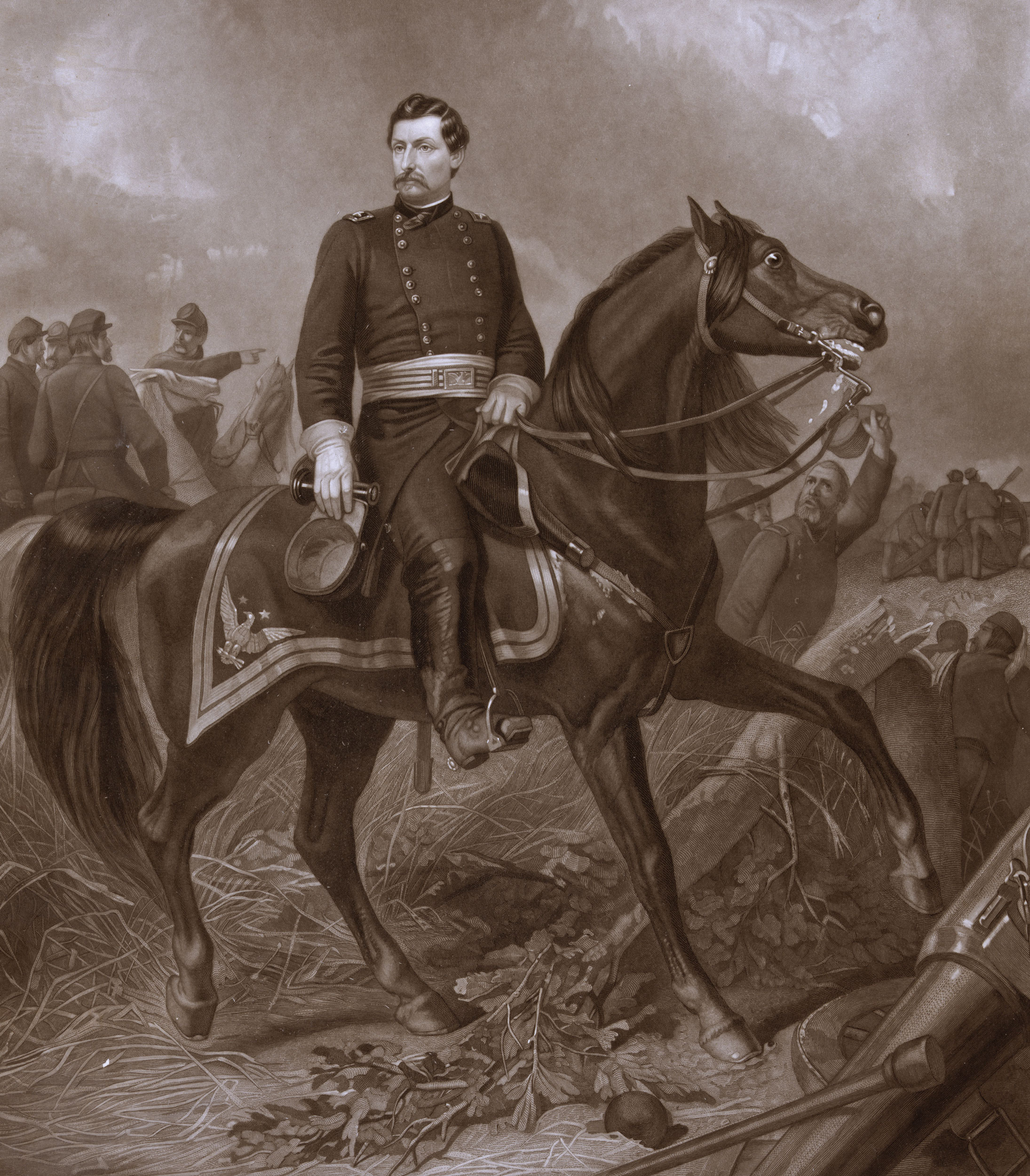
Army of the Potomac commander George B. McClellan is depicted on horseback during the Battle of Antietam in this engraving from 1863. The discovery of the plans of Robert E. Lee’s Army of Northern Virginia—in a document called Special Orders No. 191—days earlier may have hindered more than helped McClellan’s larger plans for a decisive victory in Maryland.
Shortly after noon on Saturday, September 13, 1862, First Sergeant John M. Bloss and Private Barton W. Mitchell made the find of a lifetime. It was early in the Maryland Campaign. General Robert E. Lee’s Army of Northern Virginia had slipped across the Potomac the previous week, paused for a few days at the market town of Frederick, and then marched westward beyond the green wall of South Mountain several miles distant. Its current movements were anyone’s guess.
Bloss and Mitchell belonged to the 27th Indiana Infantry, which like dozens of other Union regiments was encamped on the same ground the Confederates had occupied before they pulled out of Frederick. The detritus of that occupation was everywhere: blackened remains of campfires, discarded or forgotten items, and just plain trash. Bloss and Mitchell had scarcely dropped their knapsacks when they noticed one particular item.
The bulky envelope stood out against the rest of the trash, and even more surprising were the three cigars inside it. This would have been memorable enough, but a glance at the document wrapped around them threw the cigars’ discovery into eclipse. Labeled Special Orders No. 191, it was festooned with the names of senior Rebel generals and signed by an assistant adjutant general, R.H. Chilton, who had endorsed it, “By command of General R.E. Lee.” It quite obviously contained the details of the planned Confederate movement beyond South Mountain.
The soldiers hurried to place their find, cigars and all, in the hands of the regiment’s colonel, Silas Colgrove, who bypassed brigade headquarters and took the order straight to Brigadier General Alpheus S. Williams, his division commander and temporarily in charge of the XII Corps. The order could have been fake, meant to mislead the Yankees, but Colgrove put the document in the hands of Williams’ adjutant general, Colonel Samuel E. Pittman. Pittman had known R.H. Chilton before the war and recognized his elegant handwriting. If it was a ruse, it was a ruse conceived at the very highest Confederate level—which meant it was probably no ruse at all. The envelope’s next stop was the headquarters of Major General George B. McClellan, commander of the Army of the Potomac.1
Such is the beginning of one of the classic stories of the American Iliad, beloved because it illustrates how great events can pivot on trivial origins. The document discovered by Bloss and Mitchell has gone into the history books as the “Lost Order,” and strictly speaking, its military significance does not begin until McClellan and his staff concluded it was genuine and based the next stage of their plans upon it. But no one would ever tell the story without mentioning the two lucky soldiers and the three cigars. It situates ordinary people within extraordinary events.
But this version of the story contains one great trap. Because the order was discovered by two modest soldiers, the story is unsatisfactory unless McClellan used the order to secure a major advantage. But was that the case? And did it substantially alter what McClellan would have done had he not got hold of Special Orders No. 191?
To get at those questions requires a detailed examination of the military situation addressed in the order, including the 12,500-man garrison at Harpers Ferry, Virginia (now West Virginia). The town was located at the confluence of the Shenandoah and Potomac rivers and provided access to the lower Shenandoah Valley. But more importantly, it protected the vital bridge that carried the Baltimore and Ohio Railroad across the Potomac. With only a few brief interludes, the Union army occupied the town throughout the Civil War.
By Lee’s strategic reasoning, one of those interludes should have occurred as soon as he crossed the Potomac and headed for Frederick.
His movement isolated Harpers Ferry from the Army of the Potomac and made it vulnerable to attack. Logic dictated that the Union garrison would abandon the town and move northward out of harm’s way. The garrison, however, did nothing of the kind, thereby throwing a monkey wrench into the machinery of Lee’s invasion plans. Lee wasn’t interested in Harpers Ferry. He was interested in getting into Pennsylvania as quickly as possible. But the presence of Union troops at Harpers Ferry placed them squarely on his line of communications with the Shenandoah Valley and dangerously in his rear if he marched into Pennsylvania without removing them.
Suddenly Lee’s plans were in disarray. Special Orders No. 191 contained the solution. It laid out a scheme whereby the Confederate army would temporarily divide into four parts. The main body would cross South Mountain and pause at the town of Boonsboro, located just beyond the ridge and astride the National Road, the main highway leading to Hagerstown and the gateway to Pennsylvania. The other three parts would march to surround the Harpers Ferry garrison. According to Special Orders No. 191, “Genl Jackson’s command”—that would be Major General Thomas J. “Stonewall” Jackson—would march well to the west of Harpers Ferry, recross the Potomac, and then wheel eastward to capture a smaller Union garrison at Martinsburg before intercepting any enemy troops trying to escape from Harpers Ferry. Meanwhile two divisions under Major General Lafayette McLaws would occupy the cliff, known as Maryland Heights, just north of Harpers Ferry. A third division would occupy Loudoun Heights to the east. The order stipulated that these movements were to be completed by “Friday morning”—or September 12, the day before the Lost Order reached McClellan. Once the Harpers Ferry garrison was eliminated, all three detachments were to rejoin the “main body of the army at Boonsboro or Hagerstown.”2
Upon receiving the order, McClellan is supposed to have said, “Now I know what to do!”3 And in a dispatch to President Abraham Lincoln he exulted, “I have all the plans of the Rebels and will catch them in their own trap if my men are equal to the emergency.”4 But McClellan ought to have known what to do already, and his decision to catch the Confederates in their own trap actually distracted him from that task.
On September 13, McClellan’s army was divided into three “wings,” two of which had converged at Frederick while the third—the VI Corps, under Major General William B. Franklin—was encamped some miles to the south at the village of Buckeystown. McClellan well knew that Harpers Ferry remained garrisoned, and he knew from other sources that Lee was still in western Maryland. That means he would have moved westward across South Mountain even without the benefit of the Lost Order. The order’s primary impact was that it suggested that Lee’s “main body,” supposedly at Boonsboro—it had actually moved on to Hagerstown—was substantially understrength thanks to the detachments required to liquidate Harpers Ferry. This led McClellan to make a mistake. The obvious move was to relieve the garrison and add its 12,500 men to his own 87,000, which he instructed Franklin to do. But thanks to the Lost Order this maneuver became secondary to McClellan’s new principal effort, a lunge directly at Lee’s main body. As a result, Franklin received no reinforcements, and indeed was told that the Confederates had two divisions in the vicinity of Crampton’s Gap, the key mountain pass through which he was supposed to reach Harpers Ferry.
The result is well known. The following day—September 14—the bulk of McClellan’s army attacked Lee’s main body while Franklin moved gingerly toward Crampton’s Gap, slowed not only by his native caution but also by the knowledge that he had a force barely adequate to carry out his mission. He had scarcely made it across the gap before nightfall halted his operations. This gave the Confederates time to capture Harpers Ferry. (It was the largest mass surrender of U.S. troops until the Philippines in 1942.) We know that if the garrison had held on—still more so had it been relieved—Lee would have abandoned the Maryland Campaign then and there. But as events turned out, Lee remained in Maryland long enough to fight the Battle of Antietam on September 17, resulting in a marginal victory for McClellan but saving the Army of Northern Virginia from an ignominious retreat.
Thus the finding of the Lost Order arguably worked to the detriment of McClellan’s plans. But the story’s entrenchment in the American Iliad ensures that it will ever be told in the more poetic way.
Mark Grimsley, a history professor at The Ohio State University, is the author of several books, including And Keep Moving On: The Virginia Campaign, May–June 1864 (2002) and The Hard Hand of War: Union Military Policy Toward Southern Civilians, 1861-1865 (1995).
Notes
1. Silas Colgrove, “The Finding of Lee’s Lost Order,” in Robert Underwood Johnson and Clarence Clough Buel, eds., Battles and Leaders of the Civil War 4 vols. (New York, 1886), 2: 603.
2. “Special Orders, No. 191,” in Clifford Dowdey and Louis H. Manarin, eds., The Wartime Papers of R.E. Lee (New York, 1961), 301–303.
3. Quoted in Stephen W. Sears, George B. McClellan: The Young Napoleon (New York, 1988), 281.
4. McClellan to Lincoln, September 13, 1862, in Stephen W. Sears, The Civil War Papers of George B. McClellan: Selected Correspondence, 1860–1865 (New York, 1989), 453.