Civil War era prisoners of war in front of a sign reading Hotel de Zouave.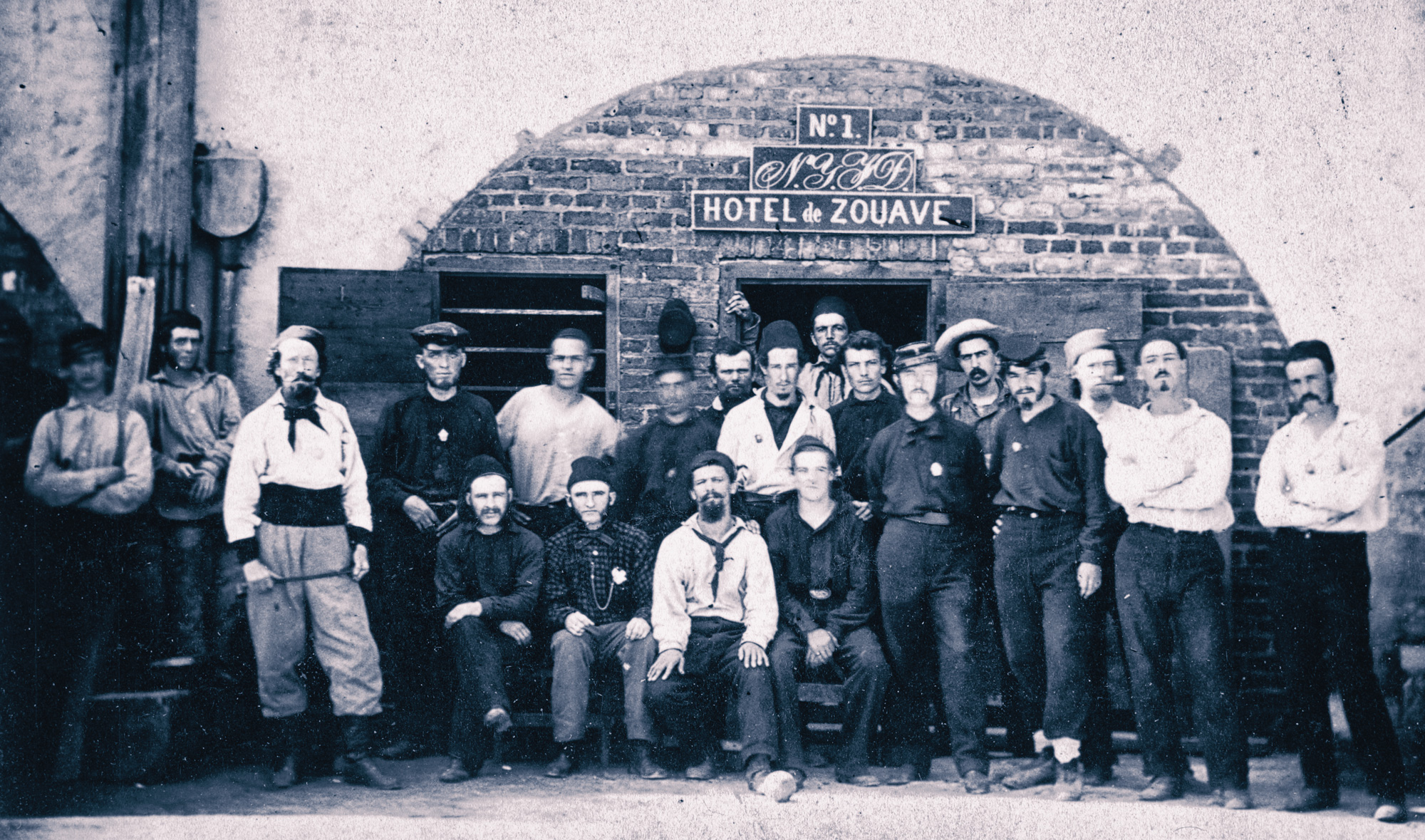 Library of Congress
Unlike most prisoners of war during the Civil War, some of the Union soldiers captured at the Battle of First Bull Run in July 1861 did not have to endure harsh or inhumane conditions. Among other accommodations, they were even fed the same rations as their guards. Two months after the battle, 156 Union soldiers from four regiments—including some from the 11th New York Fire Zouaves, shown here—were moved to Charleston, South Carolina, and housed in casemates in Castle Pinckney on Shutes Folly, an island about a mile off the city’s shore. Charleston photographer George S. Cook visited the old brick fort on October 11, 1861, and took at least 15 photographs, including this and four other group shots of Yankee prisoners, six photos of the guards (the Charleston Zouave Cadets), and several photos showing both prisoners and guards. Cook’s images were the first photos of Civil War prisoners and the first visual legacy of the Bull Run fight. Three days after Cook’s visit, one of the Pinckney captives, Colonel Orlando B. Willcox of the 1st Michigan Infantry, wrote to his brother: “There is no certainty of my situation here, and no one knows what or where to-morrow may see us. But I have faith in Providence, and trust in the magnanimity of the high-toned portion of our Southern enemies.” Willcox and the other prisoners were exchanged in 1862.
Bob Zeller is president of the nonprofit Center for Civil War Photography, which is devoted to collecting, preserving, and digitizing Civil War images.
Related topics: prisons and prisoners