 Library of Congress
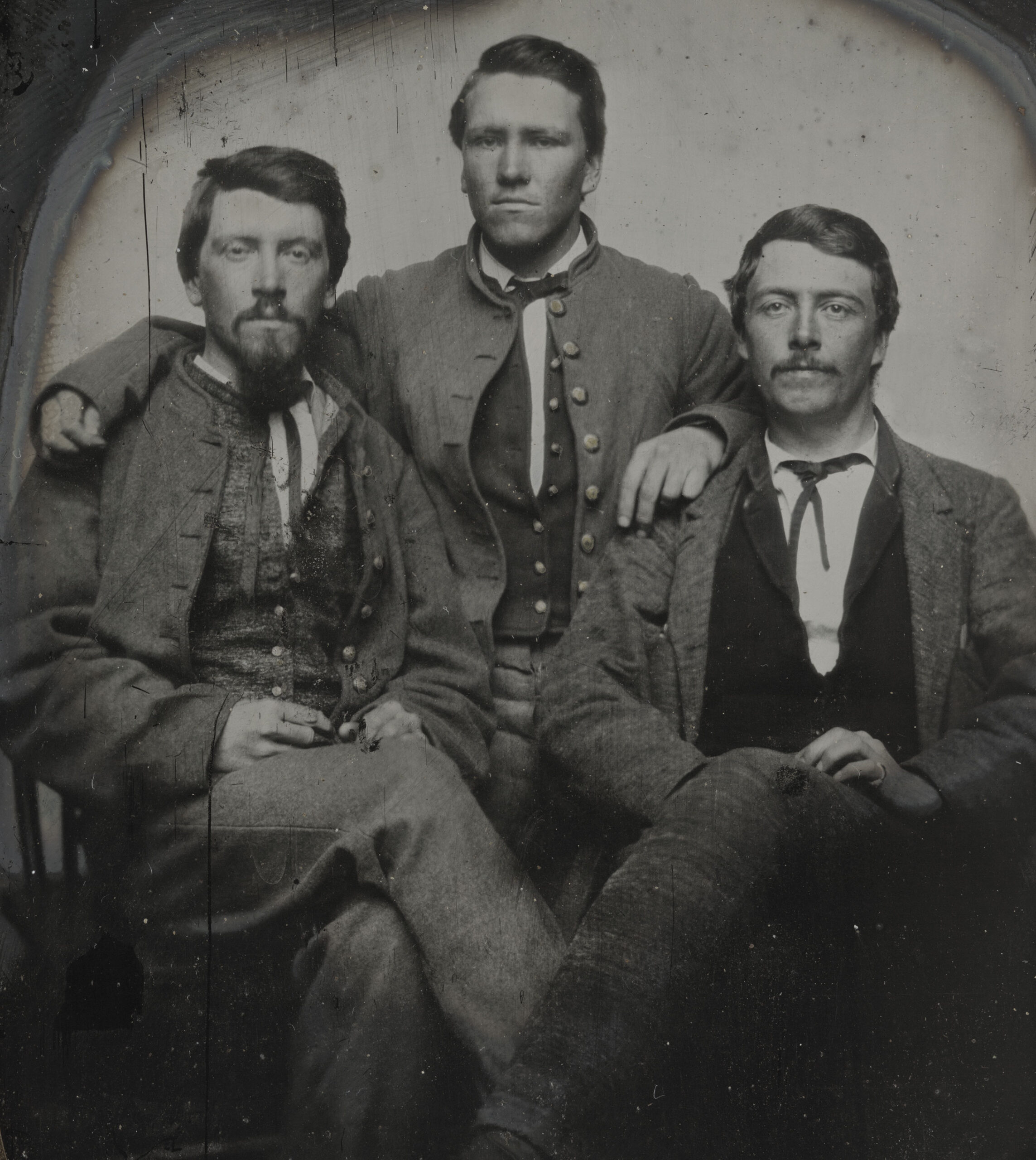
A photograph of three common Civil War soldiers
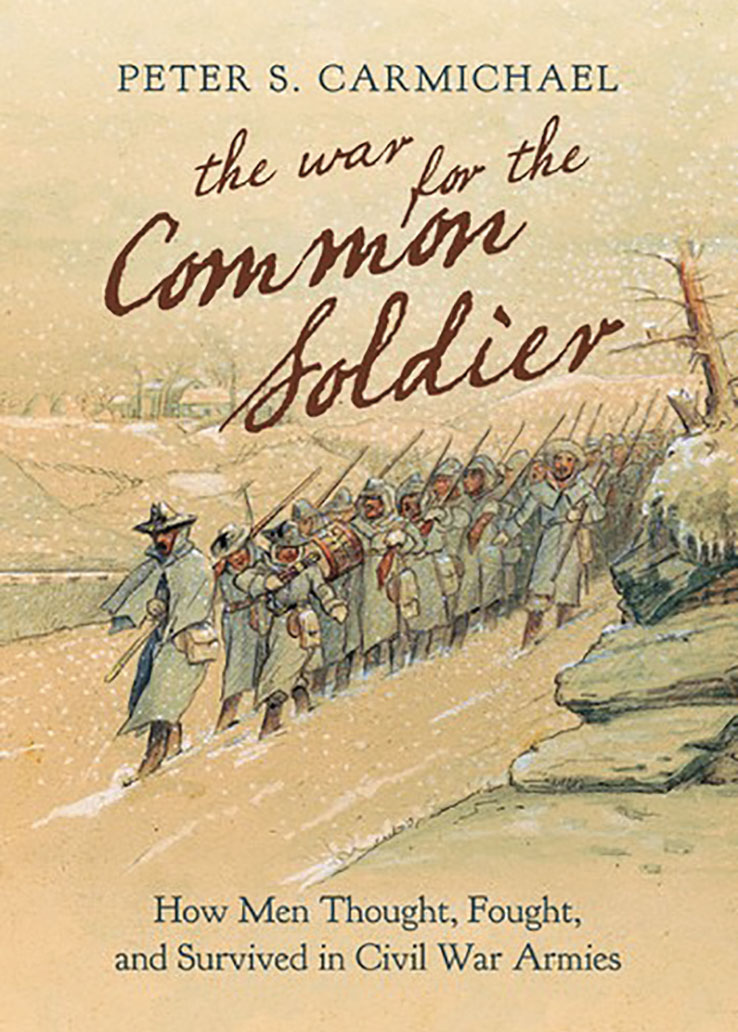
Last November, the University of North Carolina Press published The War for the Common Soldier: How Men Thought, Fought, and Survived in Civil War Armies by Peter S. Carmichael, the Robert C. Fluhrer Professor of Civil War Studies and director of the Civil War Institute at Gettysburg College. The book is garnering significant praise for its innovative approach in telling the story of Billy Yank and Johnny Reb. We recently sat down with Carmichael to learn more about his research and writing process.
Why did you decide to write a book about Civil War soldiers?
Gary Gallagher and Michael Parrish, the editors of the Littlefield History of the Civil War Era series at the University of North Carolina Press, invited me to write a volume on the common soldier. All 16 books in the Littlefield series are intended to accomplish two things: synthesize the existing scholarship on the chosen topic and advance new interpretations. Trying to do both proved difficult. I struggled to find the opening to make an original contribution that could also stand upon the existing platform of soldier scholarship.
After a great deal of reading outside of the field of Civil War history—mostly books about World War I and French history—I reached the conclusion that much of the existing Civil War scholarship fails to capture the lives of soldiers as they were actually lived. As much as I admire the scholarship of historians like James McPherson, Joseph Glatthaar, Chandra Manning, and many others, I thought their emphasis on ideology and identity created the impression that soldiers acted in predictable ways to concepts like duty and nationalism. The complicated ways in which soldiers coped with their unpredictable and often volatile existence was lacking, in my estimation. In short, I thought we needed a study of Union and Confederate soldiers that captured the totality of their experience by encompassing their physical, political, cultural, and intellectual worlds.
I decided to rely upon a case-study approach, but I make it clear in the introduction of the book that no one man can stand for all of the experiences in the rank and file. I selected nearly 30 soldiers who reflect the class, racial, and regional diversity of Civil War armies. In fleshing out the lives of these men, I relied on heavily contextualized stories that resemble what cinematographers call deep focus. This approach is biographical in its orientation, and it enabled me to keep the lens on the main figure without blotting out the background. The result is a narrative of greater depth, for it allows the reader to see how individual soldiers interacted with their comrades, officers, civilians, and the impersonal forces of war.
 Alex Hawkinson, Loudoun Museum
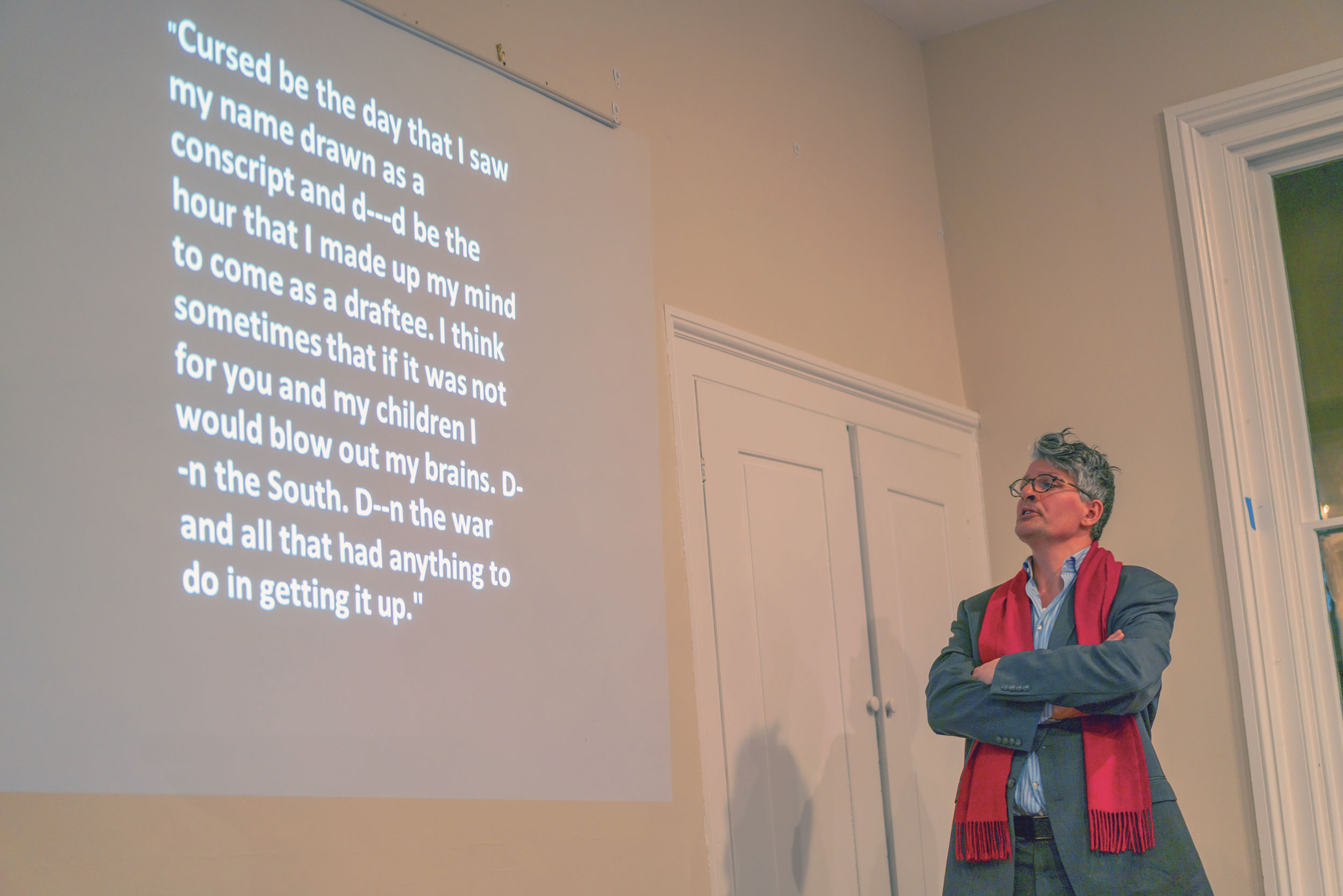
Peter S. Carmichael talks about The War for the Common Soldier at the Loudoun Museum in January 2019.
What sources did you find particularly useful or important in your research?
I quickly gave up on the idea of finding the common soldier or any sample group of men who might stand for the millions who served in Union and Confederate armies. In fact, I have long thought that the search for typicality is a pointless foray, and for historians who seek a representative study group, it almost always draws from the ranks of the privileged. These men fit our stereotype of Civil War soldiers as always courageous, dutiful, and patriotic, and thus push to the periphery the dissenters and the disillusioned. Too often these latter groups are dismissed because they are perceived (though wrongly) as apolitical or non-ideological—the supposed deadbeats of the army.
In terms of sources, the court-martial records from the National Archives in Washington, D.C., were indispensable. From these official documents the actual voices of the men can be heard. Charged with a crime and facing serious penalties, they had to justify why they challenged military authority. Their testimony sheds rich insights into the boundaries of dissent in Civil War armies, enabling us to better understand what powers confronted soldiers on a daily basis.
I also thought that the voices of the illiterate and semi-literate needed to be heard. I was fortunate to discover the correspondence of Georgia’s Wright Vinson and North Carolina’s John Futch. Both men were poor and illiterate, both dictated their letters to comrades, and both freely expressed feelings of despair while scraping by to survive in the ranks. The stories of men like Vinson and Futch do not follow the popular script of the heroic Civil War soldier. I lifted up similar stories throughout The War for the Common Soldier.
How does your take on Civil War soldiers—their motivations, ideologies, and experiences—differ from previous studies?
I lean heavily on studies devoted to soldier ideology, but I was frustrated by the standard methodology that relies upon cherry-picking of quotes from soldier letters to prove an overarching theme as to why men fought and what motivated them to stay in the ranks. I tried to minimize this approach by placing the words of soldiers within the flow of events over an extended period of time, revealing the fluid nature of thought and action in the ranks, rather than offering the reader a static snapshot of soldier thought at one particular place and moment.
But I didn’t write The War for the Common Soldier as a rebuttal to the important soldier studies on why men fought. I wanted to build upon their scholarship, but I asked a slightly different question: How did Civil War soldiers think? Such an inquiry required a more expansive approach that included cultural history, material culture, environmental history, sensory history, and visual culture. Through these methodologies it was my goal to put readers into the shoes of the soldier so that they might imagine the world as the men perceived it, to feel the daily struggles of military life as they were endured by the rank and file, and to appreciate what choices were available to enlisted men whose lives were constrained in ways that ideological studies, with their emphasis on agency, tend to diminish.
Did you learn anything about Civil War soldiers that surprised you?
Being a Civil War soldier, I concluded, was never a state of being or a fixed identity. Situational thinking prevailed, and it enabled Civil War soldiers to be many different things at different times in the war. Pragmatism—called “adaptability” by the men in the ranks—gave men the flexibility to react to varying conditions of war. Adhering to a strict code of conduct proved unsustainable in the field on both sides and in all armies. To most men’s shock, well-established binaries of duty or disobedience, morality or immorality, loyalty or disloyalty, and bravery or cowardice were blurred by the war. Situational thinking drew from their hard experiences and lessons learned on the ground. Depending on the circumstances, Union and Confederate soldiers could lean on God or put trust in themselves, their officers, and their comrades without adhering to some abstract truth, principle, or allegiance.
Is there anything about Civil War soldiers that we still need to study?
We need to know more about the emotional lives of the rank and file, the underground economies in Civil War armies, crime and punishment, the reading habits of the men, sexual violence, and how the act of writing shaped representations of military life. I also hope that historians will look more closely at how Civil War soldiers coped with the trauma of combat by focusing on the language the troops employed in coming to terms with the killing fields of the Civil War.