 Frank Leslie’s Illustrated Newspaper
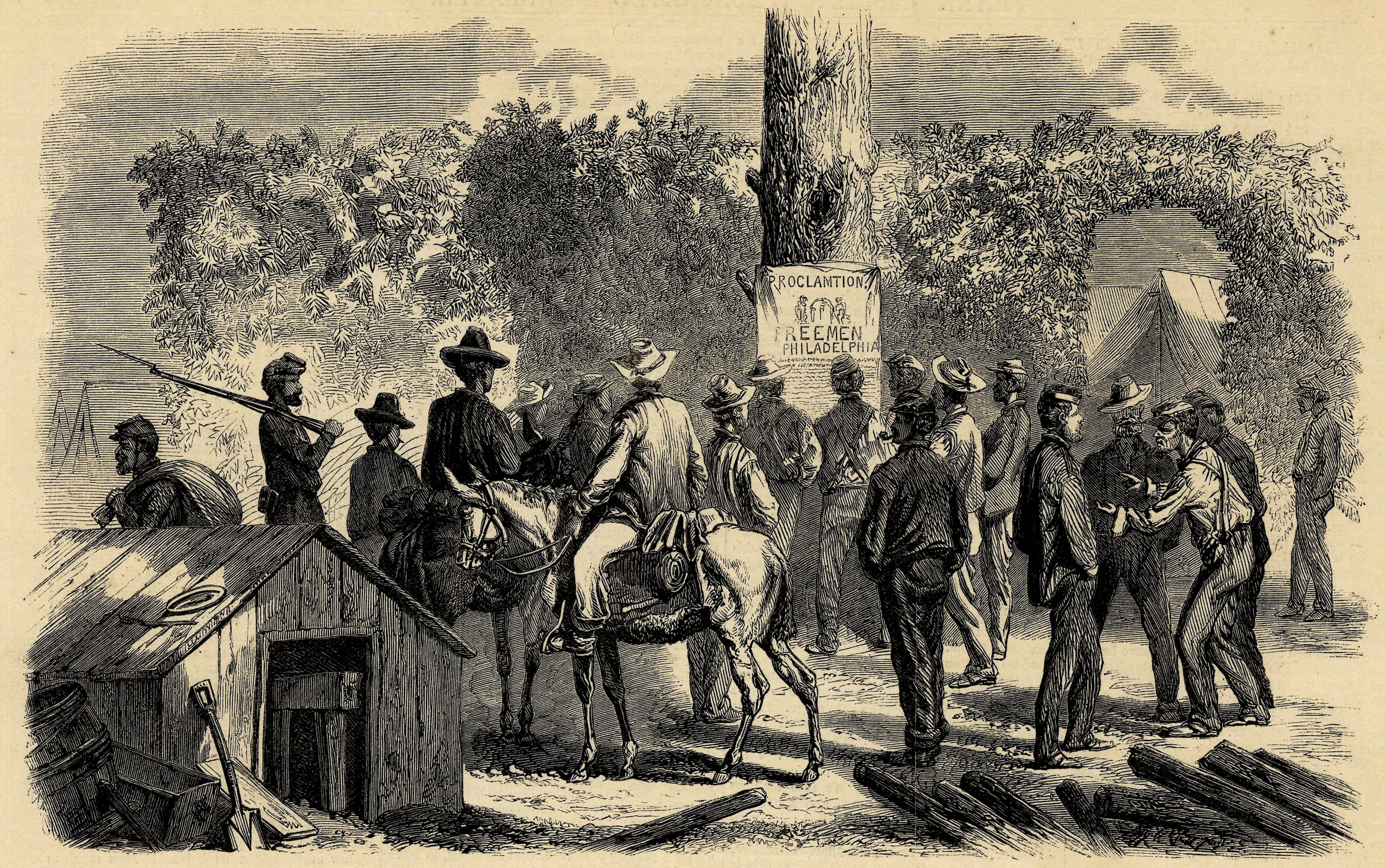
A wartime illustration of Union soldiers reading a proclamation during election season.
When the Civil War began, Pennsylvania was the only state that permitted soldiers to vote in the field. In October 1861, thousands of them voted in state and local elections, but in May 1862, the state supreme court declared Pennsylvania’s law unconstitutional. Meanwhile, several western states—including Missouri, Iowa, Wisconsin, and Minnesota—extended the ballot to their soldiers. At that time, support or opposition to such a voting practice did not fall along partisan lines.
Then in the fall, Democrats made sweeping gains nationwide. Many Republicans believed this was because their voters were serving in the army—and were largely unable to vote.
By the time of the presidential election of 1864, in which George B. McClellan challenged President Abraham Lincoln, 19 northern states had enfranchised soldiers. Four states—Connecticut, New York, Minnesota, and West Virginia—required soldiers’ votes to be mailed home and counted with the home vote, so it is impossible to know how many soldiers from those states voted, or for whom. The other states permitted soldiers to vote in the field.
Shown here are highlights of the election results from votes cast by soldiers in the field, which represented less than 6 percent of the 4,034,789 ballots cast in the election.
Soldier Votes During the 1864 Presidential Election by the Numbers
Overall votes cast for Abraham Lincoln (55.1%): 2,223,035
Overall votes cast for George B. McClellan (44.9%): 1,811,754
Approximate number of soldier votes cast in the field: 150,000
Percentage of soldier votes in the field cast for Lincoln: 78%
Highest percentage of soldier votes in a single state received by Lincoln (California): 92%
Highest percentage of soldier votes in a single state received by McClellan (Kentucky): 70%
Most votes cast in the field by soldiers from a single state (Ohio): 50,903
Fewest votes cast in the field by soldiers from a single state (Rhode Island): 265
Highest percentage of soldier votes relative to total votes in the state (Kansas): 17%
Lowest percentage of soldier votes relative to total votes in the state (Vermont): 0.6%
Most lopsided regimental result for McClellan (27th Kentucky Infantry): 209 – 3
Most lopsided regimental result for Lincoln (2nd Maine Cavalry): 273 – 1
Sources
Jonathan W. White, Emancipation, the Union Army, and the Reelection of Abraham Lincoln (Baton Rouge, 2014); Josiah H. Benton, Voting in the Field: A Forgotten Chapter of the Civil War (1915); The Tribune Almanac and Political Register (1865). The soldier vote from Maryland is taken from The Tribune Almanac and Political Register (1865). Among Rhode Island troops, the initial vote was 632 for Lincoln and 253 for McClellan, but 407 Lincoln votes and 213 McClellan votes were rejected because the soldiers were not qualified to vote under state law. A delay in the transmission of Vermont’s soldiers’ votes led to very few actually counting. Note: the “most” lopsided regimental voting results are based on currently available regimental returns.