Civil War soldier smoking a pipe.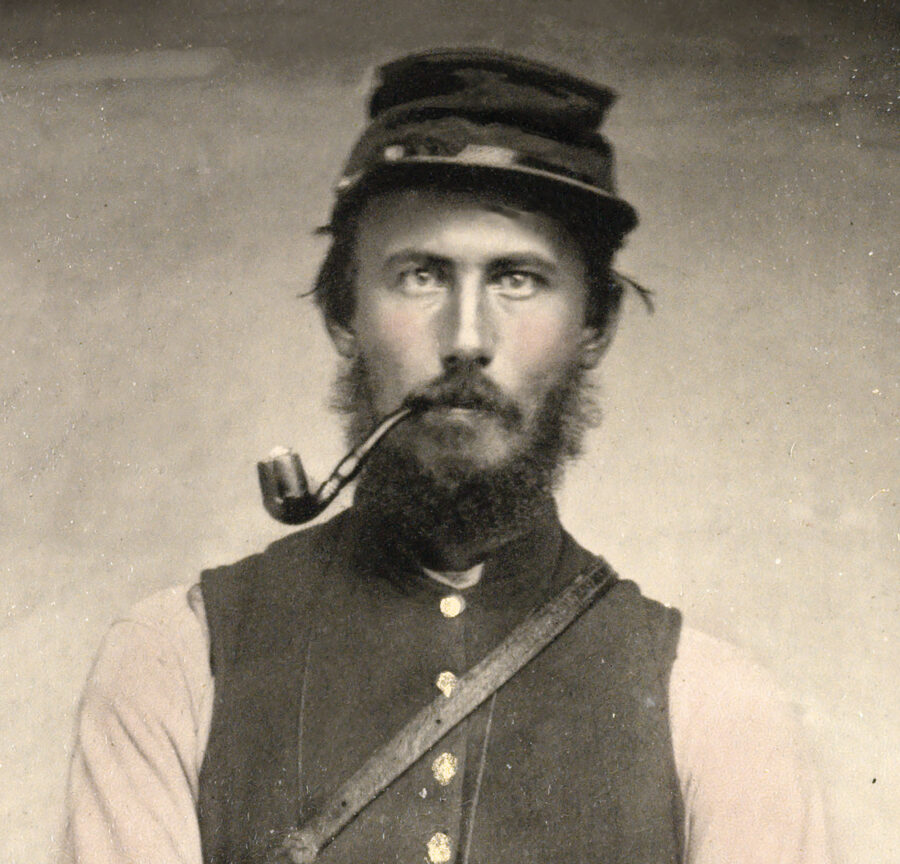 Library of Congress
On October 16, 1862, the Army of the Potomac’s Irish Brigade captured Charlestown, Virginia (soon to be West Virginia), resulting in a few casualties and some Confederate prisoners. Private William McCarter of the 116th Pennsylvania Infantry was chatting with his comrades outside a makeshift hospital, when he was “somewhat surprised by the appearance of a Rebel soldier. He came boldly forward and sat down in our midst. The Reb took out his pipe, lit it and commenced to smoke.” McCarter learned the Rebel was a hospital attendant helping Federal and Confederate surgeons tend to the wounded and recalled, “He had just then come out to enjoy like ourselves a good quiet smoke.”1
McCarter’s story is a variation of one of the American Civil War’s popular homely scenes: Johnny Reb and Billy Yank trading tobacco for coffee in no man’s land—romanticized as a tragic symbol of the war of brother against brother and tailored to promote postwar political feelings usually hinting at reconciliation. It reflects little about life in a Civil War army and reduces an important element of a soldier’s daily reality to a prop. Tobacco in the middle of the 19th century sat at the heart of a universe of cultural symbology, and snuff, spit, and smoke functioned as a social grammar, enabling their users to communicate information about their status and sensibility. To a Civil War soldier, the difference between a vulgar quid chewer, a refined cigar or pipe smoker, the foppish oddity of a snuff-taker, and the grotesque snuff-dipper, was discernible and significant. The kind of tobacco a soldier used could elicit a range of reactions depending on the background and personal preference of the observer.
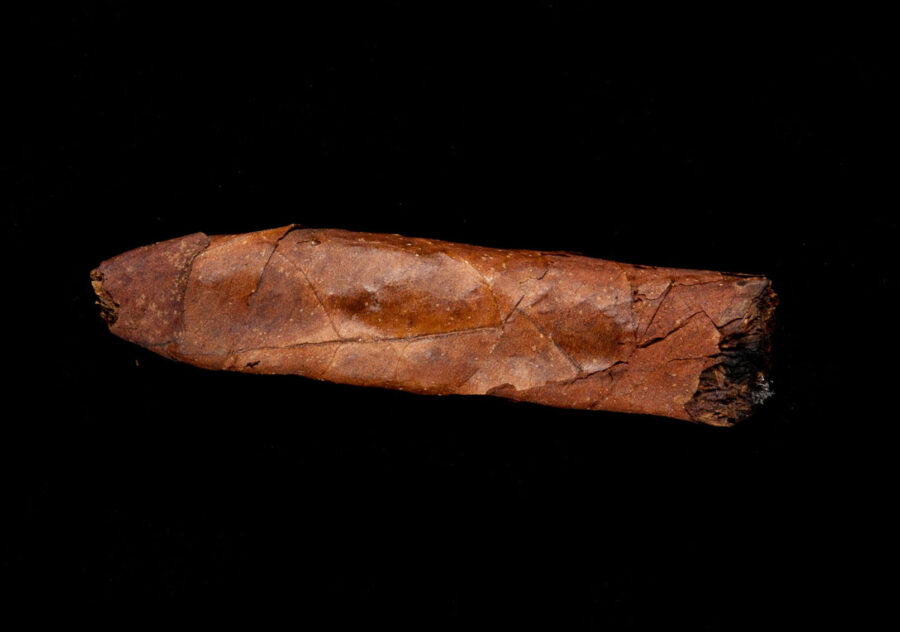 Heritage Auctions (HA.com)
Above: A cigar partially smoked by Grant during the Overland Campaign. According to the officer who retrieved it, Grant dropped it as he smoked and asked for a fresh one instead of picking it up.
But war’s ability to accelerate time, compress space, and throw into collision different groups of people makes two important ideas about tobacco stand out. The first, and perhaps most obvious, is the link between cigar smoking and martial manliness. What image of Ulysses S. Grant is complete without a cigar? Second is tobacco’s ability to encapsulate class and regional differences. Soldiers meeting people from areas of the nation and parts of the world they had never encountered could focus on tobacco to help explain the differences they saw and perceived. The conflict’s unique circumstances allowed soldiers to experiment with new and familiar forms of tobacco that might otherwise have been unavailable or taboo, experimentation born of equal parts curiosity and necessity. The grinding physical demands of campaigning made tobacco’s stimulative power feel extraordinary, not only in terms of its physiological effect, but also because soldiers were growing more dependent in proportion to the privations they endured. The use of tobacco in this time offers both a laboratory of the human body and a reflection of cultural consciousness.
During the siege of Vicksburg, Grant was reviewing the 12th Wisconsin Artillery in their trenches, when a guard ordered him to a halt. “No smoking allowed in the battery,” the sentry barked, to the “great delight of a crowd of high privates” who witnessed the incident. Grant, who was halfway through his signature cigar, flicked it into an embrasure and moved on. The Minnesota artilleryman who witnessed the encounter wrote, “When the General went away the guard went and got the cigar, and said he should send it home in a letter, and tell the folks he ordered it out of General Grants mouth.”2
This innocuous encounter between private and general perfectly illustrates the manly aspects of cigar smoking. Grant depended on the cigar to communicate his composure in the trenches. The lowly private, who briefly flipped the pyramid of military hierarchy, seized the spittle-soaked stub to confirm his soldierly authority to the folks back home. The distinct but related meanings point to tobacco’s symbolic power. Tobacco was one of the premier accessories of 19th-century manliness and its consumption in wartime imbued the user with the traits of the masculine soldier (or at least made him look the part).
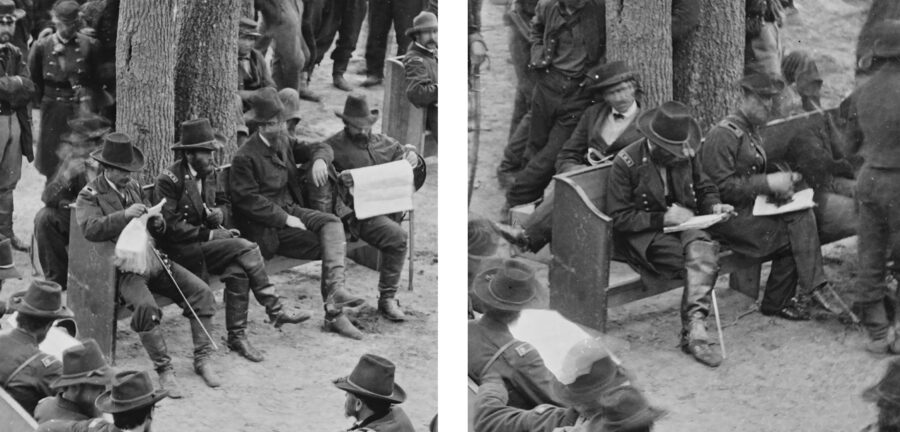 Library of Congress
During the Civil War, Ulysses S. Grant seemed always to be with a cigar—a symbol of 19th-century manliness. Above: Grant is seen with his signature cigar in these photos made by Timothy O’Sullivan at Massaponax Church, Virginia, in May 1864.
Americans had been raised in a world where using tobacco was a symbol of adulthood. When Private George Hitchcock of the 21st Massachusetts Infantry saw an old schoolmate fall beside him at Antietam, he recalled when that friend “taught me to chew my first and last quid of tobacco.”3 Tobacco usage and battle experience were both seen as signs of a manly constitution. To smoke or chew was frequently described as a ritual in the progression from boy to man. A well-worn joke in Britain was that an American youth could not be called a man until he had chewed tobacco for two years.4 And as many historians of the Civil War have highlighted, military service was understood as an opportunity to prove oneself a man.5
So it was that tobacco and soldiering often found themselves working in concert. Thomas Durham recalled that when he was tasked with raising a unit of militia, he pridefully strode through the streets of his Indiana hometown. “I was very busy and greatly interested in raising my squad. I had provided myself with a cigar and was puffing like a six-horse power engine.”6 Young men like Durham, often deeply anxious about their status as men, suddenly upon enlistment gained unfettered access to the robes and rituals of full manhood. “The coat, hat, and accoutrements” of the Civil War soldier, historian Peter Carmichael writes, conveyed “a spirit of martial masculinity that imbued Northern and Southern recruits with a sense of manly pride that encouraged feelings of superiority.”7 Those accessories were frequently complemented by a cigar or a pipe clenched in the teeth. If a uniform and a musket weren’t enough to guarantee being perceived a man, a cigar certainly wouldn’t hurt, and a veil of bluish smoke could be decisive.
Studio photographs of Civil War soldiers showcase the symbolic power of smoke. One daguerreotype in the Library of Congress features a black Union sailor, proudly displaying himself in uniform. He holds in one hand a photograph of Confederate soldiers, and in the other, a half-smoked cigar. The uniform is a sign of his willingness to engage the enemies of the United States anywhere he finds them, the small photograph a poignant symbol of his domination. The cigar solidifies it all, communicating a nonchalant confidence in making these claims. But the cigar also makes a subtle, though equally revolutionary, claim to the refinement of bourgeois manhood.8 To enjoy a cigar required nuanced taste, a sensibility generally reserved for middle- and upper-class smokers. Mostly white smokers. Allowing that a black man had the refinement necessary to enjoy a luxury item like a cigar was a recognition of his humanity, a recognition mostly unacceptable under the system of slavery.9 In 1863, an enslaved man in Richmond, Virginia, was given five lashes for smoking a cigar on the street.10 Through the material culture that the black sailor surrounded himself with, he boldly asserted his status as a civilized man qualified for citizenship. Frederick Douglass wrote during the war, “Once let the black man get upon his person the brass letters, U.S., let him get an eagle on his button, and a musket on his shoulder and bullets in his pockets, and there is no power on earth which can deny that he has earned the right to citizenship in the United States.”11 It appears that at least one black sailor felt a cigar complemented his buttons, bullets, and musket as a symbol of his status as man, militant, and citizen.
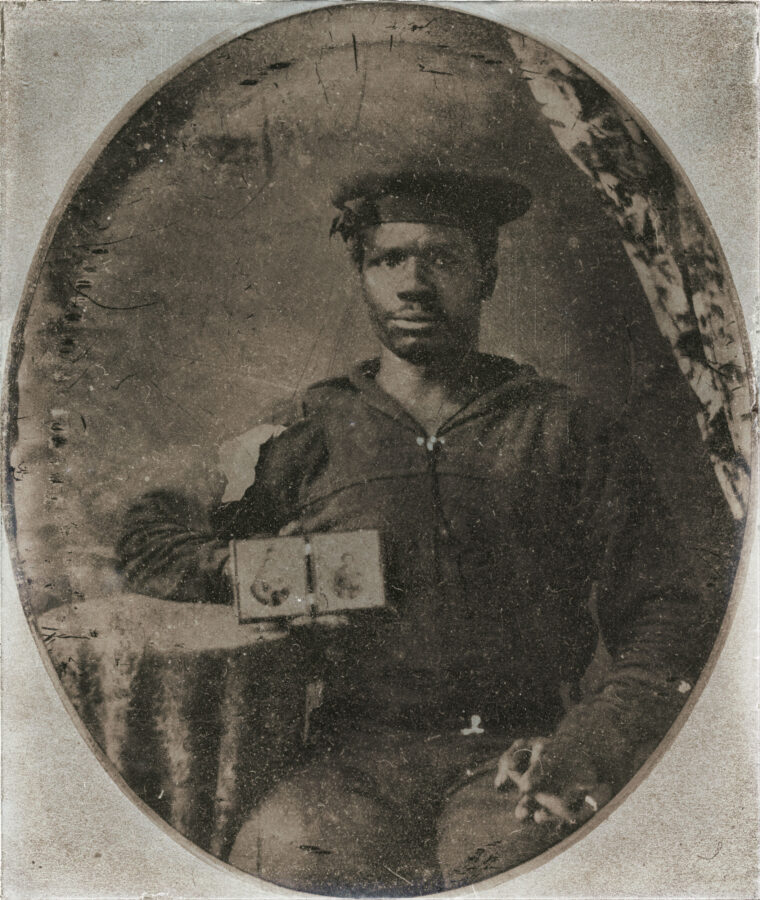 Library of Congress
In this image from the holdings of the Library of Congress, an African-American sailor holds a photo of Confederate soldiers in one hand and a half-smoked cigar—a claim to one of the refinements of manhood—in the other.
The cigar functioned as a symbol of manliness on the battlefield as well. Throughout the war, many officers were anxious to prove their fitness for leadership to the men under their command. This usually meant conspicuous exposure to enemy fire while appearing utterly calm.12 For an officer to gamely smoke under fire was the ultimate expression of steely composure. Major Adolph Proskauer of the 12th Alabama Infantry smoked during the Battle of Gettysburg, and one of his subordinates remembered, “I can see him now as he nobly carried himself at Gettysburg, standing coolly and calmly with a cigar in his mouth at the head of the 12th Alabama amid a perfect rain of bullets, shot and shell. He was the personification of intrepid gallantry and imperturbable courage.”13 Captain Robert Park, serving alongside Proskauer, wrote, “Our gallant Jew Major smoked his cigars calmly and stood in the thickest of the fight.”14 Proskauer was a Prussian Jew and an immigrant. Just like with the photographed black sailor, the cigar functioned as a claim to a definition of manliness generally denied to groups like African Americans, Jews, and immigrants.15
The 19th century was the age of observation.16 Capitalism lashed different corners of the globe together increasingly tightly, railroads collapsed time and space, and the speed and scope of communications exploded through mass print culture and the telegraph. The emerging technology of photography captured the flirtatious glance and the judgmental stare, and froze them forever on tin sheets. The Civil War accelerated all of these forces, and from 1861 to 1865, Americans were seeing more, and in a more discerning way, than ever before. Tobacco helped many of these observers translate what they saw into intelligible differences from themselves. Different kinds of tobacco—cigars but also chew, pipes, snuff, and cigarettes—constituted a form of social vocabulary for Civil War soldiers. Chewing tobacco, long favored by laborers who worked with their hands, was linked to poor southern whites and urban working classes. Cigars and pipes bore heavy overtones of bourgeois refinement. Cigarettes were foreign oddities that only started to make an impression on Americans during the war.
 Heritage Auctions (HA.com)
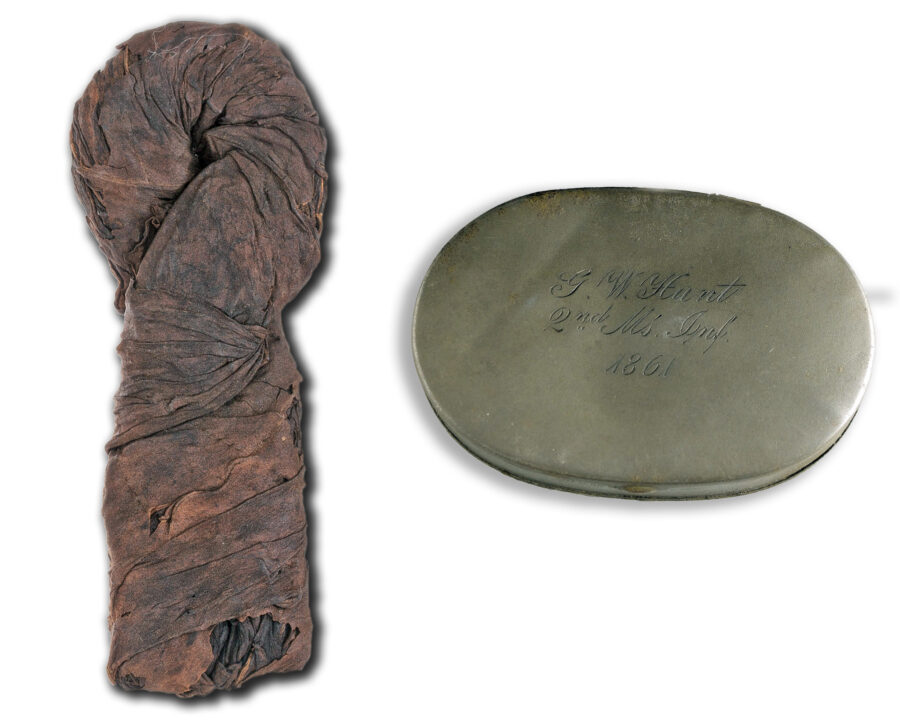
Civil War soldiers experienced varieties of tobacco use during the conflict, including chew, pipes, snuff, and cigarettes. Above: A plug of tobacco that dates from the Civil War (left) and an engraved metal snuffbox carried by a soldier in the 2nd Massachusetts Infantry.
Tobacco accompanied an existing social hierarchy, and reinforced it by creating more or less impassable barriers. It was fine to observe a tobacco chewer, and haughtily judge his inferior status, but for a refined cigar smoking man to “chaw a quid” would be vulgar. Conversely, the tobacco chewer (at least in the opinion of the cigar smoker) did not have the palate to appreciate “the charms of the reverie, or the contemplative ecstasy” of a Havana, as one exuberant French author wrote.17 But the extenuating circumstances created by the Civil War blurred the boundaries between observation and experimentation. Safely removed from the domestic oversight of home, Civil War soldiers felt free to try forms of tobacco often identified with people they considered beneath them.
Captain Frank Donaldson of the 118th Pennsylvania Infantry found himself in such a situation during the Battle of Chancellorsville. The regiment had not received rations for a few days, and worse yet, Donaldson was out of pipe tobacco. Desperate for some adrenaline, or anything that would stay his hunger, Donaldson accepted a generous offer from his first sergeant: a “chew of flounder.” He wrote, “I am glad, or sorry, I don’t know which, just yet, that I took to it so kindly and was able to stand right up with any regular and ‘chaw’ right along.”18 The language Donaldson used had meaning. “Flounder” is an allusion to fishermen and sailors, whose preference for chewing tobacco originated in the age of wooden tall ships, when smoking was often banned on board.19 By “regular,” Donaldson likely did not mean a regular chewer, but rather a regular soldier, an enlisted man who joined the U.S. Army’s small permanent force. Both groups—sailors and professional soldiers—society perceived as akin to the lower ranks of the working class, and were often described as dangerous; the vulgarity of chew became symbolic of those groups.20
To chew was to transgress Donaldson’s urbane middle-class identity and status as an officer. But the extenuating circumstances saved him from any unsavory taint. He could write home freely about his experiment because it was all a part of the challenge and adventure of soldiering. Other soldiers took advantage of circumstances to try new things. Private John King was patrolling the hill country of Alabama with the 92nd Illinois Infantry when he observed a local phenomenon. “There was a custom among Southern women entirely unknown to Northern women. It was the habit of snuff dipping.” To King, “it seemed like a horrible and filthy custom.” With all the detail of an anthropologist, King described the Alabamans’ creation and use of snuff, explaining how a small twig was chewed and wetted with saliva, dipped into powdered tobacco, then painted onto the gums. Some of his comrades “took a sociable dip from the box but they always preferred making a new brush. The girls thought it was awful funny to have a genuine ‘Yank’ dip with them. The girls would giggle and boys would laugh.”21 Far removed from the restrictive gaze of parents and neighbors, northern soldiers could engage in a flirtatious dip with southern women, though the refusal to share a brush is a telling one.
 Library of Congress
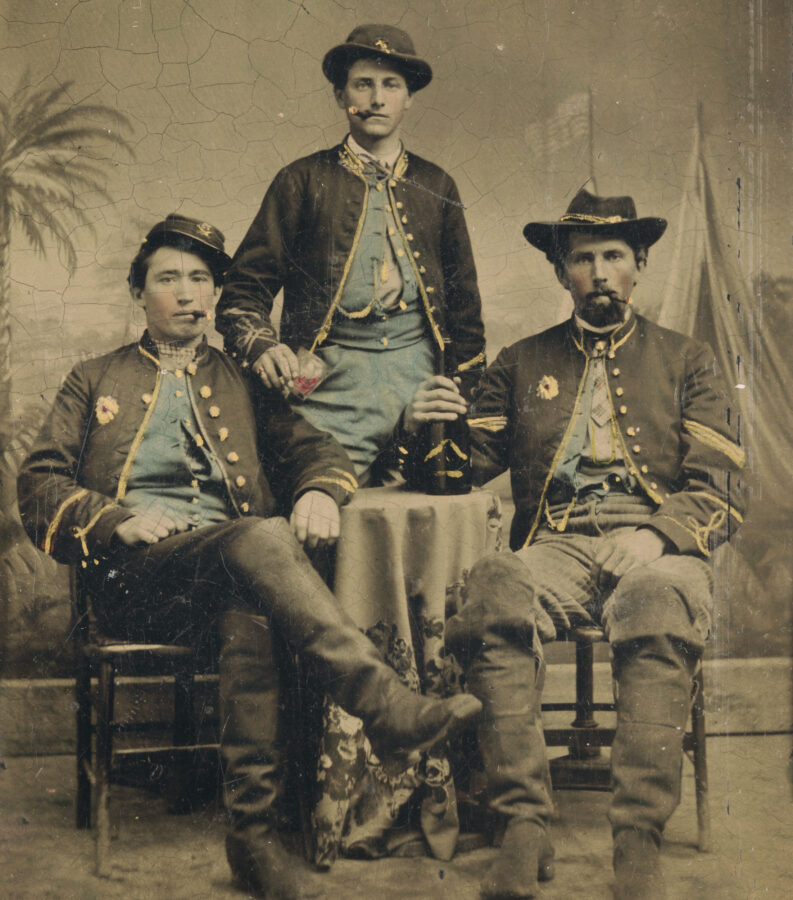
Different kinds of tobacco elicited varied responses among the troops. To some, chewing tobacco and using snuff were considered vulgar—not civilized like pipe or cigar smoking. Above: Union soldiers, cigars in their mouths, strike a refined pose for the camera.
These kinds of interactions allowed for a new form of tobacco to become popular throughout the South: the cigarette. Before the Civil War, cigarettes remained largely unknown in the United States.22 They were widely smoked in the Caribbean and in Latin America, and had been smoked for a long time in the port cities of the Deep South and borderlands with Mexico.23 When men from those areas volunteered for Confederate service, they brought their cigarettes with them, and shared them liberally with their comrades. Alan Carter Redwood, a native of Lancaster, Virginia, fell in with the 6th Louisiana Infantry during the Second Manassas Campaign and wrote, “the tedium of this last service my companions relieved by games of ‘seven-up’ with a greasy, well-thumbed deck, and in smoking cigarettes, rolled with great dexterity, between the deals.”24 Redwood was an artist and went on to become one of the foremost illustrators of the Civil War. His depiction of a “Louisiana Pelican” included a cigarette. Many southern civilians were introduced to cigarettes during the war. Elizabeth Frances Andrews, a girl living in Macon, Georgia, reported being taught how to roll cigarettes by a General Yorke of Louisiana, and over the course of the war she rolled them for refugees from Mississippi and wounded Confederate veterans.25 The circulation of cigarettes during the war appears to have facilitated the explosion of the industry after the war. Washington Duke served briefly in the Confederate army, and when he returned home, he transformed the family farm to a tobacco plantation oriented toward the cultivation of bright leaf, the critical ingredient in cigarettes. His son James Buchanan Duke would later found the American Tobacco Company.26 Lewis Ginter, who served as a major in the Confederate Commissary Department, would join with John F. Allen after the war to form Allen & Ginter, the nation’s first major cigarette manufacturer (also the inventors of the baseball card).27
The Civil War brought the cigarette to the South, and due to tobacco’s uniquely addictive qualities, it soon became a feature of American life. Cigarette smoke is inhaled into the lungs, where hypersensitive nerves make the uptake of nicotine to the brain exponentially faster than with pipes, cigars, and chew.28 The remarkable potency of the cigarette (and mechanization of its production) allowed it to establish an unparalleled global dominance that continues today.29 Johnny Rebs were among the first Americans to realize this stimulation, which extends beyond the cultural and social dimensions of tobacco to the question of how Civil War soldiers interacted with an addictive substance.
In 2022, we have the benefit of modern scientific and medical research to know that tobacco is harmful and nicotine a habit-forming drug. During the Civil War, Americans dimly understood this dependence. A reporter for the Mobile Register quipped in 1859, “People say, ‘Oh I can leave off using tobacco at any moment.’ Let them try it on and see if they will soon see or feel that a habit is not so easily gotten rid of or laid aside.”30 Americans then understood addiction and its experience differently than we do today. To a Civil War soldier, addiction was a moral trait; the pitiful result of excessive consumption by a degenerate constitution.31 Historian Sarah Tracy explains that addiction in the 19th century “was a complex model encompassing body, mind, and morals.”32 Tobacco was low on the totem of vices; alcohol and opium were the primary targets for temperance crusaders, though they were hardly friendly toward “the weed.”33 But tobacco had become so popular among respectable middle- and upper-class men that it was hard to reproach smokers.
Whether or not Civil War soldiers considered themselves addicts, they were becoming dependent on tobacco through their physical exertions on campaigns. Like alcohol and other substances, nicotine has a greater effect on bodies that are hungry, tired, or generally strained in some way.34 That effectiveness increases the impact of chemical activity in the brain, and fuels a corresponding dependency.35 It is hard to imagine, let alone quantify, the extraordinary physical demands that campaigning placed on a soldier’s body. For soldiers fed a meager diet and often sleep deprived, nicotine’s psychoactive punch grew more powerful in proportion to their travails.
The relationship between deprivation and dependency is evident in the writings of Civil War soldiers and civilians. Artilleryman Frank Wilkeson was advised by his comrades before his first campaign to carry only a change of underwear and three plugs of tobacco, rolled in his blanket and groundsheet. The veterans instilled in Wilkeson the mantra of the campaign: “Let your aim be to secure food, and food, and still more food, and keep your eyes open for tobacco.”36 Civilians along the route of march became fearfully aware of soldiers’ foraging priorities. “The Reb soldiers are running through all the time, searching all the buildings,” a woman from Spotsylvania Court House wrote in 1864. “We have to have the tobacco carried up in the garret[,] they are in everything so annoying. I hate the sight of them.”37 Few Civil War campaigns rival the deprivation and suffering endured by British soldiers during the Crimean War of 1853–1856.38 One British veteran wrote of that campaign, “My experience with the pipe dates from the Crimea. That, no doubt, is the case with many others…. We were always smoking: our pipes were the comfort, the consolation, of our lives.”39
When a difficult campaign prompted severe cravings, the demand for tobacco could become fanatical. Confederate soldier Sam Watkins remembered that during the autumn 1862 retreat from Kentucky, “soldiers got very thirsty for tobacco.” Watkins and his fellow Tennesseans would cut the green sprouts off harvested stalks of tobacco “and dry them by the fire and chew them.”40 Even more desperate were the efforts of Captain John Henry Otto of the 21st Wisconsin Infantry. During the 1864 siege of Chattanooga, he and the Army of the Cumberland were trapped in that city with only a thin “cracker line” of supplies keeping them fed. Otto preferred a pipe, as befit his rank, but there was no smoking tobacco to be had. There was, however, no shortage of chewing tobacco, as local production remedied any shortages. Otto came up with an ingenious, if repulsive, solution. He wrote in his memoir: “[T]he chewers were constantly throwing away quids which had passed through the mill [their mouths]. It struck me that these disregarded quids might do some service yet. On the sly I gathered a few of them, bathed them good in water, dried them and tied them and found them superior to fresh cut leaf tobacco.” Otto even had the gall to call his product “Excelsior,” and explained that “the bitter, oily nicotine having been squeezed out of it, it had a far sweeter flavor and taste.” Otto kept his methods secret, but word inevitably got out, and soon “every smoker would enter into a sort of contract with a chewer or two who would bind themselves to save the finished quid for him.” Otto anticipated his readers’ disgust: “Now I suspect good many will sniff their noses and call this a vile, nasty and vulgar proceeding, but to all such I humbly suggest to consider that it was not a whit more vulgar then eating of rotten stinky meat and sowbelly, the chewing of hardtack alive with fat, blockheaded maggots. It was simply making ‘a virtue out of mud.’”41
 Library of Congress
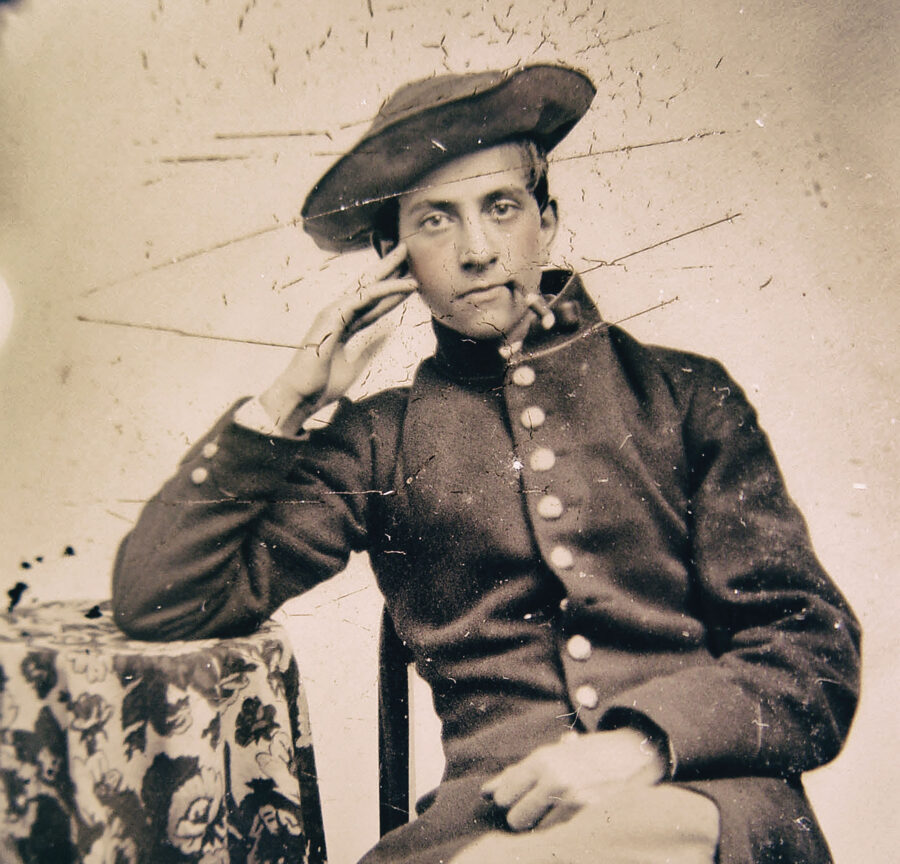
Increased exposure to tobacco among Civil War soldiers led to incidents of addiction. One young artillerist was told by his veteran comrades to keep three plugs of tobacco on him at all times, so as not ever to run short. “Let your aim be to secure food, and food, and still more food, and keep your eyes open for tobacco,” they told him. Above: A young soldier and his cigar.
Today, tobacco’s name is mud, and its users are criticized in a way that Civil War-era Americans could not have imagined. To them, tobacco was an insignia of their social reality. Different kinds of tobacco, even if they were completely foreign, constituted a cultural vocabulary to the user and the observer, and marked rank in the social hierarchy. Their cultural consciousness, their sensibility was being constantly and forcefully influenced by a powerful psychoactive agent: nicotine.
By carefully examining what it meant for a black sailor or a Jewish immigrant to smoke a cigar, for Frank Donaldson to chew a quid, and why Sam Watkins sucked on green tobacco shoots, a new understanding of the Civil War soldier is generated. Through tobacco can be seen other dimensions of performative manly identity and how some Civil War-era Americans made it essential to their identities—no thought given to the biochemistry of the human, and the soldier’s, body. Historians Jonathan W. White and Kathryn Shively have emphasized the critical intersections of physiological stimuli and cultural consciousness in Civil War soldiers.42 What soldiers put into their bodies, and when they consumed it, mattered. An illustrative story is set in January 1863: During the punishing Mud March, the men of the 118th Pennsylvania Infantry and the 25th New York Infantry were led into a forest for a rest. Morale was deadly low, and the officers of the paired regiments devised a scheme to boost it. Men from each unit would compete to see who could chop down a tree of equal width fastest. A whiskey ration was distributed before the event, the results of which were predictable. Accusations about the width of the trees and the sharpness of the axes transformed into fists and tackles, and like a whirlpool, whole companies of each regiment were drawn into the melee. It was reported—note by a Pennsylvanian—that even officers of the 118th pitched in. Only when an artillery battery trained its cannon on the muddy slugfest did the fighting stop, and the combatants reportedly only took notice when the guns were loaded, aimed, and primed.43 Fatigue, hunger, frustration, and a shot of whiskey make a potent psychological cocktail, and the story of this brawl cannot be told without it. Many critical moments of the Civil War hinged on sleep, rations, alcohol, and stimulants such as coffee and tobacco, but also latrines, laundry, and forage. We need to understand more about how Civil War soldiers perceived their experiences through their bodies. In short, we need to make virtues out of mud.
Ben Roy is a PhD student at the University of Georgia, studying the cultural history of tobacco in the 1800s. He is also interested in the American Civil War, with a focus on the social history of common soldiers and Confederate monuments.
Notes
1. My Life in the Irish Brigade: The Civil War Memoirs of Private William McCarter…, ed. by Kevin E. O’Brien (Cambridge, MA, 2003), 39.
2. Brother of Mine: Civil War Letters of Thomas and William Christie, ed. by Hampton Smith (Minneapolis, 2011), 135.
3. From Ashby to Andersonville: The Civil War Reminiscences of Private George A. Hitchcock, ed. by Ronald Watson (Campbell, CA, 1997), 22.
4. George Francis Train, Geo. Francis Train, Unionist, on T. Colley, Grattan, Secessionist (Boston, 1862), 32.
5. Stephen Berry, All That Makes a Man: Love and Ambition in the Civil War South (Oxford, 2003); Gerald Linderman, Embattled Courage: The Experience of Combat in the Civil War (New York, 1987); Earl J. Hess, The Union Soldier in Battle: Enduring the Ordeal of Combat (Lawrence, 1997).
6. Thomas Wise Durham, Three Years with Wallace’s Zouaves… (Macon, GA, 2003), 180.
7. Peter Carmichael, The War for the Common Soldier: How Men Thought, Fought, and Survived in Civil War Armies (Chapel Hill, 2018), 20.
8. Jean Stubbs, “El Habano: The Global Luxury Smoke,” Commodities of Empire Working Paper No. 20, Caribbean Studies Center, London Metropolitan University, September, 2012; Jean Stubbs, “Havana Cigars and the West’s Imagination” in Smoke: A Global History of Smoking, eds. Sander L. Gilman and Zhou Xun (London, 2004), 134–139.
9. “Jules Sandeau on the Cigar,” in John Bain’s Tobacco in Song and Story (Rahway, NJ, 1896); “The Smoking Room at the Club,” The Cornhill Magazine Volume 6, No. 31–36 (July-December 1862): 512–513.
10. “Local Matters,” Daily Dispatch, May 27, 1863.
11. “Frederick Douglass,” People, African American Civil War Memorial, National Park Service.
12. Kanisorn Wongsrichanalai, Northern Character: College-Educated New Englanders, Honor, Nationalism, and Leadership in the Civil War Era (New York, 2016); Andrew Bledsoe, Citizen Officers: The Union and Confederate Volunteer Junior Officer Corps in the American Civil War (Baton Rouge, 2015), 167.
13. Robert N. Rosen, The Jewish Confederates (Columbia, SC, 2000), 107.
14. Marc Jordan Ben-Meir, The Sons of Joshua: The Story of the Jewish Contribution to the Confederacy (New York, 2012), 43.
15. John McElroy, Si Klegg: Si and Shorty Meet Dr. Rosenbaum, The Spy, Who Relates His Adventures (Washington, D.C., 1910).
16. See “Panopticism” in Michel Foucault, Discipline and Punish: The Birth of the Prison (New York, 1975) and “Panoramic Vision” in Wolfgang Schivelbusch, Railway Journey: The Industrialization of Time and Space in the 19th Century (Los Angeles, 1977), 62.
17. “Jules Sandeau on the Cigar,” in John Bain’s Tobacco in Song and Story (Rahway, NJ, 1896).
18. Inside the Army of the Potomac: The Civil War Experiences of Captain Francis Adams Donaldson, ed. by J. Gregory Acken (Mechanicsburg, PA, 1998), 242.
19. “A New Yorker in Paris,” National Anti-Slavery Standard, January 28, 1860; E.Y. Robbins, The Soldier’s Foe: A Pocket Treatise on Health and Hygiene for Camps & Camp Life (Cincinnati,1861), 103.
20. Nick Mansfield, Soldiers as Workers: Class, Employment, Conflict, and the Nineteenth Century Military (Liverpool, 2016).
21. Three Years with the 92d Illinois: The Civil War Diary of John M. King, ed. by Claire E. Swedeberg (Mechanicsburg, PA, 1999), 149–150.
22. The first advertisement for cigarettes appeared in the New York Herald on February 23, 1845; the first advertisement in the Richmond Examiner ran on February 5, 1862.
23. Ada Ferrer, Freedom’s Mirror: Cuba and Haiti in the Age of Revolution (New York, 2014), 160; Fernando Ortiz, Cuban Counterpoint: Tobacco and Sugar (Durham, 1947, 1995).
24. Allen C. Redwood, “Jackson’s Foot-Cavalry at The Second Bull Run,” Battles and Leaders of the Civil War: Volume Two (1887), 535.
25. Entries of January 13, 1864, May 6, 8, and 13, 1865, Eliza Frances Andres, Diary of a Georgia Girl, 1864–1865 (New York, 1908).
26. Sarah Milov, The Cigarette: A Political History (Cambridge, 2019), 14–15.
27. William Lawrence Royall, Some Reminiscences (New York, 1909), 34; Richard White, The Republic for Which it Stands (Oxford, 2017), 576–577.
28. Judith Grisel, Never Enough: The Neuroscience and Experience of Addiction (New York, 2019), 118–146; Drew Swanson, A Golden Weed: Tobacco and Environment in the Piedmont South (New Haven, 2014), 50.
29. See Allan M. Brandt, Cigarette Century: The Rise, Fall, and Deadly Persistence of the Product that Defined America (New York, 2007).
30. Author’s emphasis. “The Use of Tobacco,” Times-Picayune, October 9, 1859.
31. David Herzberg, White Market Drugs: Big Pharma and the Hidden History of Addiction in America (Chicago, 2020), 20–21.
32. Sarah W. Tracy, Alcoholism in America: From Reconstruction to Prohibition (Baltimore, 2005), 40.
33. See Richard Kluger, Ashes to Ashes: America’s Hundred Year Cigarette War, the Public Health, and the Unabashed Triumph of Philip Morris (New York, 1996).
34. Shahram Heshmat, Addiction: A Behavioral Economic Perspective (New York, 2015), 60.
35. See Grisel, Never Enough, 34–49.
36. Quoted in Gordon C. Rhea, The Battle of the Wilderness, May 5–6, 1864 (Baton Rouge, 1994), 58–59.
37. Letter by Katherine H. Couse, May 17, 1864, quoted in Elizabeth A. Getz, “Between the Lines: The Diary of a Unionist Woman at the Battle of Spotsylvania Court House,” Fredericksburg History and Biography 1 (2002).
38. Richard Holmes, Redcoat: The British Soldier in the Age of Horse and Musket (London, 2001), 249–251, 401.
39. Stanley Rivers, The Meerschaum… (London, 1868), 3–4.
40. Sam Watkins, Co. Aytch: A Side Show of the Big Show (Wilmington, 1882), 89.
41. Memoirs of a Dutch Mudsill: The ‘War Memories’ of John Henry Otto…, ed. by David Gould and James B. Kennedy (Kent, OH, 2010), 202.
42. Jonathan W. White, Midnight in America: Darkness, Sleep, and Dreams during the Civil War (Chapel Hill, 2017); Kathryn Shively Meier, “The Man Who Has Nothing to Lose: Environmental Impacts on Straggling in 1862 Virginia,” in The Blue, The Gray, and the Green: Toward an Environmental History of the Civil War (Athens, 2015), 67–96.
43. History of the Corn Exchange Regiment … (Philadelphia, 1888), 162–164; Donaldson, Inside the Army of the Potomac, 207–208.