 Boston Public Library
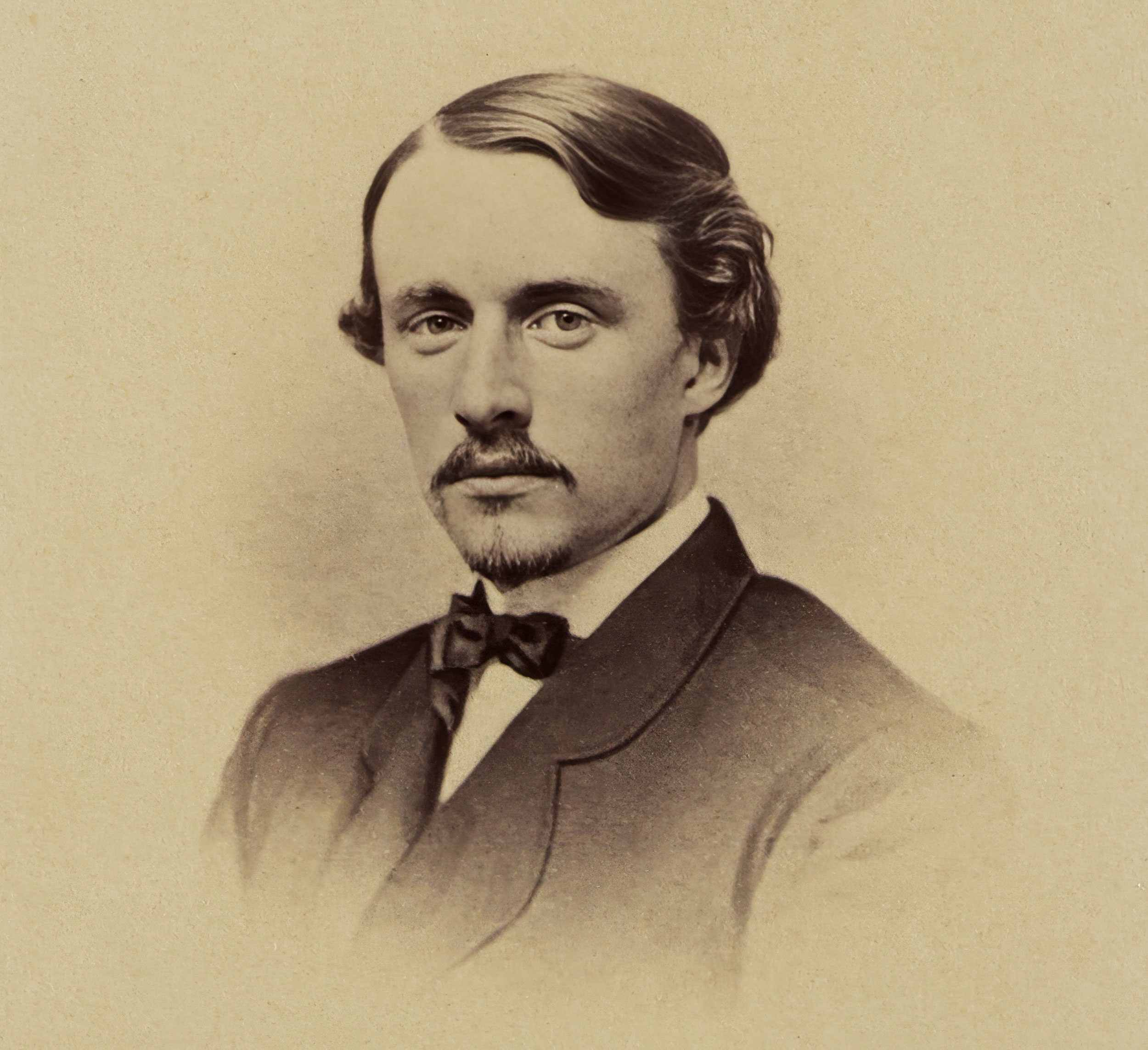
A prewar image of Robert Gould Shaw
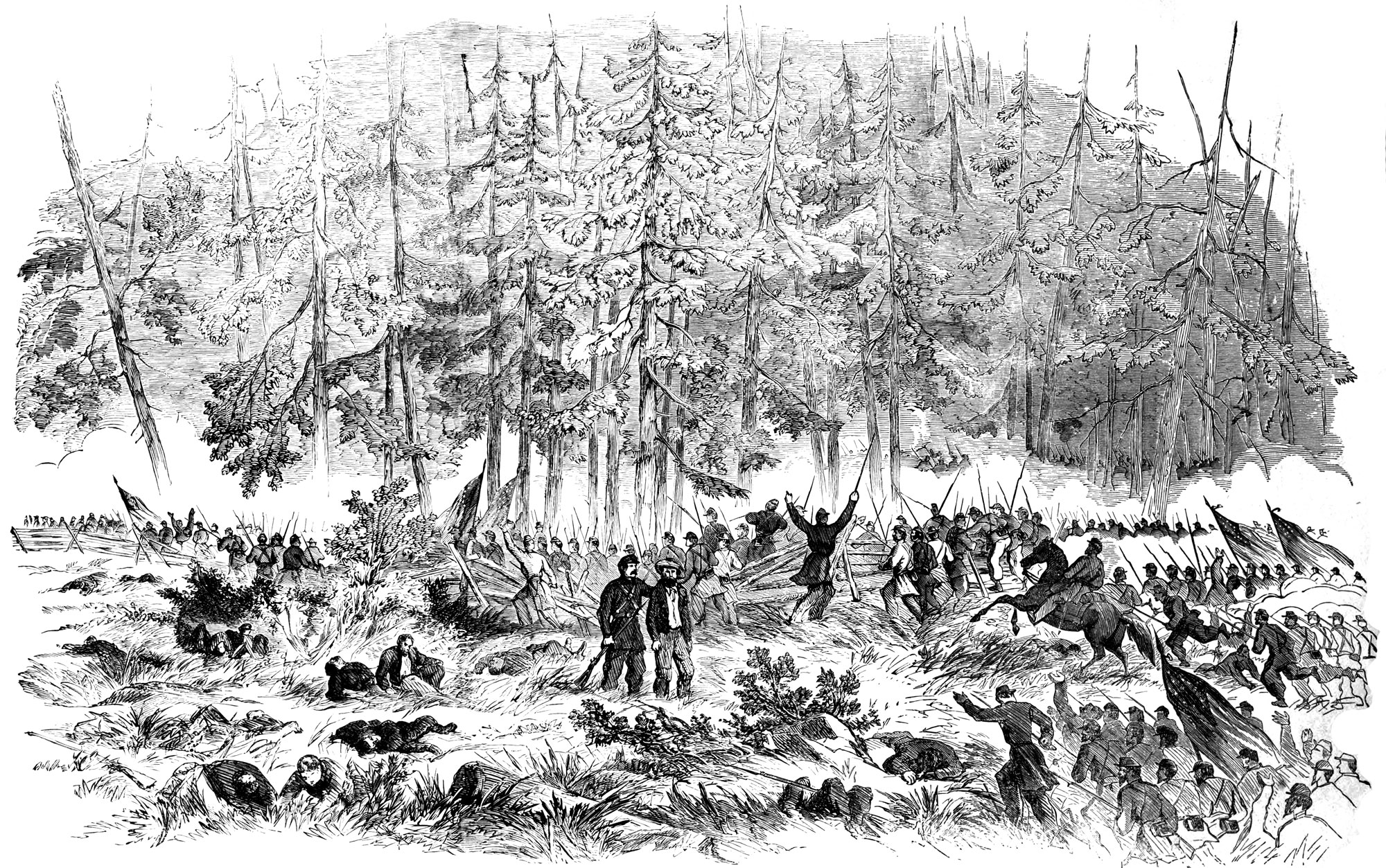
The morning after the Battle of Cedar Mountain, Second Lieutenant Robert Gould Shaw picked his way across ground strewn with the dead and the wreckage of combat. The fight had come on August 9, 1862, when Shaw’s 2nd Massachusetts Infantry, part of Major General John Pope’s Army of Virginia, clashed with Confederate forces in the hills of central Virginia, in a defeat measured in blood. Shaw’s regiment suffered especially; roughly one-third of the men, including 16 of its 22 officers, were killed, wounded, or taken prisoner.
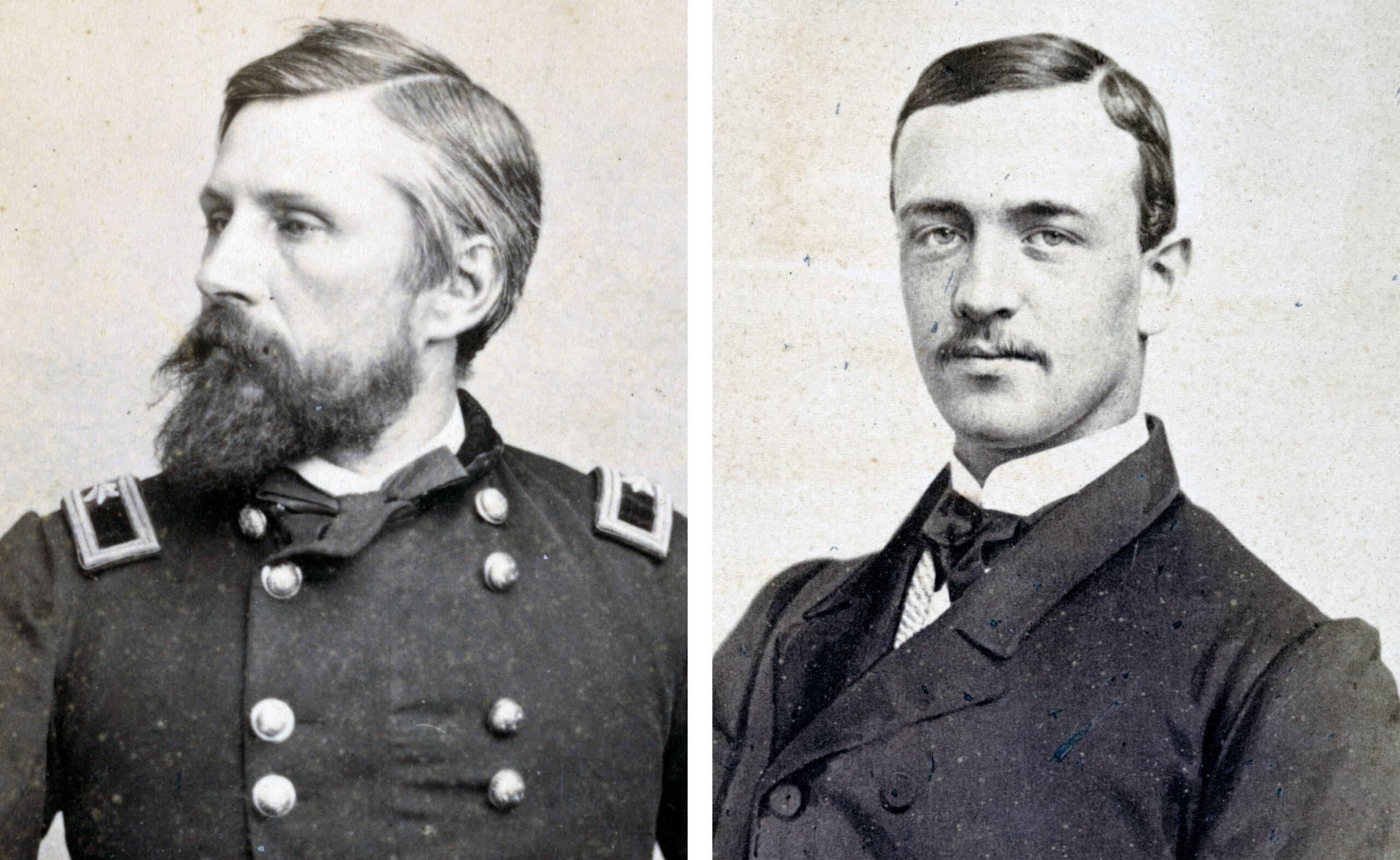
Walking the field alongside Brigadier General George Gordon, Shaw was unprepared for what he found. Writing to his mother, he described the quiet devastation of recognizing, one by one, the faces of comrades with whom he had served since June 1861. Captain Robert Cary was the first. Shaw found him on his back, his head resting on a piece of wood, his expression so composed that he seemed simply asleep. “His face was beautiful,” Shaw wrote, “and I could have stood and looked at it a long while.”1 Shaw didn’t have long to linger. The field gave up its dead quickly: Captain William B. Williams, Captain Richard Chapman Goodwin, Captain Edward Gardner Abbott, Lieutenant Stephen George Perkins. Friends, all of them, found in the space of minutes.
 Library of Congress (2)
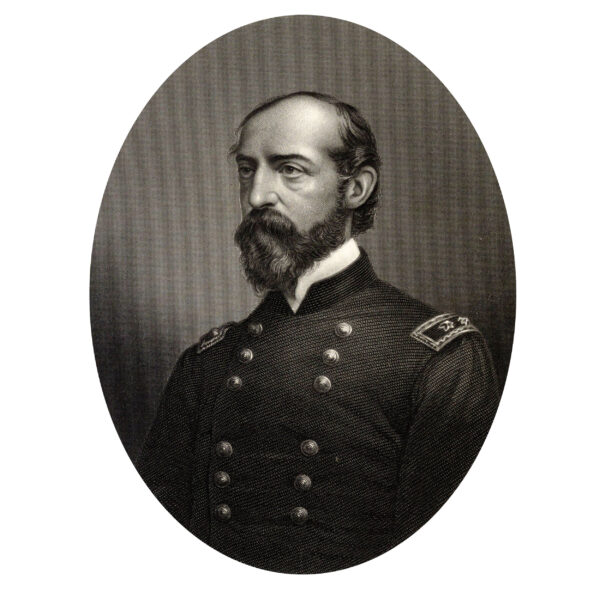
George Gordon (left) and Edward Gardner Abbott
Shaw accompanied his comrades’ bodies into Culpeper, helping to pack them in charcoal for the journey to Washington and, eventually, home. He cut a lock of hair from each man, keepsakes for their families, many of whom he knew personally, which made the grief harder to contain. He wept. “Oh! It is hard to believe that we shall never see them again,” he wrote, “after having been constantly together for more than a year.”2
This moment, like much of Shaw’s early war service, has been largely forgotten, crowded out by the story that came to define him: his decision to command one of the war’s first black regiments, the 54th Massachusetts Infantry, and his death, at 25, in battle while leading them in the dramatic assault on Fort Wagner on Morris Island, South Carolina, in July 1863. Films like Glory and earlier biographies tend to compress or skip over Shaw’s years with the 2nd Massachusetts entirely, treating them as mere prelude to an inevitable fate.
While Shaw commanded the 54th Massachusetts for roughly six months, he spent nearly 19 months with the 2nd Massachusetts, largely in Virginia, where his understanding of the war was formed. In the Shenandoah Valley he encountered escaped slaves for the first time and ran up against the hostility of Confederate civilians. At Front Royal and the First Battle of Winchester he saw what combat looked like. And throughout he was pressed to reckon with issues that would follow him forever: emancipation, the arming of blacks as soldiers, the discipline of men under his charge, and the politics surrounding command of the Army of the Potomac.
Indeed, the period between Cedar Mountain and the end of 1862 presented Shaw with his most severe test of the war. While the fighting continued to intensify, forcing Shaw to confront the loss of even more of his close friends in the regiment, President Abraham Lincoln issued his Preliminary Emancipation Proclamation, which would place emancipation as a central wartime goal. The question of military emancipation had long divided Shaw from his abolitionist parents, but the president’s proclamation now pushed their relationship to the breaking point. By the end of 1862, Shaw was left disillusioned about the purpose of the war and contemplating leaving the regiment for another assignment. More importantly, he doubted he would ever have the opportunity to make a meaningful contribution to the war’s successful conclusion.
Known affectionately as “Rob” by his family, Robert Gould Shaw was born on October 10, 1837, into a wealthy and prominent Boston abolitionist family deeply committed to social reform. Raised under the strong moral influence of his parents, Frank and Sarah Shaw, Rob absorbed their fervent antislavery convictions from an early age—yet came to resist following in their footsteps. Educated partly in Europe and briefly at Harvard, Rob developed an independent, pragmatic temperament that would put him at odds with his family’s more idealistic vision of the war. While his parents saw the conflict from the outset as a crusade for emancipation, Shaw viewed it in narrower terms, as a fight to preserve the Union, and was skeptical that the army should be used as an instrument of radical social change.
 Frank Leslie’s illustrated History of the Civil War (1895)
The period between the Battle of Cedar Mountain (depicted above in a wartime illustration) and the end of 1862 presented Robert Gould Shaw, a bright young 2nd Massachusetts Infantry officer—and future commander of the 54th Massachusetts Infantry—with his most severe test of the conflict, a time when his understanding of the war was formed.
Despite having “undisputed possession of the battle-field” after their victory at Cedar Mountain, Confederates abandoned the field and continued their northward march, leaving many wounded soldiers in farmhouses and other buildings.3 Army of Northern Virginia commander Robert E. Lee had learned that Union general George B. McClellan, whose Peninsula Campaign against Richmond had recently failed, was in the process of transferring troops from his Army of the Potomac, presumably to link up with Pope’s force in northern Virginia. With Richmond now safe, Lee began moving the rest of his troops north to unite with Thomas J. “Stonewall” Jackson’s men and defeat Pope before he could be reinforced by McClellan.
Shaw struggled to maintain contact with his family as Pope’s army stumbled through a series of humiliating retreats. From Culpeper, the 2nd Massachusetts advanced to the Rapidan River only to fall back behind the Rappahannock by August 20, another Federal withdrawal that handed Lee the initiative.
The next nine days dissolved into a nightmare of constant movement, with the regiment rarely camping anywhere for more than a day. “We have been drenched with rain & scorched by the Sun,” Shaw recalled, “have slept much of the time on the ground with blankets & have lived principally on green apples & corn.”4 The army was disintegrating through exhaustion and hunger while Lee maneuvered his forces for another devastating blow.
While Pope’s men stumbled through their exhausting retreat, Lee executed a masterpiece of strategic deception. On August 25, he launched Jackson’s corps on a daring flanking maneuver—a wide clockwise arc around Pope’s right that would sever Federal supply lines and trap the Union army between the Confederate forces. Between August 28 and 30, the two armies clashed on or near the old Bull Run battlefield resulting in another decisive Confederate victory. The 2nd Massachusetts was spared, as their corps, commanded by Major General Nathaniel Banks, was held in reserve.
The loss at Second Bull Run was made worse by the knowledge that the 2nd Massachusetts was, in Shaw’s mind, “just where we started from” six months earlier. Shaw fell back on a well-worn explanation to rationalize the army’s most recent defeat. “We shall never do much until we get a very different army from what we have now,” he wrote his father. “Until the government finds that it is worth their while to get competent officers & attend themselves to the organization of the army & not allow it to be made a private speculation for Governors of States.” The army’s lack of discipline was apparent to Shaw. “In every battle a part of the men skulk & after a day’s march the roads are lined with stragglers,” he wrote his father.5
 National Archives (Pope); Library of Congress (Mills)
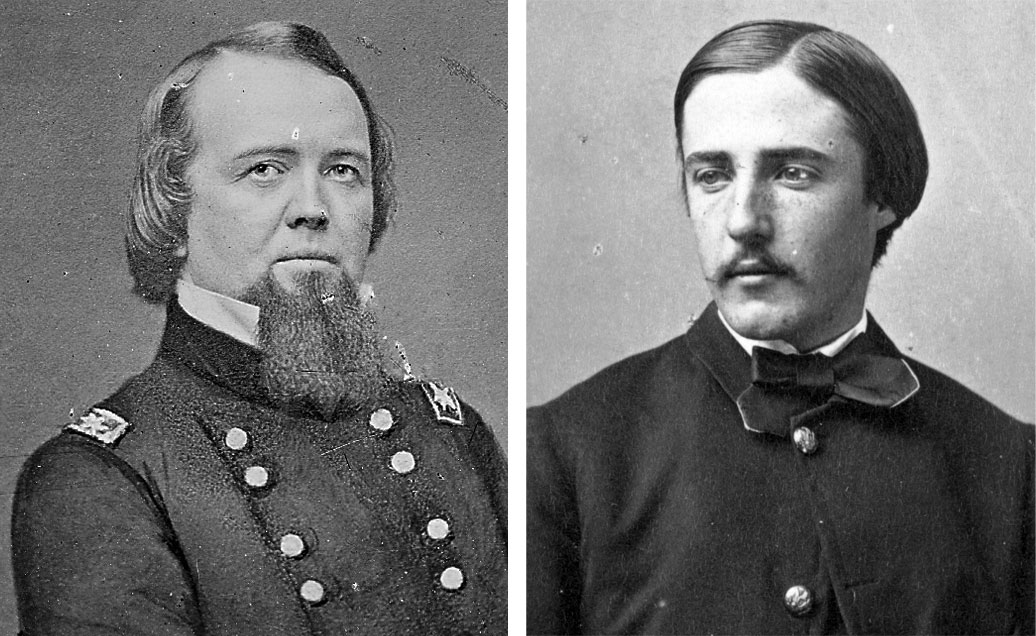
John Pope (left) and Charles Mills
On September 2, the news that McClellan had been appointed to reorganize the troops around Washington, D.C., was greeted by cheers of joy among the soldiers—one of the few bright spots at such a low point for the Union cause. Shaw remained in favor of McClellan, consistently praising him for “doing wonders” to build discipline throughout the Army of the Potomac.6 His support stood in sharp contrast to the concerns, expressed by many in Washington and in the ranks, that the general had intentionally delayed the transfer of his army to support Pope against Lee’s offensive.
In just eight weeks, Lee’s bold leadership had shattered Union strategy, driving Federal forces from Richmond’s gates back to Washington’s defenses. Now, he was poised to invade the United States. On September 4, Lee led his army across the Potomac into Maryland, believing a decisive Confederate victory in that state—or even in Pennsylvania—could shatter northern morale just weeks before the November midterm elections. Moreover, he hoped further battlefield success would convince Britain to recognize Confederate independence and intervene militarily against the Union.
Along with the news of McClellan’s return, Shaw learned that the 2nd Massachusetts, now under the command of Colonel George L. Andrews, had been assigned to Gordon’s Third Brigade, First Division, of the newly formed XII Corps under the command of Major General Joseph K. Mansfield. In addition to the 3rd Wisconsin and 27th Indiana, the Third Brigade was bolstered by the 13th New Jersey and 107th New York infantry regiments. Officers in the 2nd Massachusetts were horrified to learn that the New Jersey boys had been rushed into the field and not properly drilled in the loading and firing of their weapons. What mattered most to Shaw, however, was that his regiment was now officially part of the Army of the Potomac.
Shaw welcomed a respite at Rockville, Maryland, after weeks of brutal marching. The arrival of regimental wagons reunited soldiers with personal belongings they had not seen in more than three weeks of constant movement. Men eagerly washed and changed into clean clothes. Campfires crackled with renewed life as soldiers enjoyed proper meals and caught up on long-delayed correspondence with families who had received no word during the chaotic retreat from Virginia. Shaw finally slept under canvas rather than sharing corners of threadbare blankets with his fellow officers.
By September 11, the Army of the Potomac was moving west toward Frederick to confront Lee’s advancing army. The men were impressed with the rolling hills, patches of wood, and well-kept farms of central Maryland. One of Shaw’s fellow officers, Charles Mills, described it as “paradise compared with Virginia.”7 Shaw probably heard the news that just outside of Frederick a soldier nearby in the 27th Indiana Infantry had come across a paper wrapped around some cigars intended for one of Lee’s commanders; the papers provided the Union army with valuable information concerning the Army of Northern Virginia’s movements and campaign plans.
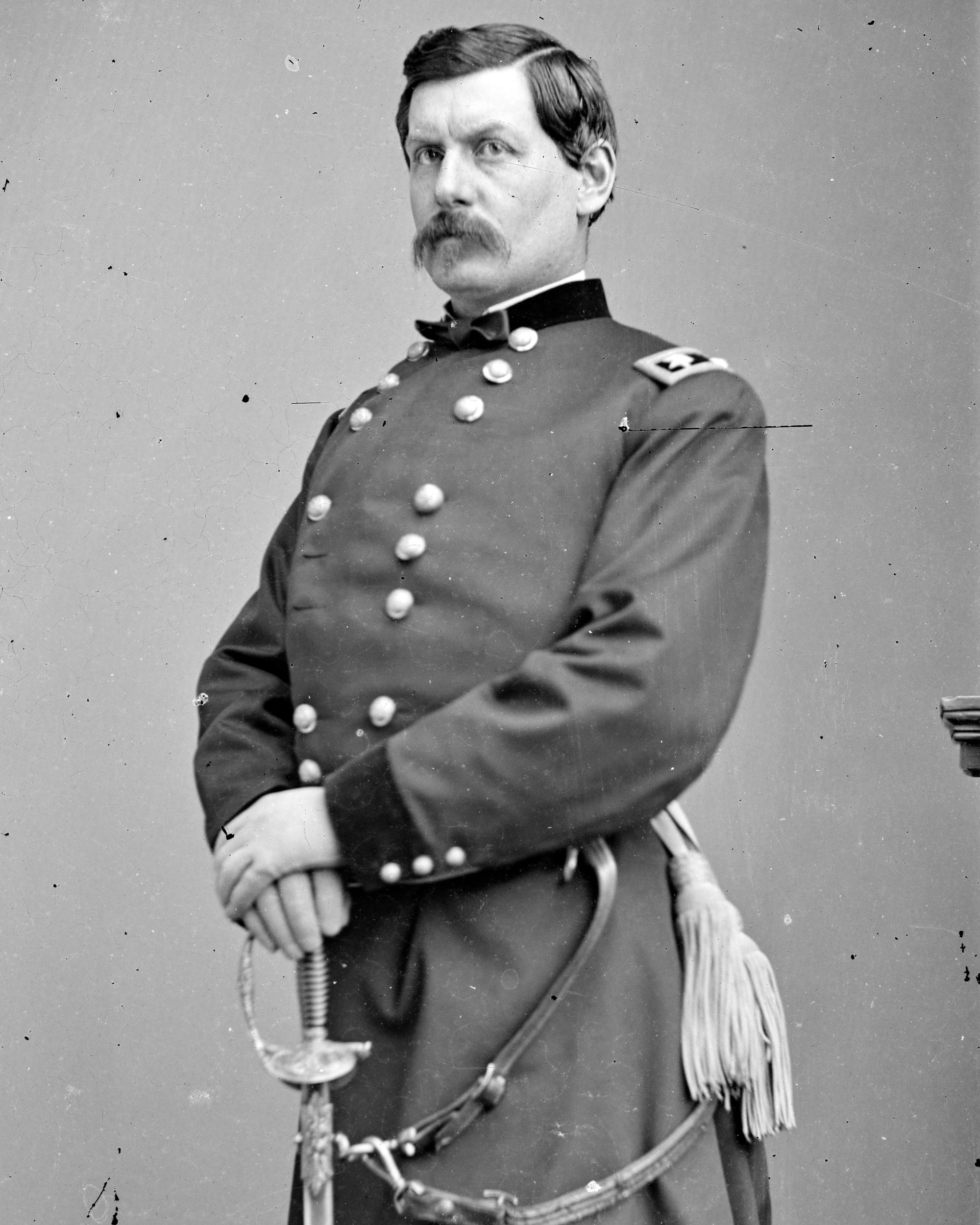 National Portrait Gallery
Shaw was among the many Union soldiers who cheered the news of the appointment in September 1862 of George McClellan (above) to reorganize the troops around Washington, D.C.
Believing he would have plenty of time to maneuver unmolested by McClellan, Lee divided his already outnumbered army by sending Jackson’s entire corps of 25,000 men to capture Harpers Ferry and secure a Confederate line of retreat, if needed. The remaining Army of Northern Virginia continued west toward Hagerstown, leaving Lee dangerously exposed should McClellan move quickly enough to exploit the separation. McClellan was, in fact, on the move. By September 15, the 2nd Massachusetts had passed through South Mountain’s gaps, where Lee had tried unsuccessfully to block Union pursuit the previous day. War debris littered the mountainside—abandoned equipment, bloodstained rocks, hastily dug graves—clear indications that a battle was imminent. The regiment bivouacked near Keedysville that night, then moved closer to the sleepy village of Sharpsburg along Antietam Creek, where Lee was desperately trying to concentrate his scattered forces. Shaw could see Confederate positions on the ridgeline across the creek, close enough to distinguish individual enemy soldiers preparing defensive works.
That evening Shaw sought out his friend William Forbes, stationed nearby with the 1st Massachusetts Cavalry. They shared letters from home by firelight. Shaw read aloud ones from his sisters Josephine and Nellie, who were enjoying an oceanside family vacation while their brother prepared for battle. “We lay on his blanket before the fire, until 10 o’clock, and then I left him, little realizing what a day the next was to be; though a battle was expected, and I thought, as I rode off, that perhaps we shouldn’t see each other again,” Shaw later noted.8
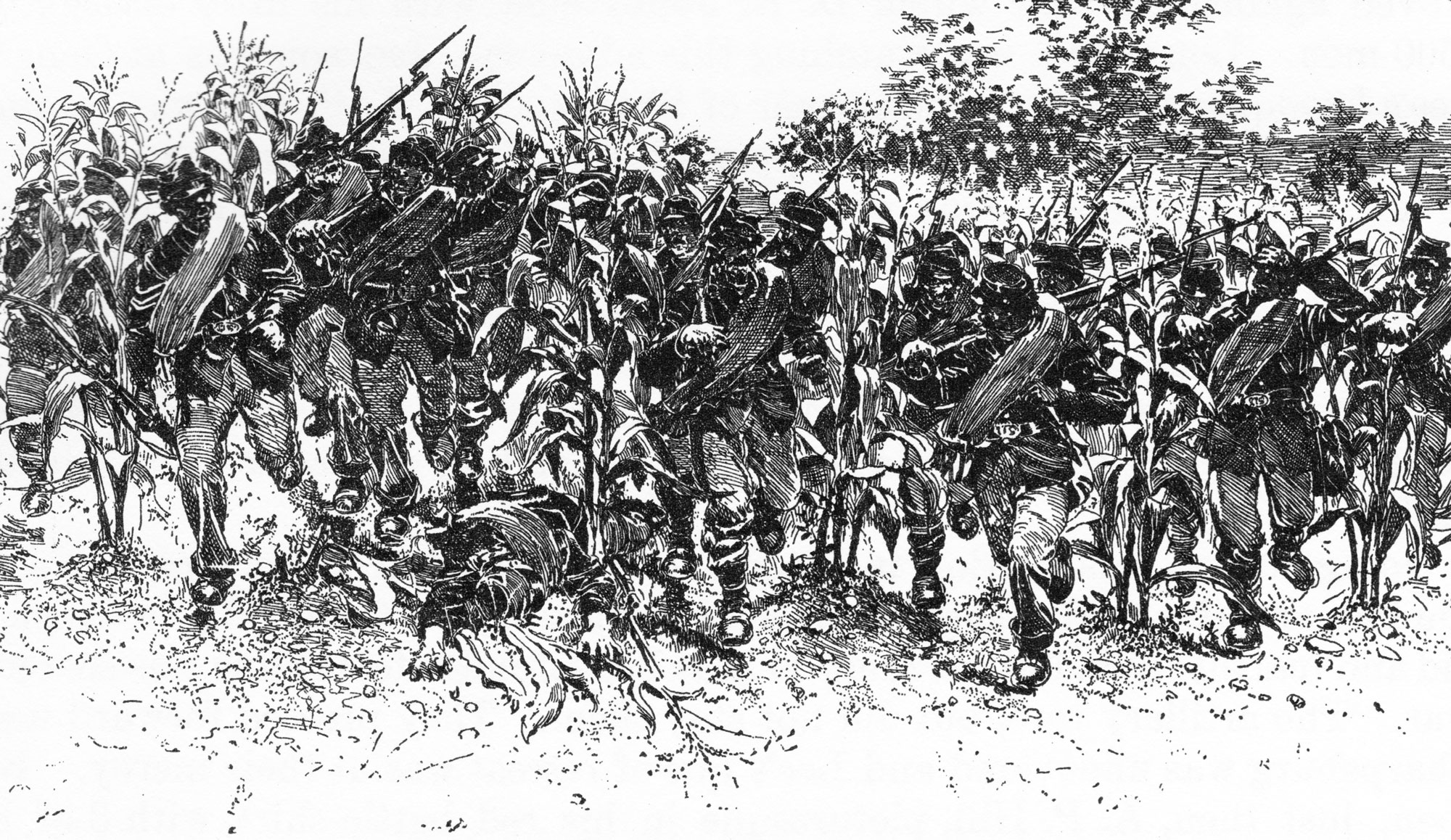 Battles and Leaders of the Civil War
At the Battle of Antietam, in Sharpsburg, Maryland, Shaw and the 2nd Massachusetts fought Confederates in the fields of David Miller’s farm. Above: A postwar depiction of Union soldiers advancing through Miller’s cornfield.
There was little opportunity to sleep. Overnight, the Third Brigade was marched roughly three miles across Antietam Creek and came to a rest in a wheat field. “Our pickets fired all night, and at daylight we were waked up by the artillery,” Shaw recalled.9
Lee’s army clung to undulating ridgelines west of Antietam Creek, his forces still dangerously divided and outnumbered. With Jackson’s corps racing north following the Union surrender at Harpers Ferry on September 15, Lee desperately needed time to reunite his scattered forces around Sharpsburg before McClellan could exploit the Confederate weakness. McClellan’s battle plan was simple—a simultaneous three-pronged assault that would prevent an outnumbered Lee from shifting reinforcements along his interior lines to threatened sectors—and promised a decisive victory if executed properly. McClellan was well aware that the Potomac River, located behind Lee’s position, eliminated any easy retreat options. Any significant Union breakthrough could trap and destroy the entire Army of Northern Virginia.
The battle that unfolded on September 17, 1862, eventually enveloped the entire area around Sharpsburg and turned the cornfields, apple orchards, and farm lanes red with blood; but for Shaw and his regiment, the battle occupied a small area of farmland north of town. At around 8 a.m., the 2nd Massachusetts received orders to march south along Hagerstown Pike as part of a broader movement involving two Union corps to gain a plateau around Dunker Church, the religious home of a group of German Baptist Brethren. Shaw’s regiment held the Third Brigade’s right flank, with the 3rd Wisconsin and 27th Indiana extending the line leftward. The 2nd Massachusetts moved briefly through David Miller’s apple orchard before advancing into his ripening cornfield to support the other regiments, whose casualties were mounting fast. Inside the corn rows, visibility dropped to mere yards as stalks higher than a man’s head created a maze of green tunnels. While Shaw could hear the Wisconsin and Indiana regiments being torn apart by Confederate volleys, he could see almost nothing through the dense crop. When Georgia and Alabama brigades counterattacked into the cornfield, the battle became a deadly game of cat and mouse.
For 30 minutes, Shaw and his men fought an invisible enemy in the agricultural labyrinth. Muzzle flashes erupted from corn rows without warning, men screamed and fell among the stalks, and officers shouted contradictory orders while trying to maintain unit cohesion in terrain that fragmented every formation.
The results were evident to Shaw as the regiment advanced through the cornfield. “It was full of their dead and wounded, and one of our sergeants took a regimental colour there, belonging to the Eleventh Mississippi,” he wrote. “Beyond the cornfield was a large open field, and such a mass of dead and wounded men, mostly Rebels, as were lying there, I never saw before; it was a terrible sight, and our men had to be very careful to avoid treading on them; many were mangled and torn to pieces by artillery, but most of them had been wounded by musketry fire.”10 Lieutenant Colonel Wilder Dwight eventually got hold of a captured Confederate banner and rode with it to cheers from along the line of the 2nd Massachusetts. Shaw’s friend and fellow officer Charles Morse recalled, “The whole field before [us] was literally covered with dead and dying.”11
Shaw watched his men stop to share their canteens with wounded Confederates and place them in “easy positions.” “There are so many young boys and old men among the Rebels,” he observed, “that it seems hardly possible that they can have come of their own accord to fight us, and it makes you pity them all the more, as they lie moaning on the field.”12
These feelings of sympathy quickly passed as the regiment was ordered to a position at the edge of an area known as the East Woods. As the 2nd Massachusetts shifted to its new position, Major General John Sedgwick’s division swept across their front to assault the nearby West Woods. “It was a grand sight,” Shaw recalled, “and they looked as if they couldn’t be repulsed.” “They were in three lines,” wrote Morse, “and looked splendidly.”13
Shortly thereafter, Sedgwick’s division “received … a most terrible musketry-fire, and finally had to fall back.” The Third Brigade was ordered to march toward Hagerstown Pike to support what Sedgwick believed to be friendly troops that had reentered the West Woods. Elements of the 2nd, along with the 13th New Jersey to their right, just south of the Miller cornfield, scaled the fences along the pike, but the site of the brigade’s colors caught the enemy’s attention. Instead of coming to the support of their comrades, Shaw and the rest of the Third Brigade had marched straight into Brigadier General Robert Ransom’s North Carolinians, who were lying in wait in the woods. A hail of Confederate bullets forced Shaw and the rest of the brigade to abandon their position. The 2nd Massachusetts’ Lieutenant John A. Fox later wrote how he watched “man after man fall dead or wounded, while we inflicted but little injury upon the enemy.”14 Morse was hit by a spent ball, which “laid me on my back for a moment, and raised a pretty black & blue spot.”15 At about this same time, Shaw too was struck by a “spent ball in the neck, which bruised, but didn’t break the skin.”16
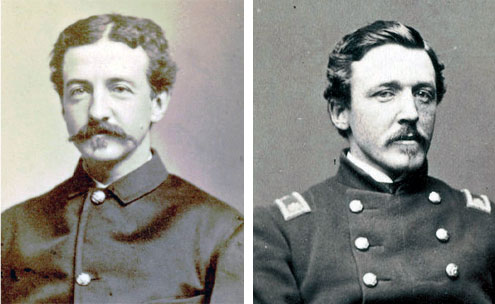 USAHEC (Fox); Medford Historical Society (Dwight)
John Fox (left) and Wilder Dwight
The scale and ferocity of the fighting in the first few hours could have constituted an entire battle unto itself, but it was just its first phase. By late morning the fighting shifted south around a farm trail that is remembered today as “The Bloody Lane.” Later in the afternoon, the Union’s IX Corps, under the command of Major General Ambrose Burnside, crossed a bridge that would eventually bear his name and advanced within sight of the town of Sharpsburg, only to be pushed back by the timely arrival of the balance of Lee’s army from Harpers Ferry. By day’s end, fewer than 12 hours of fighting had cost the Army of the Potomac over 12,000 killed, wounded, and missing, while the Confederate losses numbered roughly 10,000. Shaw later characterized the Battle of Antietam as “the greatest fight of the war,” and it remains the bloodiest day in American history.
As was the case following Cedar Mountain, Shaw experienced his own regiment’s lengthy casualty list—12 killed, 56 wounded, and 2 missing—through the loss of or injury to close friends. The growing tally now included Charles J. Mills, Francis W. Crowninshield, and James Francis, all of them wounded. The toughest loss for Shaw was Wilder Dwight, who fell during the regiment’s support of Sedgwick’s assault in the West Woods. Dwight had started the day writing to his mother, only to be interrupted by orders to advance. Following his fatal wounding, Dwight continued his now bloodstained letter: “Dearest mother, I am wounded so as to be helpless. Good bye if so it must be[.] I think I die in victory. God defend our country…. Give love to father & all my dear brothers.”17
Once darkness overtook the battlefield, Shaw noted that the “crickets chirped, and the frogs croaked, just as if nothing unusual had happened all day long, and presently the stars came out bright.” Morse and Shaw found a spot on the field to lay down to rest. They talked about their homes and families “among the thousands of dead about us.”18 Morse recalled that he and Shaw “slept within fifty feet of a pile of fourteen dead rebels, and in every direction about us they were lying thick.”19
Shaw awoke the next morning fully expecting the battle to continue. But orders to renew the attack never came, providing the Army of Northern Virginia the opportunity to recross the Potomac River later that evening. Lee’s uncontested withdrawal left Shaw perplexed. On the one hand, his confidence in McClellan’s leadership remained high. That the soldiers, Shaw asserted, “will fight under him better than under any one else, is proved by the difference between this battle and those about Manassas.” But he found it hard to believe that retaining “possession of the field” and allowing Lee’s army to leave “undisturbed” was all McClellan had “wanted.”20 In fact, control of the battlefield was all McClellan apparently needed to claim victory. Although Lee had failed to achieve all his goals for the campaign, he managed to refocus the seat of war away from Richmond; and although severely battered, his army remained intact. McClellan’s failure to pursue Lee allowed Confederates to gather stragglers, rest, and recross the Potomac to continue with offensive operations.
McClellan’s failure to pursue Lee also resulted in a widening of the gulf between Shaw and his family. Frank and Sarah Shaw had grown disgusted with McClellan’s Democratic politics and opposition to emancipation; they directly questioned their son about why his commander appeared to be incapable of destroying Lee’s retreating army. Shaw’s response revealed the length to which he would go to defend his commander. He dismissed his parents’ criticisms, falling back on familiar complaints about army discipline, citing the “thousands of stragglers between here and Alexandria” as evidence of Union weakness—one he still believed McClellan was well-suited to address. Shaw urged his mother to judge McClellan purely on his ability to “obey orders and carry out plans,” not on whether he was “inspired with the same faith in [abolitionist] principles that you have.” “If we have a man of military ability,” he asserted, “we have what we need.”21 Political convictions, moral commitments, and the war’s deeper purpose were irrelevant to Shaw as long as generals could deliver battlefield victories.
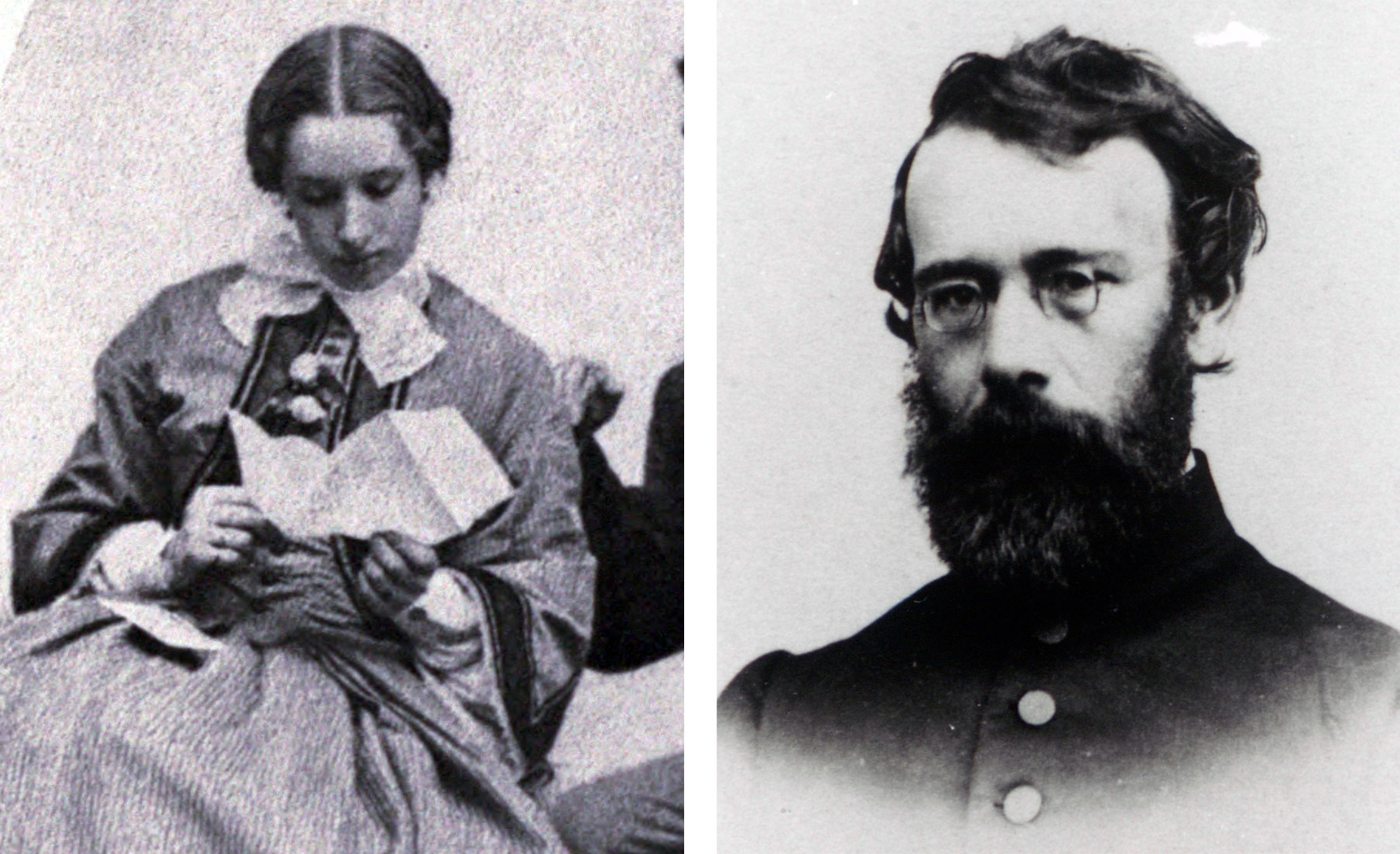 The Philanthropic Work of Josephine Shaw Lowell (1911) [Shaw]; USAHEC (Quint)
Josephine Shaw (left) and Alonzo Quint
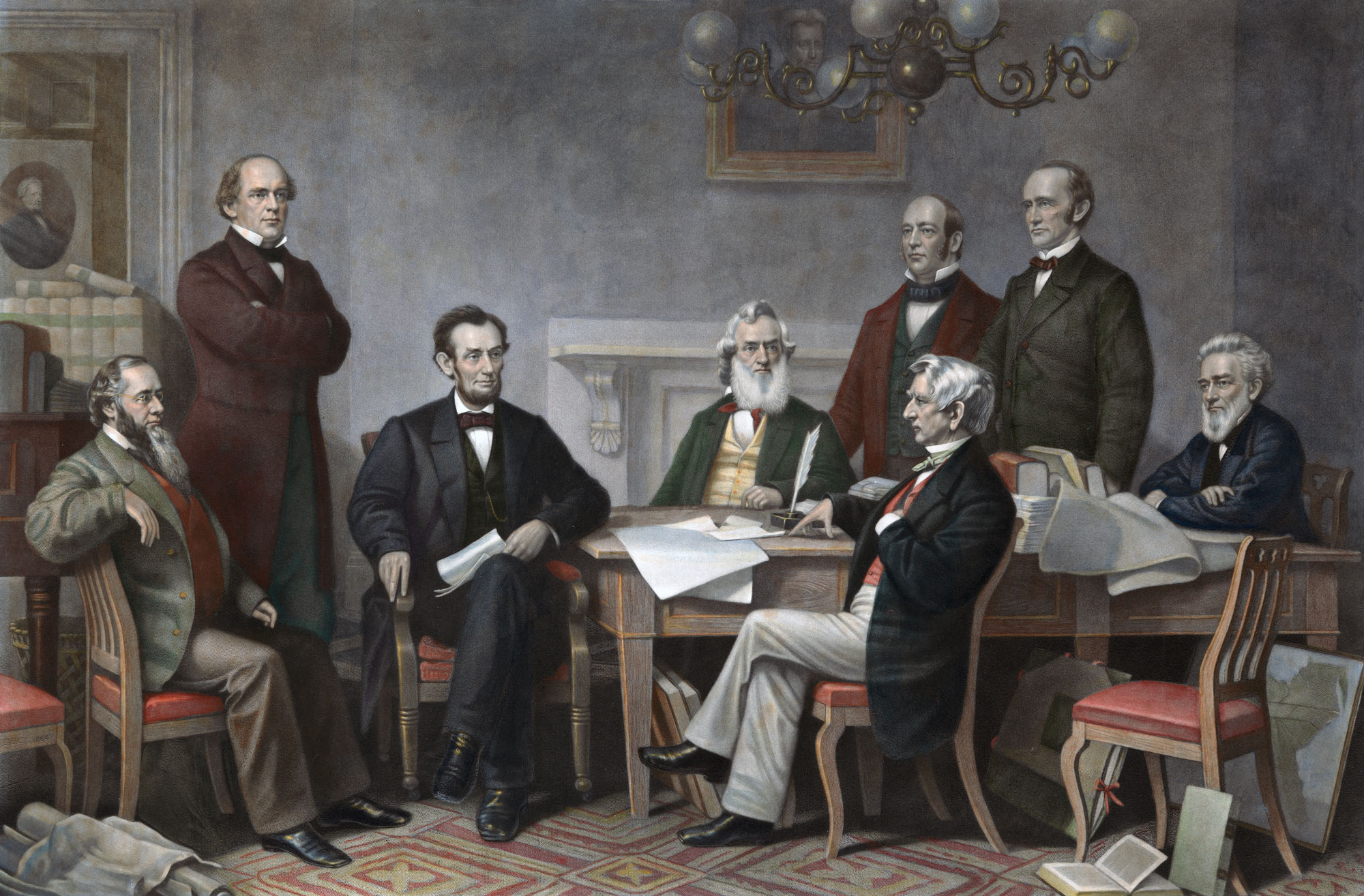
To his abolitionist parents, Shaw’s response to Lincoln’s September 22 issuance of the Preliminary Emancipation Proclamation raised clear questions. Lincoln had announced to his cabinet in July that he was planning to issue a proclamation that would give the Confederate states until the end of the year to conclude the rebellion and return to the Union. If they failed to do so, slaves (with a few exceptions) would be freed throughout the Confederacy—in areas not yet occupied by the Union army. Lincoln had agreed to wait for a military victory before announcing the new policy rather than risk looking politically desperate. Five days after Antietam, the proclamation was made public.
Though abolitionists like the Shaws lamented the fact that the proclamation would not be applied immediately—that it gave the rebelling states the opportunity to return to the Union with slavery largely intact; that it only applied to states still in rebellion; and, finally, that it reiterated support for the long-held conservative policies of compensation and colonization—the family was thrilled with the news. The proclamation, wrote Sarah to a correspondent overseas, “is in God’s providence that we shall never rest until Slavery is entirely destroyed, & that this is the first step towards it.”22 “God bless Abraham Lincoln,” Josephine wrote in her diary; but she also noted that her mother believed the proclamation did not go far enough.23
Robert, however, was much more skeptical about the proclamation’s likely impact. “For my part, I can’t see what practical good it can do now,” he said to his mother shortly after the news broke. “Wherever our army has been, there remain no slaves, and the Proclamation will not free them where we don’t go.” Just as concerning to him was the likely response of the Confederate government, which he believed would “issue a proclamation threatening to hang every prisoner they take”—black and white—and quickly turn the conflict into a “war of extermination.” As for the proclamation’s impact on the enslaved population, Shaw worried that their “condition … will not be ameliorated … if they are suspected of plotting insurrection, or trying to run away.” Shaw knew his response would disappoint his mother, so he was quick to reassure her that he believed Lincoln’s proclamation was “the right thing to do, but that, as a war measure, the evil will overbalance the good for the present.”24
 National Portrait Gallery
Whereas his family was thrilled that President Lincoln had issued a Preliminary Emancipation Proclamation days after Antietam, Shaw was skeptical of its impact. Above: Alexander Hay Ritchie’s 1866 painting depicts Lincoln reading the proclamation to his Cabinet.
In short, Shaw acknowledged the Emancipation Proclamation’s moral justification but remained fixated on strategic calculations rather than humanitarian imperatives. His primary concern was military efficiency. The question that ultimately mattered to him was whether emancipation would accelerate Union victory or prolong an already devastating conflict. Shaw’s pragmatic evaluation revealed how completely his soldier’s mind had trumped the moral considerations embraced by his civilian parents.
Shaw’s concerns about the proclamation were shared by many in the Union army, including his fellow officers in the 2nd Massachusetts. Initially, Morse maintained “that no change would be produced by” the proclamation; but he eventually admitted that Lincoln’s order was the “beginning of a great reform.” European nations would be less likely to officially recognize the Confederacy as an independent nation, Morse believed, while the Union army was likely to benefit from Confederate soldiers abandoning the army to protect their homes and families from “servile insurrection” that they believed would follow as news of the proclamation spread throughout the South.25 Earlier in the year, the 2nd’s regimental chaplain, Alonzo Quint, had opined that “if ‘general emancipation’ were now made the object of this war, I fully believe that our armies would melt away.” “Our men are fighting for the flag, not for the abolition of slavery,” he continued. “General emancipation would add untold horrors to what already has horrors enough—war.” Though the chaplain’s views eventually softened—“The more I see, the more I believe in the feasibility of emancipation,” he later wrote—he maintained that any such measure would be accompanied by numerous “obstacles.”26
Frank and Sarah Shaw should not have been surprised by their son’s position. He had never expressed much interest in the welfare of escaped slaves when his regiment was stationed in the Shenandoah Valley, nor did he ever explicitly state that he believed the war was being fought primarily to end slavery. Shaw’s focus from the beginning of his enlistment had been on preparing himself and his men for battle, defeating the Confederacy, and, in the process, advancing his own prospects through promotion. Though the fighting at Antietam had resulted in a Union victory, there was no indication that the war was any closer to being over. Shaw had no doubt that more fighting was in his future and, perhaps more importantly, he understood the war could still be lost.
 Heritage Auctions
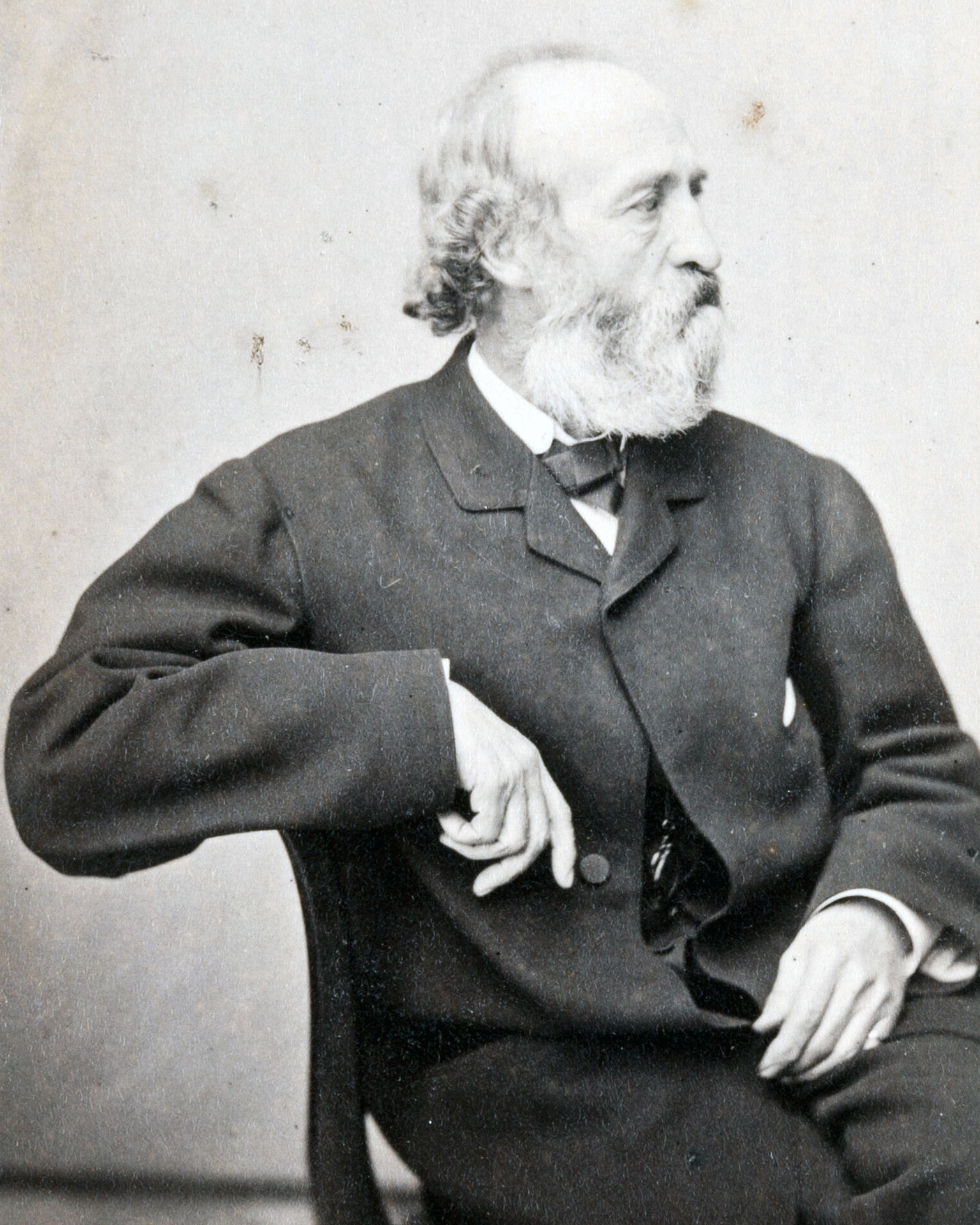
 Shaw attempted to explain his stand on military emancipation to his family, as he did whenever their views diverged, which was not rare. “You must have thought, from my late letters, that I was degenerating sadly from the principles in which I was brought up,” he wrote to his mother, Sarah, in October 1862. Above: Robert’s father, Frank Shaw.
In an attempt to reassure his mother, Shaw in mid-October again tried to explain his position on Lincoln’s proclamation. “You must have thought, from my late letters, that I was degenerating sadly from the principles in which I was brought up; but an ordinary mortal must be somewhat affected by his surroundings, and events which you look at in one way from a distance, often seem very different when you are in the midst of them. The man at a distance is more apt to be impartial.”27 Shaw pleaded for his mother’s understanding, insisting that he had not abandoned the antislavery principles taught to him as a child, but that from his perspective it was anything but clear on how best to prosecute the war and bring it to a successful conclusion. He wanted his mother to appreciate the confusion, uncertainty, and mortal danger that clouded every military decision.
More than anything, Shaw wanted his parents to cease discussing the president’s proclamation with him, and he characterized as “sensible” McClellan’s “order cautioning officers and soldiers to refrain from discussion of the President’s acts.”28 In a letter written at the end of October, Shaw pleaded with Josephine to refrain from “making any more remarks on the conduct of the War.” The “subject is one, of which I am heartily sick.”29
 Heritage Auctions (Shaw); USAHEC (Morse)
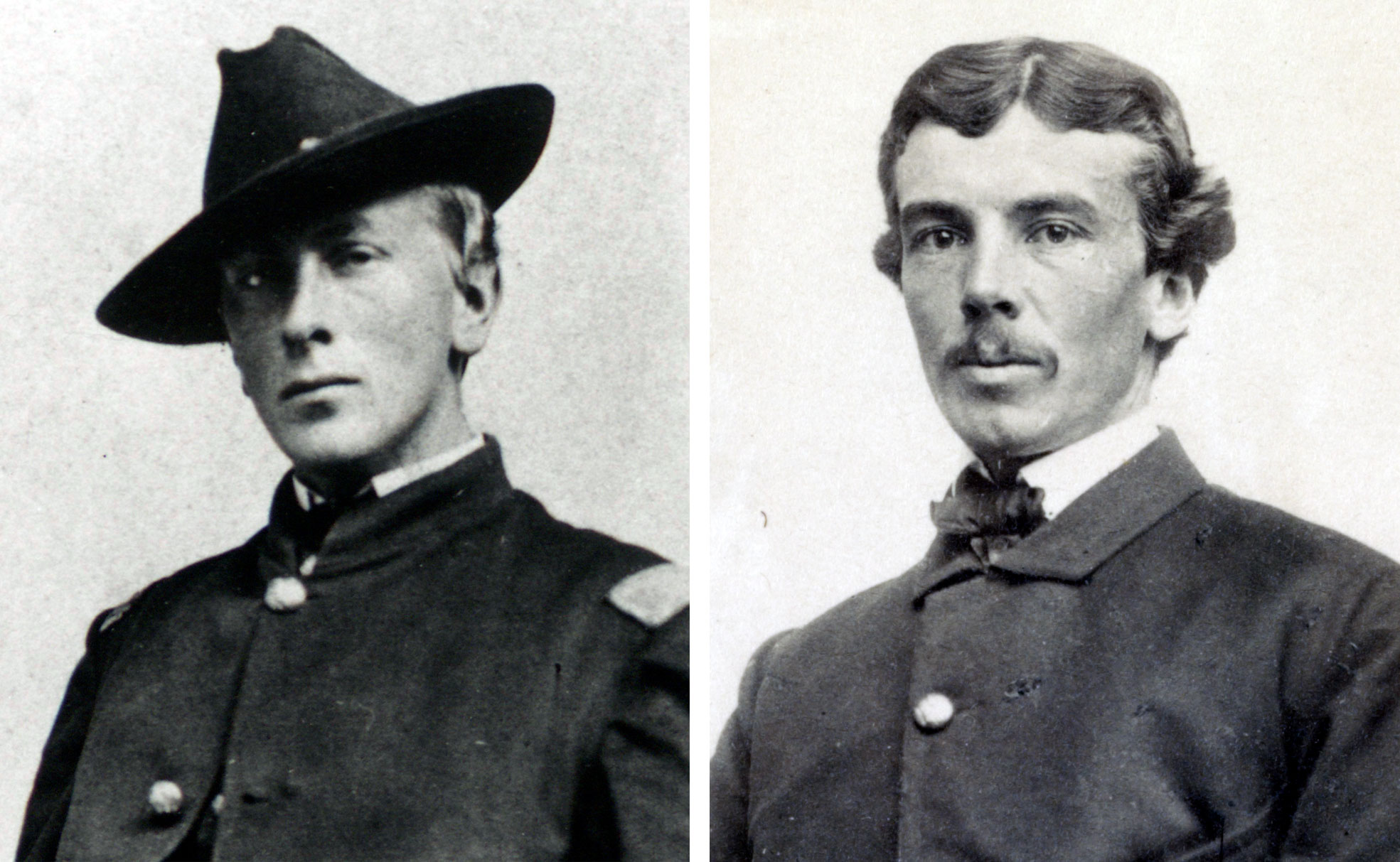
Charles Morse (left) and Charles Russell Lowell
A few days after Antietam, the 2nd Massachusetts was ordered to take up a new position at South Mountain, near Harpers Ferry. The once familiar and picturesque landscape now looked desolate; Shaw noted how the “trees had all been cut down and the old paths obliterated” by the recent movement of armies.30 The new encampment took them away from the work of treating the thousands of wounded—and burying the dead—in and around Sharpsburg. Shaw, along with Morse and a few other officers, organized a mess and managed to find a “good cook, who can make a good coffee … can cook eggs in any way very nicely, and can also make pies and pudding, to roast and broil a stew is child’s play for him.”31 Shaw used the lull to catch up on paperwork and the drilling of new recruits.
News that Lincoln removed McClellan from command the day after the congressional midterm elections on November 4 was welcome in the Shaw home; but throughout the Army of the Potomac there was little confidence in his replacement, Ambrose Burnside. Still, concerns on the home front that the Army of the Potomac’s rank and file would fight only under McClellan were quickly dispelled. Quint, the 2nd’s regimental chaplain, responded that such notions were “perfectly foolish.” “Our men fight for their country, not for a man.”32 Shaw would have agreed, yet he failed to see what Burnside had “ever done to merit the position.”33 The change in command, along with deteriorating weather, convinced Shaw that the army’s post-Antietam inactivity would continue indefinitely.
Shaw began considering—not for the first time—a transfer out of the regiment. He had long been on the lookout for a command, and related responsibility, befitting his elevated class. In early October Shaw had been offered and rejected a position on the staff of his former tutor Frank Barlow, now a brigadier general and rising star in the Army of the Potomac. More enticing was the prospect of joining a cavalry unit being organized in Massachusetts, something Shaw had heard about through his cousin John Murray Forbes. Another friend, Charles Russell Lowell, was purportedly going to command the unit, with Caspar Crowninshield (Shaw’s former Harvard roommate currently in the 1st Massachusetts Cavalry) serving as its major. Life in the cavalry would present a number of challenges, given Shaw’s lack of experience in such a unit, but his biggest consideration was rank. Promoted to captain after Antietam, Shaw was now one of the more experienced officers in the 2nd Massachusetts and was unwilling to “accept any position below that of 4th Captain” in a new unit, something he doubted the new cavalry regiment could “guarantee … to me.”34
The return to the regiment of a familiar face, Shaw’s friend Harry Russell, who had been confined at Richmond’s Libby Prison after his capture at Cedar Mountain, made his decision to stay put much easier. Even though many friends had been wounded or killed, Shaw was still attached to the 2nd. “A man is or should be very loath to leave a regiment in which he has gone through as much as we have in this,” he explained to his sister. “I have had a great many discontented moments, when I have thought I wanted to change, but when it came to deciding, I never went—Excepting on to Gordon’s staff & then I was delighted to be back.”35
The regiment’s celebration of its second Thanksgiving away from home proved to be a “very quiet affair” due to the absence of “so many faces.” Shaw could not help but reflect on the fates of his friends. “It is very strange and unfortunate,” he observed, “that the officers that have been killed were the very best we had, both as comrades and as military men…. No doubt, after a man is dead his virtues only are remembered, but in our case the dead ones really were the best.”36 Shaw’s melancholy was magnified by a lingering concern that their deaths would ultimately prove to be in vain, given the continued inaction of the Army of the Potomac and the broader state of military affairs.
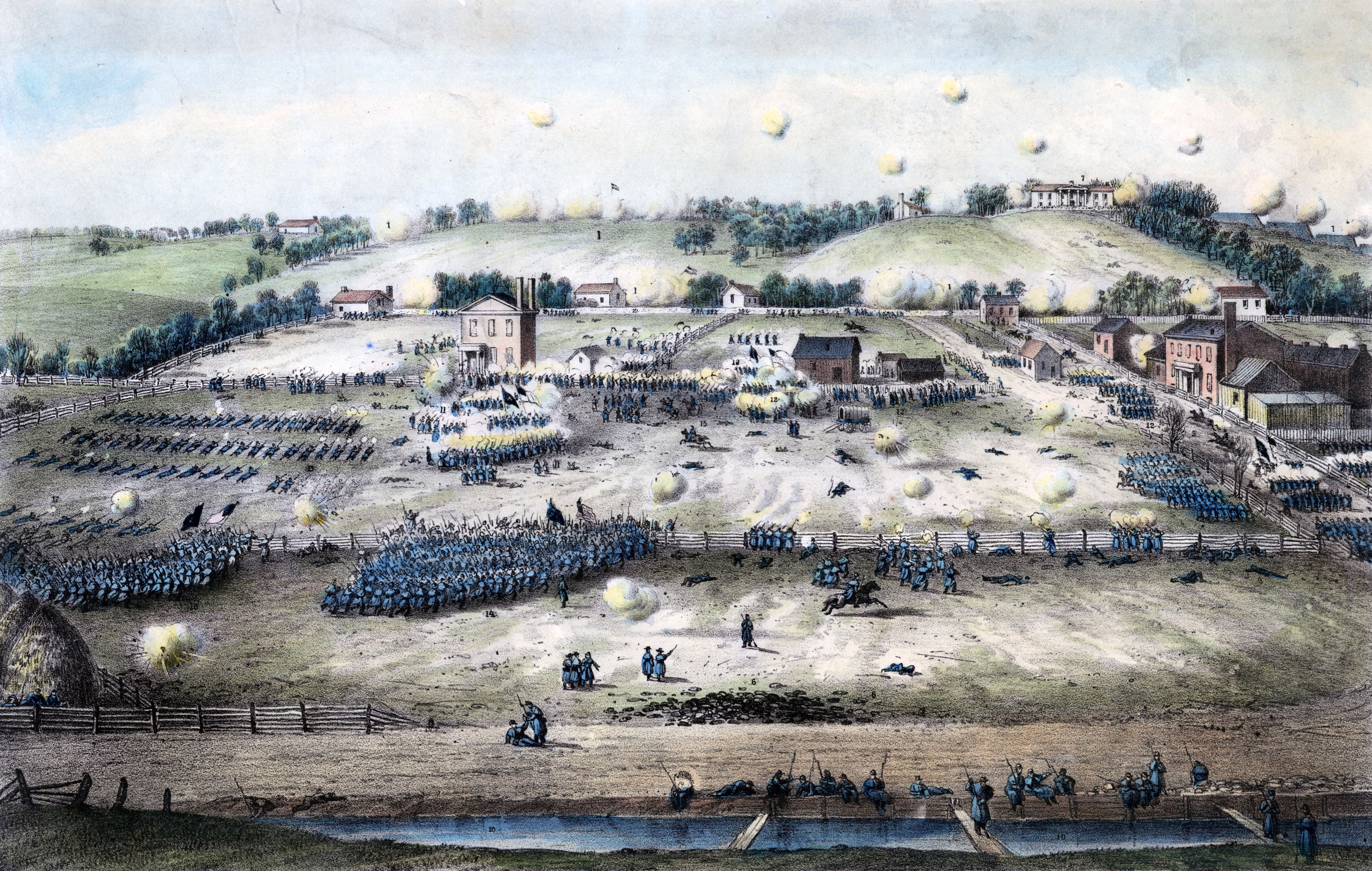
Shaw’s skepticism about Burnside’s qualifications were proven all too true, when on December 13 the new commander launched wave after wave of assaults against prepared Confederate positions overlooking the town of Fredericksburg along the Rappahannock River. By battle’s end, the Army of the Potomac had suffered roughly 12,500 casualties, the Confederates roughly half that number, with little gained for Burnside.37 Shaw learned of the defeat while encamped 45 miles north of Fredericksburg at Fairfax Station with much of the rest of the XII Corps, which had been sent there and held in reserve. The 2nd Massachusetts had left their comfortable winter quarters to face “some very hard weather” that included “rain, snow, and cold” with little more than their tents and a couple of blankets that Shaw and Russell fastened together to stay warm.38 Shaw likely worried about his friends in the 20th Massachusetts Infantry, which had taken part in the street fighting in Fredericksburg on December 12 before joining the failed main assault the following day.
But it was the loss of his cousin Theodore Parkman days later, on December 16—the result of friendly fire during a skirmish at Whitehall, North Carolina—that hit Shaw hardest. “It must be all chance; for if he had lived,” Shaw believed, “he would probably have done more good in the world than I ever shall.”39
There was little more Shaw could say about his cousin’s loss in a minor, inconsequential fight other than to acknowledge that it was a “terrible thing that so many lives should have been lost for nothing.”40 Shaw was feeling disillusioned as 1862 came to a close. He had witnessed too many military setbacks and mourned the loss of too many friends. In a letter to his sister on December 23—about a week before the Emancipation Proclamation was to take effect—Shaw expressed his frustrations with the war’s lack of progress:
They say that “Uncle Abe” is on the verge of lunacy. I don’t wonder at it. I am afraid now there is a danger of the government backing down. I had rather stay here all my life (though in this case, I should pray for a short one) than give up to the South. The most satisfactory ending to me, would be to have them brought to their knees, and then kicked out, and allowed to set up for themselves within certain limits. I would have them hemmed in on all sides by free States, and not allowed a chance of extending.41
 Anne S.K. Brown Military Collection
A wartime depiction of the December 1862 Battle of Fredericksburg
Shaw must have known that his parents would read or at least hear about the content of this letter. After reassuring his mother that he had not abandoned his abolitionist principles, the question of emancipation appeared to be of little concern to him as the year came to an end. Shaw was willing to see the war end with a defeated, but independent, Confederacy left to govern itself with slavery still largely intact. His conviction that slavery could be contained by a cordon of free states harkened back to a position embraced by many Republicans before the war; to people like his parents, however, such a view represented a surrender of principles. Perhaps Shaw recognized that his was an untenable position, and perhaps he was simply using the opportunity to vent his frustrations.
The previous 12 months had been transformative for Robert Gould Shaw and the rest of the nation. Through it all, Shaw struggled to come to terms with the shifting landscape of the conflict. He had experienced the chaos and violence of battle, and although he stood the test well, he mourned the loss of friends whose comradeship he had relied on for support. He had witnessed thousands of African Americans flock to the Union army along the roads and pathways of Virginia’s Shenandoah Valley, forcing Republicans in Congress to approve policies that gradually eroded the institution of slavery. Lincoln’s Preliminary Emancipation Proclamation moved the issue to the center of the nation’s wartime agenda, but it also widened the significant gulf between Shaw and his parents over how the war should be conducted. The war would assume a revolutionary character in the new year, one that would continue to undermine the institution of slavery, in part, through the recruitment of African Americans into the Union army. The only question that remained was whether, and how, Shaw would embrace achieving these new wartime goals.
Kevin M. Levin is the author of numerous books and articles on the Civil War, including Searching for Black Confederates: The Civil War’s Most Persistent Myth. This article is based on his latest book, A Glorious Cause: The Life and Legacy of Colonel Robert Gould Shaw. You can find Levin at Civil War Memory.
Notes
1. Robert Gould Shaw (RGS) to Sarah Blake Shaw (SBS), August 12, 1862, in Russell Duncan ed., Blue Eyed Child of Fortune (Athens, 1992), 230. Hereafter cited as BECF.
2. RGS to SBS, August 12, 1862, BECF, 231.
3. RGS to Annie Haggerty Shaw (AHS), August 13, 1862, BECF, 235.
4. RGS to Frank Shaw (FS), August 29, 1862, BECF, 237.
5. RGS to FS, August 29, 1862, BECF, 238.
6. RGS to SBS, August 30, 1861, BECF, 132.
7. Gregory J. Acken ed., Through Blood and Fire: Selected Civil War Papers of Major General Joshua Chamberlain (Kent, OH, 2023), 37.
8. RGS to FS, September 21, 1862, BECF, 240.
9. RGS to FS, September 21, 1862, BECF, 240.
10. RGS to FS, September 21, 1862, BECF, 240. On the fighting in this sector of the battlefield, see Scott Hartwig, I Dread the Thought of the Place: The Battle of Antietam and the End of the Maryland Campaign (Baltimore, 2023), 182–87, 194–98.
11. Charles Morse to Mother, September 21, 1862, Charles F. Morse Papers, Massachusetts Historical Society (MHS).
12. RGS to FS, September 21, 1862, BECF, 240.
13. Charles Morse to Mother, September 21, 1862, Charles F. Morse Papers, MHS.
14. John A. Fox to Dear Ones at Home, September 21, 1862, Massachusetts Spy (Boston), July 30, 1862.
15. Charles Morse to Mother, September 21 and September 22, 1862, Charles F. Morse Papers, MHS.
16. RGS to FS, September 21, 1862, BECF, 241. On the fighting in the West Woods, see Hartwig, I Dread the Thought of the Place, 281–292.
17. Wilder Dwight to Elizabeth A. Dwight, September 17, 1862, Theodore F. Dwight Papers, MHS.
18. RGS to SBS, September 25, 1862, BECF, 247.
19. Charles Morse to Mother, September 22, 1862, Charles F. Morse Papers, MHS.
20. RGS to FS, September 21, 1862, BECF, 242.
21. RGS to SBS, October 14, 1862, BECF, 253.
22. SBS to John Elliot Cairnes, October 16, 1862, in Adelaide Weinberg, John Elliot Cairnes and the American Civil War: A Study in Anglo-American Relations (London, 1969), 147.
23. William R. Stewart, The Philanthropic Work of Josephine Shaw Lowell (New York, 1911), 34.
24. RGS to SBS, September 25, 1862, BECF, 245.
25. Charles Morse to Father, October 6, 1862, Charles F. Morse Papers, MHS.
26. Alonzo Hall Quint, The Potomac and the Rapidan: Army Notes, from the Failure at Winchester to the Reenforcements of Rosecrans (Boston, 1864), 48, 170. On reactions in the Army of the Potomac to Lincoln’s preliminary proclamation, see Zachary A. Fry, Republic in the Ranks: Loyalty and Dissent in the Army of the Potomac (Chapel Hill, 2020), 49–50; Hartwig, I Dread the Thought of the Place, 733–738.
27. RGS to SBS, October 14, 1862, BECF, 254.
28. RGS to Josephine Shaw Lowell (JSL), October 13, 1862, Shaw Family Correspondence, New York Public Library.
29. RGS to JSL, November 21, 1862, BECF, 260.
30. Lyman Richard Comey, ed., A Legacy of Valor: The Memoirs and Letters of Captain Henry Newton Comey, 2nd Massachusetts Infantry (Knoxville, 2004), 78.
31. Charles Morse to Father, September 26, 1862, Charles F. Morse Papers, MHS.
32. Quint, Potomac and the Rapidan, 223.
33. RGS to FS, November 13, 1862, BECF, 255. On reactions in the Army of the Potomac to McClellan’s removal from command, see Fry, Republic in the Ranks, 59–65; Hartwig, I Dread the Thought of the Place, 774–778.
34. RGS to SBS, November 17, 1862, BECF, 257.
35. RGS to JSL, November 21, 1862, BECF, 259.
36. RGS to AHS, November 28, 1862, BECF, 263.
37. On the fighting at Fredericksburg, see George C. Rable, Fredericksburg! Fredericksburg! (Chapel Hill, 2002).
38. RGS to FS, December 18, 1862, BECF, 266.
39. RGS to SBS, December 30, 1862, BECF, 273.
40. RGS to AHS, December 18, 1862, BECF, 267.
41. RGS to JSL, December 23, 1862, BECF, 271–272.
Related topics: emancipation