Ellsworth’s blood-spattered jacket and pants displayed alongside other relics at the Metropolitan Fair’s Arms and Trophies Room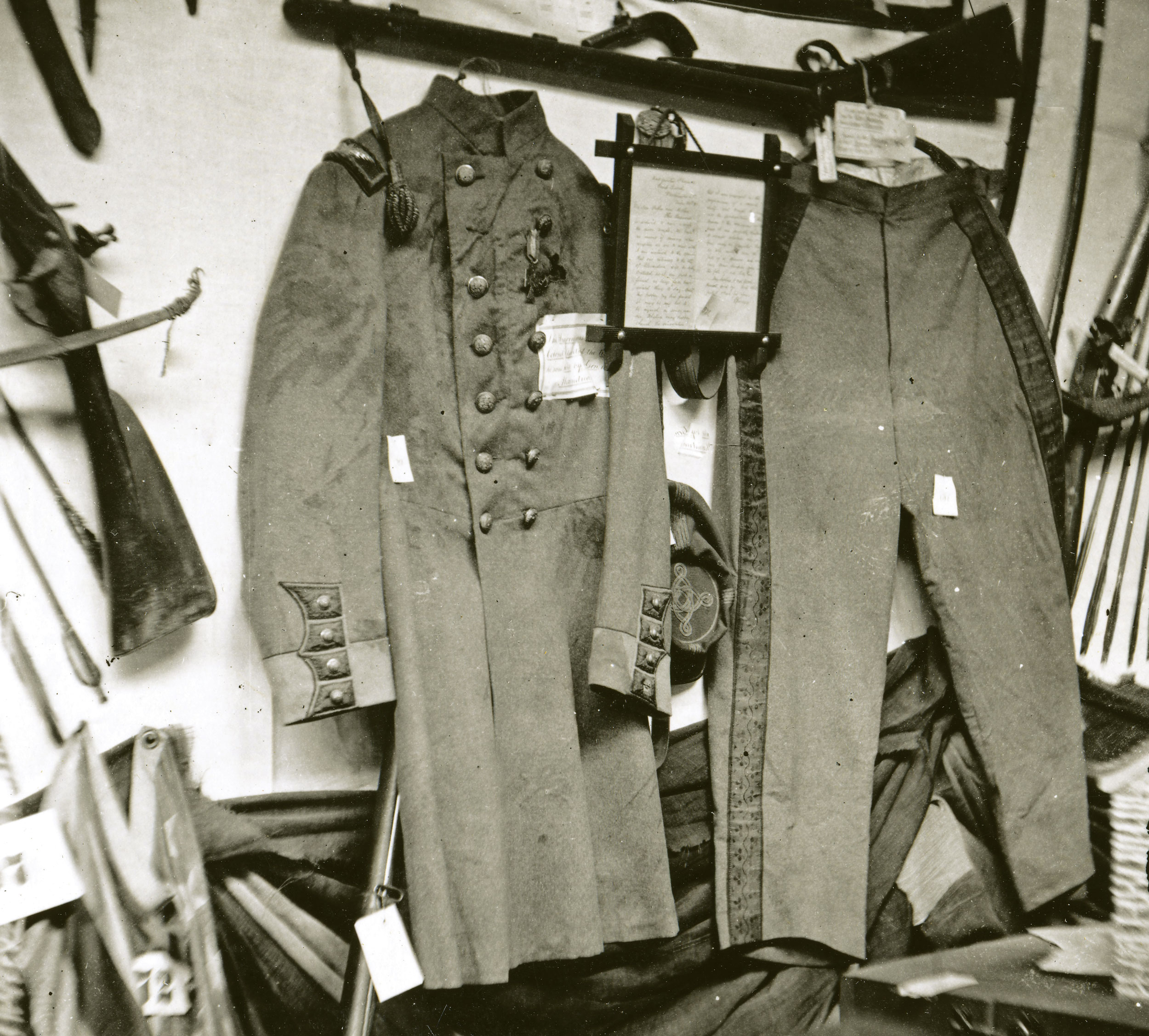 National Archives 111-B-5353
The blood-spattered uniform of Colonel Elmer E. Ellsworth, the first Union officer to die in the Civil War, was one of the most gripping sights amid a vast conglomeration of war relics on display in the “Arms and Trophies Room” of the Metropolitan Fair. The exhibition, held at Union Square in New York City on April 4–23, 1864, was a fundraiser for the U.S. Sanitary Commission. Modeled after a Sanitary Fair held in Chicago in the fall of 1863, the New York event was a great success, raising more than $1 million to benefit the organization in its efforts to help wounded and sick Union soldiers.
As was the custom for museum exhibitions in the mid-19th century, the items on display—including an array of guns, swords, and captured battle flags, along with Ellsworth’s jacket and pants—were all crammed together on a wall. Ellsworth, the 24-year-old commander of the 11th New York Infantry, known as the “Fire Zouaves” because its ranks were mostly filled with New York City firemen, was shot to death by innkeeper James Jackson after removing a large Confederate flag from the roof of the Marshall House in Alexandria, Virginia, on May 24, 1861, the day after Virginia seceded from the Union. Ellsworth had been Abraham Lincoln’s law clerk in Springfield, Illinois, in 1860, and the president had his body brought to the White House, where it lay in state in the East Room before being taken to New York. Ellsworth soon achieved martyrdom, and the phrase “Remember Ellsworth” became a rallying cry throughout the North.
Bob Zeller is president of the nonprofit Center for Civil War Photography, which is devoted to collecting, preserving, and digitizing Civil War images.