 Courtesy Brigadier General (Ret.) John W. Mountcastle
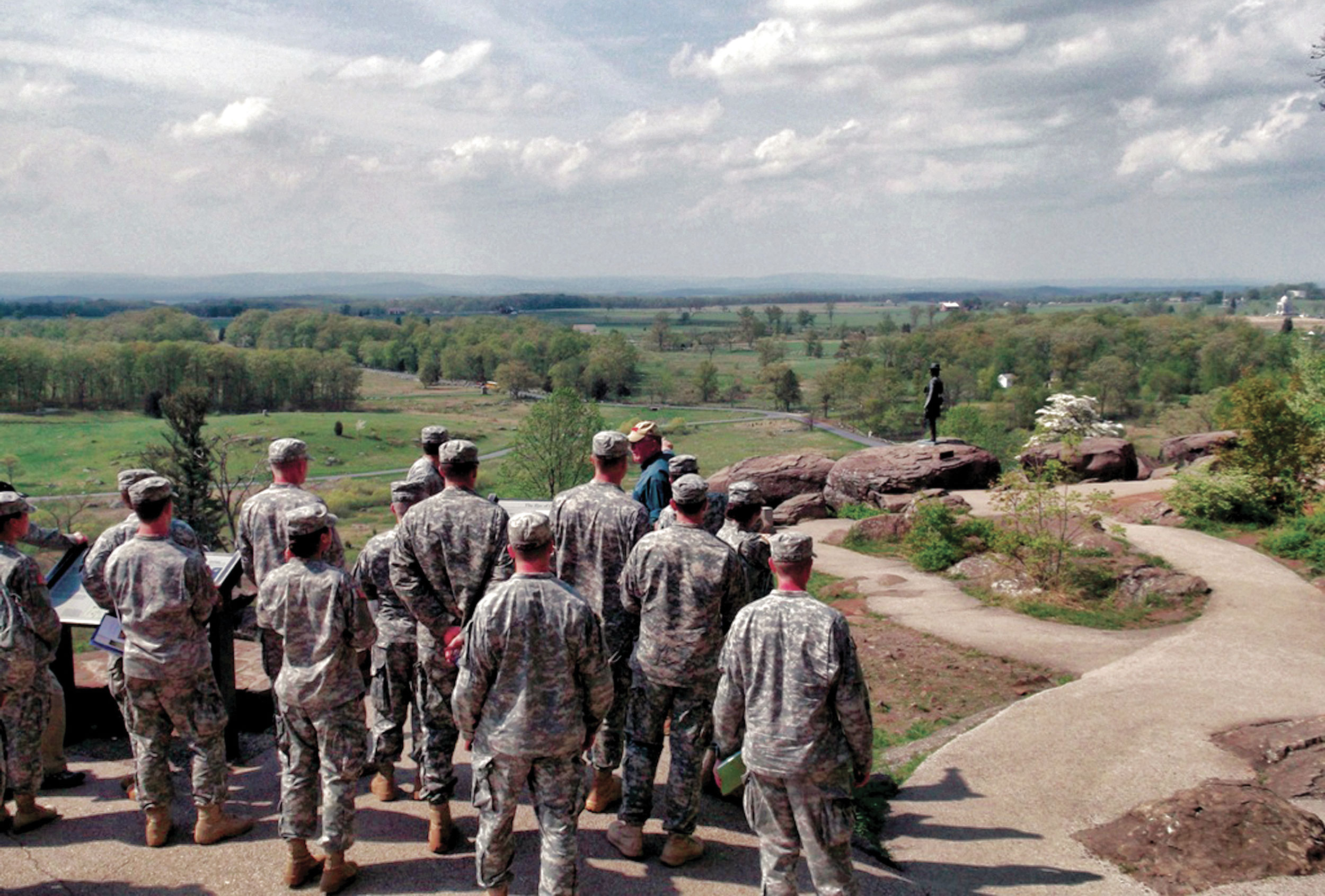
Cadets from the United States Military Academy at West Point take in the view from Little Round Top during a staff ride at the Gettysburg Battlefield.
It was a beautiful day with minimal cloud cover and a gentle breeze. The group surrounding me was attentive, hands grasping their newly acquired maps. Their aides hovered behind them, just in earshot, phones at the ready. I had just told them about the valiant charges of the Federal II Corps against the Sunken Road at Antietam and the equally valorous but ultimately unsuccessful Confederate defense. I was about to launch into a “so what?” discussion when the chairman of the Joint Chiefs of Staff leaned toward me and looked at the embroidered slogan on my tennis shirt.
“It depends,” he said, reading the italicized script. “Well, it sure as hell does,” he added. There were snickers and nods from the group, and a sidebar conversation between two other generals broke out.
“That’s my seminar’s motto at the Army War College,” I offered. “The students understand that nothing is ever really an easy answer in war. There are always variables that affect a decision and, in turn, are affected by that decision. One must think hard about everything, much as you gentlemen do every day.”
There were more nods and asides, and the chairman puckered his lips into a slight grin.
“The problem here on September 17, 1862, was that McClellan thought too much about all those variables, and lost what Clausewitz calls the coup d’oeil moment,” I continued. “The third and final Union charge against this position, where we are standing now, broke through the Confederate line, flanked it, and poured fire down the length of what would become known as Bloody Lane. Reinforcements were called for but were not sent. The center of Robert E. Lee’s line was pierced and he had no intact, nearby units to plug the hole. McClellan could’ve won it here but hesitated—and the second great contingency point in this battle came and went.” I paused, trying not to be overwhelmed by the moment. Here, gathered on the Antietam Battlefield about a decade ago, were all the Joint Chiefs of Staff—our nation’s highest ranking military officers—and most of the geographic commandant commanders. And they were listening to me.
It was a high honor. Historians in the U.S. Department of Defense dream of such experiences, and some never get them, even after decades of service. I was lucky: A student I had taught at the U.S. Army Command and General Staff College ended up on the chairman’s staff and recommended me when the chairman asked who could lead a “ride” at Antietam. A staff ride is an experiential visit to a battlefield in which participants are led on a focused evaluation of historical decision-making at all levels of war, on the ground where those decisions were made, to gain valuable insights on the nature of war and leadership. They are not “tours,” but we do walk the terrain and think about what happened on it. I had been leading staff rides for over five years when I was offered this opportunity.
I took a deep breath and asked my first question. “If you had been the Union commanding general at that moment and knew what he knew, which as we discussed was not a lot, but saw this breakthrough happen, what would you have done?” This was the key historical query for this stand, or stop, of the staff ride. Somebody answered: “Order in enough troops to secure and exploit this position, but keep enough reserves in hand until I knew what I was up against.”
I parried with a follow-up: “What about all those unknown masses of Rebels who could be hidden behind the Piper field and in Sharpsburg itself?”
The reply: “I’d find out pretty fast if they were there, and their numbers, by advancing a recon in force from here.” More nods, grunts of agreement, and one of the principals stepped away to confer with his aide. I queried the group if they thought that was a good idea, and if other options theoretically beckoned. Other participants jumped in then, proffering would-be decisions for Army of the Potomac commander George B. McClellan:
Hold the Sunken Road with the remnants of the II Corps and some of the VI Corps and stop there; ride down to see IX Corps commander Ambrose Burnside and push him to move immediately in his sector while the enemy was still reeling from this rupture; or, as Little Mac decided, do very little indeed. The generals started to discuss with each other, rather than focus on me. The chairman turned around and joined them.
I smiled. This was exactly what I hoped for. With staff riders this senior in rank, one never knows how they might react to open-ended Socratic questions, especially on a day when they were preoccupied with bad news from the Middle East. “What does McClellan’s actual decision-making tell us about the role of intelligence in war, and how it influences the timing of events?” I asked after they started to quiet down.
A general to my right answered immediately, “It’s the key to everything. If you have weak or inadequate intel, you can’t do a darn thing, or you can’t do it with any assurance of success.”
“As all of you know, we can’t ever have complete, perfect intel,” I added. “So how do we—how do you, as our country’s senior-most military leaders—mitigate this reality?” I was taking a chance, uncertain as I was about their feelings on the recent issue or whether they’d think this was a simple question about current technological capabilities, one that was beneath their rank. But it was the best way to start connecting this segment of the battle to the modern-day realities besetting our armed forces. Had the chairman not asked about the “It depends” on my shirt, I would have arrived at this point eventually, but in modern military staff rides, one goes with the flow of conversation, molding and framing the discussion toward a culmination point containing insights for today’s leaders. No stand ever goes exactly the same, regardless of how many times you’ve led it, and the insights gleaned at the Sunken Road might be different from those considered by other groups at this same spot. The keys to leading a good staff ride, besides a strong working knowledge of the battlefield, are flexibility and knowing your group.
The chairman replied to my question with something like this: “We have to build good relationships with each other, with other officers at every rank, to help build trust in each other’s judgment.” His answer encapsulated the purpose of this particular staff ride: building trust among his immediate subordinates to better create a team of teams. Many organizations in the Department of Defense and the federal government engage in staff rides for that very reason. Learning about Civil War history as a group, outside on the field, is always a better day than one spent in office cubicles in Washington. But a good staff ride, led by a strong facilitator, should offer participants much more. It should help them gel as colleagues working for a common goal; inform them that the basic essence of any problem they face is, actually, not all that new; provide clear insights from the past that inform (not predetermine) their decision-making; and make them think hard about the nature of war and its unchanging features, like chance, fog, and friction, that afflicted Lee and McClellan and still affect modern military leaders.
It was a wonderful moment. For a small while, no one said anything, and then I broke the silence with an observation about the famed Irish Brigade’s decimation in the field in front of us and the ensuing destruction of the organization a few months later at Fredericksburg. Combined with the issuance of the preliminary Emancipation Proclamation and the sacking of their beloved Little Mac within weeks of the fight at Antietam, the Irish of the North, nearly all Democrats, starting losing faith in the Union war effort, transforming this battlefield event into a policy-level headache for President Abraham Lincoln. My group was especially interested because this demonstrated a truism that most of them had experienced: The levels of war often conflate at particular moments, in which tactical-level events can and do affect strategy and policy. When I asked if they had undergone anything similar, a lot of heads bobbed up and down. Then I asked a tough question, one we historians in professional military education cherish: “What does this sequence of events tell us about the stream of time?”
I got a lot of blank looks, which I expected. Sometimes one must bring up uncomfortable topics to intensify learning and synthesis. Whether to keep pressing depends on the group: their education, preparation, or experience (all groups are asked to read a few key documents beforehand to familiarize themselves with the campaign), and whether they’re tired or sun-drenched from the day’s weather. I took the measure of this group and went for the hard closer.
“When you study history to gain value for modern strategic thinking, as all of you do,” I said, “you can’t help but notice that an historical decision made earlier in time—upstream, if you will—directly or indirectly influences what decisions will even exist, let alone be brought to the fore, later on or downstream.” I waited a few seconds, then asked if that sounded like modern doctrine.
“Branches and sequels,” a general to my left blurted. “Second- and third-order effects!” another quickly replied. A few more responses, and it was clear everyone got the message. They all knew the answer, but it was my job to remind them that decisions made on this bloody field, many years ago, were not that different from the ones they make every day. Leaders must choose among options, but they must think hard before doing so, as every decision has consequences and births new issues to grapple with. When lives are on the line, they must think about the stream of time. In the end, that observation probably resonated more than any other that day.
“OK, Gentlemen, on to our next stand, Burnside’s Bridge!” I called and started walking back to our minibus. I turned my head on the way and noticed the chairman deep in thought, still looking out at the field. “Victory,” I thought, as I smiled to myself.
Christian B. Keller is Professor of History and the General Dwight D. Eisenhower Chair of National Security at the U.S. Army War College. Besides leading staff rides and teaching military strategy and theory, he is the author or co-author of five books on the Civil War, including the forthcoming The Great Partnership: Robert E. Lee, Stonewall Jackson, and the Fate of the Confederacy (Pegasus Books, July 2019).