 Library of Congress
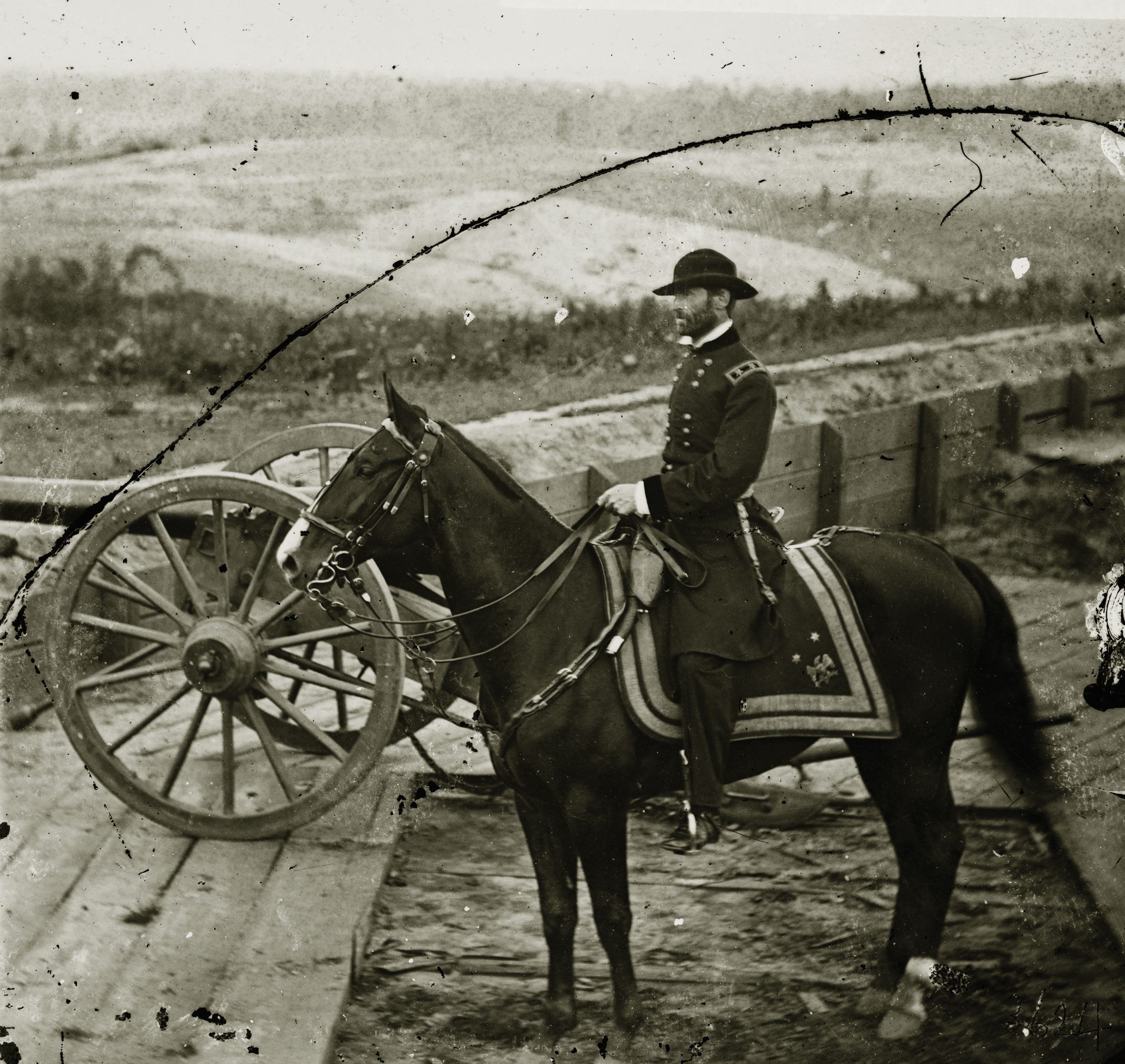
Major General William T. Sherman poses for the camera shortly after the fall of Atlanta in one of the myriad U.S. fortifications that enveloped the vital southern city.
On November 17, 1864, residents of Princeton, Illinois, awakened to a stunning headline: Major General William Tecumseh Sherman had “destroyed Atlanta and the railroad leading to…Chattanooga.” Now he was marching eastward, blared the Bureau County Republican, “in the direction of the Atlantic coast, intending to strike probably Savannah or Charleston.” The newspaper’s editor hinted that the information had come to him through “private sources,” because General Sherman desired that the march, and particularly its geographic objective, remain secret. Nonetheless, the Republican forecast a brilliant victory—especially given who was traveling with him. Sherman’s soldiers were tough Midwesterners—“the very flower of his army, 40,000 strong.”1 Most Bureau County Republican readers were Illinois farmers and staunch Midwestern patriots; many had sent their sons to fight in the war’s western theater.
Many historians have described the fear, anger, or desperate courage of those who found themselves in the path of Sherman’s armies during their campaign through Georgia. But the northern home front’s response to the march—as it was unfolding—has remained unexplored. In fact, newspapers like the Republican kept their readers closely informed of the progress of Sherman’s men, and their editors’ reports and opinions, both positive and negative, reveal a great deal about the North’s enduring political divisions and the changing American ideas on the subject of warfare against civilians.
Newspaper clipping of Sherman’s march.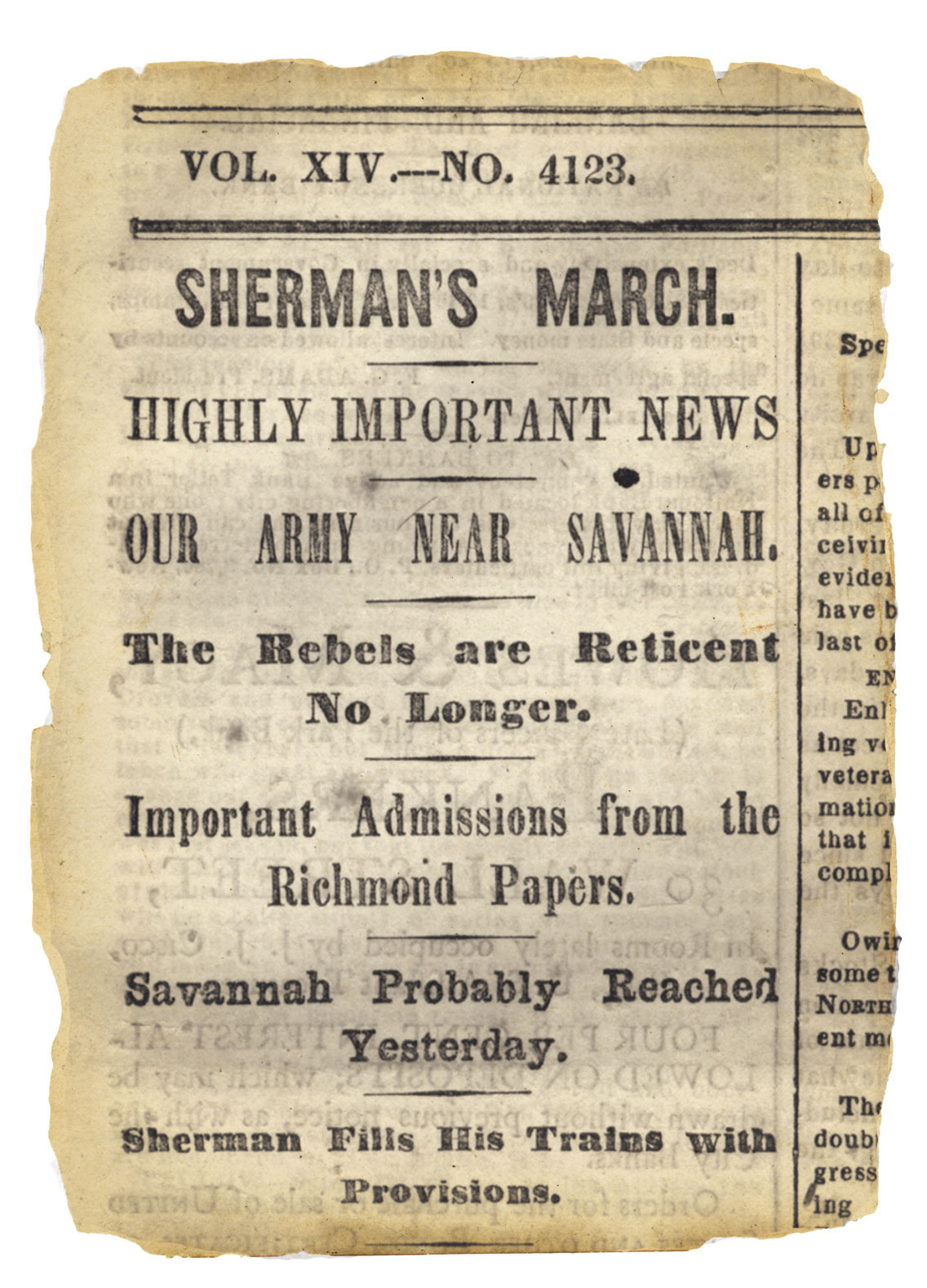 Library of Congress
I. The March
The seeds of Sherman’s march were planted in the spring of 1864, when Lieutenant General Ulysses S. Grant, recently given command of the entire U.S. Army by President Lincoln, headed east to craft a strategy to end the war. While Grant confronted Robert E. Lee in Virginia, Sherman, his friend and trusted subordinate in whose hands he had left command of the western armies, was to advance upon Atlanta. Under orders from Grant to “get into the interior of the enemy’s country as far as you can, inflicting all the damage you can against their War resources,” Sherman pushed steadily into Georgia with overwhelming force, nearly 100,000 soldiers in all, during the early months of summer. By August, he had Atlanta in a stranglehold, and on September 2, after Sherman’s men had successfully cut off its vital railroad connections with the rest of the South, the Confederate army that defended it had little choice but to evacuate, leaving the city to U.S. forces.2
 Library of Congress
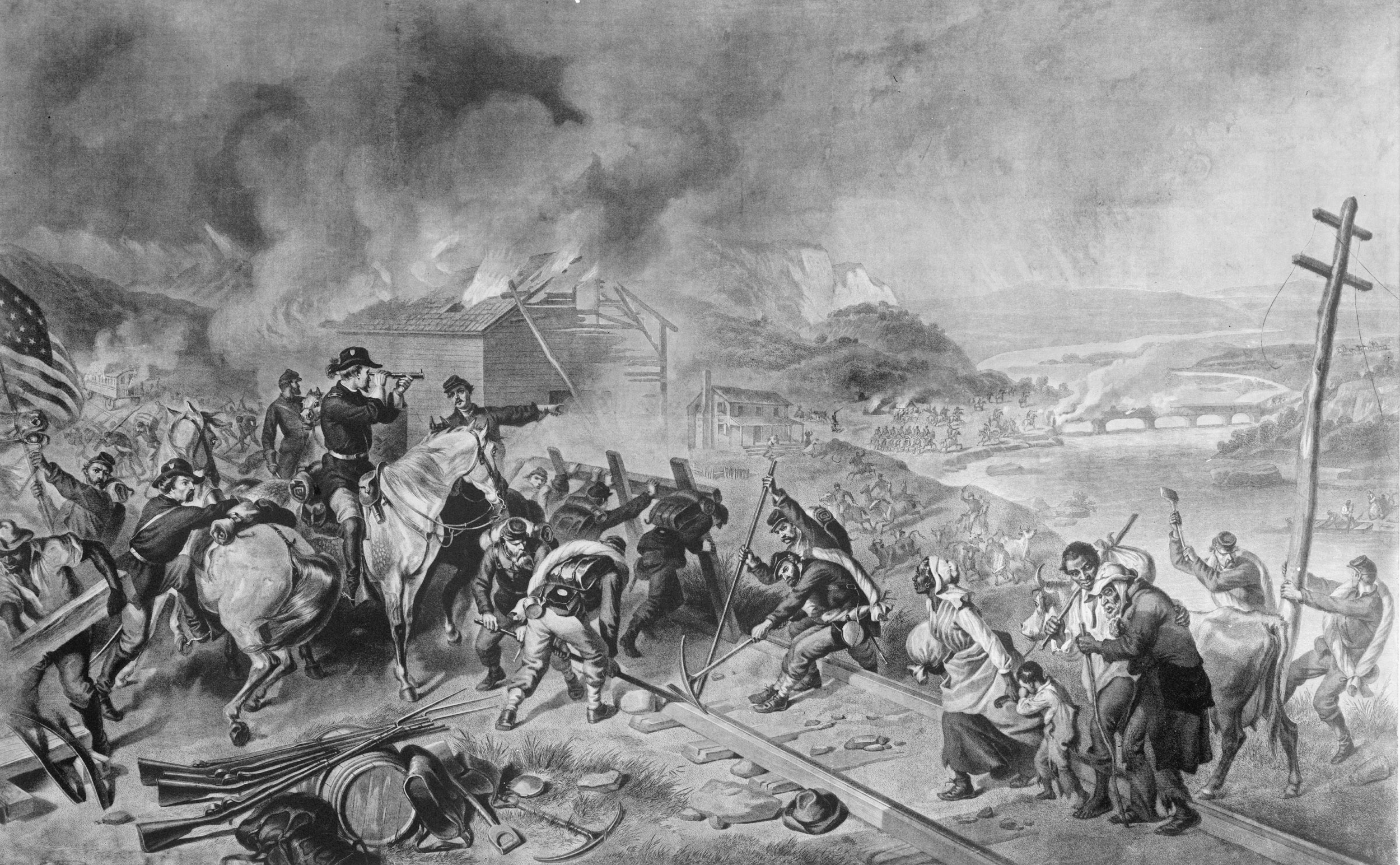
U.S. soldiers wreak havoc on the Georgia countryside in this 1883 lithograph of the march.
After evacuating Atlanta’s residents and ordering the city’s arsenals, factories, and public buildings burned, Sherman pondered his next move. While the Rebel army that had fled Atlanta was still at large, Sherman decided not to pursue with his full force. Instead, he requested that Grant permit him to march the bulk of his army, some 62,000 men, through the heart of Georgia to the seacoast. While risky, the potential benefits of such a move, Sherman argued, were significant. Not only could Sherman “divide the Confederacy in two,” cutting the lines of supply and reinforcements to Lee, who at the time was fighting Grant to a stalemate in Virginia, but he might also deliver a significant psychological blow to southern civilians by demonstrating that their government could not protect from an invading enemy army. Or, as Sherman put it in a letter to one of his generals, “I propose to demonstrate the vulnerability of the South, and make its inhabitants feel that war and individual ruin are synonymous terms.”3
On November 15, after cutting his lines of communication with Washington, Sherman departed Atlanta and began the southeasterly advance toward Savannah. He intended for his army to travel as lightly and quickly as possible. Anything that might slow their progress—heavy artillery, extra supply wagons, and miscellaneous noncombatants—was left behind. Packed with only 20 days’ rations on their backs, his soldiers would live off the land, foraging liberally for necessary provisions throughout the surrounding countryside. As Sherman outlined in his marching orders, while his troops were not allowed to enter “the dwellings of the inhabitants, or commit any trespass,” they were permitted to take various foodstuffs (with the caveat that families be left with sufficient victuals to survive) as well as horses, mules, and wagons. Sherman also authorized his corps commanders to order the destruction of mills, houses, and cotton gins, except in areas where the army was “unmolested.” Yet wherever guerrillas or bushwhackers hindered the march, or where inhabitants burned bridges or obstructed roads, or “otherwise manifest[ed] local hostility,” U.S. officers were to “order and enforce a devastation more or less relentless according to the measure of such hostility.”4
As it turned out, Sherman faced little serious resistance. Indeed, Confederate commanders in Georgia could scrape together only about 13,000 troops—many of them old men and young boys—to oppose the swiftly moving U.S. columns. In eight days, Sherman’s men reached the state capital, Milledgeville; about three weeks later, in mid-December, they arrived at the outskirts of Savannah, which surrendered without bloodshed on the 22nd.
 Library of Congress
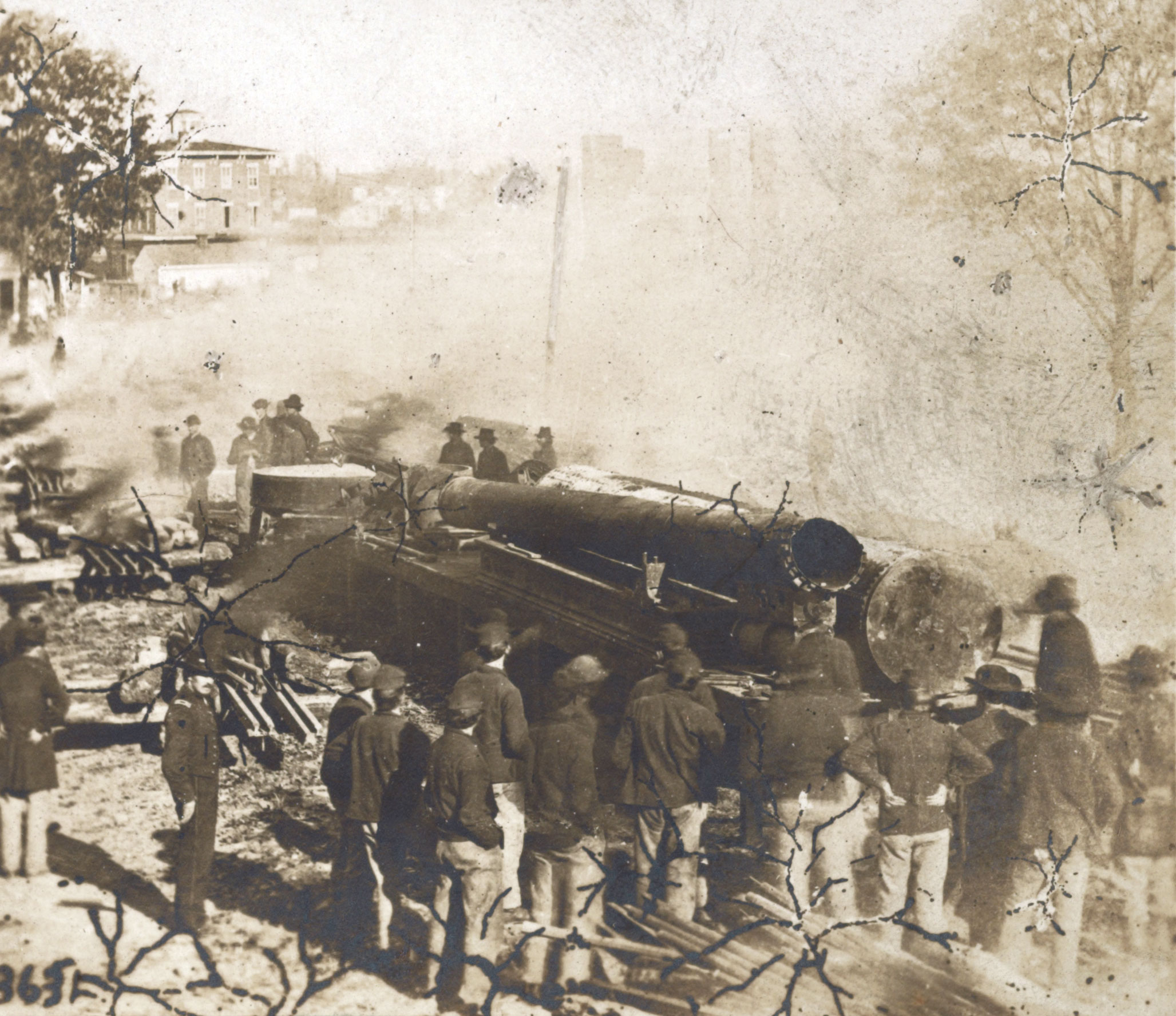
Sherman’s men destroy railroad track en route to Savannah.
The march had been an unmitigated success. Swiftly and efficiently, Sherman’s army had cut a nearly 60-mile-wide field of destruction through the heart of Georgia, demolishing railroads, burning public and private buildings, and stripping the countryside of most of its livestock and crops along the way. Beyond its material impact, the march had, as Sherman intended, also wreaked emotional havoc on the local populace. Southern newspapers like the Richmond Enquirer, which at first delighted in the news that U.S. forces had left Atlanta for the coast, falsely interpreting the move as a sign of enemy defeat, soon began receiving disturbing reports from Georgia. Descriptions of the widespread pillage and destruction being inflicted by Sherman’s men, including rumors of brutality against women, soon filled the southern press, helping fuel the sense of panic and helplessness that gripped the Georgians in Sherman’s path and negatively impacting southern morale.5
II. Reporting Sherman’s March in the North
Beginning in late November, stories about the march began making their way into northern newspapers, whose editors pieced together information about Sherman’s whereabouts and activities from a variety of sources. Official reports by recently relieved or furloughed U.S. officers provided a number of assorted details, as did interviews with newly secured Rebel prisoners and deserters. On November 30, for example, the Cincinnati Enquirer printed the words of freshly captured Confederate general Roger A. Pryor, who had reportedly remarked that “the South now regarded Gen. Sherman with more alarm than any other officer in the service of the United States.”6 Similarly, the Daily Illinois State Journal noted on December 13 that a group of imprisoned Confederate deserters told U. S. soldiers that they had heard “that Sherman was only a short distance from Savannah, and that he was halting there waiting for the concentration of his various columns.”7 And Sherman had indeed reached the outskirts of Savannah by then.
But northern newspapers relied most heavily on their southern counterparts for information about the march. Or, as the editor of the Scioto (Ohio) Gazette put it on November 29, “[A]ll our information about [Sherman] must come through rebel sources.”8 Southern newspaper reports, which usually contained accurate details on Sherman’s movements, normally took a week to reach northern editors, who reproduced them carefully in their own publications. As a result, northern papers were able to report with accuracy that Sherman’s men had clashed with enemy forces at Griswoldville on November 22, had captured Milledgeville the following day, and were heading in the direction of Savannah in mid-December. These reports and headlines were frequent enough—at least as to Sherman’s position and direction—that the northern public knew, in essence, where Sherman’s columns were and how they were faring.
What the newspaper reporters and editors did not know—at least until early December—was where Sherman’s army was going, and why. “This is the first instance of an army lost during this war,” declared the Cleveland Plain Dealer on November 17. “No one knows where sherman has gone or what he has gone after. All is speculation.” In trying to make sense of it all, northern editors frequently betrayed their political allegiances. Republican editors—men who generally supported the ongoing U.S. war effort—reported news of Sherman’s early successes triumphantly, praising the U.S. troops involved as hard-bitten warriors and expressing little sympathy for the southern civilians in their path. “Audacity is undoubtedly necessary to success in war,” wrote a Republican editor in Ohio in mid-November. “[B]ut this movement of sherman is one of the boldest on record—[he should be] able to break the backbone of the rebellion, this time certain.”9 Some Democratic editors, while generally distrustful of the administration and dissatisfied with the war effort, also found positive things to say in response to these early reports. Even though he wrote on November 10 that the “story that Sherman has burned Atlanta and [is] marching upon Charleston, South Carolina is not believed,” the editor of the Cincinnati Examiner nevertheless thought the prospect of Sherman’s success in Georgia was “highly encouraging.” Similarly, the ultra-conservative and at times nearly pro-southern Chicago Times proclaimed toward month’s end that the “panic created both in Georgia and South Carolina by the march of the irresistible conqueror is something which has no parallel during the war.”10
As more details came in about the march, however, some Democratic papers began adopting a much less charitable tone. Editors of the Chicago Times, for example, soon revived their old questions about Sherman’s mental stability. (Earlier in the war, both Sherman and Grant had battled ugly rumors published widely in northern papers: Grant that he was an alcoholic, and Sherman that he was “crazy.” These reports resulted in a permanent feud between Sherman and the press, which is why Sherman regularly expelled reporters from his armies and once even court-martialed a civilian reporter who had dared to criticize him.) On December 2, the Times worried that “while Sherman is no doubt steadily advancing across the state of Georgia, in full accordance with the programme which he prepared for himself before leaving Atlanta…we might consider his course very erratic.” In spite of—or, perhaps because of—this rather strong hint about Sherman’s sanity, the paper also described him as elusive and unfathomable: “His army is omnipresent, and then again it is nowhere. It is here, there, and everywhere, stretching its terrific lines across the state, and soon it has vanished entirely.”11
The political leanings of northern editors were nowhere more apparent than in their reporting of the conduct of Sherman’s men. News that Sherman’s foragers were terrifying southern civilians—“creating an intense and widespread panic,” as an editor in Baltimore put it—caused many Democratic editors to express grave doubts about the ethics of the march.12 Newspapers like The Cincinnati Enquirer, whose editor harbored sympathies with the southern cause and had come out against Lincoln in the recent presidential election, devoted much space to highlighting what was portrayed as unnecessary aggression on the part of U.S. soldiers. In a typical report on December 10, the Enquirer focused on the destruction of civilian property wrought by Sherman’s men:
No farm [on the road to Milledgeville] and, as far as we can hear, towards Atlanta, escaped these brutal savages. The country below here to the Oconee river road was strewn with the debris of their progress—dead horses, cows, sheep, hogs, chickens, corn, wheat, cotton, books, paper, broken vehicles, coffee mills, and fragments of nearly every species of property that adorned the beautiful farms of this country, strew the wayside as monuments of the meanness, rapacity, and hypocrisy of the people who boast that they are not robbers and do not interfere with private property.”13
Other Democratic editors viewed the march similarly, many of them worried that Sherman’s scorched-earth policy would only serve to embitter southern civilians and therefore make it more difficult to reunite the nation later on. The purpose of Sherman’s march was not to end the war, but rather to “make a wilderness and to call it peace,” concluded the editor of the Columbus (Ohio) Crisis.14
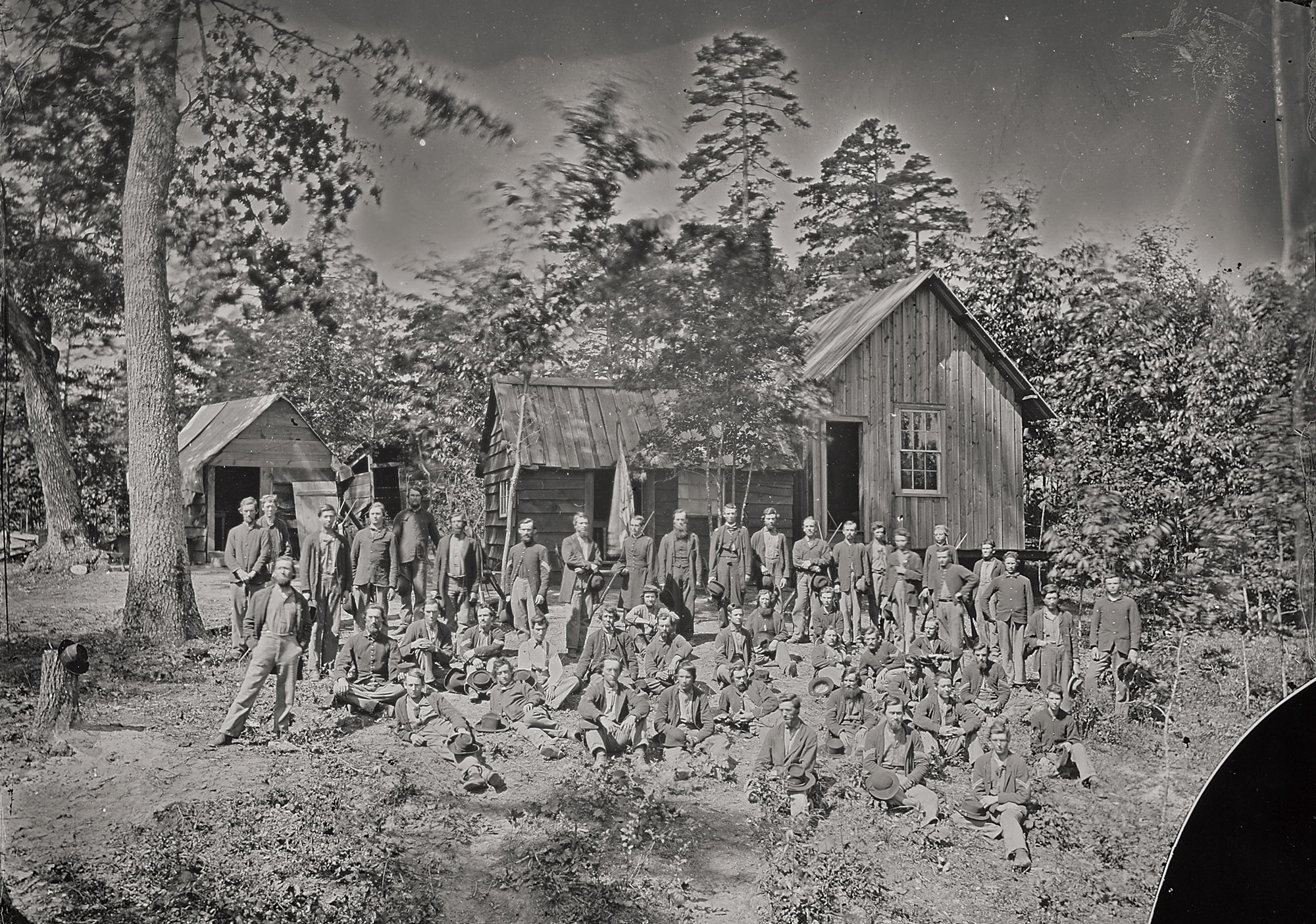 National Archives
These soldiers—members of the 21st Michigan Infantry—were part of the veteran army with which Sherman made the March to the Sea.
Sherman—and, by extension, the administration’s war effort—also took criticism from Democratic editors for other reasons. On November 23, the Albany Atlas condemned Sherman bitterly, but not because his men were harming southern civilians. “He has left a bloody track and marked his line of march in the blaze of conflagration,” noted the editor, who lamented only that the destruction had negatively impacted Sherman’s own men and supplies. “The blood of his own soldiers has flowed as freely as that of the enemy,” bemoaned the Atlas, “and the torch which has devastated the country has consumed his own source of supplies.” If anything, Sherman’s activities were to be disparaged because they were too fleeting: “He has swept through the country like a prairie fire, as terrible but as transient.” Still, the Atlas conceded that Sherman’s march would be judged from the result, and it joined Republican newspapers in admiring Sherman’s “boldness and originality.”15
Much more than their Democratic counterparts, the North’s Republican editors appeared generally willing to excuse Sherman’s men any excesses they might have been committing on the march. Some newspapers, like The New York Times, justified Sherman’s heavy hand in Georgia as an acceptable means to a satisfactory—and speedy—end to the conflict. While the march might “leave a track of desolation and ruin,” the Times wrote, “humanity in war demands that it should be short and severe.”16 Others reveled in what appeared to be the incompetent defense of the Rebels’ territory. In Iowa, the Burlington Weekly Hawk-Eye mocked the Georgia civil and military officials who, out of desperation, resorted to issuing “fierce and feverish proclamations calling in every male, old and young, able to shoulder a musket to immediately report for duty.”17
Republican editors saved their strongest opinions for those southerners who found themselves in Sherman’s path. Rebel citizens were to be held responsible for their loyalties to the Confederacy, such editors explained, especially if they in any way supported the guerrilla fighters who harassed Sherman’s army along its path to the sea. In short, even the severest punishment meted out to those who supported the war against the Union should be considered right and just. Speaking of Sherman’s foraging policy, and the impact it was having throughout the Georgia countryside, an Iowa editorial published shortly after U.S. forces had arrived at the outskirts of Savannah described the order as a “singular example of moderation in enforcing the severities of war, in circumstances which might excuse the most pitiless exactions.” Foraging was nothing more than the “ordinary method of supplying troops during their progress through a hostile district.” Indeed, according to the editor, Sherman displayed “an unwonted solicitude for those who deserve as Rebels no tenderness at his hands by requiring…foraging parties to leave…subsistence enough for the families from whom they take their supplies of grain.” Moreover, because guerrillas constituted a “predatory force, without organization and without means of subsistence except such as are furnished by those who sympathize with them,” then those who supported guerrillas ought to be decimated.18
Still, Republican newspapers certainly recognized that civilian populations would suffer during such a campaign, and that it would be harder to reconstruct the nation after war’s end if southern noncombatants were deprived of food and the means of livelihood. In December, an editorial in The New York Times acknowledged the destruction being wreaked by Sherman’s soldiers and the likely consequences for civilians. The march, its author made clear, was not to be “viewed merely as a raid.” Because Georgia was the “granary for the Confederacy, destroying its harvests would cripple Lee’s army in the coming winter. Carrying off cattle and horses would lame the transporting power of the rebel Confederacy.” At the same time, the writer recognized that a “destructive invasion of this kind” would create a “vast number of new enemies. Every man robbed and stripped by the tempest of destruction now sweeping thro’ Georgia, is henceforth a hundred-fold more bitter hater of the North and the Union than ever before.” It would be just as if Robert E. Lee and his Confederate army were to sweep the banks of the Hudson River, leaving nothing but “blackened homesteads and wasted farms” in their wake. To be sure, in civil warfare, there was a “certain limit, beyond which, if you injure a man, nothing is left but hate and despair.” Even so, he concluded, those were the “necessary evils of war… . The sole and the grand importance of the invasion of Sherman we hold to be its military aim.”19
After more than three years of bitter conflict, it is hardly surprising that a pro-administration paper would take such a sharp line toward non-combatants. According to Republicans, destroying the southern home front’s ability to feed and supply the Rebel armies was of paramount importance, regardless of the physical or psychological consequences for southern civilians. This tough line only hardened toward the end of November, when reports about the horrific conditions at Andersonville prison began reaching the North. Contempt for Georgia civilians, who were held partly to blame for the starvation and abuse suffered by U.S. POWs in the infamous pen, soon reached a fever pitch. When the Daily Illinois State Journal reported that escaped Union prisoners had carried back news that Sherman was “devastating the country generally,” its editor boasted that soon the general would “have his heel on that naughty state and on the stiff necks of the rebels.”20
After Sherman reached Savannah on December 21, he wired President Lincoln, proffering the city and 25,000 bales of cotton as a Christmas present. Sherman’s career through Georgia figured in newspaper accounts as a madcap festival—even a schoolboy’s prank. An Iowa paper crowed that every railroad depot, line, and tie in Sherman’s path had been destroyed “leisurely,” and that his army had fared “sumptuously.” Horses, pigs, and other livestock had been shot and wasted; the editorial expressed no regret that civilians might suffer starvation as a result, nor even that these animals were not necessary to feed Sherman’s victorious warriors. “This is war,” declared the Hawk-Eye, “according to Sherman.”21
Sherman and his soldiers soon became objects of extreme adulation in the northern press. Some editorials swooned over them as handsome, strong, devil-may-care heroes; others praised their experience as hard-bitten western soldiers, indeed, as the “flower of the best and bravest material which the West has given to the war, the heroes of hundreds of battles, the veterans who have oft before laurelled their brows by their heroic deeds of valor and renown.”22
Newspapers that had previously criticized Sherman’s appearance as gaunt, disheveled, and even peculiar now took an astonishing turn. Perhaps no one would have been more surprised by one Ohio newspaper’s breathless appraisal of Sherman’s looks than the general himself: “Tall, straight, lithe, with a firm step; deep, gray, expressive eyes; face not unmarked with care, but usually placid, his nose slightly aquiline; hair dark, and now interwoven with threads of silver; hands that were made to be useful rather than ornamental, intellectual brow. Well balanced head, strong shoulders, small waist, active limbs, and feet enclosed in good sized boots.”23
After the capture of Savannah, Sherman resumed regular telegraph, dispatch, and mail contact with his superiors in Washington, D.C., where General Henry Halleck, the U.S. Army’s chief of staff, soon dropped some strong hints about the possibility of an “accident” befalling the capital city of the most rebellious of all rebel states: Charleston, South Carolina. Indeed, Halleck mused that “if a little salt should be sown upon its site, it may prevent the growth of future crops of…secession.”24 And every northern editor sensed that Sherman would now turn his steps toward South Carolina, the Cradle of the Rebellion. The recent flattering descriptions of the general and his soldiers in the northern press now grew strident; these men would bring the Rebels to their knees. Predictably, anti-administration papers began reprinting, without comment, fearful southern descriptions of the devastation left behind by Sherman’s army. The Cincinnati Daily Enquirer, for one, published an editorial clipped from the Richmond Whig entitled “Reconstruction and Subjugation,” which condemned the march through Georgia and expressed dread of the coming news from South Carolina. “Our outraged women, our homeless babes, our sons untimely slain, our blackened homes, our slaves in arms against us, our prisoners…all tell us what the Yankee is at heart.”25
Most northern newspapers, however, refrained from publishing such comprehensive denunciations of Sherman’s march, and even the Democratic editors who did reprint them did so without remark. The political tide had turned. Anti-Lincoln papers had to be careful how they presented negative war news. Republican journals, however, became nearly gleeful in their predictions of punishment for the Palmetto State. The Scioto Gazette boasted that Sherman’s men had grown tired of “chickens, sweet potatoes, sorghum, &c.,” and had been promised a rare South Carolina delicacy: “Oysters on the half shell, oysters roasted, stewed, &c., —in short, oysters.”26 Indeed, because Sherman’s armies boasted a significant proportion of men from the western states, Ohio Valley and Midwestern newspapers seemed particularly interested in South Carolina’s fate. “The soldiers of Sherman’s army are said to be intensely anxious to be led into South Carolina,” no doubt so that they could teach the “fire-eating denizens of that cradle of treason” a few sharp lessons. The Cleveland Daily Plain Dealer expressed a devout hope that the soldiers would soon be gratified. “The people of South Carolina,” the Plain Dealer explained, had been “the most insulting and defiant of any in the South, [and]…[n]o men are better qualified to silence their boastings and bring them to the dust than the gallant soldiers of Sherman.”27 Similarly, an Iowa paper gloated, “With the talent for desolating a country, [it] will be impossible to restrain the men…and it is almost impossible to wish to have them restrained from wiping from existence so foul an enemy to the Republic.” Such editorials frequently assumed a mocking tone. Sherman was often assailed by “good-humored requests to be taken to South Carolina.” And when the men did finally reach the state, the Hawk-Eye fancied that its residents’ “flower pots will suffer somewhat.”28
Sherman’s campaign in South Carolina was as effective as his march through Georgia. On February 15, 1865, General P.G.T. Beauregard evacuated Charleston, and three days later the city surrendered to the U.S. Army. Taking their headlines from the title of a popular hymn, many northern newspapers announced, in inch-high capitals: “BABYLON IS FALLEN.” It was time to strike down South Carolina’s traitors and bring the state back into the Union. The task, thought many northern editors, would no doubt be easy for Sherman’s men; his army was still healthy, strong, and intact, “with all its original power unwasted by battle, glowing with the enthusiasm ready for [the] active work” of reconstructing South Carolina.29
Two months after the fall of Charleston, however, both praise and criticism of Sherman’s exploits abruptly ceased, as a horrified nation confronted Abraham Lincoln’s assassination. Even the president’s severest critics fell silent in the North, and no one cared to be reminded of southern civilians’ sufferings. Indeed, when news leaked that Sherman had given sweeping and generous terms of surrender to General Joseph E. Johnston only four days after the killing, he was nearly accused of treason, and had to face the Committee on the Conduct of the War, a joint congressional committee that oversaw and controlled military matters. Sherman was exonerated, but the accusation left him angry and bitter.
Memoirs by both northern and southern participants of the war, such as Jefferson Davis, Sherman himself, and Ulysses S. Grant, briefly revived accusations of excess or brutality on the part of Sherman’s men, but they could not stem the tide of the changing world that overtook the Civil War generation. The story of the March to the Sea receded from memory for a decade or two. There is little doubt, however, that the northern public had been kept well-informed of Sherman’s activities, and that the stories of devastated farms and burned cities had created little outrage, even among conservative northerners. The northern reading public had weighed the ends against the means. War-weariness, revenge, and military necessity struggled against the possibility of reconstructing the nation by refraining from war against civilians. But the long-term assessment, according to the way the war is remembered, is simply that this was “war according to Sherman”: perhaps baffling, but entirely in keeping with the new calculating, uncompromising, ruthless forms of conflict that characterized the postwar decades.
Silvana R. Siddali, associate professor of history at Saint Louis University, is the author of From Property to Person: Slavery and the Confiscation Acts, 1861-1862 (Louisiana State University Press, 2005) and Missouri’s War: The Civil War in Documents (Ohio University Press, 2009). She is currently writing a book on democracy and self-government in the Old Northwest Territory. With great thanks to Nora Koziol, an outstanding undergraduate research assistant who earned her B.A. at Saint Louis University in 2011.
Notes
1. Bureau County Republican (Illinois), November 17, 1864.
2. Quoted in James McPherson, Battle Cry of Freedom (New York, 1988), 722.
3. McPherson, Battle Cry of Freedom, 808; telegram to General George H. Thomas, October 20, 1864, quoted in Joseph T. Glatthaar, The March to the Sea and Beyond: Sherman’s Troops in the Savannah and Carolinas Campaigns (New York, 1986), 6-7.
4. William T. Sherman, Military Division of the Mississippi Special Field Order 120, November 9, 1864.
5. The Richmond Enquirer, November 21, 1864, quoted in David Herbert Donald, Jean Harvey Baker, and Michael F. Holt, The Civil War and Reconstruction (New York, 2001), 390.
6. The Cincinnati Enquirer, November 16, 1864.
7. The Daily Illinois State Journal, December 13, 1864.
8. Scioto Gazette, November 29, 1864.
9. Cleveland Daily Plain Dealer, November 17, 1864.
10. Chicago Times, November 30, 1864.
11. See also the Daily Illinois State Journal, December 6, 1864, for a similar view.
12. Baltimore American and Commercial Advertiser, November 24, 1864.
13. The Cincinnati Enquirer, December 10, 1864.
14. Columbus Crisis (Ohio), December 14, 1864.
15. Albany Atlas and Argus editorial, reprinted in the Cleveland Daily Enquirer, November 23, 1864.
16. The New York Times, November 19, 1864.
17. Burlington Weekly Hawk-Eye, December 3, 1864.
18. Ibid.
19. “The Objects of Sherman’s Invasion,” The New York Times, December 6, 1864. This editorial was widely reprinted in northern newspapers.
20. Daily Illinois State Journal, November 18, 1864, December 13, 1864.
21. Burlington Weekly Hawk-Eye, December 31, 1864.
22. The Cleveland Daily Plain Dealer, December 5, 1864.
23. The Cincinnati Commercial, reprinted in the Cleveland Daily Plain Dealer, February 21, 1865.
24. Quoted in The Civil War and Reconstruction, 393.
25. The Richmond Whig, reprinted in the Cincinnati Daily Enquirer, January 29, 1865.
26. Scioto Gazette (Ohio), January 3, 1865.
27. Cleveland Daily Plain Dealer, December 30, 1864.
28. Burlington Weekly Hawk-Eye, December 31, 1864.
29. Bureau County Republican, March 2, 1865.
Related topics: William T. Sherman