 Library of Congress
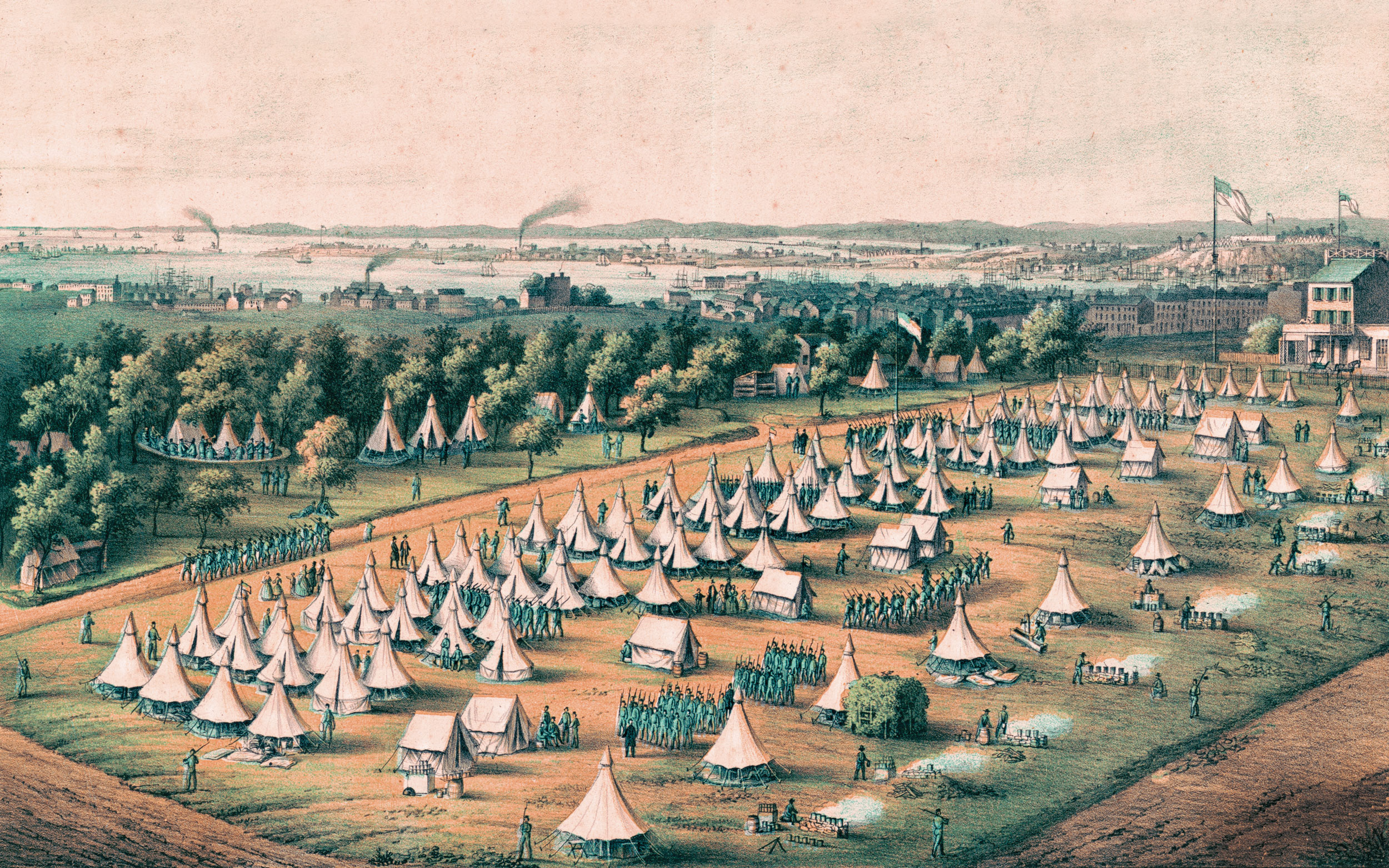
This 1861 lithograph provides a bird’s-eye view of the camp of the 7th Maine Infantry at Patterson Park in Baltimore, Maryland, a city occupied by Union forces within weeks of the outbreak of the Civil War.
At first glance, Edward S. Hall’s May 1861 pencil sketch of the federal military occupation of Baltimore appears to suggest that the dawn of civil war had hardly touched the great Maryland city on the Chesapeake Bay. It seems to indicate that Baltimore might even be spared from the calamities of a war that would kill 750,000 men, maim and injure millions more, devastate incomprehensible amounts of property, and collapse the nation’s most profitable industry—while simultaneously liberating 4 million enslaved people. Although a southern slaveholding state and home to a small coterie of Fire-Eating secessionists, Maryland refrained from joining the Confederate rebellion of 1861, due in large measure to the occupation of the state’s largest city in the early days of the conflict. Indeed, merely one month after the war’s opening engagement at Fort Sumter, and two months before the fateful battle at Bull Run, Hall’s sketch hints that, as early as May 1861, the war might well pass Maryland by.
Yet art can be deceiving, fixed in its own prescribed time and context, and measured by the still completion of the artist’s tranquil pen. As a professional artist whose drawings documented the advent of the Civil War for Frank Leslie’s Illustrated Newspaper, Hall did not intend to mislead the viewer. He rather sought to capture a moment in which Union soldiers quietly labored behind the lines to enforce federal authority during the war’s first moments.1 And indeed, Hall accurately captured what appeared to be order, peace, and calm throughout the Chesapeake. But in so doing, his sketch also implies that zones of military occupation were free from conflict, liberated from the presence of massive armies, and absolved from the destructive conflagration of battle. Hall’s rendition of occupation thus neglects perhaps the single greatest challenge of the entire American Civil War: waging the uncertain aftermath of invasion.
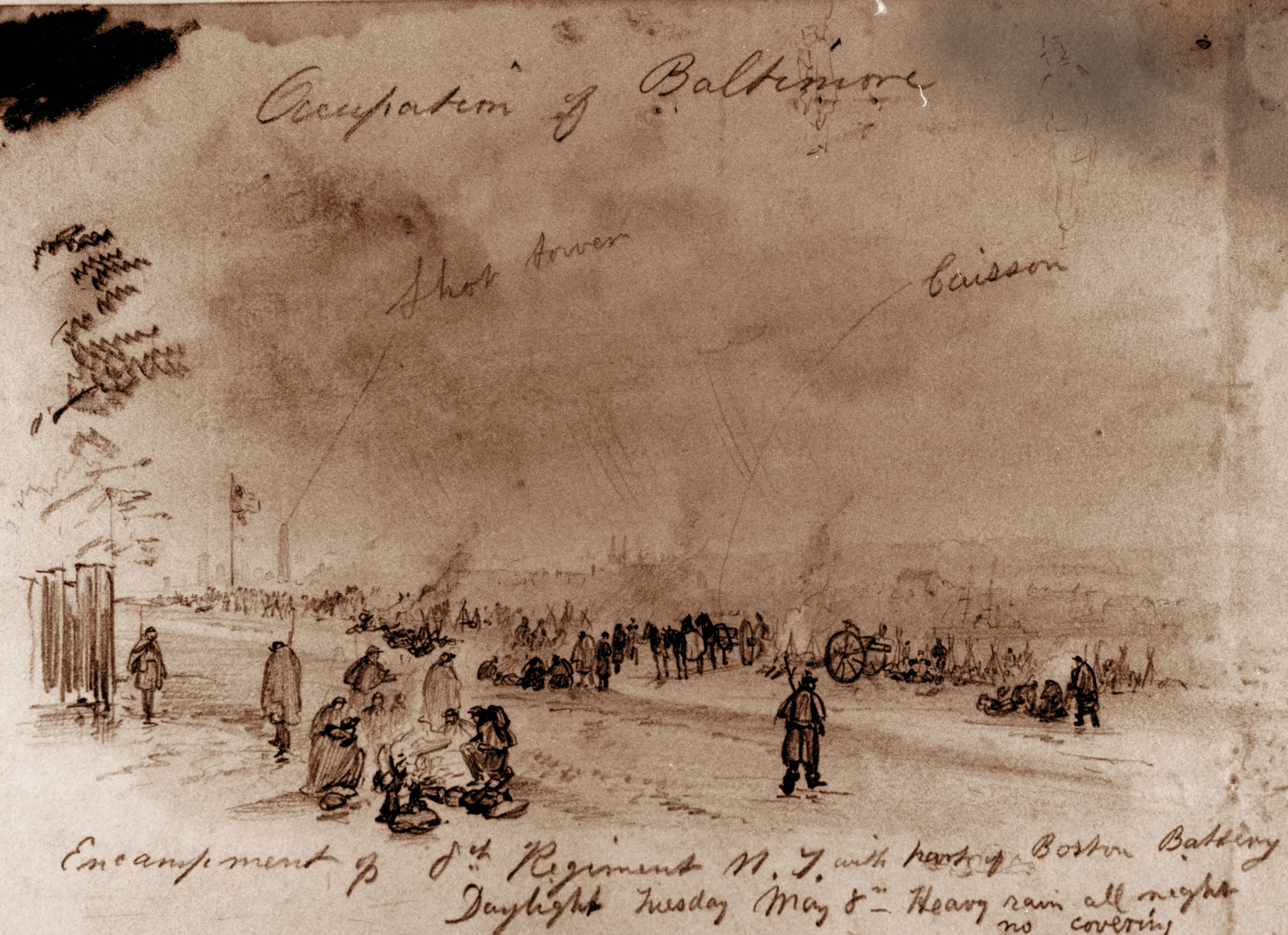 Edward S. Hall, “Occupation of Baltimore” (1861), courtesy the Becker Collection
Edward S. Hall’s May 1861 pencil sketch of the early days of the Union military occupation of Baltimore imparts a sense of tranquility and order. In truth, the city would experience its share of uncertainty and conflict during the balance of the war.
Invading foreign territories in pursuit of national military objectives, and defeating enemy armies upon the field of battle, posed great difficulties for 19th-century American armies. It was likewise vastly complicated to occupy territories and peoples hostile to the invaders’ presence. Union armies during the American Civil War did not merely engage Confederate forces in open battle, waging the grand, romantic campaigns of national lore. Approximately one-third of Union soldiers also occupied the Confederate States of America and even portions of the loyal slaveholding South, populating scores of garrisons across an antagonistic landscape. There, the uncertain and often confusing dynamics of military occupation exposed Union soldiers to a unique kind of warfare waged far beyond the front lines, one that few volunteers imagined when they enlisted in the armed forces.2
And it all began in Baltimore. Hall’s work might indeed reveal a composed, serene wartime landscape. But what occurred in Baltimore a few weeks prior to the sketch’s production foreshadowed the twin challenges of invasion and occupation. Long before belligerent armies could meet on the battlefield, the enslaved had a military haven to escape to, or grisly casualty lists consumed the national consciousness, Union soldiers experienced the complicated and unpredictable trials of invading territory unfriendly to the federal Union. It is here that Edward S. Hall’s drawing offers a window into the turbulent first days of the Civil War, while also introducing the broader challenge of military occupation, a problem that would plague United States armies for the remainder of the conflict and in wars ever since.
 The War with the South (1862)
F.O.C. Darley’s “Massachusetts Militia Passing Through Baltimore” depicts the bloody clash between Union troops and pro-secessionist locals on April 19, 1861—an event that foreshadowed the twin challenges of invasion and occupation during the Civil War.
On April 18, 1861—four days after the surrender of Fort Sumter, three days after President Abraham Lincoln’s call for 75,000 volunteers to squash the rebellion, and one day after Virginia seceded, the 6th Regiment Massachusetts Volunteer Militia paraded triumphantly along the avenues of New York City before resuming its rail journey to Washington to join a swelling Union army. Confident and cocky, the Massachusetts soldiers were headed first to Baltimore, one of the South’s finest cities, to change trains for the final leg of their journey to defend the nation’s capital. Yet rumors circulated throughout the city that the men might not be allowed a peaceful transfer. Although most of Maryland’s citizens had opposed secession, many were also appalled at Lincoln’s recent call for troops, an ostensible admission that the administration sought war against Maryland’s slaveholders. A mix of secessionists and rabblerousers, many of them armed, thus pledged not to let the Yankee invaders pass through Baltimore toward their rendezvous at Washington.
Because Baltimore’s two train stations had no direct rail connection, horses were to pull the Massachusetts soldiers’ rail cars across town after the regiment arrived at the city’s President Street Station on April 19. As they began the trek, they were met with taunts and insults from a ballooning mob that blocked the cars. Then, in an act reminiscent of the one that preceded the so-called Boston Massacre of 1770, someone in the crowd launched a stone at one of the soldiers’ cars, unleashing chaos. The more than 200 Massachusetts soldiers—who had already left the cars, determined to continue on foot—formed into what seemed to be two battle columns. Though they attempted to project a daunting presence, these citizen soldiers had no formal military training and had been in uniform for less than a week. Likely terrified, they nonetheless approached the throng, hoping to scatter the rabid locals. But the civilian horde resisted the soldiers’ steady advances. Ultimately, the blue-clad northerners were compelled to fire warning shots into the air, which inspired the opposite of their intended effect. The restive crowd then flung bricks, hurled stones, tossed bottles, and finally opened fire on the Union soldiers, who responded in kind.3
Edward Jones, the colonel of the 6th Massachusetts, described the incident in his official report: The regiment “proceeded to march in accordance with orders, and had proceeded but a short distance before [it was] furiously attacked by a shower of missiles, which came faster as [it] advanced. [The soldiers] increased their step to double-quick, which seemed to infuriate the mob, as it evidently impressed them with the idea that the soldiers dare not fire…; pistol shots were numerously fired into the ranks, and one soldier fell dead. The order, ‘Fire!’ was given, and it was executed; in consequence, several of the mob fell, and the soldiers again advanced hastily. The Mayor of Baltimore placed himself at the head of [our] column … and proceeded with [us] a short distance … begging … not to let the men fire; but the mayor’s patience was soon exhausted, and he seized a musket from the hands of one of the men, and killed … [a member of the mob] therewith.”4
Captain Albert S. Follansbee of the 6th Massachusetts echoed his colonel’s account: “As soon as the order was given, the brick-bats began to fly into our ranks from the mob. I called a policeman, and requested him to lead the way to the depot. He did so. After we had marched about a hundred yards, we came to a bridge. The rebels had torn up most of the planks. We had to play ‘Scotch hop,’ to get over it. As soon as we had crossed the bridge, they commenced to fire upon us from the street and houses. I ordered the men to protect themselves; and then we returned their fire, and laid a great many of them away. I saw four fall on the sidewalk at one time. They followed us up, and we fought our way to the other depot—about one mile. They kept at us till the cars started. Quite a number of the rascals were shot, after we entered the cars. We went very slow, for we expected the rails were torn up on the road.”5 The Massachusetts soldiers, now securely on the train for Washington, soon departed for the safety of the capital.
What might be considered the first skirmish of the Civil War ended with four dead Union soldiers, 12 dead civilians, and an additional 36 troops and nearly 50 civilians wounded.6 In a war that would come to be distinguished by the bloody killing fields of Shiloh, Antietam, and Gettysburg, the inaugural fight in the streets of Baltimore seemed to be more a disjointed donnybrook than a precursor to those large-scale engagements and their nearly 100,000 combined casualties. But the Baltimore riot did nevertheless foreshadow the complications of invasion, including the turbulent interactions between Union military forces and hostile southern civilians.
It was becoming clear that a war of occupation might well be necessary to secure victory and preserve the Union. This realization, however, contradicted the plans of high-ranking generals, who had criticized the premise of conquering and holding territory. As early as March 1861, General-in-Chief Winfield Scott warned against a protracted war of occupation, fearing that Union forces might become mired indefinitely in the hostile South. A successful occupation, Scott warned, would take years to complete, require hundreds of thousands of soldiers, and yield an “enormous waste of human life to the North.” Moreover, wars of invasion and subjugation frequently inspired hatred and vengeance between victor and vanquished, undermining the ultimate goal of a national reunion. And in the process, the United States might well transform into a military leviathan, unintentionally shattering the democratic republic that was the envy of the world. “Fifteen devastated Provinces,” Scott predicted, referring to the nation’s 15 slaveholding states, would replace semi-sovereign states, “held for generations by heavy garrisons,” bleeding dry the federal treasuries and burdening a once free citizenry with taxation to sustain a standing military state.7
 Library of Congress
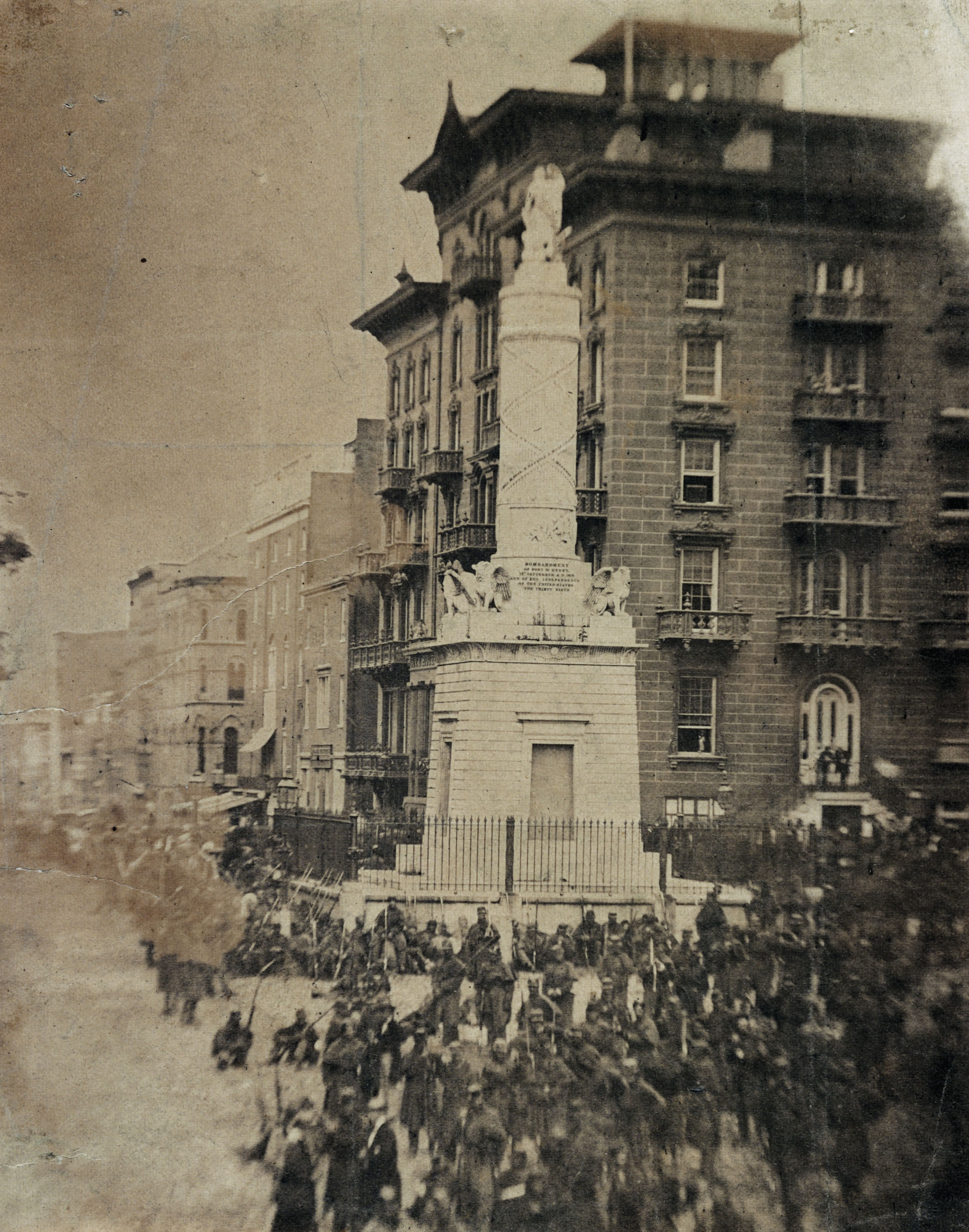
In the wake of the Baltimore riot, the Lincoln administration—balancing wishes for a bloodless conflict with the desire to prevent Maryland from seceding from the Union—authorized a military occupation of the state. Soon after, the 6th Massachusetts Militia (shown here bivouacked in Monument Square in July 1861) returned to the streets of Baltimore as a symbolic gesture of federal authority.
Yet the contingencies of war and the immediate memories of Baltimore shattered Scott’s desire for a limited, bloodless conflict. What might happen if, in the attempt to prevent future incursions by the Union army, Maryland seceded and joined the Confederacy? Losing that state would mean that the United States capital was surrounded on all sides by a newly declared foreign nation, subsumed by enemy forces, and isolated from the very republic over which it claimed legitimacy. In a letter Abraham Lincoln wrote on April 20 to Maryland governor Thomas H. Hicks and Baltimore mayor George W. Brown, the president declared that “[p]reserving the peace of Maryland” stood among his principal objectives. Two days later, while addressing a delegation of Baltimore citizens visiting the White House, Lincoln explained the centrality of Maryland to the Union war effort and the necessity of maintaining peace throughout the state:
[T]his Capital … [g]eographically … lies surrounded by the soil of Maryland; and mathematically the necessity exists that they [Union soldiers] should come over her territory. Our men are not moles, and can’t dig under the earth; they are not birds, and can’t fly through the air. There is no way but to march across, and that they must do. But in doing this there is no need of collision. Keep your rowdies in Baltimore, and there will be no bloodshed. Go home and tell your people that if they will not attack us, we will not attack them; but if they do attack us, we will return it, and that severely.
In a hurried attempt to maintain the state’s loyalty, Lincoln soon authorized a federal military occupation of Maryland, suspended the writ of habeas corpus in the state, imprisoned a pro-secession newspaper editor, and arrested several public officials and members of the state legislature suspected of harboring Confederate sympathies. Soon after, the 6th Massachusetts Militia returned to the streets of Baltimore as a symbolic gesture of federal authority.8
By May 1861, Union military forces had established a permanent occupation of the city that would last the entire war. Benjamin F. Butler, an ambitious Massachusetts politician who used his prewar political connections to secure a generalship in the Union army, was charged with pacifying the city and establishing a functioning occupation. Butler sought to “revenge” what he called “the cowardly attack made upon” his fellow Massachusetts soldiers earlier in the spring. And, as he later wrote in his memoirs, “I desired to keep that promise.” Butler promptly went to work fortifying both the interior of the city and the surrounding countryside with troops and heavy cannon, while also guarding entry into Baltimore Harbor and limiting civilian access to the railroads. Butler’s efforts, embodied by his declaration to local residents that he “had come there to stay,” were as effective as they were swift.9
Union troops occupying Baltimore noticed the changing sentiments of the city’s residents as they came to terms with their northern visitors. Charles Blake, a soldier in the 12th Maine Infantry, noted in June, “when we arrived in Maryland we began to feel that we were in an enemys country…. Before [arriving] we [received] ten cartridges and we loaded our guns so as to be ready for any emergency, and as we drew near Baltimore we examined our pieces to see that they were all in shooting order, and then we waited for the onslaught.” With stories of the April riot undoubtedly fresh in their minds, Blake and his comrades expected the worst from their civilian enemies. “But there was no fight,” he concluded, “for General Butlers men were in town and evry thing was quiet.”10
By September, as the war escalated elsewhere, Baltimore seemed pacified. “Secession is dieing very fast,” noted John Corden, a member of the 6th Michigan Infantry. “I am afraid we shall not get a chance to see a bit of a fight.” He continued, “We marched through this notoriously secession City entirely unmolested[. T]he secession party here now dare not say a word as they are entirely at our mercy…. [W]e make quite a formidable appearance.” Other occupying soldiers, even if they noticed Confederate sympathizers, remarked that their presence was hardly threatening, due principally to the Union army’s position. “We are Encampt about in the Center of the City,” wrote another 6th Michigan soldier in September, “[and when we arrived] we was greeted at most every corner of the street by Rebels Hurrahing for Jeff Davis.” Still he felt secure, “for there is about 40,000 men here [and our guns] are all turned uppon the city.”11
It indeed appeared that order had been restored to the city, as reflected in Edward Hall’s sketch of occupied Baltimore. New York attorney and diarist George Templeton Strong traveled through Baltimore in late May and noted the seeming calm that had befallen its once chaotic streets: “Baltimore, that nest of traitors and assassins, was traversed in peace. There were crowds at the corners of the streets watching the trains. They were looking out for the troops that were in a train we passed on a turn-off at Havre de Grace. But the crowd was silent and innocuous, for Fort McHenry is now strongly reinforced and Federal Hill is white with the tents of government troops.”12
But the appearance of peace in the midst of war was merely that: an appearance. Military occupation during the Civil War represented an independent war unto itself. As 1861 morphed into 1862, the mere presence of Union armies, carrying the banner of federal authority, did not naturally convince rebellious white southerners to renounce their secessionist ways. It became clear that a defined process of the occupation of Confederate communities would be required to secure victory.13
 Harper's Weekly
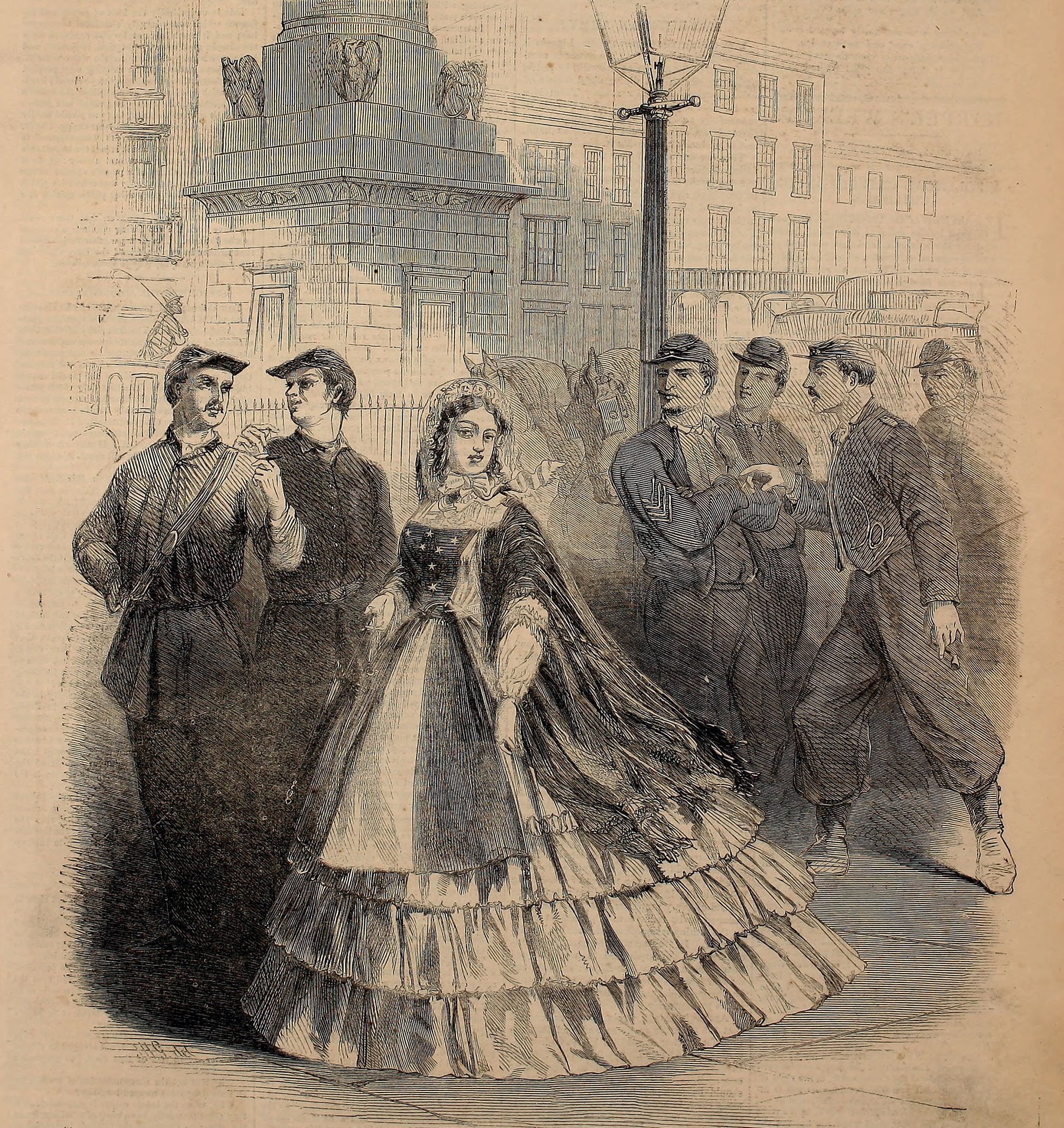
As the war entered its second year, the mere presence of Union armies—in Baltimore and other occupied areas throughout the South—did not naturally convince rebellious white southerners to renounce their secessionist ways. Above: In this sketch from Harper’s Weekly, a pro-secessionist woman flaunts her allegiance by donning a Confederate flag apron while walking past Union troops in the streets of Baltimore.
Hall’s sketch of occupied Baltimore could not capture these complicated dynamics. Soldiers depicted in his drawing were some of the first Union troops to face the problems of wartime occupation, experiences that would soon be repeated by northern volunteers throughout the occupied Confederacy. As Frank Peck, a soldier in the 12th Massachusetts Infantry—the first Union regiment to march into New Orleans in May 1862—wrote of the civilians he encountered, “You cant feel as we do who have for six months been in the midst of people who would rejoice to see every one of us in the bottom of the sea, and who are merely conquered [but] not converted.” Peck would come to deplore occupying New Orleans, admitting, “[this] isnt what I enlisted for.”14
Or consider Cyrus Boyd of the 15th Iowa Infantry, who, while on occupation duty in Holly Springs, Mississippi, encountered someone who did not appear to be a traditional enemy. A local woman approached Boyd, pleading for protection of her property and children. “I told her not to fear as no man would disturb her,” Boyd explained. “This evening this same woman was arrested for shooting one of our men who was on guard…. She cowardly shot him although he was guarding her property.”15
Boyd’s vignette underscores how Union soldiers across the occupied Confederacy interacted with civilian-enemies who did not wear a Confederate uniform. Indeed, occupying armies throughout the ages have inspired fierce, violent, and clandestine resistance—and the Civil War was no different. Union soldiers learned that a surreptitious southern enemy stalked federal armies, employing any means necessary to repel the invaders. An unrestrained war unfolded within the more sanctioned conflict waged by otherwise civilized belligerents—and in many respects, the Baltimore riot of 1861 might well be considered the inauguration of guerrilla conduct during the Civil War. This conflict, waged far beyond the front lines, had few rules and perpetuated chaotic violence. Union soldier John M. King, whose regiment occupied Middle Tennessee, described the civilian insurgents who swarmed the lines around Nashville. “The citizens were all rebel in sympathy and to guard those magazines and store houses was no easy task,” he wrote in early 1863. “Rebel spies and bushwhackers were going in and coming out [of the city] dressed as farmers, women, and the like, crawling through the guard line under the cover of darkness, getting ammunition and supplies to shoot our men from behind a tree or under a bush.”16
From Baltimore to New Orleans, from Holly Springs to Nashville, Union armies would eventually occupy scores of southern communities, ultimately eclipsing the conciliatory vision that President Lincoln once considered necessary to subdue the rebellion. Civil and military leaders initially believed in 1861 that conciliatory policies would assuage white southern angst and convince the region’s Unionists to disavow the Confederate rebellion and restore the Union. Lincoln himself warned of the conflict deteriorating into a “violent and remorseless revolutionary struggle,” which he feared would shatter the limits of restraint, collapse stable southern institutions, and stoke bitter resentment between the American belligerents. But when Confederates mounted a bitter and violent resistance to Union armies, it compelled the federal government to wage a “hard war” of occupation against armies and civilians. “War is the remedy our enemies have chosen,” observed Union general William Tecumseh Sherman. “I say let us give them all they want; not a word of argument, not a sign of let up, no cave in till we are whipped or they are.” Union forces swept across the southern landscape, crushing the will to resist, hindering southerners’ ability to make war, and, most significantly, dismantling the cause of secession: slavery.17
By 1863 the Union’s military occupations of the Confederacy—and the Civil War itself—assumed a new character when Lincoln issued the Emancipation Proclamation. A war measure aimed to deprive the Confederacy of critical but unfree labor, the proclamation invited African-American men to serve in the Union army. By war’s end, some 180,000 black volunteers donned the Union blue. Most United States Colored Troops (USCT), as they were designated, served behind the lines in auxiliary capacities, but in so doing they participated directly in the Union’s military occupation of the Confederacy.18
As occupiers, African-American troops played critical roles in shattering the institution of slavery, as evident in the experiences of the 1st USCT as it traversed the countryside of southeastern Virginia in 1864. While on a foraging expedition, the regiment captured a local planter who “had a reputation for meting out the most unmerciful whippings to enslaved women.” The soldiers brought the slaveholder to their camp, where they disrobed their captive, applied a whip, and brought “the blood from his loins at every stroke, and not forgetting to remind the gentlemen of the days gone by.” George Hatton, a soldier in the 1st, thus observed: “But behold what has been revealed in the past three or four years; why the colored men have ascended upon a platform of equality, and the slave can now apply the lash to the tender flesh of his master … while standing upon the banks of the James River, on the soil of Virginia, the mother state of slavery, as a witness of such a sudden reverse!”19
Although fraught with great challenges, military occupation during the Civil War succeeded in consolidating federal authority, establishing points of departure for campaigning Union armies, enacting the policies of emancipation, and beginning the long process of Reconstruction. It also waged a kind of war against domestic institutions to convince white southerners of secession’s folly. “We cannot change the hearts of those people,” Sherman confessed in late 1862, “but we can make war so terrible that they will realize the fact that, however brave and gallant and devoted to their country, still they are mortal and should exhaust all peaceful remedies before they fly to war.”20
Yet General-in-Chief Winfield Scott’s 1861 warnings about becoming mired in the South seemed to resonate throughout the conflict. The Union’s war of occupation ended up requiring untold amounts of troops, costing exorbitant amounts of money, transforming the United States army into a bureaucratic institution, and engendering tensions between the occupiers and occupied, the implications of which became deeply entangled in the challenges of postwar reunion. Such an effort was nonetheless critical to preserving the Union and unfolding the essential processes of emancipation.21
One final consequence of military occupation during the Civil War—one that is not captured in Edward S. Hall’s sketch—should be considered. Brief passages penned by two U.S. soldiers illustrate it well. “We are guarding 80 Tons of Powder [on behalf of the government],” the first wrote. “Soldiers have to be careful what they Buy [in this city] for [the local residents] Poison most Evry thing they seel to [the soldiers]. there is a great many got Poisoned. they Shoot the Pickets that is Stationed among here[.] there was 2 shot here the other night.”
“The life of an infantryman is never safe,” wrote the second soldier. “How do I know? Well I live it every day. I lost a good friend of mine just two days ago to an enemy…. The worst feeling in the world is having lost one of your own and not being able to fight back. The more I go on patrol, the more alert I tend to be, but regardless of the situation here … we are never safe. No matter the countermeasures we take to prevent any attacks. They seem to seep through the cracks. Every day a soldier is lost or wounded by enemy attacks. I for one would like to make it home to my family one day. Pray for us and keep us in your thoughts.”
These two descriptions reveal a small fraction of the challenges associated with military occupation. And while their authors speak a unified language, articulating similar fears and uncertainties, they are separated by nearly 150 years. The first was written during the Civil War by Charles Henry Moulton, who served in the occupation of Baltimore in 1861. Staff Sergeant Juan Campos from Texas wrote the second in October 2006 from Iraq. He died in 2007 from a roadside bomb attack. Although Moulton and Campos entered the army more than a century apart under wildly dissimilar circumstances and interpreted their incongruent missions in fundamentally different ways, each was united by a sense of disillusionment, discouraged by a restrictive uncertainty about their respective environments. The occupations of the Confederacy in the 1860s and Iraq during the 2000s could not be more disparate in their political dynamics, contrasting in their cultural dimensions, and divergent in their martial conduct. Soldiers in both conflicts nevertheless echoed strikingly similar refrains about the enduring challenges of invasion. And thus as we glance at Edward S. Hall’s seemingly innocuous sketch, we see that the problem of military occupation is not a dead artifact of the American past.22
Andrew F. Lang is associate professor of history at Mississippi State University. He is the author of In the Wake of War: Military Occupation, Emancipation, and Civil War America (Louisiana State University Press, 2017), which received the Society of Civil War Historians’ Tom Watson Brown Book Award. He is also the coeditor of Upon the Fields of Battle: Essays on the Military History of America’s Civil War (LSU Press, 2018) and the lead co-author of the forthcoming The American Civil War and the World: Limited War, Limited Peace, the final installment of the Littlefield History of the Civil War Era published by the University of North Carolina Press.
Notes
1. Hall’s “Occupation of Baltimore” is part of Boston College’s Becker Collection: beckercollection.bc.edu.
2. This essay derives from the author’s book, In the Wake of War: Military Occupation, Emancipation, and Civil War America (Baton Rouge, 2017).
3. This version of the Baltimore riots is referenced in Daniel E. Sutherland, A Savage Conflict: The Decisive Role of Guerrillas in the American Civil War (Chapel Hill, 2009), 1–6; William W. Freehling, The South vs. The South: How Anti-Confederate Southerners Shaped the Course of the Civil War (New York, 2001), 47–50; and Frank Towers, “‘A Vociferous Army of Howling Wolves’: Baltimore’s Civil War Riot of April 19, 1861,” Maryland Historian 23 (December 1992): 1–27.
4. Report of Colonel Edward Jones, April 22, 1861, quoted in John W. Hanson, Historical Sketch of the Old Sixth Regiment of Massachusetts Volunteers during its Three Campaigns in 1861, 1862, 1863, and 1864 (Boston, 1866), 38; and quoted in Brooks D. Simpson, Stephen W. Sears, and Aaron Sheehan-Dean, eds., The Civil War: The First Year Told by Those Who Lived It (New York, 2011), 305–306.
5. “Capt. Follansbee’s Account,” quoted in Hanson, Historical Sketch of the Old Sixth, 39–40; Sears, et al., eds., Civil War: First Year, 307–308.
6. Sutherland, Savage Conflict, 4; Freehling, The South vs. the South, 48–50.
7. Winfield Scott to William H. Seward, March 3, 1861, in Winfield Scott, Memoirs of Lieut.-General Scott, LL.D 2 vols. (New York, 1864), 2:627; Lang, Wake of War, 46.
8. Abraham Lincoln to Thomas H. Hicks and George W. Brown, April 20, 1861, and Lincoln, “Reply to Baltimore Committee,” April 22, 1861, both quoted in Roy P. Basler, ed., The Collected Works of Abraham Lincoln 9 vols. (New Brunswick, 1953–1955), 4:341, 342 (hereafter cited as CWL).
9. Benjamin F. Butler, Butler’s Book: Autobiography and Personal Reminiscences of Major-General Benjamin F. Butler (Boston, 1892), 226, 233.
10. Charles Blake diary entry, June 2, 1861, Charles H. Blake Diary, Historic New Orleans Collection, Williams Research Center, New Orleans.
11. John Corden to My Dear Wife, September 21, 1861, John Corden Papers, and Charles Henry Moulton Diary entry, September 3, 1861, Charles Henry Moulton Papers, 1835–1916, both in Bentley Historical Library, University of Michigan.
12. Strong diary entry, May 29, 1861, quoted in Allan Nevins and Milton Halsey Thomas, eds., The Diary of George Templeton Strong: The Civil War (New York, 1952), 3:150–151.
13. The most comprehensive treatments of wartime military occupation are Stephen V. Ash, When the Yankees Came: Conflict and Chaos in the Occupied South, 1861–1865 (Chapel Hill, 1995); Mark Grimsley, The Hard Hand of War: Union Military Policy Toward Southern Civilians, 1861–1865 (Cambridge, 1995); Gregory P. Downs, After Appomattox: Military Occupation and the Ends of War (Cambridge, 2015); Lang, Wake of War.
14. Peck to Mother, October 20, and September 22, 1862, Peck Correspondence, Montgomery Family Papers, 1771–1974, Library of Congress; Lang, Wake of War, 60–62, 85–86, 120.
15. Mildred Throne, ed., The Civil War Diary of Cyrus F. Boyd, Fifteenth Iowa Infantry, 1861–1863 (Baton Rouge, 1998), 97; Lang, Wake of War, 66–67.
16. Diary entry, February 10, 1863, in Claire E. Swedburg, ed., Three Years with the 92d Illinois: The Civil War Diary of John M. King (Mechanicsburg, 1999), 52; Sutherland, Savage Conflict, 1–6, passim; Lang, Wake of War, 107–108, 105–128.
17. Lincoln, “Annual Message to Congress,” December 3, 1861, CWL, 5:48–49; William T. Sherman to James Guthrie, August 14, 1864, in U.S. War Department, The War of the Rebellion: A Compilation of the Official Records of the Union and Confederate Armies 129 vols. (Washington, 1880–1901), Series 1, 39:2:248 (hereafter OR).
18. Lang, Wake of War, 129–181.
19. Letter of George W. Hatton, May 28, 1864, in Edward S. Redkey, ed., A Grand Army of Black Men: Letters from African-American Soldiers in the Union Army, 1861–1865 (New York, 1992), 95–96; Lang, Wake of War, 178.
20. Sherman to Ulysses S. Grant, October 4, 1862, OR, 17:2:261.
21. D.H. Dilbeck, A More Civil War: How the Union Waged a Just War (Chapel Hill, 2016); Lang, Wake of War; Aaron Sheehan-Dean, The Calculus of Violence: How Americans Fought the Civil War (Cambridge, 2018).
22. Charles Henry Moulton to Brother and Sister, September 3, 1861, Moulton Papers, Bentley Historical Library; Juan Campos blog entry, October 3, 2006, published in The New York Times, March 22, 2008.