 David Silkenat
The Scottish-American Civil War Monument in Edinburgh, Scotland
For 11 years I was fortunate to teach the American Civil War at the University of Edinburgh in Scotland. American friends and colleagues often asked if I found it difficult making the war relevant to students outside the United States. To their surprise, I replied that Edinburgh had its own Civil War landscape if you knew where to look. Before the war, American abolitionists regularly visited the city—long a hotbed of British abolitionism—including William Lloyd Garrison, William and Ellen Craft, William Wells Brown, and Josiah Henson (the inspiration for Uncle Tom in Harriet Beecher Stowe’s novel).
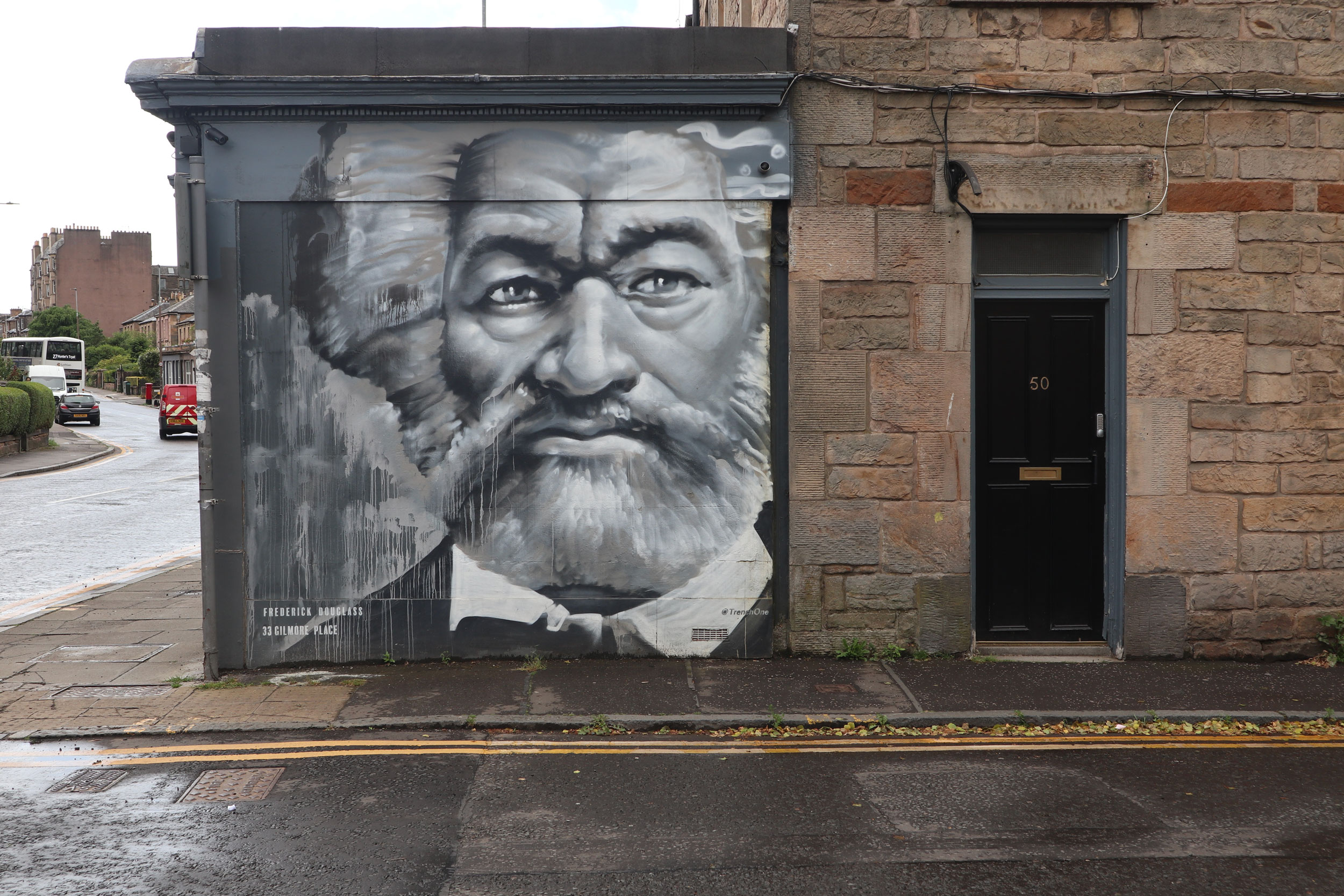
Frederick Douglass spent months in the city in 1846–1847 and 1859–1860, much of it living at 33 Gilmore Place, recently graced with a historical marker and a nearby mural portrait of Douglass. Jefferson Davis visited the city in 1869 after his release from prison, and Ulysses S. Grant visited Edinburgh Castle on his post-presidential Grand Tour in 1877.
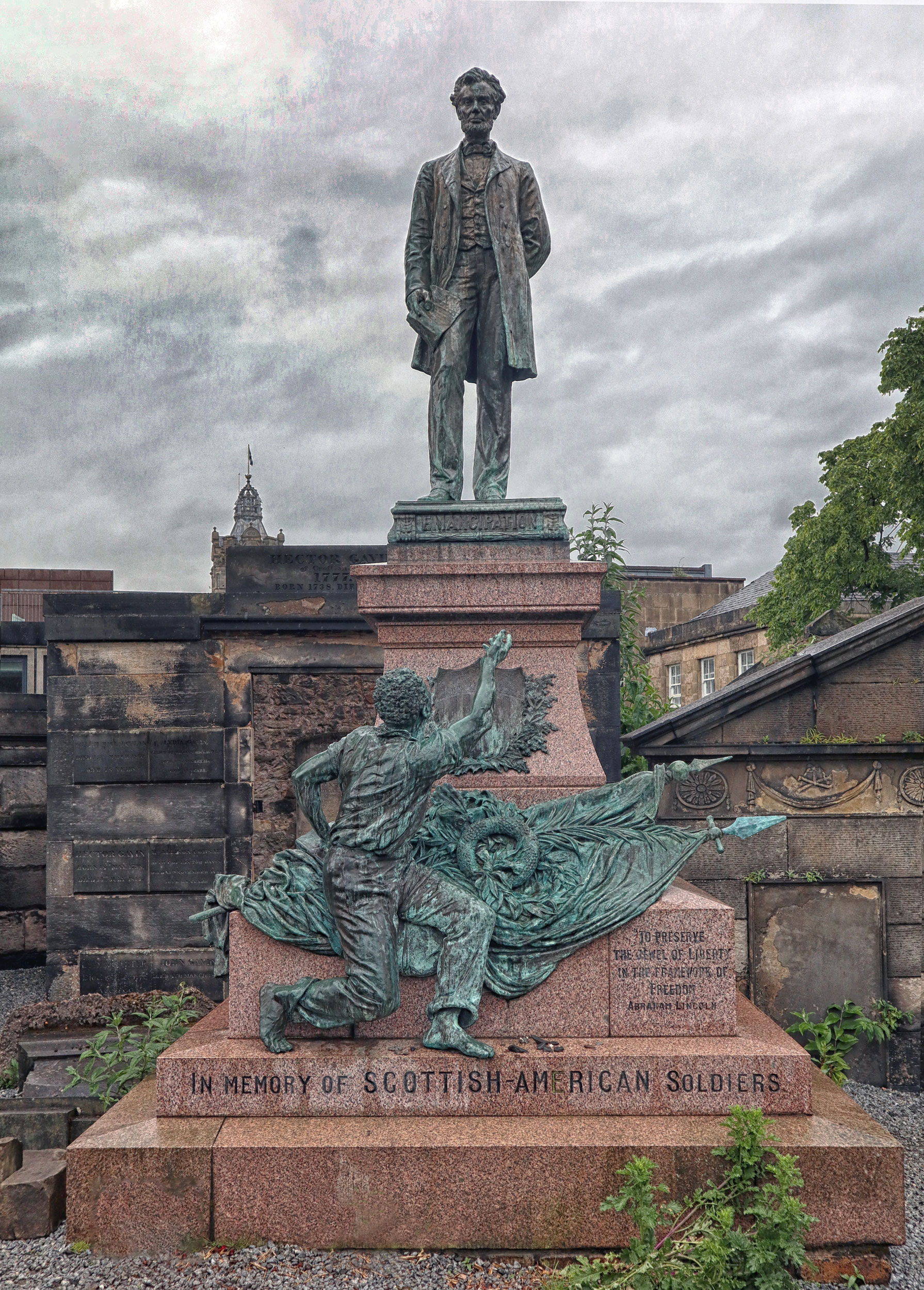
The largest and most prominent Civil War site in Edinburgh stands near the city center in Old Calton Hill Burial Ground on Waterloo Place, not far from Waverley Rail Station. Fifteen feet tall, the Scottish- American Civil War Monument sits on a promontory in a Gothic cemetery, next to the grave of philosopher and historian David Hume and facing the Martyrs Monument, a giant black obelisk dedicated to five political reformists from the late 18th and early 19th centuries who were imprisoned and deported for espousing parliamentary reform. Across the street from the graveyard, in what is now Howie’s Restaurant, Douglass addressed Edinburgh abolitionists in 1846. Tourists often pass by the entrance to the Old Calton Hill Burial Ground en route to the summit of Calton Hill, which hosts the Nelson Monument, dedicated to the slain victor at Trafalgar, and the unfinished Scottish National Monument, a memorial to the Scots who died in the Napoleonic Wars.
Erected in 1893, the Scottish-American Civil War Monument is centered on a life-size bronze statue of Abraham Lincoln, standing atop a multistage Scottish red granite pedestal, stoically peering into the distance with the Emancipation Proclamation in his hand. On the four sides of the statue, just below Lincoln’s feet, are the words “Suffrage,” “Union,” “Education,” and “Emancipation.” On the pedestal, a barefoot freedman reaches up, admiring the president who does not meet his gaze. He sits perched awkwardly on the granite, a pair of battle flags beneath him. Wearing an open-necked shirt and rolled up sleeves, he holds a book in his hand, signifying the literacy denied him in slavery. A Hardee hat beside him alludes to black service in the Federal military. A Union crest adorns the front of the pedestal, decorated with Scottish thistles and American cotton flowers. Lincoln’s words, slightly misquoted, are engraved on the granite: “To preserve the jewel of liberty in the framework of freedom,” a phrase from an 1864 letter the president wrote to Michael Hahn, the governor of Louisiana, in which he endorsed black suffrage.1 The design strongly resembles Thomas Ball’s 1876 Emancipation Memorial in Washington, D.C., which similarly depicts Lincoln as the Great Emancipator.
The story behind the monument demonstrates the global reach and consequences of America’s most important conflict. It begins in 1833 with the birth of John McEwan in Blackford, a small town about 40 miles northwest of Edinburgh. McEwan’s father was a textile weaver, a trade he passed to his sons, Peter and John. But the introduction of steam and water-driven mills had devalued what had once been profitable work. Facing limited opportunities, Peter left Scotland for Chicago in 1852. His younger brother joined him five years later, boarding the American passenger ship Cultivator in Liverpool to New York, then going by train to Chicago.
In May 1862, John McEwan enlisted in Company H of the 65th Illinois Infantry, sometimes called the Scotch Regiment because of the high proportion of Scottish immigrants in its ranks. The regiment’s early record lacked distinction: Assigned to guard Harpers Ferry, the 65th was among the units captured there in September 1862 by Confederates under Thomas J. “Stonewall” Jackson. Paroled to Chicago, the regiment could not return to active campaigning until exchanged in April 1863. The 65th redeemed itself over the second half of the war, fighting in the western theater under Ambrose Burnside. McEwan, like much of the regiment, reenlisted in March 1864 in Knoxville and was granted a brief furlough to return to Chicago, after which the outfit was dispatched to join William T. Sherman’s army for the Atlanta Campaign. In late 1864, they fought against John Bell Hood’s forces in the Franklin-Nashville Campaign. In early 1865, they participated in the siege of Wilmington, North Carolina, before rejoining Sherman for his push northward through the state. The 65th was stationed in Raleigh when Joseph E. Johnston surrendered his army to Sherman at Bennett Place in April 1865.
By all accounts, McEwan did his duty. “John is a good soldier—we had none better—always sober, and always ready for duty. If he knew what fear was, he never showed it,” recalled Melvin Nichols, who served alongside McEwan. “I have seen him in very close quarters several times, but he never shirked or exhibited a white feather.”2 By the time he mustered out in July 1865, McEwan had risen in rank to sergeant major, the regiment’s senior enlisted man. But more than three years of hard soldiering had left him eager for home in Scotland.
 David Silkenat
A mural to famous abolitionist and familiar antebellum visitor Frederick Douglass is among the various spots in Edinburgh that speak to its American Civil War connections.
Recrossing the Atlantic, McEwan settled in Galashiels, a town in the Scottish Borders, about 30 miles south of Edinburgh, still wearing his “blue army coat with brass buttons.” He found work as a woolen weaver, his father’s profession, and married Margaret (“Maggie”) King, the daughter of Irish immigrants, in November 1866. In 1867, they welcomed the first of six children. Maggie, whom he met in the textile mill, recalled that “little groups would gather about him as he told war stories.” The war had left McEwan with more than stories: Not long after returning to Scotland, his health began to fail, a persistent illness that he attributed to his military service. (Family tradition suggests he had emphysema from wartime exposure.) In 1884, McEwan applied for a federal pension but was denied because he could not “connect his ailment with exposure on the field,” a common experience of ill veterans who engaged with the pension system. After a decade in the Borders, the family moved to Edinburgh, where they lived in cramped accommodations in the Cowgate, a neighborhood known for overcrowding, squalor, and poor sanitation. Eventually, McEwan’s health deteriorated to the point where he could not work, and Maggie and the children had to labor in the mills for five shillings a week to keep them out of the poorhouse.3
McEwan’s illness eventually left him bedridden. According to Maggie, his identity as a Union veteran remained important to him more than two decades after he left the United States. Even in the depth of his illness, “he loved to have the old gun near at hand where he could touch it” and “when the poor soldier, after long months of suffering, died, they found the gun under the coverlet beside him, pressed close to his heart.” With his family unable to afford a proper burial, John McEwan was buried in an unmarked paupers’ grave in 1890. When Maggie McEwan visited the following Sunday “with the bairns,” she “couldna mark the spot” where their father lay.4
Fearing destitution, Maggie McEwan visited the United States Consulate, then located on Queen Street in fashionable New Town, hoping that she could obtain help securing a widow’s pension from the consul. In the summer of 1890, Wallace Bruce had only recently arrived in the city, appointed by President Benjamin Harrison. A native of upstate New York, Bruce was a lawyer whose real passion was poetry and who had published several volumes of verse. The poetry of Robert Burns and the novels of Walter Scott were topics he regularly lectured on. Bruce was not at the consulate on the day of Maggie McEwan’s visit and she ended up telling her story to his wife, Annie. Moved by the widow’s story, Annie Bruce asked if she could visit the soldier’s grave, as Decoration (Memorial) Day had just passed, only to be horrified to learn that Maggie McEwan could not pinpoint its location.
 National Portrait Gallery (Carnegie); Library of Congress (Hayes)
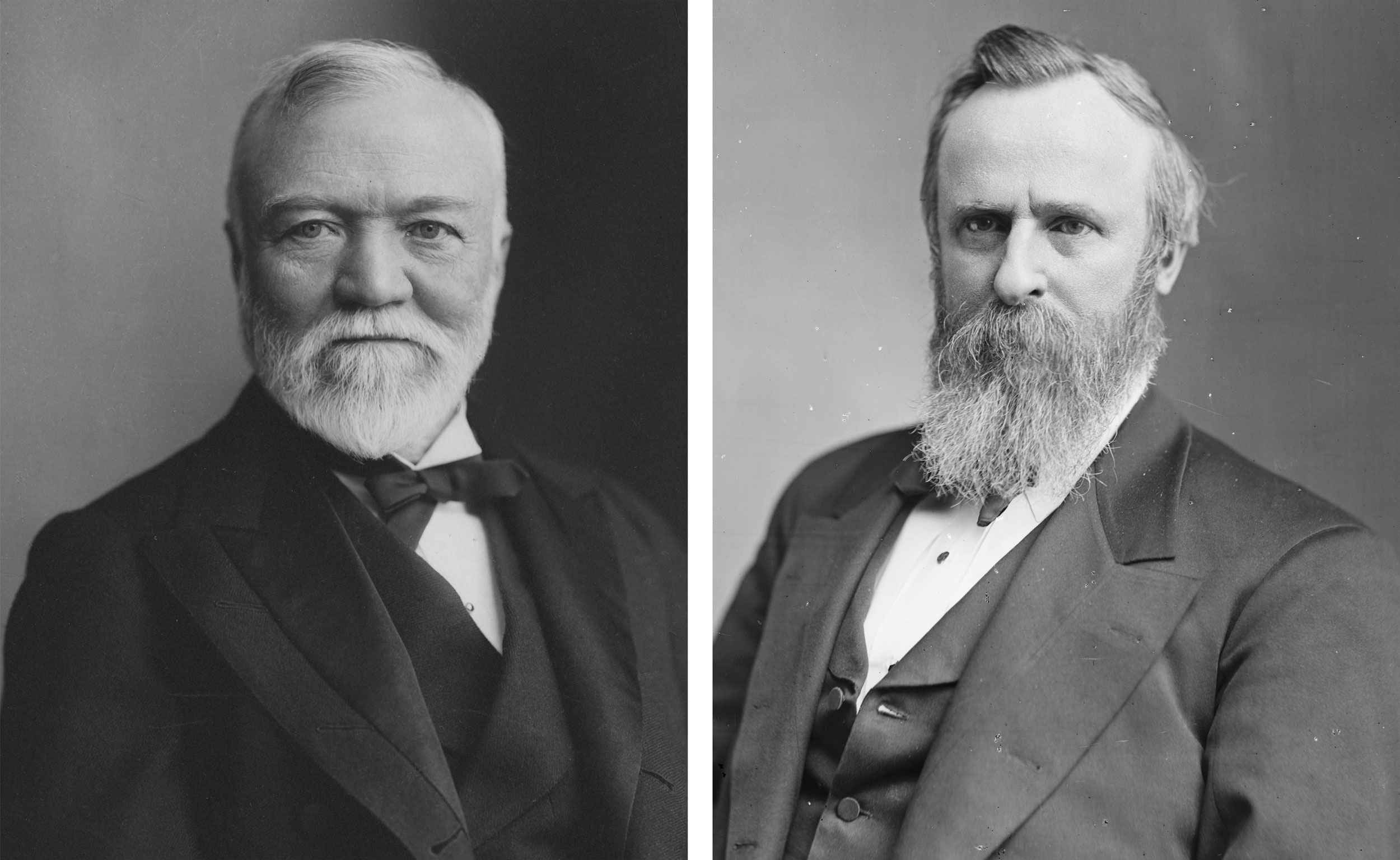
Andrew Carnegie (left) and Rutherford B. Hayes
When Wallace Bruce returned and heard Maggie McEwan’s story, he determined not only to help her receive a pension, but also to secure a “burial spot in Edinburgh for Scottish-American soldiers” like McEwan. Working with the Lord Provost and Town Council, Bruce secured a nine-foot-square plot in Old Calton Hill Burial Ground. In addition to a final resting place for Civil War veterans, Bruce determined that an appropriate monument should mark the site. He believed that a bronze statue of “Lincoln Freeing the Slave” would be “a fitting monument in Great Britain—this being the final act of Saxon freedom.” He quietly began collecting donations from prominent Scottish Americans and visitors to the consulate. One of the earliest donations came in November 1890 when Scottish immigrant Andrew Carnegie pledged $200, writing that he had “nothing but praise” for the project.5
In early August 1892, Bruce sailed to New York to address the Chautauqua Assembly of the Union veterans’ association Grand Army of the Republic (GAR). There, before an audience of 5,000, including former President Rutherford B. Hayes, he announced his plan to erect a statue in Edinburgh to honor the Scottish Union dead. Bruce embarked on a campaign to raise money for the monument. “It made indeed a long winter of letter-writing and business—a long winter without time for a single poem,” he later noted, “but I am glad that a monument to Lincoln in the most beautiful city in the world and the first monument of the great statesman erected in Europe, is the best poem of my life.” Prominent New York aristocrats followed suit, including William Rockefeller, J.P. Morgan, Cornelius Vanderbilt, and William Waldorf Astor. Vice President Levi P. Morton also made a contribution, as did Peter McEwan, who had made a small fortune in Chicago as a hotelier.
Bruce tapped his close friend Henry Roswell Heath to spearhead the fundraising effort. Born in 1845, Heath had lied about his age to join the 20th Massachusetts Infantry in August 1861. Wounded and captured at Ball’s Bluff, he spent the winter in a Richmond prison until he was exchanged in February 1862. Given a medical discharge, Heath attended Claverack Academy in upstate New York, where he met Wallace Bruce, and went on to a career in business in New York City. Heath was active in the GAR, and he used his connections among Civil War veterans to solicit donations to the Edinburgh monument. Through their combined efforts, Bruce and Heath raised $6,300.
 Defuniaksprings.net (Bruce), Poughkeepsie Public Library (Bissell)
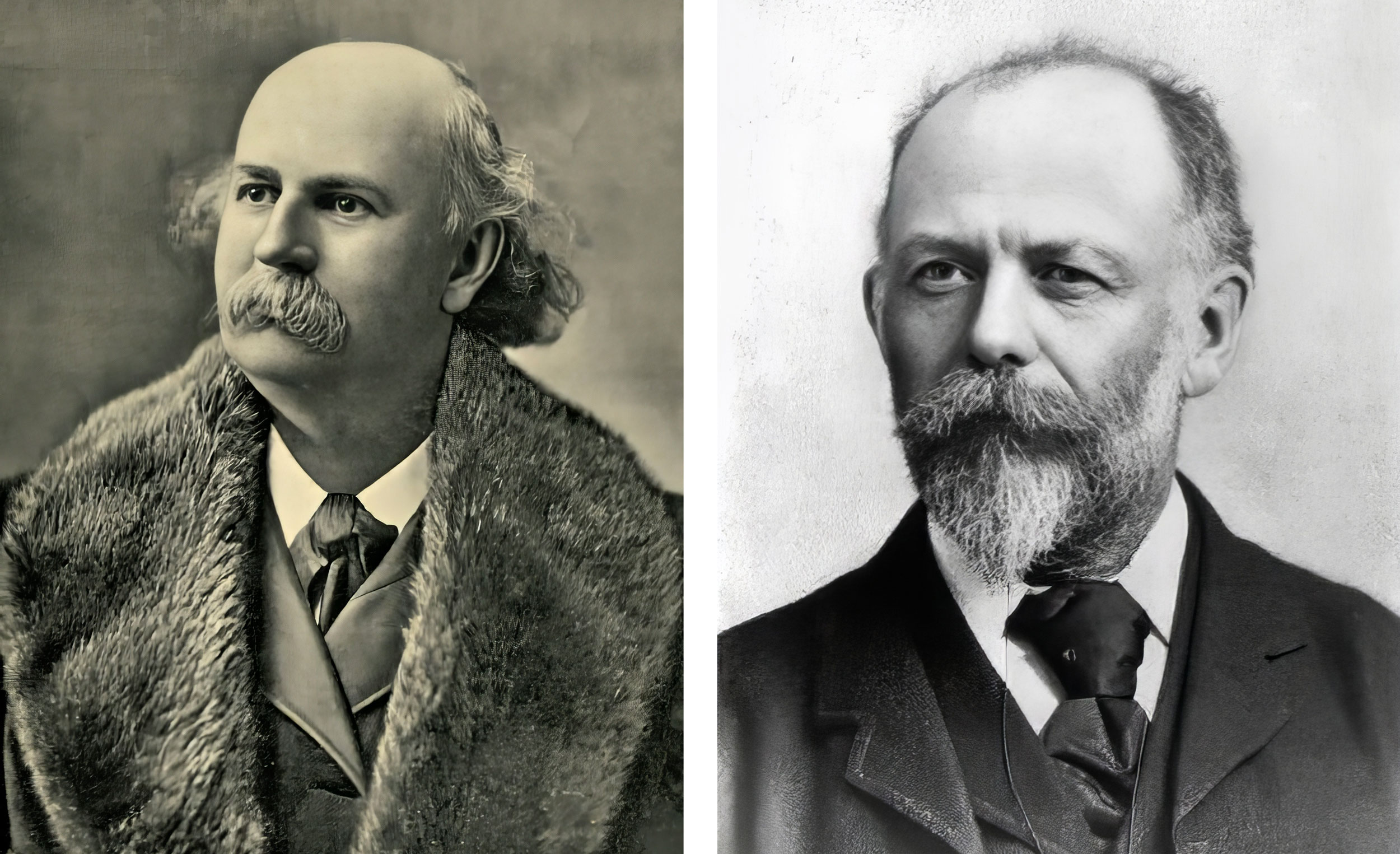
When United States consul in Edinburgh Wallace Bruce (left) learned Maggie McEwan’s story, he determined not only to help her receive a widow’s pension, but also to secure a “burial spot in Edinburgh for Scottish-American soldiers” like her late husband. Sculptor George E. Bissell (right) wrote that the freedman depicted in his Scottish-American monument was intended to be “a sturdy man; self-reliant, and equal to the duties and responsibilities of citizenship.”
Bruce chose sculptor George E. Bissell to design the monument. The son of a Connecticut quarry master, Bissell had served in the 23rd Connecticut Infantry before joining the Union navy, working as a paymaster in the South Atlantic Squadron. After the war, he worked in his father’s marble business in Poughkeepsie, New York, and began sculpting in clay and bronze. By the 1880s, he had developed a reputation for his Civil War memorials, including monuments in Colchester, Waterbury, Winsted, and Salisbury, Connecticut. Although he maintained a presence in Poughkeepsie, Bissell spent most of his time in Paris, where he lived and worked with other artists.
While Bruce decided on the monument’s theme, Bissell determined its composition and design. Bissell was probably familiar with Ball’s Emancipation Memorial—Ball and Bissell moved in the same social circles—and Bissell’s design for the Edinburgh monument shares many elements from Ball’s Emancipation. In 1915, Freeman H.M. Murray, a Washington, D.C, civil rights activist, journalist, and lecturer, and ally of Douglass, W.E.B. DuBois, and Ida B. Wells, compared the two statues. He noted that the Edinburgh statue was “somewhat similar to Ball’s,” but argued that Bissell’s work was a “distinct improvement over Ball’s; an improvement both in what it shows and what it omits.” He attributed the interpretative difference between the two monuments to the decades that separated their composition and changing ideas about the nature of emancipation. “In 1893 it could be realized that Emancipation was not wholly the personal work of Mr. Lincoln,” Murray argued. “While Emancipation was in scope an almost unparalleled benevolence,” it was “not so much an immediate and unmitigated blessing as a gradually unfolding opportunity.”
Like Ball’s version, Murray noted, Bissell’s Lincoln “holds the Emancipation Proclamation in his hand and is looking forward with the certitude born in the spirit which knows that the humane and noble cause for which he and the people are ready to make ‘the last great sacrifice of devotion’ would assuredly triumph.” It was in the depiction of the freedman that Murray saw the most significant difference between the two compositions. Murray argued that “Bissell’s Freedman is neither dazed nor exultant. He is, nevertheless, appreciative and thankful.” In his correspondence with the sculptor, Murray concluded that the freedman was “of a somewhat later time” than the Lincoln in the composition. While Lincoln is depicted as he was in 1863, the freedman had lived through the vicissitudes of Reconstruction and understood emancipation’s unfinished promise. Bissell wrote to Murray that the freedman was intended to be “a sturdy man; self-reliant, and equal to the duties and responsibilities of citizenship.” He is “full of gratitude” for Lincoln, who “with an impulsive gesture he calls the attention of the world to the man who was the author of the freedom of his race, and is an exemplar for all the rulers and law-makers that may follow.” Murray, who was born in Cleveland, Ohio, was interested in the Edinburgh statue for more than intellectual reasons. His father had been a Scottish immigrant disowned by his family for marrying a black woman, had enlisted in the Union army, and was killed just before Second Bull Run.6
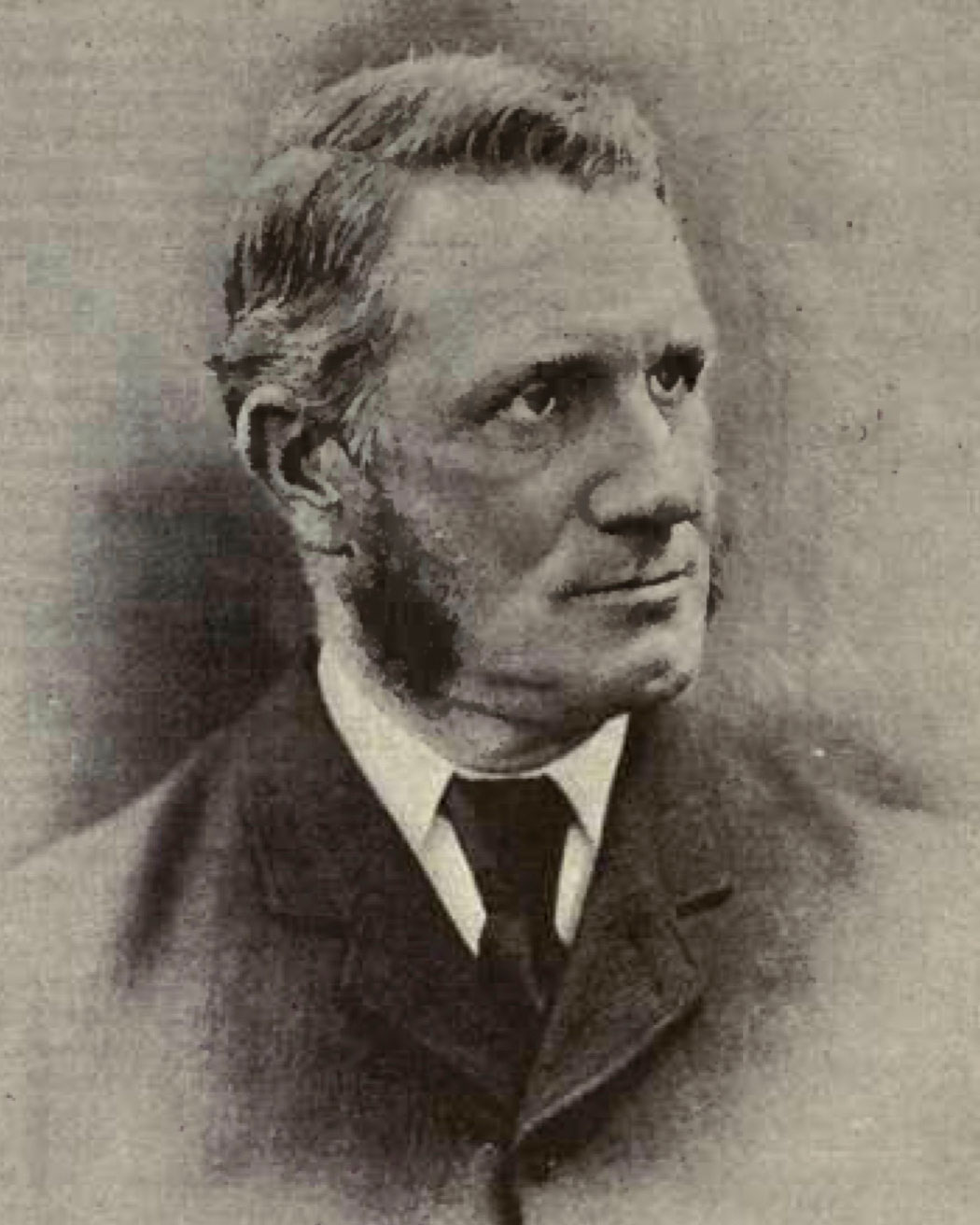 The Forth Bridge (1890)
Sir William Arrol
As a model for the freedman, Bissell hired the services of a man known to art historians as “Salem, Prince de Tombouctou.” Born in Algeria, Salem had joined the French Armée d’Afrique as a young man and subsequently relocated to Paris, where he served as a model for painters and sculptors for more than two decades. One contemporary described him as “a splendid specimen of a man.” The pose Bissell selected strongly resembled that used by his contemporary Adolphe Yvon in his painting Nègre agenouillé, étude de nègre (Kneeling Black Man, Study of a Black Man). Yvon also featured Salem in his painting Genius of America where he appears in the identical pose in a much larger scene.7
Having completed the sculptures in clay, Bissell arranged for Parisian founder E. Gruet Jeune to cast the statue and other bronze elements of the Edinburgh monument. Bissell also designed the red granite pedestal, but the job of constructing it fell to the Scottish firm of Stewart McGlashen & Son, the cheapest of the bids submitted for the project. (In 1903, Bissell sculpted a monument of Lincoln for Clermont, Iowa, that draws heavily on the Edinburgh statue, but without the freedman.)
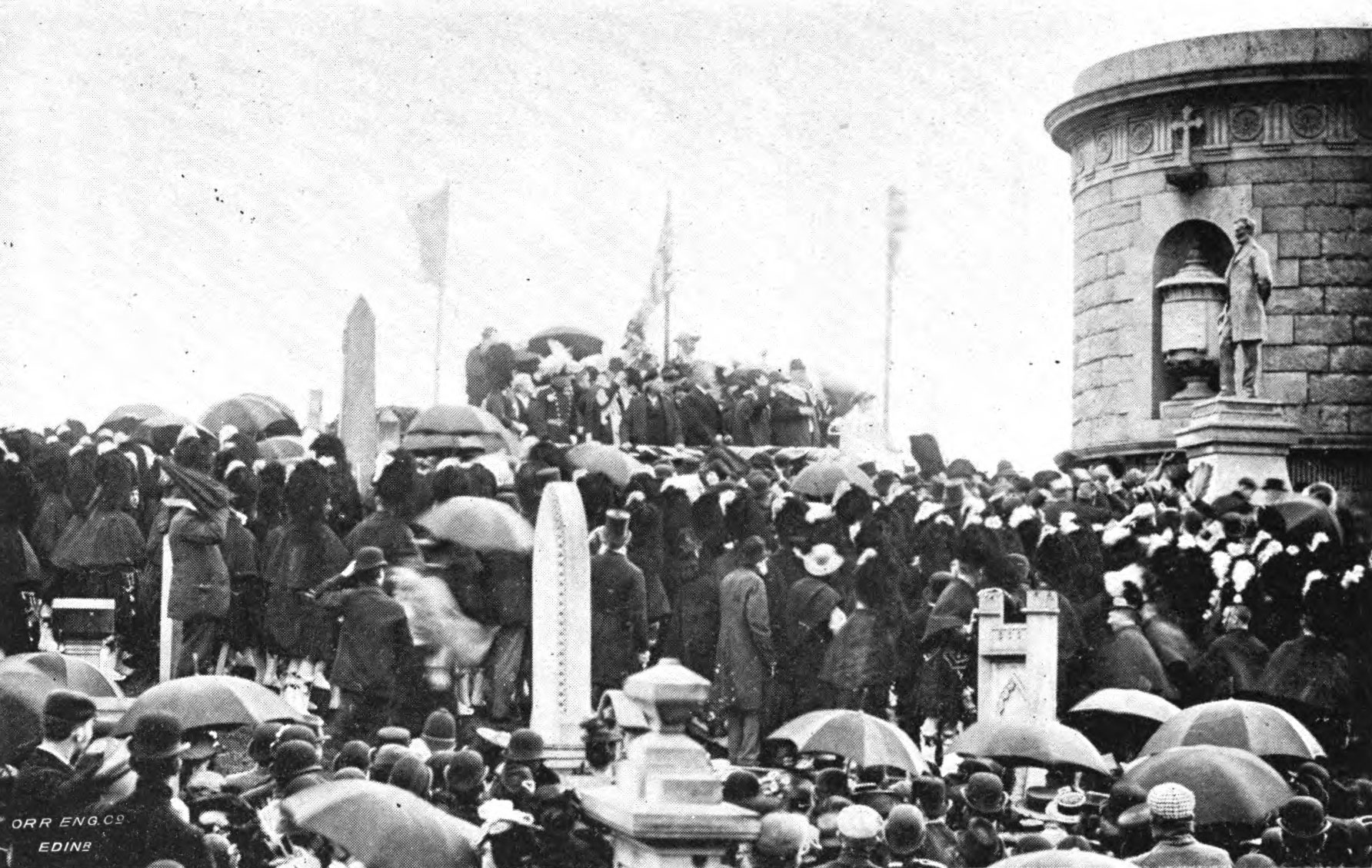
Bissell finished the commission just in time for the monument’s dedication on August 21, 1893, a date selected to coincide with the end of Wallace Bruce’s four-year term as consul. Travel delays prevented the participation of two of the scheduled speakers, New York Republican and former U.S. senator Chauncey Depew and Andrew D. Baird, former colonel of the largely Scottish 79th New York Infantry, the so-called Highland Regiment. At the height of Scotland summer, the weather that day was wet, windy, and cool, but despite the conditions, the crowd spilled out of the cramped burial ground onto Waterloo Place.
The ceremony began with the arrival of the regimental band of the Argyll and Sutherland Highlanders, some 250 strong, marching down from Edinburgh Castle, down the Mound, across Waverley Bridge, and up Princes Street, the bagpipes and drums audible well before they arrived at Calton Hill Burial Ground. Most of the dignitaries and speakers had come from the City Council Chambers on the Royal Mile, where Wallace Bruce had received a solid silver Loving Cup to commemorate his service as the American consul. They arrived to see the statue draped in the British and American flags. Nearby a small speakers’ platform had been erected, decorated with the Stars and Stripes, Union Jack, and Scottish Saltire, and fronted by an edging of heather.
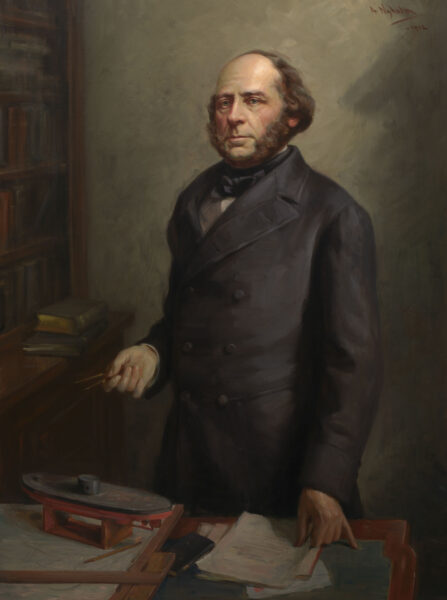
After a benediction by Rev. Robert Christie of Pennsylvania (born in St. Ninian’s, Scotland), a series of speakers addressed the crowd, each of whom articulated a different interpretation of what the monument symbolized. First to speak was engineer Sir William Arrol, famed for his recently completed Forth Bridge across the Firth of Forth. Arrol understood the monument as a symbol of the “great fight for freedom” that he hoped would inspire current and future generations of Scots to keep the flame of liberty alight. “There is one thing in Scotland that we have always been proud of, and that was our readiness to assist with and take part in any efforts for freedom and liberty,” he said. “We in Scotland always considered that we were the freest country in the world” and that “we are and always will be in the van of freedom.” Arrol understood Lincoln as “a great statesman—who stood up for freedom and liberty” and hoped that the monument would serve as “an object-lesson to all of Scotland” to continue the struggle for both.8
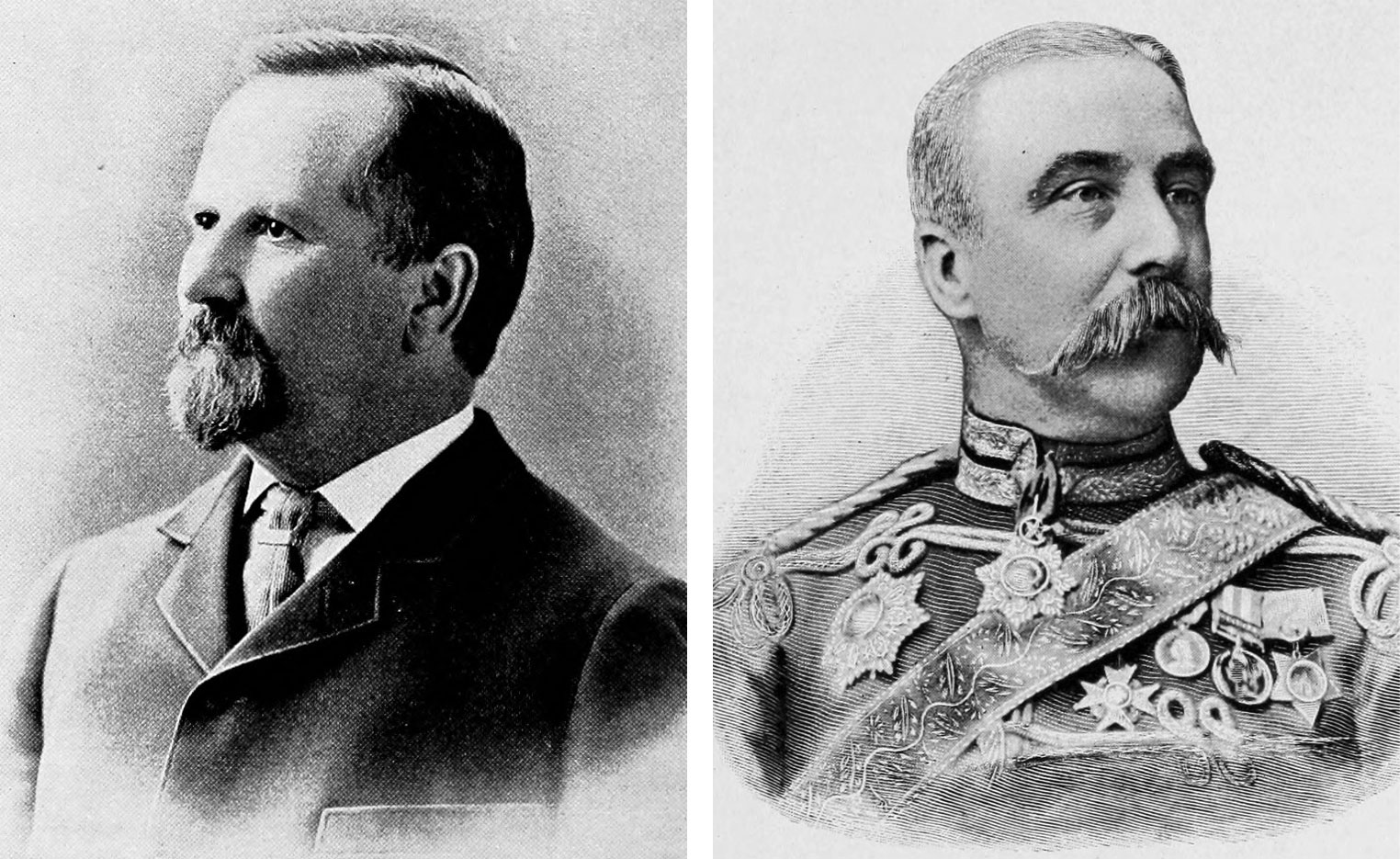 The Eagle and Brooklyn (1893) [Heath]; From Manassas to Appomattox (1896) [Fremantle]
Henry Roswell Heath (left) and Sir Arthur James Lyon Fremantle
Heath next addressed the crowd. As a representative of the GAR, Heath understood the “first monument erected to Abraham Lincoln in Europe” as testament to the “two hundred thousand [Union] veterans” of “our great American Civil War … now scattered over a great continent, with representatives in every part of the globe.” As historian Damian Shiels had recently demonstrated, federal pension records document a global diaspora of Union veterans and their families in the decades after the conflict. These international veterans had become invisible and forgotten in the monumental landscape stateside, and Heath was glad that their service and sacrifice would now be recognized and honored.9
After Heath finished, the time had come for the monument’s unveiling. Clara Bruce, the consul’s daughter, dressed in a flowing white gown and a gold band on her head, removed the American and British flags that draped the statue. As the Highland regimental band played “Hail Columbia” and “Rule Britannia,” Bissell stepped forward to accept the crowd’s accolades.
They cheered not only for the beauty of the monument, but also for the five Union soldiers from Scotland whose names, beginning with John McEwan’s, appeared on the side of the pedestal. Other than McEwan, it is unclear how the names of the other four veterans were selected. The list includes their regimental affiliation and rank, but not their birth and death dates. Like McEwan, they all had been born in Scotland, returned to their native land, and died there. Bruce probably obtained their names from the pension office, as their wives had all applied for and received widow’s pensions. (In 1993, on the monument’s centenary, a sixth name was added on the opposite side of the monument: Alexander Smith of the 66th New York Infantry. He appears to be the only Civil War veteran actually interred at the site.)
After the unveiling, Consul Bruce delivered the day’s longest speech. He situated the monument in the millennia-long struggle for freedom. “The course of individual liberty has been onward and upward,” he argued, “from Marathon and Plataea to the last struggle for human rights.” A proper historian, Bruce claimed, “traces the torch of liberty from country to country, from century to century.” Eventually Bruce highlighted what he saw as the specific meaning of the new monument. First, it was a “monument in memory of Scottish soldiers … brave who fought there for freedom.” Second, it was a monument to Lincoln, “last great martyr in the cause of Saxon freedom—an honest man, who saved us in the hour of our peril.” He was proud of the “happy location for this monument—the first ever erected to Lincoln in Europe—in the most beautiful city in the world.” Bruce had intended to read his own 16-verse poem, “Columbia’s Garland,” but was prevented by the inclement weather.10
Accepting the monument on behalf of the City of Edinburgh, Russell the Lord Provost (the equivalent of mayor) thanked Bruce, praising the statue and the nation it honored. “It is a monument to freedom,” he said. “We are deeply interested in the United States; we are materially interested in the United States; we are morally interested in the United States.” He promised that “we shall guard it carefully and see that it suffers no loss.” Once the Lord Provost had finished, the Highland regimental band played “Auld Lang Syne.”11
Among the last to speak was General Sir Arthur James Lyon Fremantle, who had toured American battlefields in 1863 as a military observer. Thirty years later he commanded the British forces in Scotland and was stationed at Edinburgh Castle. Fremantle praised Arrol, claiming that “our friends in America will appreciate the fact of so great and good a man” participating in the monument’s dedication. With a few final words by Arrol and Bruce, the event concluded. The dignitaries retired to the Waterloo Hotel immediately next to Calton Hill Burial Ground for an evening of drinking, toasts, and singing.12
If Margaret McEwan or any of their children attended the dedication, newspaper accounts did not mention it. After receiving her widow’s pension in September 1890, Maggie and her children continued to live in Edinburgh, where she found work as a confectioner. Her meagre wages, supplemented with her widow’s pension, barely kept her out of the poorhouse. At the time of the monument’s dedication, she was planning to leave Scotland. In October 1893, she and her youngest children boarded a ship in Glasgow bound for New York. They lived in the Chicago area for a few years before moving to San Mateo, California. Maggie died in San Francisco in 1913.
 The Lincoln Monument (1893)
A crowd of onlookers and dignitaries views the Scottish-American monument after its unveiling in Edinburgh on August 21, 1893.
During my time teaching in Edinburgh, I often brought students to the monument at the end of the semester, telling them the story of its origins. Although most of them had studied in the city for several years before taking my class, few had visited the site before, despite its proximity to the city center and campus. The monument and the story behind it provided a wonderful opportunity to connect many of the major themes and topics we had studied all year: the importance of emancipation, the experience of soldiers and veterans, the Civil War’s international dimensions, and historical memory and commemoration, among others. For many students, especially those who had never visited the United States, seeing the monument brought the conflict to life in a way that the classroom cannot.
David Silkenat is the Richard J. Milbauer Chair of Southern History at the University of Florida. He is the author of four books, including Raising the White Flag: How Surrender Defined the American Civil War (2019) and Scars on the Land: An Environmental History of Slavery in the American South (2022).
Notes
1. Lincoln’s actual words to Hahn were, “I barely suggest for your private consideration, whether some of the colored people may not be let in—as, for instance, the very intelligent, and especially those who have fought gallantly in our ranks. They would probably help, in some trying time to come, to keep the jewel of liberty within the family of freedom.” Abraham Lincoln to Governor Michael Hahn, March 13, 1864, Abraham Lincoln Papers, Library of Congress.
2. The Lincoln Monument: Unveiled in Edinburgh August 21, 1893 in Memory of Scottish-American Soldiers (Edinburgh, 1893), 92–93.
3. Ibid., 82–83.
4. Ibid., 83.
5. Ibid., 84, 88–91.
6. Freeman Henry Morris Murray, Emancipation and the Freed in American Sculpture (Washington, D.C., 1916), 32–36.
7. Susan Waller, “Salem, the Prince of Tombouctou: A North African Model in Nineteenth Century Paris,” Nineteenth-Century Art Worldwide 21 (2022): (19thc-artworldwide.org/autumn22/waller-on-salem-the-prince-of-tombouctou-a-north-african-model).
8. The Lincoln Monument, 10–11.
9. Ibid., 12–14.
10. Ibid., 15–22.
11. Ibid., 22–24.
12. Ibid., 25.
Related topics: Abraham Lincoln