A hardtack cracker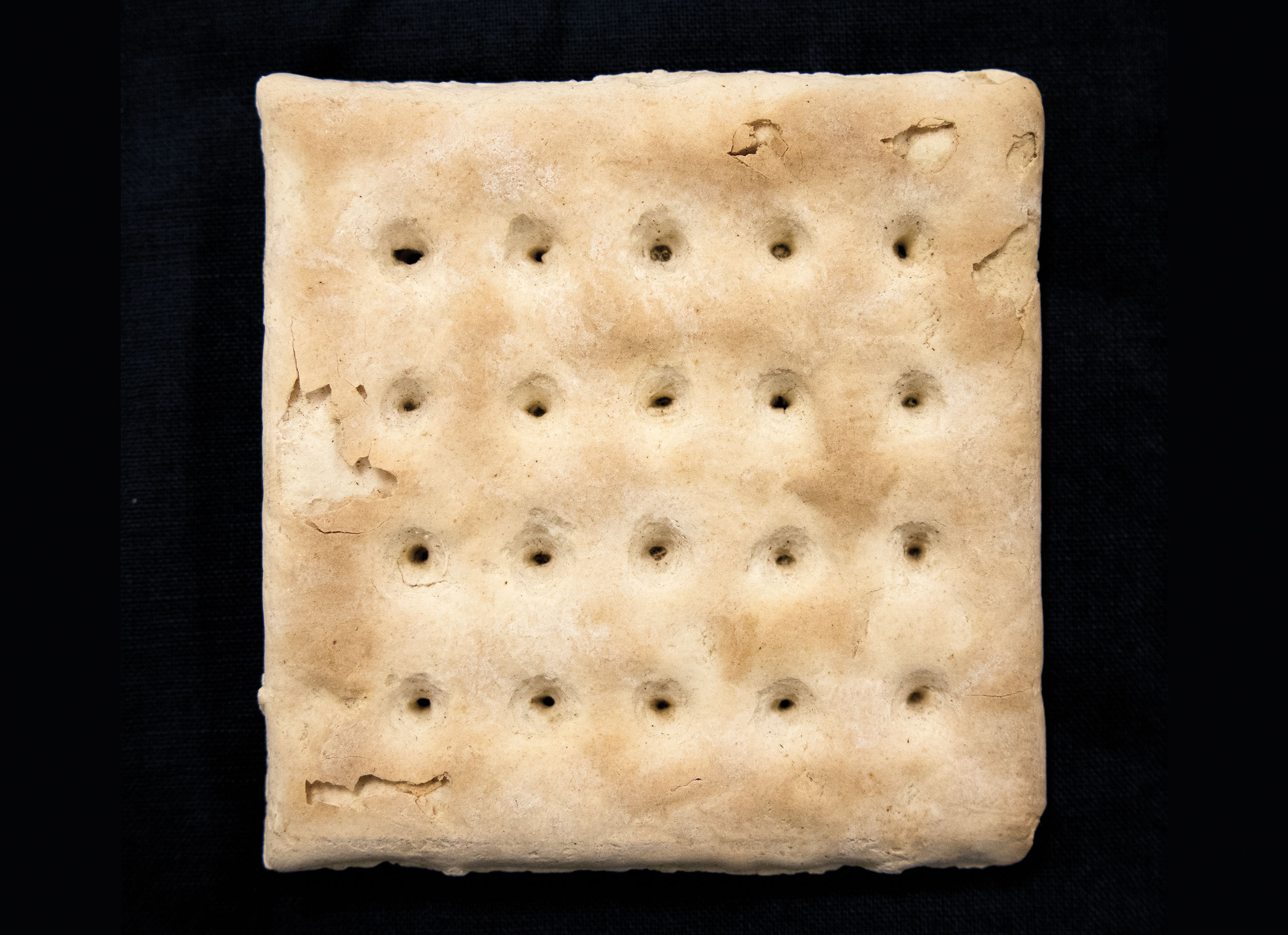 Jennifer Weaver / courtesy of the Gettysburg Foundation
“’Tis the song and sigh of the hungry, / Hard crackers, hard crackers, come again no more! / Many days have you lingered upon our stomachs sore, / O hard crackers, come again no more!”
So went the chorus of a popular army tune about hardtack, the infamous hard bread that was a staple of the Union soldier’s daily ration. Made from a simple recipe of flour, water, and (sometimes) salt, hardtack was, according to U.S. Army specifications, meant to be “white, crisp, light, and exhibit a flaky appearance when broken.”
In truth, the crackers that reached the soldiers—whether the result of subpar ingredients, poor preparation, or improper storage—were often moldy, riddled with maggots and weevils, or, most often, “so hard that they could not be bitten,” as one Union soldier put it. Those who did not want to risk their teeth might soak their hardtack in coffee or water, crumble it and add it to soup, or fry it in pork fat (creating a dish called “skillygalee”).
By war’s end, civilian and government bakeries had produced untold millions of the inexpensive, easily transportable crackers for the Union army. Above we highlight several figures pertaining to the notorious “teeth dullers,” including statistics related to hardtack production at the U.S. military bakery in Jeffersonville, Indiana.
Hardtack by the Numbers
3 ⅛″ x 2 ⅞″ x ½″ | Dimensions of an average piece of hardtack
1.6–1.8 | Weight, in ounces, of an average piece of hardtack
9–10 | Pieces of hardtack each Union soldier was to receive as part of his daily “camp” ration
3–12 | Number of months that properly prepared hardtack was expected to keep
Hardtack production and costs at the U.S. military bakery in Jeffersonville, Indiana, between May 1863 and August 1865:
27,500,536 | Pounds of hardtack produced
149,429 | Barrels of flour used
20,491 | Bushels of coal used
5,990.5 | Cords of wood used
512,710 | Barrels and packing boxes used
$1,311,609.19 | Jeffersonville bakery’s total operating costs
$285,751.57 | Jeffersonville bakery’s net profits
Sources
H.C. Symonds, Report of a Commissary of Subsistence, 1861–5 (1888); John D. Billings, Hardtack and Coffee (1887); C.L. Kilburn, Notes for Preparing Stores for the United States Army (1863). The hardtack shown is from the collection of the Civil War Museum of Philadelphia (CWMP 86.26.56).
Related topics: food and drink