 Library of Congress
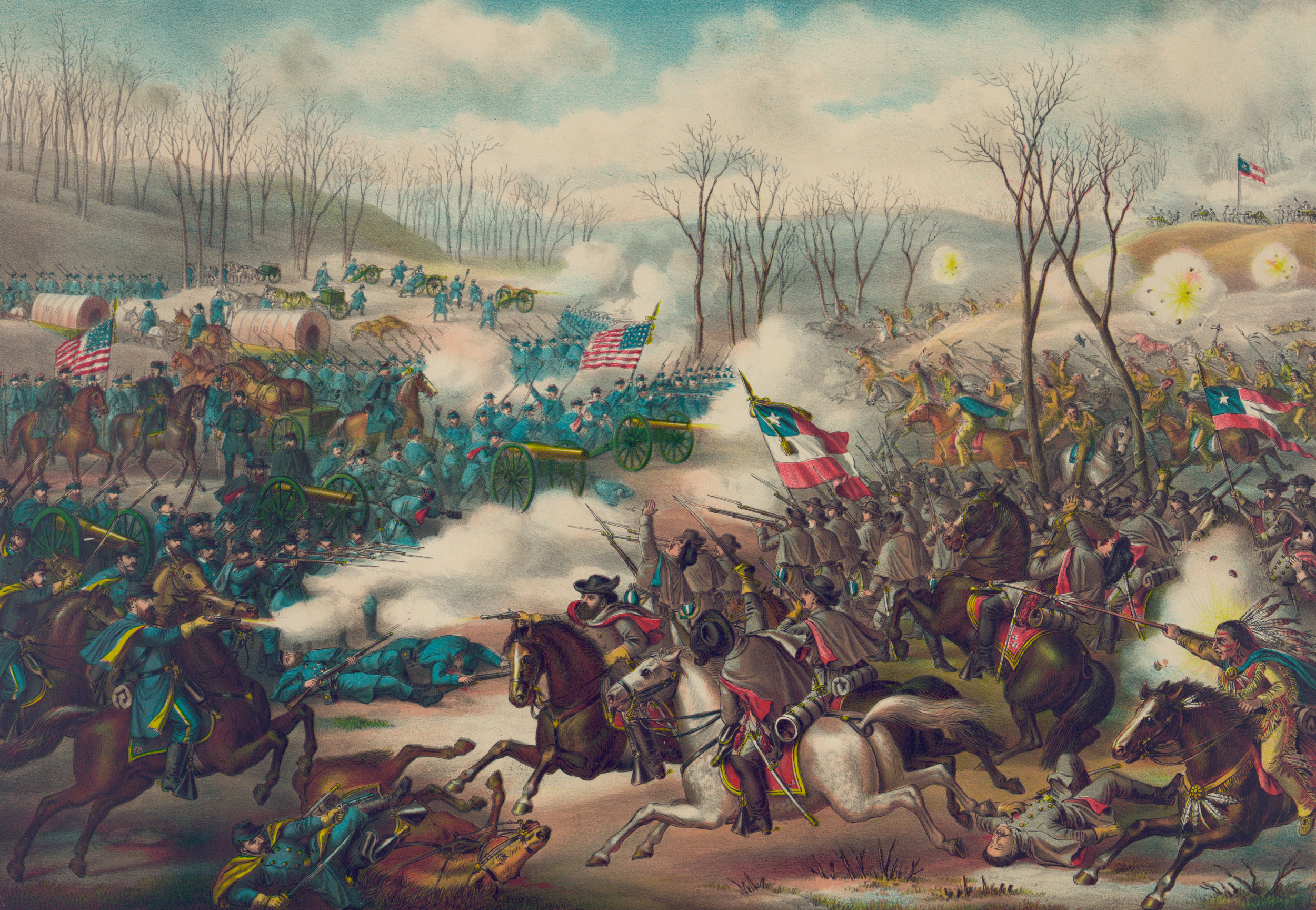
This Kurz & Allison chromolithograph depicts the Battle of Pea Ridge, Arkansas, where a bold decision by Confederate general Benjamin McCulloch led to his death.
The first shot that struck Brigadier General Benjamin McCulloch at Pea Ridge on the morning of March 7, 1862, would have sounded no different from the thousands already echoing through the Arkansas woods. The battlefield had dissolved into chaos, with confused lines of men who often had only the faintest idea where friend or enemy stood. McCulloch was on horseback, peering through the trees to discover what Federal forces lay before him. A Union skirmisher raised his rifle and fired. Within moments, one of the Confederacy’s most experienced officers lay dead.
McCulloch’s death may be thought of as a random moment of battlefield chance. Bullets have no conscience, and generals in the wrong place at the wrong time can stop a bullet as readily as a private. Yet chance alone cannot explain why McCulloch exposed himself so completely. His death emerged from a series of human decisions, each one understandable by itself, yet devastating when connected. Those choices were made by McCulloch, his fellow commanders, and by the officers who struggled to command armies across terrain that made certainty impossible.
 The Life and Services of Gen. Ben McCulloch (1888)
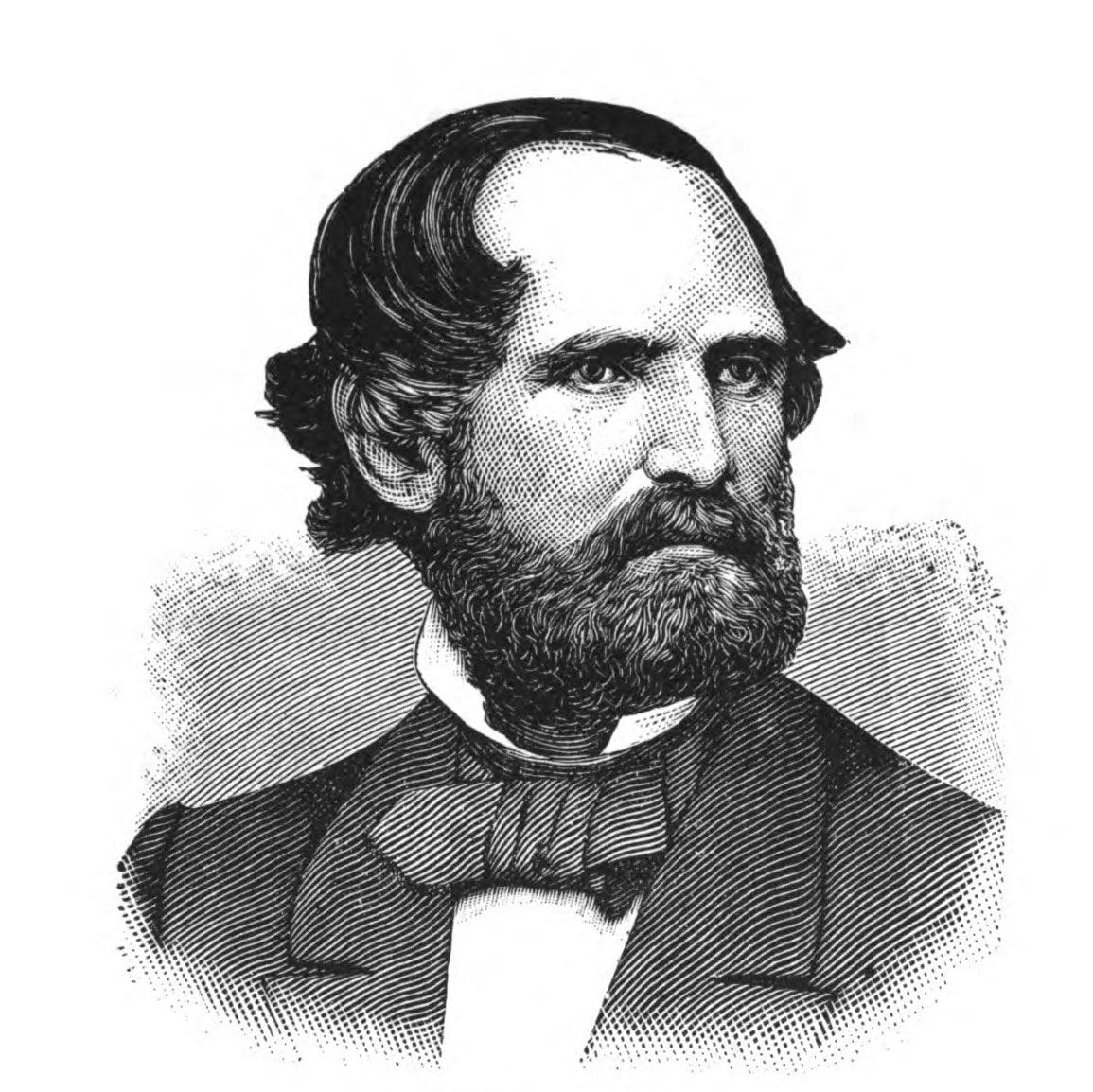
Benjamin McCulloch
Ben McCulloch hardly fit the image of a polished military commander. He was born in Tennessee and, as a child, idolized his neighbor Dave Crockett. In his 20s he followed Crockett to Texas, where he hunted, surveyed, filibustered, mined, served as a Texas Ranger, fought during the Texas Revolution, battled Native Americans, and gained national fame during the Mexican-American War. By the outbreak of the Civil War, he was a rising star.
All of that shaped McCulloch, who distrusted rigid systems of command, disliked hierarchy, and refused to wear a military uniform. He was intelligent, well-read, and highly experienced, and preferred seeing situations with his own eyes before making important decisions. The habits that had served McCulloch well in frontier fighting, where engagements often involved relatively small forces moving across wide expanses, formed a reservoir of judgment that had saved his life and the lives of his men more than once. These habits also seemed to translate into battlefield success, as demonstrated in his strong performance at the Battle of Wilson’s Creek in August 1861. Unfortunately, they would also be his undoing.1
The Battle of Pea Ridge began as an ambitious Confederate effort to recover Missouri from Union forces and restore Confederate military momentum west of the Mississippi River. Major General Earl Van Dorn commanded roughly 16,000 Confederate soldiers against about 10,500 Federals under Brigadier General Samuel Curtis. Van Dorn intended to launch a bold turning movement around Curtis’ right flank before attacking the enemy from the rear, destroying the Union army, then advancing north from Arkansas into Missouri.
 The Life and Services of Gen. Ben McCulloch (1888)
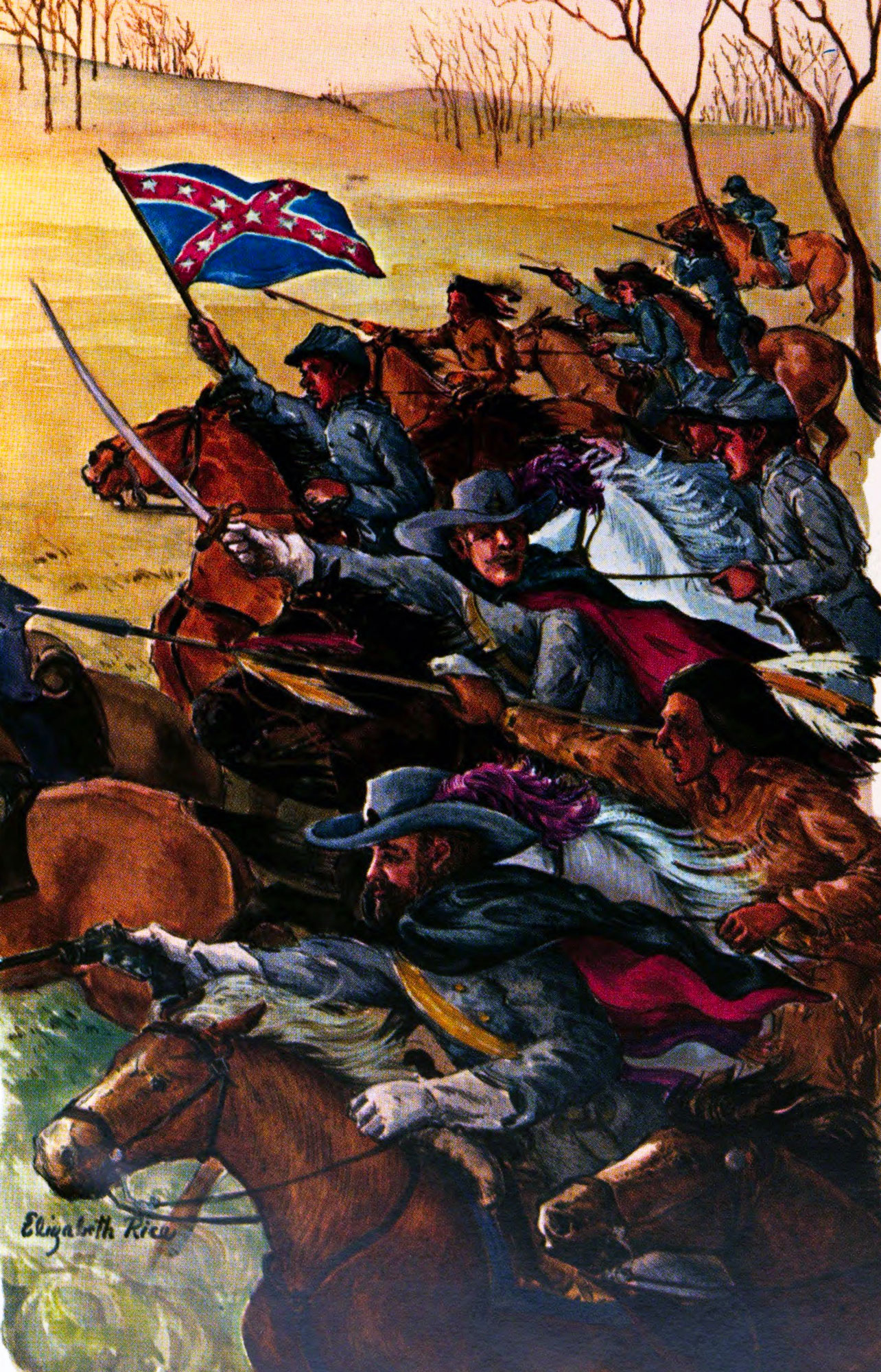
A mid-20th-century depiction of the Battle of Pea Ridge
The plan looked impressive on paper, but its execution demanded extraordinary coordination, something the ragtag Confederate army could not accomplish even under ideal circumstances. Van Dorn divided his army into two wings; McCulloch commanded one, a mixed division of Arkansas, Louisiana, and Texas men, along with Confederate-aligned Native Americans, while Major General Sterling Price led the other, consisting primarily of Missourians. Dense forests, rough Ozarks terrain, delayed marches, short supplies, and brutal cold disrupted Van Dorn’s aggressive timetable. By March 7, the Confederates had reached their objectives—at different times, hungry and footsore, and with only a partial understanding of where supporting forces stood.2
Even before the shooting started, command decisions had narrowed McCulloch’s options. Van Dorn’s ambitious operational design established the conditions that shaped every later choice. He expected the separated wings to maintain momentum and coordination despite limited staff work, poor maps, and primitive communications. Orders traveled slowly. Couriers became lost. Commanders often relied on assumptions rather than confirmed information.
This mattered enormously once fighting erupted near the tiny hamlet of Leetown, near the Federal army’s supply line, where McCulloch believed only small Federal detachments blocked his advance. Instead, Union colonel Peter J. Osterhaus had moved his mixed force of infantry, cavalry, and 12 guns aggressively to investigate reports of Confederate activity, while additional Federal reinforcements drew near. What began as an attempted reconnaissance by McCulloch’s wing quickly expanded into a significant engagement.3
McCulloch reacted cautiously at first. Attacking blindly through wooded terrain invited disaster, and the ground near Leetown was difficult; careful use of his artillery paid off as McCulloch’s gunners were able to push portions of the Federal line back.4
Although McCulloch’s judgment to that point was sound enough, his next decision was the fatal one. Fighting a battle without a clear understanding of the enemy’s strength and location often leads to defeat. McCulloch surely understood this and seems to have thought personal reconnaissance would produce better information than conflicting reports delivered by subordinates. If he could not get a clear picture of things from his subordinates, then the best option, to McCulloch, was to ride forward and see for himself.
Modern readers may wonder why a general entertained such obvious danger. The answer lies partly in Civil War command culture. Generals frequently led from the front because battlefield communications remained painfully limited. Signal systems were primitive. Dense woods rendered flags useless. Smoke concealed troop movements. Written orders consumed precious time. Officers often believed direct observation represented the fastest path to accurate decisions.
McCulloch also trusted his own judgment more than scattered secondhand reports. So, following his instincts, at about 10:30 a.m. he mounted up and began preparing a scouting expedition. According to historian Thomas Cutrer, McCulloch told staff officers Lunsford L. Lomax and Frank C. Armstrong, “I will ride forward a little and reconnoiter the enemy’s position.” While unwise, his decision was not reckless. Before he left, McCulloch ordered his staff to remain behind, telling them, “Your gray horses will attract the fire of the sharpshooters.”5 He knew he had to be careful, and did not wish to put his staff in unnecessary danger.
McCulloch rode forward and paused on a brushy height to observe the Federal lines. Union soldiers from the 36th Illinois Infantry had occupied concealed positions among the far trees, and they quickly spotted a mounted Confederate officer moving through the brush. “In a moment,” according to one witness, “was heard a volley, fired from at least twenty-five rifles.” At least one of the Federal skirmishers’ musket balls, perhaps fired by Private Peter Pelican, struck McCulloch and also wounded his horse. McCulloch slumped from the saddle and died almost instantly.6
The consequences extended far beyond one man’s death. Command rarely survives sudden decapitation without confusion. McCulloch had issued no detailed succession plan for the immediate tactical situation unfolding around Leetown. Brigadier General James McIntosh, a cavalryman, assumed command of McCulloch’s wing according to seniority. Rather than pause long enough to establish control over scattered units, McIntosh ordered an aggressive charge intended to recover the initiative, as well as McCulloch’s body.7
McIntosh’s decision reflected courage, but like McCulloch’s, it also reflected incomplete information. McIntosh soon rode into heavy Federal fire and was killed at the head of the charge. Within a remarkably short span, the wing had lost its commanding general and his immediate successor. Responsibility next passed to Colonel Louis Hébert, who possessed little understanding of the broader battlefield situation because he had focused on directing his own brigade. Hébert advanced through the woods searching for the enemy, became isolated, and was eventually taken prisoner. Command of McCulloch’s wing effectively collapsed.8
McCulloch’s and McIntosh’s deaths froze Confederate momentum precisely when coordinated pressure might have overwhelmed Federal resistance around Leetown. Brigades waited for orders that never arrived. Some units continued fighting independently. Others halted altogether because no one could determine the larger plan. Van Dorn, operating elsewhere on the battlefield, remained unaware for hours that an entire wing of his army had essentially ceased functioning as an organized force.9 The following day, the battle at Pea Ridge ended in a decisive Confederate defeat.
McCulloch had confronted uncertainty with courage, and his solution reflected habits he had developed over decades on the frontier. Battles are shaped first by people making difficult decisions with limited knowledge, convinced that one more step forward will reveal the truth. But in this case, long habits cultivated through hard experience failed to match the requirements for commanding a large Civil War army. At Pea Ridge, Benjamin McCulloch took a risk and a step too many.
Andrew S. Bledsoe is professor of history at Lee University in Cleveland, Tennessee. He is the author of Citizen-Officers: The Union and Confederate Volunteer Junior Officer Corps in the American Civil War (Louisiana State University Press, 2015); co-editor, with Andrew F. Lang, of Upon the Field of Battle: Essays on the Military History of America’s Civil War (LSU Press, 2019); and author most recently of Decisions at Franklin: The Nineteen Critical Decisions That Defined the Battle (University of Tennessee Press, 2023).
Notes
1. John Henry Brown, ed., The Encyclopedia of the New West (Marshall, TX, 1881), 296; Thomas W. Cutrer, “Ben McCulloch: Texas Ranger and Confederate General,” Handbook of Texas Online, tshaonline.org/handbook/entries/mcculloch-benjamin (Accessed June 3, 2026).
2. United States War Department, The War of the Rebellion: A Compilation of the Official Records 129 vols. (Washington, 1880–1901), Series 1, Volume 8, 286–287 (hereafter cited as OR).
3. OR, Series 1, Volume 8, 211-213.
4. Ibid., Series 1, Volume 8, 298-299.
5. Thomas W. Cutrer, Ben McCulloch and the Frontier Military Tradition (Chapel Hill, 1993), 303–304.
6. Ibid., 305; OR, Series 1, Volume 8, 217–218, 226.
7. OR, Series 1, Volume 8, 286, 303.
8. Ibid., Series 1, Volume 8, 289.
9. Ibid., Series 1, Volume 8, 295.