 Library of Congress
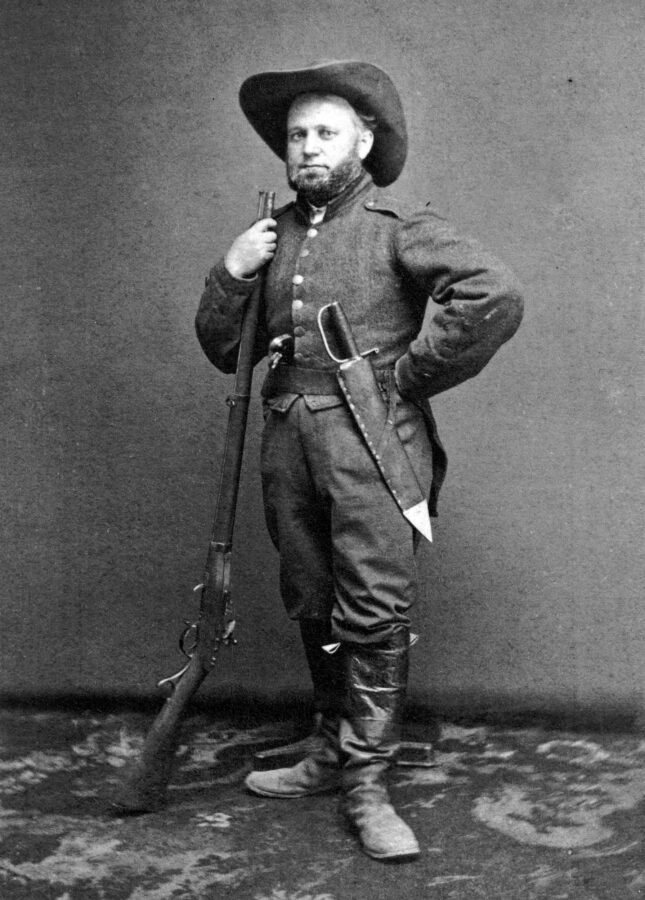
A soldier from Alabama poses with his rifle and Bowie knife, an intimidating blade carried by many Confederate soldiers as a personal weapon.
Arkansas Toothpick | noun | { common } A Bowie-knife of a peculiar kind, the blade of which shuts up into the handle.1
On September 19, 1827, about a dozen men gathered on an isolated sandbar in the middle of the Mississippi River—a neutral piece of land outside the jurisdiction of Mississippi and its neighboring state Louisiana. Seeking to settle a long-standing quarrel, Thomas H. Maddox and Samuel Levi Wells arrived with dueling pistols in hand and supporters in tow. The duel concluded with two errant shots missing their marks, but tempers remained high among the partisans, many of whom held personal grudges against one or more of the others. Someone fired, and a melee broke out. James Bowie, bleeding from gunshot and stab wounds, rushed at his rival with a long knife and may have disemboweled him. In the end, two men lay dead and three wounded. The “Sandbar Fight,” along with Bowie and his large knife, became legendary American icons.2
Bowie, a well-known frontiersman and soldier famously killed in 1836 at the Battle of the Alamo, certainly carried a knife in the 1820s, but history cannot definitely tell us what type of knife he carried on September 19, 1827 (if, in fact, the duel occurred on that date). It may have been a large butcher knife rather than the first “Bowie knife.” Although probably a falsehood or piece of urban legend, the Bowie knife’s origin story is often traced back to the Sandbar Fight. Yet convincing counternarratives exist. A Bowie descendant claimed that the hunting knife was first owned by Rezin Bowie, James Bowie’s father, and crafted by his plantation blacksmith Jesse Cliffe, while another branch of the family credits James’ older brother Rezin (or Reason) P. Bowie with the design.3 In the 1890s, William F. Pope, a former Arkansas judge, connected the knife’s origins to his home state. (The Bowie brothers were, by the way, Louisianans.) Rezin P. Bowie, Pope contended, “was a keen lover of the chase” who hired a blacksmith named James Black in Washington, Arkansas, “to make a hunting-knife after a certain pattern of his own designing.” Having whittled his design plan on the top of a cigar box, Rezin P. Bowie “told the smith that he wanted a knife that would disjoint the bones of a bear or deer without gapping or turning the edge of the blade.” Deeply impressed with the final product, Bowie paid the blacksmith fifty dollars—forty more than the knife had cost. According to Pope, “no genuine Bowie-knives have ever been made outside the State of Arkansas, for when Black died … his secret of tempering the steel, which was the main point of excellence of the Bowie-knife, died with him.” Eliminating the distinction between a Bowie knife and its variants, Pope continued, “the Bowie was sometimes called an ‘Arkansas toothpick,’ and Arkansas is occasionally sneeringly referred to as the ‘Toothpick State.’”4
Like many frontier states, Arkansas had a reputation for lawlessness. One of the earliest recorded mentions of a Bowie knife appeared in an 1835 letter. Capturing the sentiment of northeasterners, a man from Boston, Massachusetts, wrote “the good people here absolutely shudder at the bare mention of Arkansas. Bowie knives, Jude Lynch, Captain Slick, negro insurrections, duelists, horse thieves, Indian savages, frontiers—very awful!”5 Two years later in December 1837, the Arkansas Legislature cemented the bloodthirsty reputation when John Wilson, the speaker of the General Assembly, fatally stabbed Representative Joseph J. Anthony.6 Newspapers across the United States covered the incident. Decades later in 1889, famed abolitionist Frederick Douglass recalled, “some forty years ago a killing occurred in the halls of your legislature, in which an honored citizen was almost dissected by a bowie-knife, and the evil repute cast abroad by that event yet clings around the fair name of your state.”7
Irrespective of its origin stories, the knife became immensely popular on the antebellum frontier and in the American South. In the 1850s, white men of Kansas Territory were often “ornamented with a couple of navy revolvers, and in addition a Sharp’s rifle was hanging from his side. Occasionally might be seen a large bowie knife or an ‘Arkansas toothpick,’ as they were sometimes classed; the boots forming the scabbard, the handle of the frightful weapon stuck out a few inches above the tops which were generally of red leather.”8 Visitors to Columbus, Georgia, “observed also, what to us was a novelty, the open sale of dirks, bowie-knives, and a long kind of stiletto, called the ‘Arkansas toothpick.’ These are sold by druggists, in whose shops or stores these deadly weapons are hung up for public inspect, and sold by them as part of the legitimate wares of their calling; thus plainly indicating, that weapons to kill, as well as medicine to cure, could be had at the same shop; and placing beside the deadly poisons of arsenic, laudanum, hemlock, and hellebore, the deadly weapons of no less fatal power.”9
Recognizing the Arkansas toothpick’s lethal potential, state legislatures enacted laws curtailing the use of sharp knives. On May 13, 1837, Mississippi passed the first law restricting Bowie knives. Aimed at preventing dueling, the law mandated a fine of no less than $300 to any person found fighting with “rifle, shot gun, sword, sword cane, pistol, dirk, bowie knife, dirk knife, or any other deadly weapon.” If a mortal conflict, the offending party “may also be prosecuted and convicted as in other cases of murder.”10 Just a few weeks after Representative Anthony had been fatally stabbed, the Tennessee Legislature passed a statute that forbade the sale or transfer of “any Bowie knife or knives, or Arkansas tooth picks, or any knife or weapon that shall in form, shape or size resemble a Bowie knife or any Arkansas tooth pick.” In addition, the law made it a felony for any person to “maliciously draw or attempt to draw” a concealed knife “for the purpose of sticking, cutting, awing, or intimidating any other person.”11 In 1841, Mississippi began taxing Bowie knives and the state’s property tax included “one dollar on each and every Bowie Knife.”12 In 1854, the scope of the law was expanded to include a one dollar tax on any “Arkansas tooth-pick, sword cane, dueling or pocket pistol.”13 Other southern states adopted similar legislation to prohibit, regulate, or tax large knives, and many states had laws on the books by the late 1850s.
Among white men in the South, knives assumed a symbolic importance in the fight for slavery’s expansion West. The Kansas-Nebraska Act passed by Congress in 1854 gave settlers the power of popular sovereignty to determine the future of slavery in the western territories. Pro-slavery advocates quickly adopted the Bowie knife as a weapon of choice in their bloody battle for control of Kansas. According to historian Jason Phillips, “Jutting from belts in defiance of social propriety, bowies celebrated wildness, adventure, honor, and physical violence. Bowie-knife politics crossed lines and broke laws to assert the supremacy of Southern white men.”14 Southern statesmen wielded knives in the legislatures while armed voters cast their pro-slavery ballots at polling places. In Kansas City, border ruffian leader John Stringfellow vowed to “mark every scoundrel that was the least tainted with Freesoilism or Abolitionism” and “enter every election district in Kansas … and vote at the point of the bowie-knife and the revolver.”15
These weapons had some military utility, and Civil War soldiers North and South prized their Bowie knives and Arkansas Toothpicks. At the start of the conflict, the Alabama Legislature allocated $6,000 for the purchase of 1,000 “Bowie-knife shaped pikes” and 1,000 Bowie knives for the 48th Regiment, Alabama Militia.16 Large knives of various makes and models were especially popular as personal weapons among Confederate soldiers, frontier troops, and guerrilla forces. While serving in Missouri in 1861, Union general John Charles Frémont and his troops encountered a western guide “armed with a huge bowie-knife, which he carried slung like a sword. It was at least two feet long, heavy as a butcher’s cleaver, and was thrust into a sheath of undressed hide. He classed this pleasant instrument an Arkansas toothpick.”17
Having entered into the American lexicon, both Bowie knives and Arkansas Toothpicks appeared regularly in late-19th-century publications. And, unlike in the antebellum era, Americans began to draw sharp distinctions between Bowie knives and Arkansas Toothpicks. Considered a “formidable weapon,” the Bowie knife featured a long, narrow blade that was “over a foot long and two inches broad.” However, Maximilian Schele de Vere’s Americanisms: The English of the New World described the Arkansas Toothpick as a variety of knife that “can shut up into the handle,” which made it “more easily worn on the body.”18 Today few Americans own or carry a Bowie knife or Arkansas Toothpick, but the knives have been immortalized in our nation’s history. 
Tracy L. Barnett is visiting assistant professor of History at Old Dominion University in Norfolk, Virginia. She earned her doctorate in American History from the University of Georgia this year. Firearms—their meaning to men and their availability in 19th-century America—are at the center of her scholarship.
Notes
1. John Russell Bartlett, Dictionary of Americanisms: A Glossary of Words and Phrases Usually Regarded as Peculiar to the United States (Boston, 1860), 12.
2. Robert F. Scott, “Who Invented the Bowie Knife?” American Speech, Vol. 12, No. 1 (February 1937): 197–198; “Sandbar Fight in Early Days on Mississippi Told,” The Town Talk (Alexandria, Louisiana), May 7, 1945.
3. Scott, “Who Invented the Bowie Knife?,” 197–198.
4. Spelling of Rezin P. Bowie, James Bowie’s brother, varies across sources; in this case, Pope employs “Reason.” Emphasis in original. William F. Pope, Early Days in Arkansas: Being for the Most Part the Personal Recollections of an Old Settler (Little Rock, 1895), 45–46.
5. Arkansas Advocate (Little Rock, Arkansas), October 16, 1835, as quoted in William B. Worthen Jr., “Arkansas and the Toothpick State Image,” Arkansas Historical Quarterly 53 (Summer 1994): 166.
6. Worthen, “Arkansas and the Toothpick State Image,” 166.
7. Ibid., 167.
8. Charles S. Gleed, ed., The Kansas Memorial: A Report of the Old Settlers’ Meeting Held at Bismarck Grove, Kansas, Sept. 15th and 16th, 1879 (Kansas City, 1880), 136.
9. James Silk Buckingham, The Slave States of America, Vol. I (London, 1842), 247.
10. 1837 Miss. Law 289–90, An Act To Prevent The Evil Practice Of Dueling In This State And For Other Purposes, § 5.
11. Acts Passed at the First Session of the Twenty-Second General Assembly of the State of Tennessee: 1837-8 (Nashville, 1838), chap. 137, 200–201.
12. 1841 Miss. Chapter 1, 52; 1844 Miss. chapter 1, 58.
13. 1854 Miss. Chapter 1, 50.
14. Jason Phillips, “John Brown’s Pikes: Assembling the Future in Antebellum America” in Joan E. Cashin, ed., War Matters: Material Culture in the Civil War Era (Chapel Hill, 2018), 14.
15. William Lonsdale Watkinson, ed., The London Quarterly Review, Volume 8 (London, 1857), 33.
16. David Kopel, “Second Amendment: Bowie knife statutes 1837-1899,” Reason (November 20, 2022).
17. “Frémont’s Hundred Days in Missouri,” The Atlantic Monthly, Vol. IX, No. LII (February 1862): 248.
18. Maximilian Schele de Vere, Americanisms: The English of the New World (New York, 1872), 322.