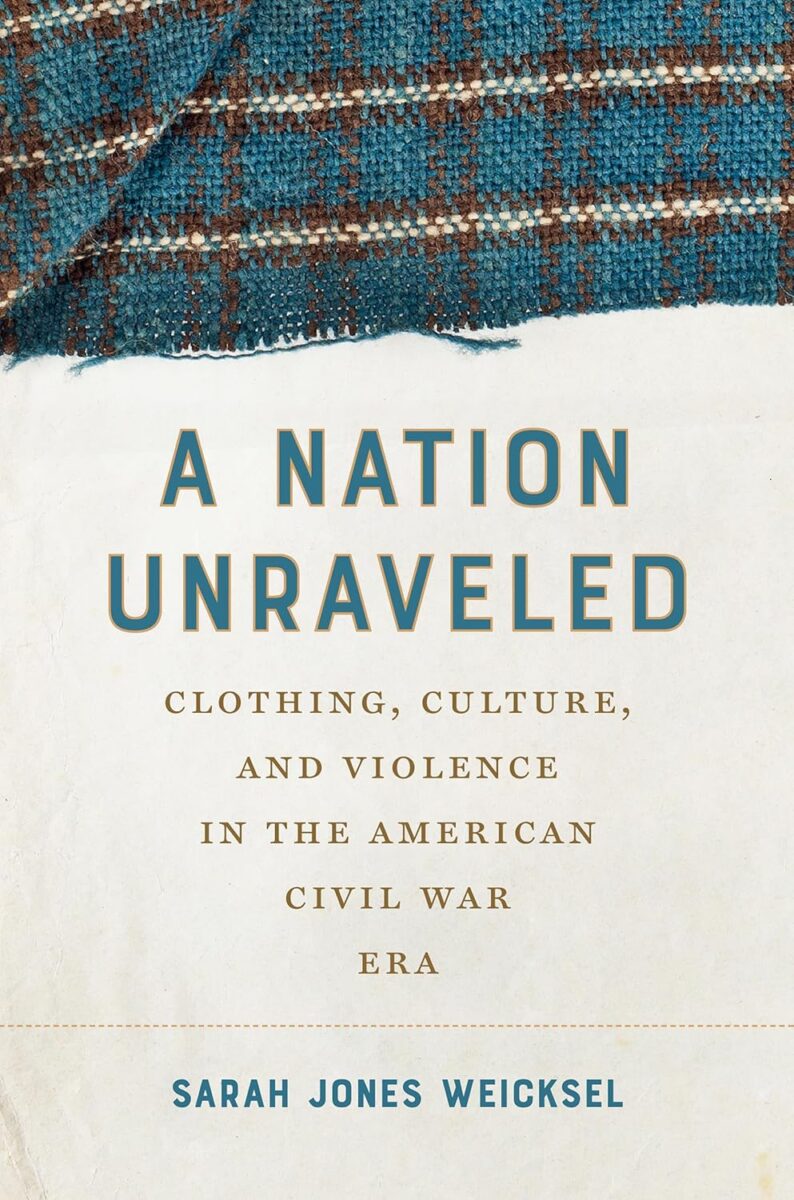
Sarah Jones Weicksel has woven a brilliant new history of the Civil War by placing material objects at the center of a rich, multidisciplinary analysis. A gale of recent books has paid long overdue attention to Civil War era material culture. Joan E. Cashin, Jason Phillips, Joseph Beilein, Amy Murrell Taylor, Thomas J. Brown, and Shae Smith-Cox, for example, have reaped interpretive dividends by taking objects seriously in their accounts of how Civil War Americans battled over resources, imagined the future, waged guerrilla war, drilled in Zouave tactics, and sought refuge from slavery. But Weicksel, the executive director of the American Historical Association, delivers an investigation at once more finely grained and more wide-ranging, doing more than any previous scholar to demonstrate how and why clothing became a “contested site through which Americans confronted broader questions about war and emancipation” (247). “Clothing,” Weicksel contends, “was a central means by which people experienced how war was waged against them” (3).
Weicksel divides her book, amply illustrated with photographs of artifacts and contemporary illustrations, into four thematic parts. These parts track “the life cycle of clothing” while also loosely tracing the chronology of the war, from the mobilization of armies to the work of memory. “Making” explores the cultural work of soldiers’ uniforms and military garb; “Wearing” renders legible how clothing shaped the everyday, lived experience of war (especially for white northern civilian relief workers and enslaved persons); “Destroying” considers how clothing became a key terrain of wartime violence; and “Saving” meditates on the meaning of textile preservation as well as the agency of objects in the fashioning of a “collective narrative of war and reconciliation” (11-12, 233).
Though sartorial choices have long functioned as important markers of wartime identity and patriotism, the nineteenth century notion that garb “could shape an individual’s morality, civility, gender, and piety,” Weicksel contends, lent clothing a particular potency during the U.S. Civil War (3-5). The author deftly captures that potency—and the “fluid and multilayered” meaning of clothing—in the wide-ranging chapters that follow (14).
In the spring of 1861, looms clacked and spinning wheels whirled to meet an unprecedented demand for martial threads. Uniforms studded with shiny rows of brass buttons forged “a shared material culture of gender, patriotism, and military prowess” (54). Newspaper graphics even “trained” civilians how to read the insignias, buttons, and shoulder straps that trimmed military uniforms. Soldiers further shaped “a material culture of manhood” by “requests and instructions they send to their loved ones” for undergarments and shirts—what Weicksel brands “battlefront style” (41). Battlefront style not only permitted soldiers to express their individuality in the anonymizing world of the army; it also supplied a tangible reminder of the support for their efforts back home.
Weicksel contends that “soldiers’ aid societies have garnered an outsized place in narratives about wartime clothing production” (63). “Although women’s sewing circles dominate postwar reminiscences,” she writes, “the vast majority of military garments were produced through an outwork system based out of army clothing depots that employed cutters, tailors, seamstresses, and inspectors” (75).
A Nation Unraveled makes its most compelling interventions by supplying testimony about how the war intruded on even the most mundane aspects of everyday life. The author shows, for instance, how women trimmed their garments with “military-esque decorations” and embraced a “uniform-inspired fashion” (101). By forcing people to make sartorial choices that could literally chafe at the skin and clash with prewar dress culture, clothing could exert influence on attitudes toward the war (177). In the Confederate South, white women bristled at widespread textile shortages, which the author attributes not to a leaky Yankee blockade, but to the overwhelming needs of the rebel armies. Later, those women bristled at the Confederate state itself, which, in 1864, barred the importation of “luxury items” and forced a reckoning over the reach of the rebel government (114).
A close study of clothing yields a host of fresh perspectives on old subjects ranging from the front lines to the refugee camps. Battlefield looting, a practice noticed in many studies of battles and military campaigns, assumes new meaning when viewed from the cultural context of clothing. As the author compellingly demonstrates, looting was a way to strip a body of its manhood, no less than its identity. The postwar ban on the wearing of Confederate uniforms was likewise a tool of “emasculation” imposed by the victors (213). Northern voluntary aid society members, Weicksel notes, “sought to embody freedom through manipulation of the material world” (126). White relief workers remarked upon the tattered garb of the enslaved and sought to compel “discipline”; looking ahead to a post-emancipation society, the fitted, secondhand garments these men and women distributed would maintain existing hierarchies of race and class (134).
A Nation Unraveled demonstrates how the war magnified “the importance of everything from fine skills to soiled rags”; as such, a short review cannot tally its many insights (248). Examining garments and textiles alongside the war’s documentary record, taking seriously everything from their production to their preservation, Sarah Jones Weicksel has advanced the “material turn” in Civil War studies. A close reading of this impressive first monograph will repay scholars and the lay public alike.
Brian Matthew Jordan is Associate Professor of U.S. Civil War History and Co-Director of the Civil War Consortium at Sam Houston State University. He is the author or editor of six books on the Civil War and its era, including Marching Home: Union Veterans and Their Unending Civil War, which was a finalist for the Pulitzer Prize in History.