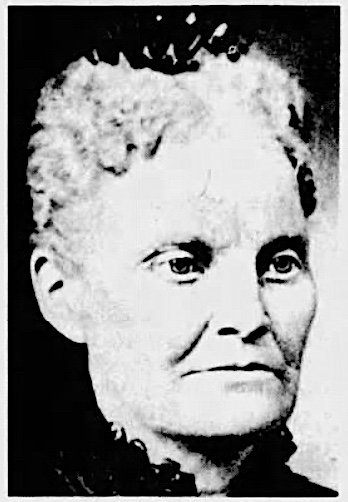
 Salisbury Post
 Sarah R. Johnston
As noted in the previous installment of this column, L.P. Brockett and Mary C. Vaughan’s Woman’s Work in the Civil War (1867) aimed to honor the countless women whose labor shaped the war’s medical care. Though sentimental and patriotic in tone, the collection unexpectedly preserves glimpses of women’s judgment, skill, and moral reasoning at moments when formal systems faltered. Through these biographies, we see improvised medical practice, ethical dilemmas, and acts of care that anticipate a transforming American medical landscape.
Brockett and Vaughan’s decision to include Sarah R. Johnston, a southern woman who aided Union prisoners of war, illustrates their effort to claim even southern compassion as evidence of Union moral triumph. Nearly all the women profiled in Woman’s Work are northern, making Johnston’s appearance striking. Revisiting Johnston’s story exposes both the reach and the limits of the authors’ sentimental patriotic frame.
Sarah Reeves (1822–1906) was born into a “prominent ante-bellum family” in Salisbury, North Carolina.1 In 1840 she married John Sloan Johnston and the family managed a comfortable social position until their fortunes deteriorated in the 1850s.2 The Johnstons left their well-appointed home and moved across town to a small house on East Bank Street near the town’s defunct cotton mill, which was repurposed as the Salisbury Prison after the Civil War began. Pressed by mounting financial strain, Sarah took up teaching to sustain her household.
Salisbury Prison opened on December 9, 1861. In its early years, before Ulysses S. Grant ended the prisoner exchange system between the Union and Confederate armies in 1864, civilians occasionally brought food or goods to the incarcerated men. The POW exchange system allowed modest movement in and out of the compound, and while disease and privation were present, they had not yet overtaken the prison. The system’s collapse brought severe overcrowding and intensified deprivation and a rapid rise in disease and death.
During one such prisoner exchange before the 1864 turning point, Union prisoners were paraded through town to the rail station. Watching the procession, Johnston noticed a young soldier collapse under the strain of the short march. As the column pressed forward, he was at risk of being trampled. Johnston stepped toward him, calling for water, but the onlookers refused to help. She made the bold decision to bring him home, promising to “take care of him as if he were her own son, and if he died to give him Christian burial.”3 Nursing him, Johnston discovered “blisters applied to his chest which had never been dressed and were full of vermin,” a devastating indictment of medical neglect inside the prison. After Johnston cleaned and dressed his wounds, the soldier identified himself as Hugh Berry of Oshkosh, Wisconsin. Suffering from tuberculosis, he accepted her offer to die with dignity. He lived only a few days.
After Berry’s death the townspeople refused to allow him to be buried in Salisbury’s public cemetery. Forced to choose between denying him burial or inviting community wrath, Johnston dug a grave for him in her garden. For a time, she stood guard at her door with a pistol to prevent the desecration of his body by locals who disagreed with her. A quartermaster’s wartime burial record of deceased Salisbury prisoners later noted a lone grave located at “Mrs. Johns[t]on’s garden, Salisbury, N.C.,” confirming this extraordinary story.4
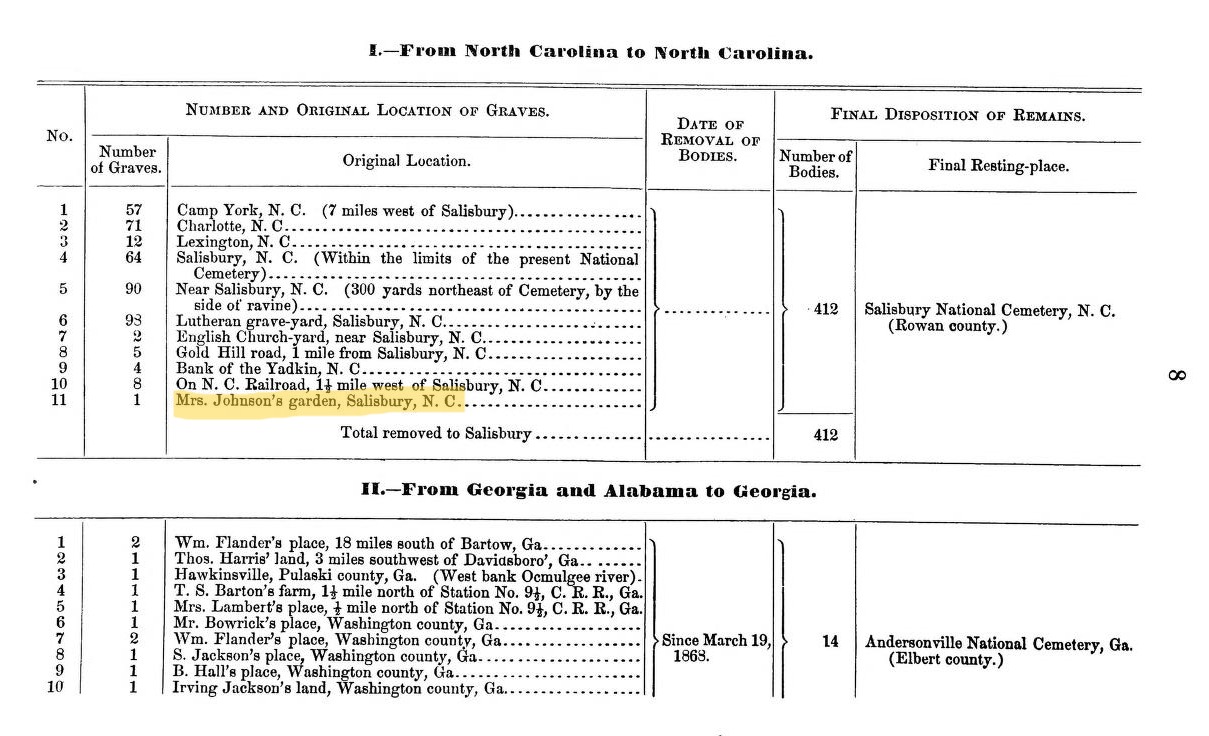 Statement of the Final Disposition of the Bodies of Deceased Union Soldiers and Prisoners of War, Volume 3 (1868)
This Quartermaster Report, prepared by Brevet Colonel C.W. Folsom, notes a lone grave located in “Mrs. Johnson’s garden” in Salisbury. Highlighted by the author.
Johnston’s decision to nurse and bury a Union soldier who had been taken prisoner provoked immediate social backlash. Neighbors cut ties, students withdrew from her class, and the family grew increasingly destitute, tolerated locally largely because her son served in the Confederate navy.5 Brockett and Vaughan note that Johnston remained committed to relieving suffering, now in the face of mounting personal hardships. They claimed that she “cut up her carpet and spare blankets to form into moccasins” and intercepted new prisoners being mustered in to give them hearty bread and water. In one instance, Confederate officers threatened that if she continued with her activity she would be “pinned to the earth with a bayonet.” She responded with a direct challenge, asking one “why he did not pin her to the earth.” Johnston exemplified the notion that compassionate care was more important than sectional strife.6
Johnston continued to offer aid when she could. She transcribed burial inscriptions to send word to northern families, hoping “to let the sorrowing friends of those martyrs to their country know where their loved ones are laid.” After Union forces captured Salisbury in 1865, she copied rebel prison records listing admissions, deaths, and remaining prisoners from October 1864 to April 1865. Her work mirrored emerging practices of memorial recordkeeping that historian Drew Gilpin Faust identifies as central to the Civil War’s transformation of death and mourning practices.7
Posthumously, local newspapers claimed that Johnston received a federal pension through a “special act of Congress” for caring for Hugh Berry. The process to secure this special pension through congressional action prior to the Nurses Pensions Act was used by women who served in the Civil War but who were not yet covered under other pension legislation.8 The Salisbury Post expressed skepticism about this, although the federal government did grant these pensions to a number of women, including Mary Bickerdyke. Johnston’s case would have been distinct: remuneration for humanitarian service rendered to a Union soldier by a southern woman. Whether or not such an act occurred, the endurance of this claim shows how her story became a vessel for competing interpretations of loyalty, compassion, and national belonging.
Brockett and Vaughan’s immediate postwar account casts Johnston’s ostracism within a narrative of heroic patriotism. Her vignette concluded noting that she moved north, an implication that her wartime compassion reflected latent Union loyalty. However, Johnston returned from her northern travels to live out her long life in Salisbury. The patriotic coda Brockett and Vaughan supplied reveals far more about postwar narrative desires than about Johnston herself.
Sarah R. Johnston sits uneasily within the frame Brockett and Vaughan constructed in Woman’s Work in the Civil War. She was not a northern patriot, nor a Unionist in disguise. Her story illuminates the fragile boundaries between enemy and neighbor, and between medical care and moral witness. Her story reminds us that the Civil War’s medical history can also be told through small acts of mercy, gardens turned into burial grounds, and women whose acts of mercy defied the expectations of their communities.
Megan VanGorder is an assistant professor of history at Illinois State University. Her forthcoming book, A Mother’s Work: Mary Bickerdyke, Civil War-Era Nurse, will be published in Spring 2026 by UNC Press.
Notes
1. “Mrs. Johnston Dead, Aged Woman’s Sudden End,” Salisbury Post, May 14, 1906.
2. Accounts differ on the cause: One early 20th-century biographical history cited John Sloan Johnston’s willingness to “cosign notes for friends,” while a local Salisbury Post column offers a far more caustic assessment, claiming he “drank himself out of gainful employment and a steady income.”
3. Brockett and Vaughan, Woman’s Work in the War, 270.
4. Statement of the Disposition of Some of the Bodies of Deceased Union Soldiers and Prisoners of War Whose Remains have been Removed to National Cemeteries in the Southern and Western States, Volume III (Washington, D.C., 1868), 8.
5. Her son Thomas Pickney Johnston served in the Confederate navy and later became a well-respected and staunch temperance advocate in Salisbury.
6. Brockett and Vaughan, Woman’s Work in the War, 271.
7. Drew Gilpin Faust, This Republic of Suffering: Death and the American Civil War (New York, 2008), 241.
8. Megan VanGorder, “Special Acts of Justice: Mary Bickerdyke and the Extension of Civil War Veteran Care,” Indiana Magazine of History 121, no. 2 (2025): 78.
Related topics: medical care
Congratulations upon the publication of this excellent article which highlights the humanitarian contribution of one woman to the alleviation of suffering during the Civil War, the challenges of her moral choice and the lenses applied by immediate post-war historiography.
The Society for Women and the Civil War (SWCW)
http://www.swcw.org