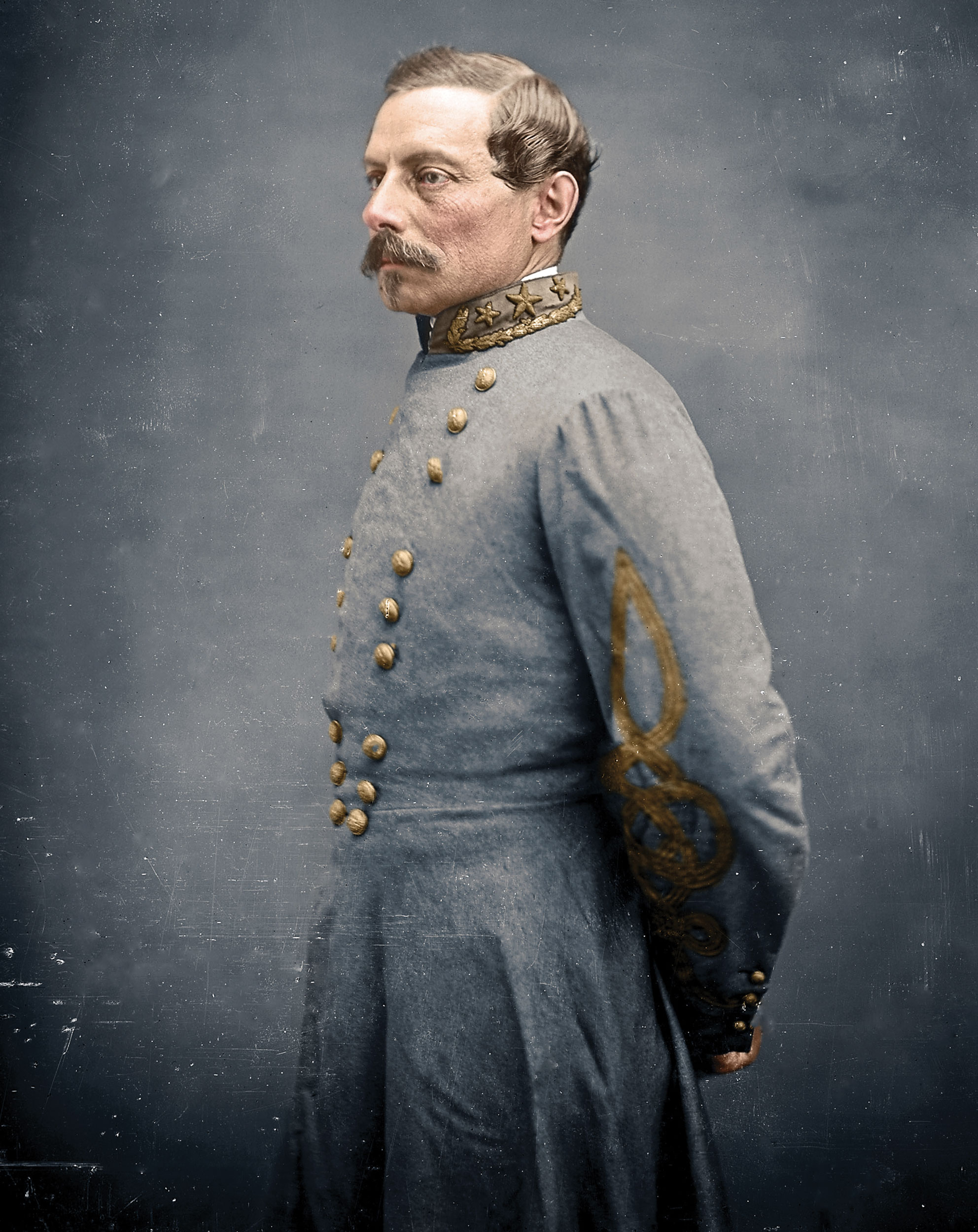
 National Archives (Colorized by Mads Madsen of Colorized History)
At the Battle of Shiloh in April 1862, Confederate general Pierre G.T. Beauregard (pictured here) made a decision that not only helped decide the fate of that engagement, but also influenced the course of the war in the western theater.
As dusk settled over the ravaged fields above Pittsburg Landing on April 6, 1862, General Pierre G.T. Beauregard sat astride his horse near the captured Union camps and composed a message for Richmond. The Confederacy, he informed President Jefferson Davis, had won a “complete victory.” The enemy had been thoroughly beaten and driven “in utter disorder” toward the Tennessee River. He believed he had Ulysses S. Grant’s army cornered, its back against the water, its will to fight broken. All that remained, he was certain, was to finish the job in the morning.1 Beauregard was wrong on nearly every count, and the decision he made in that half-light—to halt the Confederate assault rather than press it to conclusion—would help decide not just the fate of a single battle, but the course of the war in the western theater.
By the spring of 1862, the Union war effort along the Tennessee River had built a fearsome momentum. Grant’s victories at Forts Henry and Donelson in February had pierced the overstretched Confederate defensive line across Kentucky and Tennessee, forcing General Albert Sidney Johnston to abandon Nashville and concentrate his scattered forces at the vital rail junction of Corinth, Mississippi. Grant, with roughly 42,000 men, encamped his army at Pittsburg Landing to await the arrival of reinforcements from Don Carlos Buell’s Army of the Ohio, some 20,000 strong. Once united, Grant planned for the combined Federal force to strike Corinth and sever the Confederacy’s east-west rail connection in the region.
Johnston understood the danger of waiting for the enemy to act. Rather than allow Grant and Buell to combine, he resolved to strike first, marching his army of roughly 44,000 Confederates north to fall upon Grant’s unsuspecting camps before Buell could arrive. It was a bold gamble, executed imperfectly—the march took longer than planned, discipline among inexperienced troops broke down, and any hope of complete surprise nearly evaporated. Yet when the Confederate lines emerged from the woods at dawn on April 6, they still managed to achieve a significant level of surprise. Federal soldiers were bayoneted in their tents as the gray columns tore through camps still smoldering with breakfast fires.
The Union line reeled backward through the morning, but it did not shatter. At a modest country lane that came to be called the Hornet’s Nest, Union brigadier generals Benjamin Prentiss and W.H.L. Wallace organized a stand that would attract the Confederate army’s attention, and absorb its hard-won momentum for hours. Assaults broke against the position again and again; eventually, the Confederates massed as many as 60 cannon, hoping to blast the Union defenders into submission. It worked, but it cost the Confederates dearly in both time and coordination. By late afternoon, when the Hornet’s Nest finally collapsed and nearly 2,200 Federals surrendered, the Confederates who had struck with such precision at dawn had dissolved into a tangle of intermingled brigades, exhausted men, and depleted ammunition.2
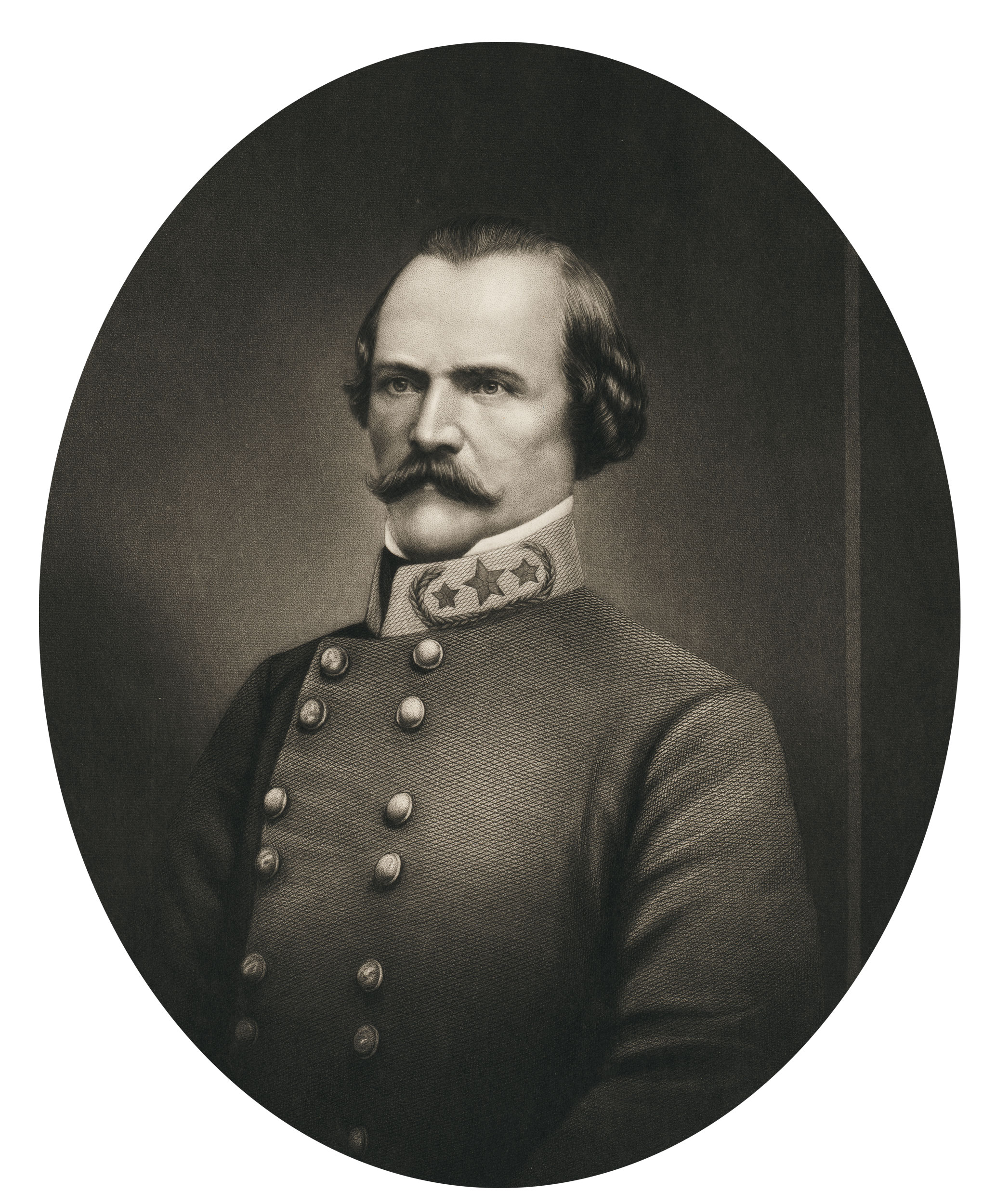 National Portrait Gallery
Albert Sidney Johnston
The Confederate army also lost its commander. Around 2:30 that afternoon, while personally directing an attack near a peach orchard on the Union left, Johnston was struck in the back of his knee by a bullet. He dismissed the wound as minor—perhaps numbed by nerve damage from an old injury—and continued issuing orders even as blood pooled inside his boot. The bullet had severed an artery. By the time his staff recognized the severity of the wound, Johnston was fading and within minutes had bled to death. He was the highest-ranking officer killed in action on either side during the entire war.3
Command of the army, and of the battle’s outcome, now fell to Beauregard. He inherited a force that had, despite its early misfires, clawed its way to within sight of victory. Grant’s survivors had fallen back nearly three miles, forming a last, desperate line near Pittsburg Landing, anchored by artillery and the gunboats USS Tyler and USS Lexington on the Tennessee River. Confederate brigades, disorganized but sensing the kill, continued to press forward through the early evening. One final assault against the Union line was thrown back in the gathering dark. And it was at this moment, with the sun nearly gone and his own units badly scrambled, that Beauregard made the decision that would define his reputation for the rest of his life. He called off the attack.
The Creole general’s thinking was not unreasonable on its face. His divisions had lost all semblance of organization, funneled and fused by a day of ferocious, disjointed fighting. Ammunition was low. Darkness made further coordinated assault nearly impossible. And crucially, Beauregard had received intelligence—inaccurate, as it turned out—suggesting that Buell’s reinforcements were not converging on Pittsburg Landing after all, and that the Federals he now faced stood alone.4 Confident that Grant’s battered remnant could be swept into the river with fresh troops in the morning, Beauregard withdrew his exhausted men into the captured Union camps to rest, refit, and, in some cases, plunder the tents they had overrun.
It was a fateful miscalculation. Even as Beauregard’s telegram of victory clattered over the wires to Richmond, Buell’s lead division of Union reinforcements was already filing off steamboats at the landing, and another enemy division under Lew Wallace was finally arriving on the field after a day lost to confused orders and taking a wrong road. By dawn, the wavering enemy Beauregard expected to finish off had swelled by tens of thousands of fresh troops. The Federal force that greeted his renewed attack on April 7 was, if anything, larger and stronger than the one his men had shattered the day before.5
The reversal of fortune was swift and brutal. Grant and Buell counterattacked at 6 a.m., and though Beauregard’s exhausted Confederates fought with the same stubbornness that had carried them the day before, they had nothing left to press an advantage that no longer existed. By midafternoon, his men outnumbered and badly spent, Beauregard ordered a retreat toward Corinth, abandoning the ground his army had bled to seize.
Historians have debated Beauregard’s decision ever since, and the verdict is less tidy than the Lost Cause narrative that later blamed him for squandering Johnston’s near victory. Given the exhaustion of his troops, the collapse of unit cohesion after a full day of attack, and the formidable defensive position Grant had organized at the landing, it is far from certain that a continued assault on the evening of April 6 would have broken the Union line at all—darkness, disorder, and naval gunfire might have doomed a night attack.6
What is certain, though, is that Beauregard’s decision rested on a fatally incomplete picture of the battlefield, and that incomplete picture, more than any failure of nerve, cost the Confederacy its chance at a decisive western victory. Believing the fight already won, Beauregard stopped reaching for a triumph that was still, however narrowly, within reach—and gave his enemy the one thing an army beaten in detail most desperately needs: time.
Shiloh’s second day cost the Confederacy dearly in blood and strategic position. Corinth fell within weeks, and with it any real hope of reclaiming the initiative in the West. Beauregard never fully escaped the shadow of that twilight decision.
Years later he would confide, with evident bitterness, that he had believed he had Grant “just where I wanted him,” certain he “could finish him up next day.”7 He never got the chance. War, as Shiloh demonstrated with stark clarity, often turns on the small moments when weary commanders decide a battle is already over.
Andrew S. Bledsoe is professor of history at Lee University in Cleveland, Tennessee. He is the author of Citizen-Officers: The Union and Confederate Volunteer Junior Officer Corps in the American Civil War (Louisiana State University Press, 2015); co-editor, with Andrew F. Lang, of Upon the Field of Battle: Essays on the Military History of America’s Civil War (LSU Press, 2019); and author most recently of Decisions at Franklin: The Nineteen Critical Decisions That Defined the Battle (University of Tennessee Press, 2023).
Notes
1. United States War Department, The War of the Rebellion: A Compilation of the Official Records 129 vols. (Washington, 1880–1901), Series I, Vol. 10, pt. 1, 384–385 (hereafter cited as OR); Wiley Sword, Shiloh: Bloody April (Lawrence, 1974), 322–324.
2. Timothy B. Smith, Shiloh: Conquer or Perish (Lawrence, 2014), 218–241; OR, Series I, Vol. 10, pt. 1, 108–110.
3. OR, Series I, Vol. 10, pt. 1, 387; Sword, Shiloh: Bloody April, 259–263.
4. O. Edward Cunningham, Shiloh and the Western Campaign of 1862 (New York, 2007), 291–296.
5. OR, Series I, Vol. 10, pt. 1, 292–294 (Buell’s report); Cunningham, Shiloh, 300–305.
6. Smith, Shiloh: Conquer or Perish, 275–281.
7. Quoted in Sword, Shiloh: Bloody April, 325.