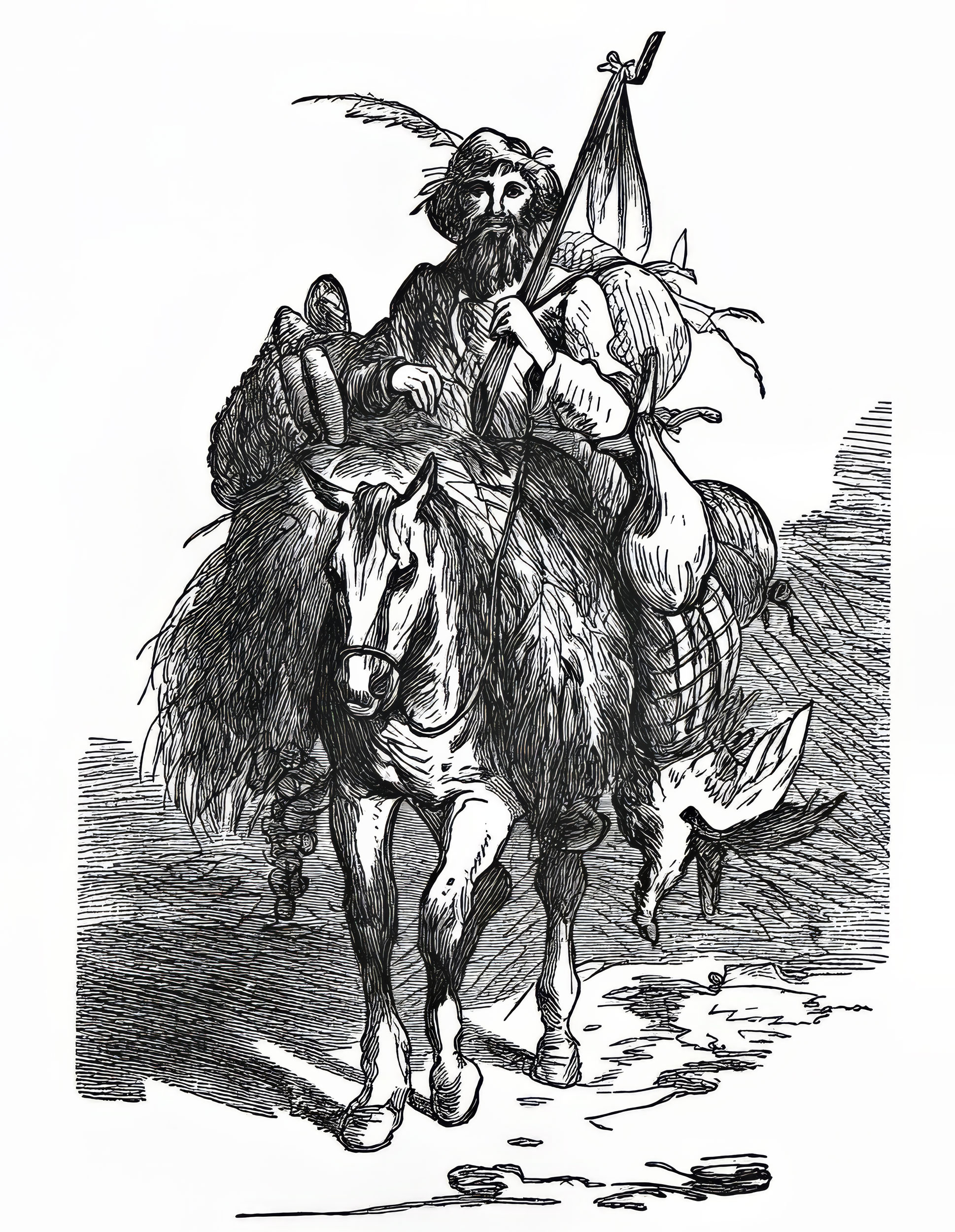
 The Soldiers’ and Sailors’ Half-Dime Tales of the Late Rebellion (1868)
One of William T. Sherman’s “bummers” is depicted returning to camp weighed down with foraged items in this postwar illustration.
Bum•mer | noun | An idle, worthless fellow without any visible means of support. A word much used by our soldiers during the late civil war. The “New York Herald,” May 2, 1876, thus describes the individual: The army bummer is usually a “General” who has been in the Quartermaster’s or Commissary Department, and whose rank represents influence about the War Office…. Since the war he has been very “loyal.” He has “sustained” the Union, and “supported” the government. Unable to earn an honest living, without brains for any position higher than that of a car conductor, he lives by lobbying…. [I]n time, he finds himself the enjoyment of a good income, for which he does nothing but eat and drink and talk. He is a disgrace to the army, whose uniforms he wears for his own gain.1
There was nothing flattering about being called a bummer in mid-19th-century America. Entering into common parlance during the age of westward expansion, the term first appeared in print in the mid-1850s. Associated with rowdy bachelors and drunken lowlifes, the Weekly Oregonian warned in 1855, “Come, clear out, you trunken loafer! Ve don’t vant no bummers here!”2 The residents of Portland were not the only western community to attempt to oust bummers from their midst. Four years later in San Francisco, Louis Murat was dragged into the Station House “in a state of helpless drunkenness.” A local newspaper reported that he was a supposed descendent of Joachim Murat, King of Naples, and had arrived in America in 1849, “having considerable means and letters of credit; the former he squandered, and the latter he lost, and for two years he has been a common street bummer.”3
This certain class of fellow—always a man—became a hallmark of Californian society. As defined by a journalist for a Nevada City, California, newspaper, the “California Bummer” was “not so much a species or type of any particular genus as he is a condition … between that which benefits and that which injures community. It is the chrysaline state, in which uselessness awaits the change, which develops positive vice.” The description continued with a paradoxical definition: “Your true Bummer is not a vicious or wicked man. He gambles but little, for the reason that cash is an essential, in that business, and your Bummer regards coin as the root of all evil, and most heartily eschews it. Intemperance, too, he is proof against. Of course he drinks occasionally with his friends to promote sociability, but when he becomes a sot he is entirely out of the circle of the Bummers. In short, he is a man without a positive vice, or a single virtue; a human leech that requires food and clothing, as his prototype does blood, and like him, fastens upon whatever can furnish them.” Sponging off society, the bummer was often well dressed and affable in conversation yet penniless and idle in life. “So goes the California Bummer,” the article concluded. “The drone and curse of every community throughout the State; despised and detested alike by those whose integrity and industry is his constant reproach, and also by those whose bold vices he dare not imitate…. This is not a fancy sketch, and there is not a single mining town in the State that has not the original, and has not witnessed this result.”4
Although unknown to this journalist, bummer most likely derived from the German words bummelin (“strolling”) or bummeler (“loafer”) and arrived in the United States amid the waves of immigrants in the decades before the Civil War. According to one late-19th century publication, “its origin has been attributed to Boehmen, the German name of Bohemia, a nation proverbial for the number of its sharpers and adventures. In France the gipsies are called Bohémines, because of their roving and worthless character.”5 The term quickly assumed a similar meaning on the other side of the Atlantic Ocean, where strolling and loafing men in New York and San Francisco soon found themselves called bummers.
By 1861, many Americans—especially those living alongside recent German immigrants in northeastern cities and coastal ports—were familiar with the term bummer and the Civil War thrust these lazy men into a public spotlight. Once enlisted or drafted into the army, bummers were prone to disappearing during combat or going off to forage during long marches. Often disdained as a shirker or dishonorable fellow by other soldiers during the early years of the war, “the bummer went to the war, fully equipped for ‘everything from squirrel hunting to manslaughter in the first degree,’ and his trousers were so loose and baggy that he could get over a barbed wire fence without scratching himself.” Humorist Melville D. Landon wrote, “the difference between a true soldier and a bummer … is this: the true soldier drew his sword in the cause of right and country while the bummer drew his sword in a raffle.” A true soldier died honorably on the field of battle while the bummer “got wounded by a chicken bone in his throat at Fairfax Court House” or “got dyspepsia eating sardines and jam with the Sanitary Commissioners in Baltimore.”6
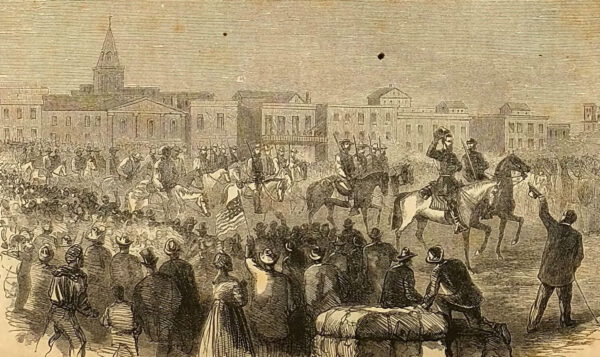
Then, on November 9, 1864, Union general William T. Sherman issued Special Field Orders No. 120, which reduced military supply trains and authorized the army to “forage liberally on the country” during his planned March to the Sea. Preparing to march around 60,000 soldiers 300 miles from Atlanta to Savannah, Sherman intended to bring hard war to the Confederate heartland and to white southerners’ doorsteps. Although under formal instructions not to “enter the dwellings of the inhabitants,” company commanders permitted groups of Union soldiers—selected for their “boldness and enterprise”—to gather “corn or forage of any kind, meat of any kind, vegetables, corn-meal, or whatever is needed by the command.”7 Rather than confining themselves to gathering foodstuffs or essential military supplies, Sherman’s bummers set off into the Georgia countryside to resupply as well as to steal, plunder, burn, and harass southern civilians.8 To his fellow Union soldiers, Sherman’s bummer was a peculiar but oftentimes helpful opportunist. As one Illinois infantryman recalled, “the army bummer … supplied the missing link between hunger and plenty to eat.”9 And those who partook in the foraging expressed pride in their skills. Countering a popular image of bummers as lazy or worthless tramps, Charles Belknap of the 21st Michigan Infantry spoke with fondness about his service as one of Sherman’s bummers: “Bummer was a title born to Sherman’s army on the march to the sea…. He made his profession high art, and high art is always morality.”10
Southern civilians, though, lived with a daily fear of “plunder and fire.”11 Anticipating the worst, women hid household goods beneath their hoopskirts and buried their silver in the yard. In his postwar memoirs, Sherman admitted, “no doubt, many acts of pillage, robbery, and violence, were committed by these parties of foragers, usually called ‘bummers;’ for I have since heard of jewelry taken from women, and the plunder of articles that never reached the commissary.”12 The extent to which Sherman’s soldiers conducted unauthorized plunder remains disputed by historians.13 Nonetheless, the march firmly cemented bummers’ reputations for ruthless and wanton foraging and, by war’s end, northerners and southerners alike knew precisely how to define the word. “Sherman, whose infamies were so unparalleled as to require the use of a new word to express their enormity, who had made the term ‘bummer’ expressive of the quintessence of all ignominy,” recalled Albion Winegar Tourgée, a former Union soldier, in 1879.14
The term’s meaning shifted yet again in the 1870s and ’80s. Although no more flattering than its antebellum precedent, bummer became associated with idle and corrupt politicians in Washington, D.C., and other big cities. Possibly connected to white southerners’ disdain of northern Republicans holding political office in the Reconstruction Era, one 19th-century writer defined a carpetbagger as “a man without means, character, or occupation, an adventurer, a camp-follower, ‘a bummer.’”15 The concept stuck, and soon inept political leaders across the country were known as bummers. Thriving in an era of widespread financial fraud, party bosses, and the spoils system, incompetent and immoral congressmen, senators, governors, and statesmen drew upon taxes, fees, and their party’s money to line their pockets and retain their offices. They wined and dined at the public’s expense while providing little public benefit. “Certain salaries and fees in local offices are notoriously kept high, so that the incumbent may freely ‘bleed’ for party use, or, what is the same thing, for the use of party ‘bummers,’” complained political writer James Bryce.16 By the 1880s, dictionaries regularly incorporated this new definition alongside mentions of Sherman’s foragers and antebellum loafers.
One is rarely called a bummer today. A shortened version—bum—endures as an insult to those perceived as lazy or to individuals experiencing can still claim to be accused under a bum rap, or a false accusation or inaccurate homelessness. And one criminal charge. In contemporary journalism and modern political commentary everything from capitalism to Gen Z to frozen food to opera has been given a bum rap.17 Although the term has shed its 19th-century associations, bum and bum rap continue to function as enduring expressions of insult and exoneration. These modern meanings are a far cry from the mounted foragers and opportunists described as haunting the Civil War landscape, but they reveal how its vocabulary has outlived the conflict.
Tracy L. Barnett was a visiting assistant professor of history at Old Dominion University in Norfolk, Virginia, from 2025 to 2026. She has a doctorate in American history from the University of Georgia. Firearms—their meaning to men and their availability in 19th-century America—are the center of her scholarship.
Notes
1. Emphasis in the original. John Russell Bartlett, Dictionary of Americanisms: A Glossary of Words and Phrases Usually Regarded as Peculiar to the United States, Fourth Edition (Boston, 1877), 79–80.
2. Weekly Oregonian (Portland, Oregon Territory), January 27, 1855, as cited in “Bummer,” Oxford English Dictionary, Accessed August 4, 2026: doi.org/10.1093/OED/9968520742.
3. Weekly Oregonian (Portland, Oregon Territory), June 4, 1859.
4. Nevada Democrat (Nevada City, California), January 5, 1859.
5. Robert Brown, The Countries of the World: Being A Popular Description of the Various Continents, Islands, Rivers, Seas, and Peoples of the Globe (London, 1894), 26.
6. Melville D. Landon (Eli Perkins), Thirty Years of Wit and Reminiscences of Witty Wise and Eloquent Men (New York, 1891), 261–262.
7. William T. Sherman, Memoirs of General William T. Sherman, Vol. II (London, 1875), 175.
8. Ibid., 175, 182.
9. William Wirt Calkins, The History of the One Hundred and Fourth Regiment of Illinois Volunteer Infantry, War of the Great Rebellion, 1862-1865 (Chicago, 1895), 344.
10. Charles E. Belknap, “Bentonville: What a Bummer Knows about It,” War Papers: 12 (Washington, D.C., 1893), 4.
11. Dolly Sumner Lunt, A Woman’s Wartime Journal: An Account of the Passage over Georgia’s Plantation of Sherman’s Army on the March to the Sea, as Recorded in the Diary of Dolly Sumner Lunt (New York, 1918), 24.
12. Sherman, Memoirs of General William T. Sherman, 182–183.
13. For more on this historiographical debate and the memory of Sherman’s March to the Sea, see Anne Sarah Rubin, Through the Heart of Dixie: Sherman’s March and American Memory (Chapel Hill, 2014).
14. Albion Winegar Tourgée, A Fool’s Errand, by One of the Fools (New York, 1879), 218.
15. Ibid., 161.
16. James Bryce, The American Commonwealth, Third Edition, Vol. II (New York, 1895), 122–123.
17. Emma Camp, “Capitalism Gets a Bum Rap,” Wall Street Journal, July 13, 2026; Bryan Robinson, “Gen Z Colleagues Are Annoyed By You—Probably—For 4 Reasons,” Forbes, January 11, 2025; Melissa Breyer, “6 Essential, Sustainable Shortcuts in the Kitchen,” Treehugger, June 5, 2023; Rachel McRady, “Kevin O’Leary Defends Costar Timothée Chalamet at Oscars 2026 After Opera-Ballet Backlash: ‘He Took a Bum Rap’” People.com, March 15, 2026.