 Library of Congress
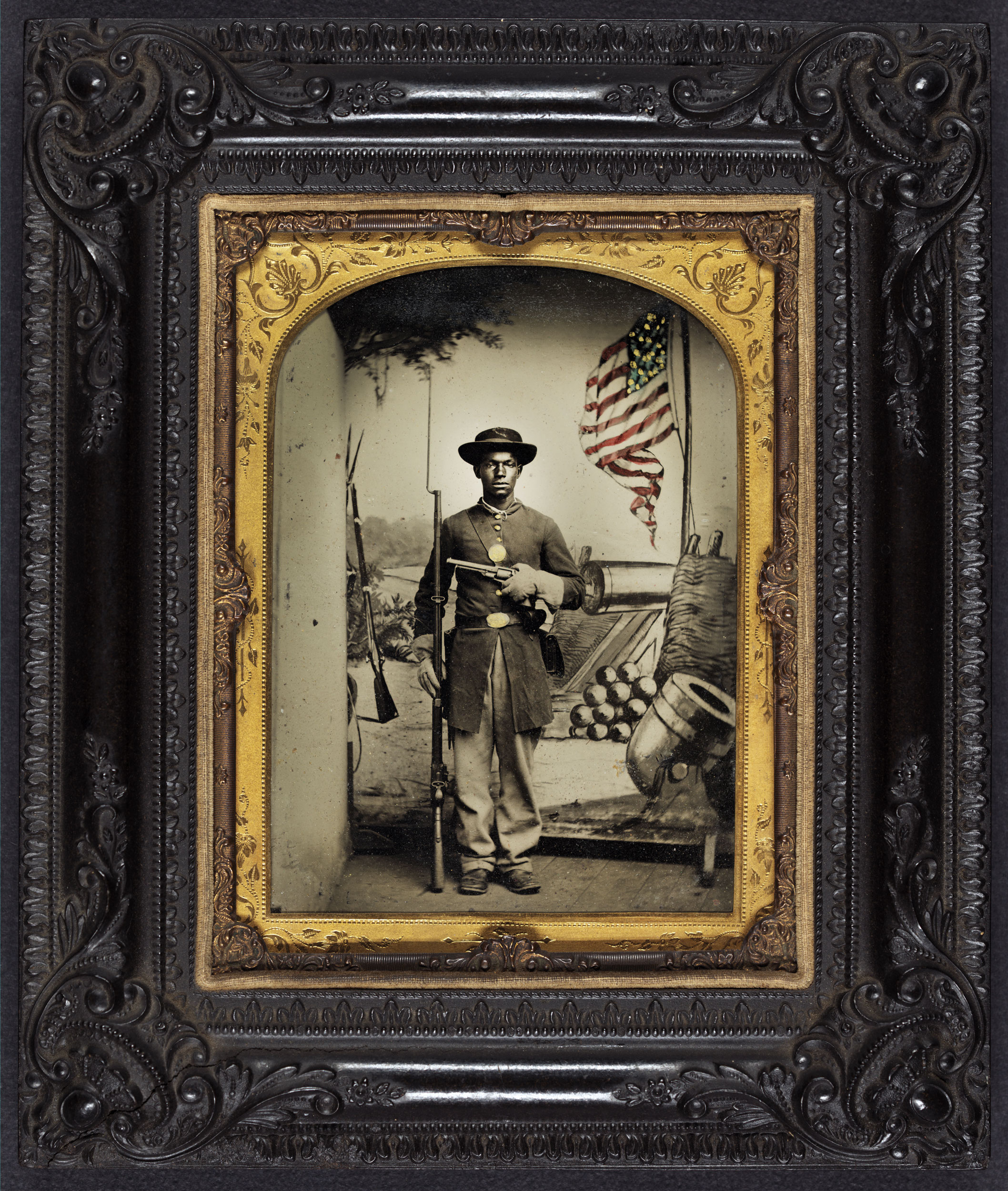
An unidentified member of the U.S. Colored Troops poses for the camera at Benton Barracks in Missouri during the Civil War.
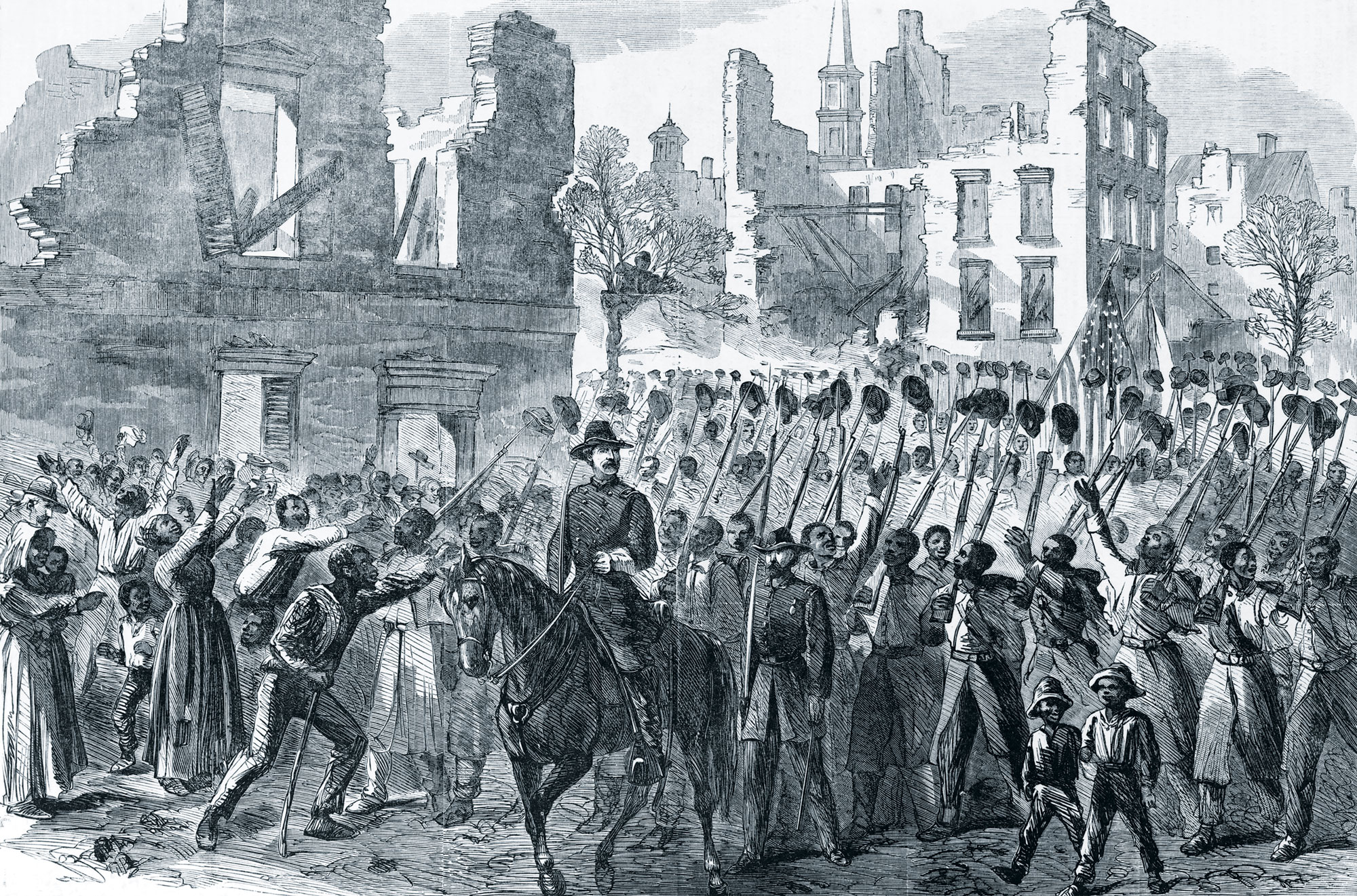
General William T. Sherman and his army conducted their March to the Sea in November and December 1864, enslaved women and men flocked to the U.S. standard for safety. Sherman’s force marshaled Georgian land as Union territory before driving the war into the Confederacy’s South Carolinian heart. On February 18, 1865, the Union army plunged the spike into Charleston. The 21st U.S. Colored Troops (USCT) regiment was at the vanguard. Black Charlestonians greeted the soldiers with glee. New-York Tribune correspondent James Redpath recalled their warm embrace: “The negroes cheer us … [and] dance for joy when they see our glorious flag.” Throughout February and March, freedpeople cheered black and white liberators alike. The famed 54th Massachusetts Infantry and its sister regiment, the 55th Massachusetts, streamed through the city to jubilant huzzahs. The freedpeople celebrated the fall of slavery, a reverence that culminated in a festival of 5,000 revelers who gathered on March 21 in the Citadel Green to voice their thanks. To flag the death of bondage, they paraded through the city with a coffin marked “SLAVERY.” All the while, perhaps inspired by the sight of fellow black men donning striking blue uniforms or compelled to action by continued Confederate resistance, freedmen throughout South Carolina and Georgia left their families to join the Union army, even as the war’s end came into view in the spring and summer of 1865.1
 Library of Congress
The 55th Massachusetts Infantry, an African-American regiment, marches through the streets of Charleston, South Carolina, in February 1865. Though the war was coming to a close, sights like these helped spur further military enlistments among the region’s black residents.
The army put many of the newly enlisted men into the 128th U.S. Colored Troops regiment. The regiment had been mustered into service only eight days before General Robert E. Lee surrendered the Army of Northern Virginia to General Ulysses S. Grant at Appomattox Court House and a few weeks before General Joseph E. Johnston conceded to Sherman in North Carolina. Most Confederates submitted soon after Lee and Johnston, so the black troops of the 128th USCT never had the chance to fight their former enslavers. But even though combat had abated, the men would not be headed back to the plantations. The nation needed an occupying force, and these black men were the sole option after the government decided to send white soldiers back to their northern homes. To maintain a presence, the army distributed black troops around the South. In South Carolina, as the white Yankees marched home, only the 128th USCT, 13 companies of regular infantry, and two companies of regular cavalry remained.2
While the army provided a wage, meals, and shelter to the black men who enlisted in the 128th and other USCT regiments, occupying the former Confederacy still posed grave challenges. Not only did the troops have to enforce rules on war-torn communities, but they also helped ex-slaves with the challenging transition from slavery to freedom in the face of resistance from defeated Confederates, who took off their uniforms but continued antagonizing their former slaves and the Union authorities. In short, black soldiers became the agents implementing Union victory and emancipation in the South. White southerners reacted vehemently, taunting black occupiers and discrediting them.3 They attacked black soldiers and, when they were unable to assault the men, harassed the soldiers’ families. Black troops retaliated to protect themselves, their kin, and the freedoms won during the war, but the struggles would grow more intense.4 In October 1865, news of a protest in Jamaica increased the tension. In what became known as the Morant Bay rebellion, black Jamaicans killed more than 20 Europeans and Jamaicans of European descent. That uprising stoked long-held fears of black violence across the South. In South Carolina, the state’s governor betrayed white paranoia in a letter to the occupying army, which requested that it be “vigilant and watchful keeping the negroes in perfect order and arresting every one of them who may be turbulent or drunk.”5
 Library of Congress
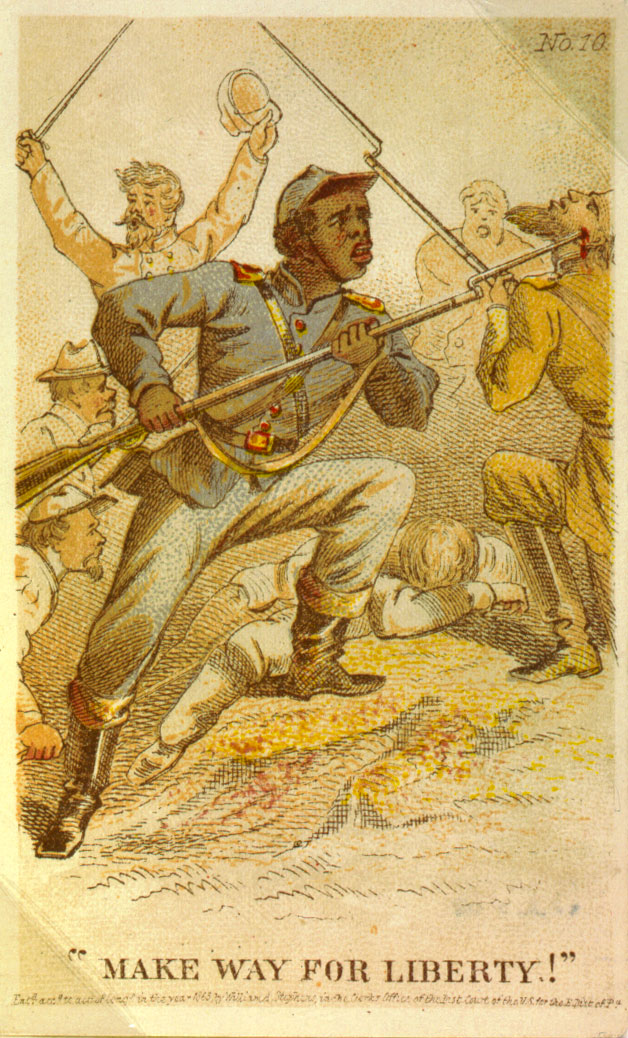
A slave-turned-soldier kills a Confederate foe in this wartime depiction of African-American battlefield heroics.
Black troops’ postwar battles were not confined to their skirmishes with white southerners or even the struggle for liberty on a national scale. The men also faced numerous difficulties in their everyday lives as soldiers. Aside from having to deal with ill-behaved and often violent ex-Confederates, the troops suffered from disease. Disease had hit freedpeople particularly hard during the war. While in service, freedmen’s chances of staying well did not improve greatly. Even though they received resources including shelter, clothing, and nutrition, illnesses—including diarrhea, dysentery, typhoid, pneumonia, tuberculosis, and smallpox—still killed many black soldiers. Smallpox was a particular menace. The disease had killed five times as many black men as white men during the war, and while the 128th USCT was stationed at Folly Island in South Carolina, it suffered a smallpox outbreak that claimed at least two men in the regiment.6
The new soldiers were stricken with boredom, too. The army was a place of rigid discipline, limiting men’s mobility and controlling life’s daily rhythms. Garrison duty required them to wake up early, drill in the morning and afternoon, and eat meals and go to bed at set times. As the former slaves discovered, the grind and boredom of military routines did not often live up to the excitement they might have hoped for when they dreamed of martial glory and life beyond the plantation fields—making the arrival of a steamship seem like an escape from the tyranny of camp malaise for the men of the 128th USCT.
 Library of Congress
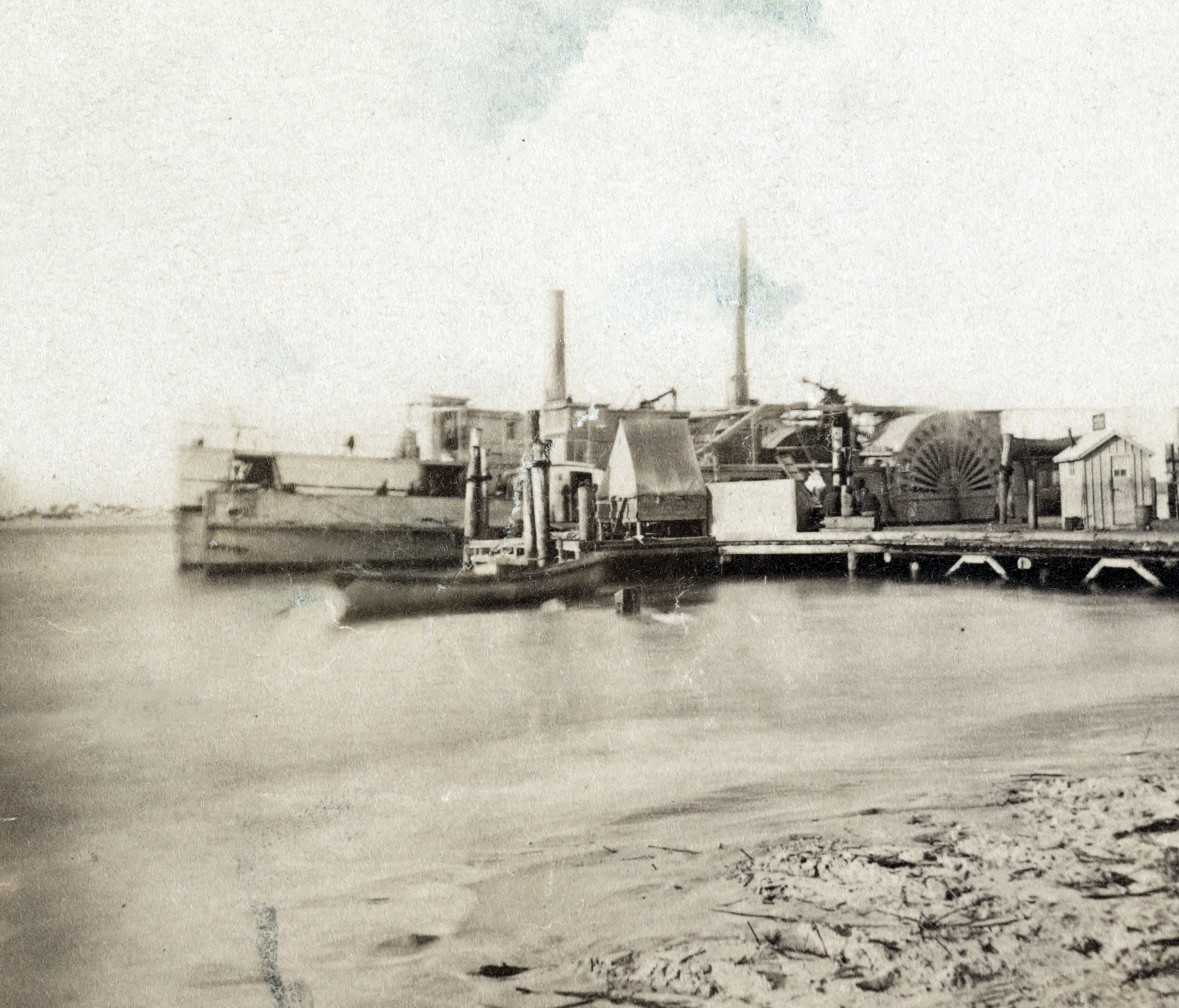
In July 1866, the African-American soldiers of the 128th USCT—who, like most volunteers, had dreamed of glory on the battlefield—found a welcome diversion from the boredom and discipline of military occupation duty in the arrival of a steamship near their camp on Folly Island, South Carolina. (Above) A steamboat dock on Morris Island, South Carolina, during the war.
On July 18, 1866, the steamboat Idea appeared like a mirage to the men of the 128th as it arrived in Stono Inlet around 6 p.m. Hoping to relieve the stress of soldiering and break the daily monotony with a dance on the steamer that summer evening, the soldiers serving in Company G charged out of their tents toward the wharf. It had not been uncommon for slaves to throw parties as a way to free themselves from the drudgery of the fields for a few moments.7 Perhaps unaware of the men’s innocent desire to have a little fun, Lieutenant Lester Hall, one of the company’s white officers, concluded that Idea’s presence was distracting the men from their duties. He marched to the wharf to order the steamboat to open water and the men to their quarters.
When Hall delivered his order, the men ignored him. The young officer had only taken a command in the 128th the previous month after serving in the 56th New York Infantry, so maybe he thought repeating himself would to the trick.8 Twice more he issued the order, but to no effect. Swollen with disgust at the men’s insubordination, Hall began pushing them toward camp. In response, Private Nelson Hicks told Hall he had “no right to shove” them. Like many of his comrades, Hicks had joined the army late in the war and had been a slave before it. (Recruiters recorded him as a laborer when he enlisted in Savannah, Georgia, on March 8, 1865.9) Meeting the defiance head-on, Hall pulled out his revolver and thrust it toward Hicks and the men, driving them from the wharf. Hall then escorted Hicks to his quarters. To silence him, Hall bucked and gagged the private, a brutal punishment in which a soldier’s arms were drawn up around his knees and a rod inserted between them to immobilize him.10 Civil War troops disdained such painful punishments, and former slaves especially so, with the violence wielded by plantation overseers still fresh on their minds. Satisfied that he had restored order, Hall went to dinner.11 As he ate, the men fumed. They talked rebellion.
 Library of Congress
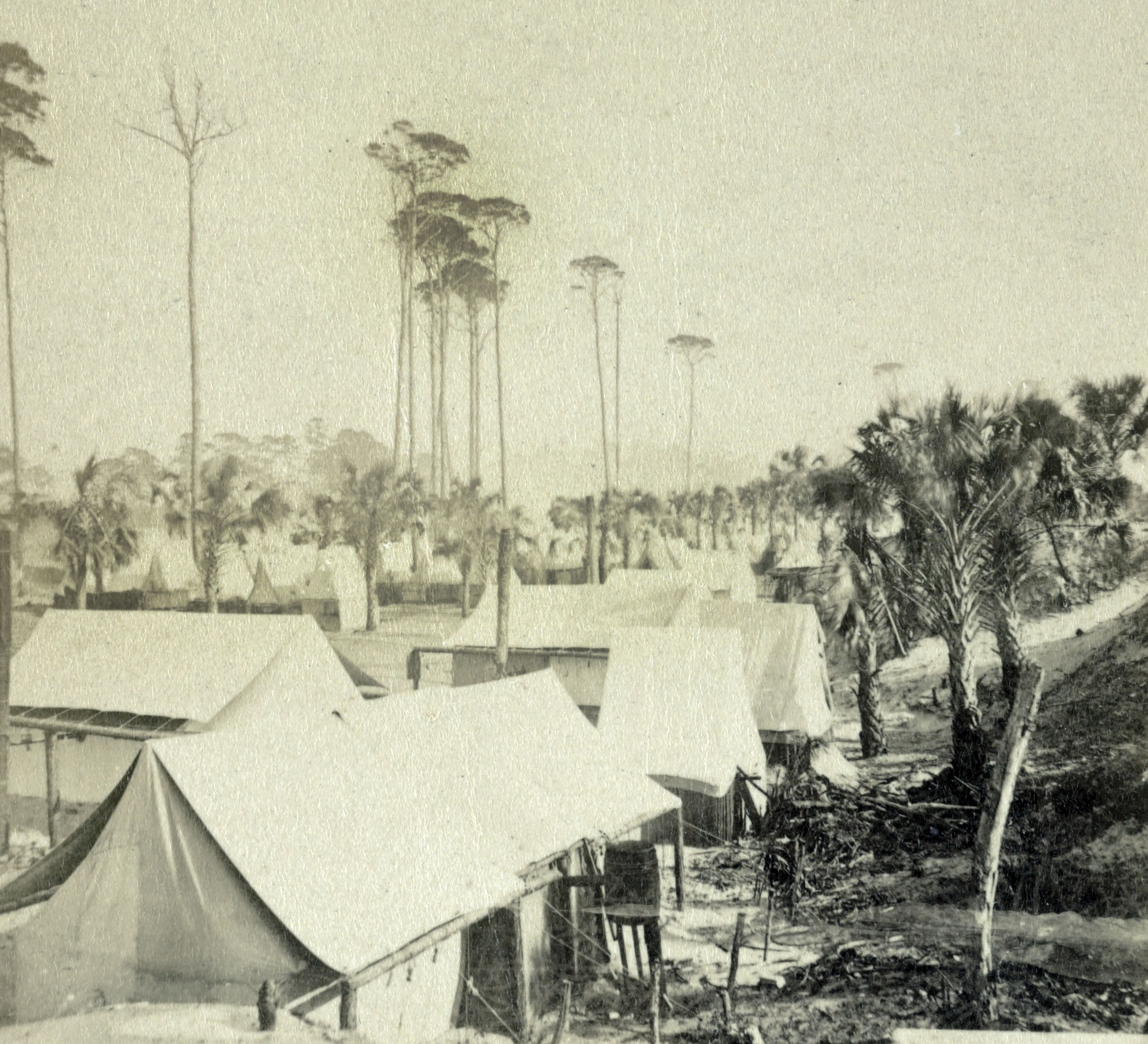
Dense rows of tents cover the ground in a Union army camp on Folly Island, South Carolina, during the war—a camp much like the one in which the mutiny in the 128th USCT took place in July 1866.
Although rebellion had not been a major issue for the Union armies, the concept itself was not new to white or black Americans. Indeed, the Civil War itself had in effect precipitated a massive slave rebellion in America, with countless black southerners going on strike when the war began and many of them leaving plantations behind.12 By war’s end, 4 million Americans had exited bondage as a result of escape, rebellion, and Union policy. As they became free, African-American women and men endeavored to define that freedom, yet they were not the only ones to do so. The government and its officials—including white officers in USCT regiments—carried their own ideas into the South. At times, the ideas of freedpeople and government officials meshed. As historian Chandra Manning has pointed out, the U.S. government and freedpeople negotiated a new social contract as the war unfolded, with a “wartime citizenship” based on what the former slaves offered the national government at its core. In exchange for intelligence, labor, and loyalty, the government helped secure black freedom and provided food and clothing to former slaves.13
A key aspect of this wartime alliance between the government and freedpeople was the direct participation of African Americans in the northern war effort as members of the Union military. Black men had been barred from military service before the Civil War, but activists like Frederick Douglass identified such service as a route to freedom and pressed Union officials to admit black men into the army and navy. As Douglass famously declared, “Once let the black man get upon his person the brass letter, U.S., let him get an eagle on his button, and a musket on his shoulder and bullets in his pocket, there is no power on earth that can deny that he has earned the right to citizenship.” Douglass got his wish. When President Abraham Lincoln issued the Emancipation Proclamation, he consented to the use of black troops, an action given teeth by the formation of the Bureau of Colored Troops shortly after. Many black men soon enlisted for the chance to toughen their claims to manhood after centuries of degradation.
Union and African-American interests aligned—for the moment. The government received more than 180,000 devoted black soldiers by the war’s end. While 51,032 were from northern states—of those, Pennsylvania offered the most with 8,612—the South contributed the majority. A total of 135,065 black troops joined from the seceded states and the border slave states. The army mustered them into USCT regiments, including the 128th USCT. Most of the men who enlisted in the 128th hailed from Georgia and South Carolina, which provided 3,486 and 5,462 men, respectively.14 While Douglass offered his thoughts on the meaning of military service, ex-slaves brought their own ideas and expectations. In an institution defined by strict rules and regulations, these became a source of friction for black recruits and their white allies. Such was the case for the troops of the 128th USCT when the emergence of the steamship Idea landed Private Hicks in ropes.
The men of the 128th discussed their options as Lieutenant Hall ate. Believing an injustice had been done, several of them snuck into Hall’s tent and cut Hicks loose. After finishing his dinner, Hall sauntered back to his tent and noticed Idea had not yet left the dock as he had ordered. He hiked to the wharf and reiterated his orders to the steamer, which promptly headed toward open water. Hall then learned that Hicks had been freed from captivity. Hall found the insolent Georgian, brought him back into his tent, and bucked him again.
In response, men from Company G poured out of their quarters. They loaded their guns and fixed bayonets. Hall met the men in the street to dissuade them from mutiny. Alone and outnumbered, he attempted to reason with them. When his rhetorical powers failed him, he resorted to a more aggressive form of persuasion: He pulled his revolver and leveled it at the crowd in hopes of dispersing the increasingly fervent gathering. When that did not have the desired effect, Hall fired several times and hit three men.
Hall quickly retreated, and in the confusion he heard a soldier yell, “Run him through!” The men from Company G returned fire as they withdrew from the street toward their quarters, but missed their target. Hall found cover within the Quarantine Hospital, even as bullets cut through the tent canvas. Tensions then apparently cooled temporarily, as there is no record of continued violence that day. The enlisted men surveyed the damage and found that one of the men whom Hall had hit had died. That night, the men reflected on the incident. No record of their exchange exists, but in the end, the men resolved to act. At 4 the next morning, Hall awoke in his tent to the furious yells of Private James Clark demanding justice for the murder of a soldier.
Clark, a slave prior to the war, had enlisted in the 128th on March 8, 1865, in Beaufort, South Carolina. While the regiment was stationed on Folly Island, Clark’s wife and mother resided in Charleston. Prior to the war Charleston had been a refuge for enslaved women who escaped but either could not make it to the North or chose to remain under the Carolina sun. Perhaps Clark’s wife found work there, as many African-American women had before emancipation.15 Clark’s mother, however, needed her son’s help, and he traveled to the city when he could. The opportunity to travel to see them probably felt like a great privilege. Slaveholders regularly separated loved ones and controlled slave marriages, so freedpeople rejoiced when they could form and maintain families. Keeping a family was one of many new freedoms they held dear. Clark may have enlisted to support his family as a freedman and felt a growing sense of respect as a soldier and wage earner.16 Having lived under the depravities of bondage, the South Carolinian likely saw Hall’s violence as an affront to his freedom and that of his fellow black soldiers.
Stepping from his tent, Hall encountered Clark loading a double-barrel shotgun. Supported by a few comrades beside him, Clark boldly shouted, “Do you know what you did? You killed one man and wounded two others.” Tuning Clark out, Hall pleaded with the others to lower their muskets. Unable to diffuse their anger, Hall fled. Clark opened fire, but he squandered the shot. The troops chased Hall for miles, but he eluded them and made it to Lighthouse Inlet, where he happened upon a fisherman who ferried him to regimental headquarters on Morris Island. There, Hall found the commanding officer. The officers gathered reinforcements to accompany Hall back to Folly Island later that day. With this bolstered force, Hall subdued the rebellion and arrested Clark to stand trial for mutiny.17
 Library of Congress
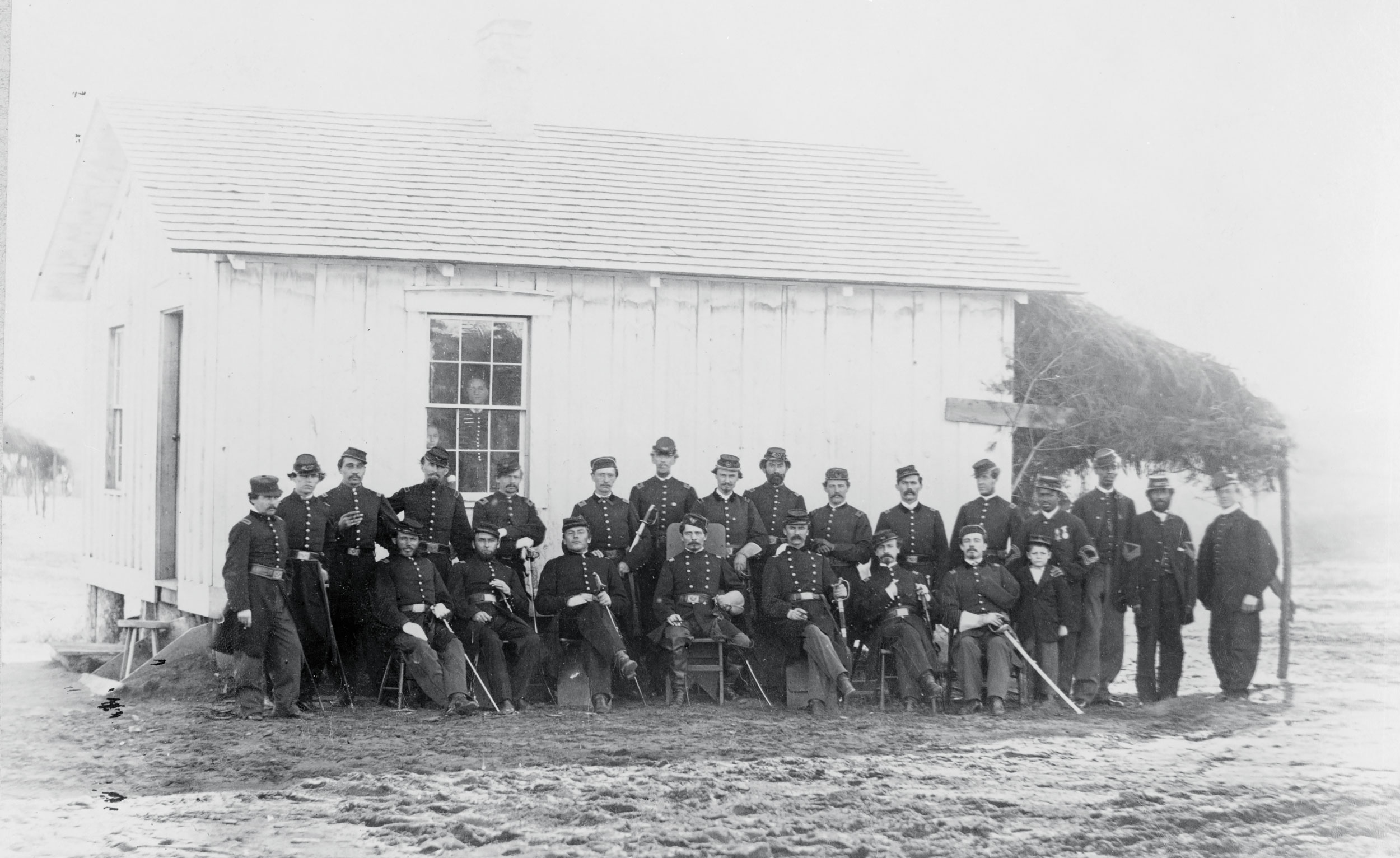
Clashes—some of them violent—between white officers and black enlisted men were not uncommon during the war. Above: The white officers and black non-commissioned officers of the 4th U.S. Colored Troops at Fort Slocum in Washington, D.C., in April 1865.
A month later, Clark awaited court-martial in a Charleston jail. During the American War of Independence, colonists had borrowed courts-martial from the British legal system in order to adjudicate infractions and maintain military order.18 Over the 19th century, the courts-martial system grew in sophistication as the army determined the best way to organize and discipline American soldiers. The Revised United States Army Regulations of 1861 outlined the procedure. Two separate courts-martial bodies were created. Regimental courts-martial were called to manage lesser crimes, such as theft, while more serious crimes, such as rape, murder, and mutiny, went to a general court-martial. These general courts-martial did not have juries and a judge. Instead, they were decided by officers, ranging in number between five and 13, who sometimes but rarely had experience in the law. A judge advocate prosecuted the alleged criminal, and the accused defended himself, though he could receive legal assistance at the tribunal’s discretion.19
At Clark’s trial, the white officers of the court listened to testimony for eight days. The judge advocate had charged Clark with mutiny, alleging that Clark encouraged his comrades to run Hall through with their bayonets and that Clark intended to murder Hall. To build his case, the judge advocate called Hall to testify. The lieutenant said that the matter began when Idea arrived and the men wanted to have a “frolic” with ship’s passengers. When some of the troops at the wharf refused to obey his order to return their tents, he said, he shoved a man, which sparked a “spirit of resistance” in Private Nelson Hicks. After recounting all relevant details, Hall noted that on the morning of July 19, Clark had been “[h]ostile, insubordinate, [and] showed signs of ugliness.” Hall added that Clark, as well as all members of his company, had had the Articles of War read to them after their enlistments and therefore knew the conduct required of soldiers.
Clark presented an alternative story. He undermined the judge advocate’s argument, attempting to douse the prosecution’s claim that he had led the mutiny and intended to harm the lieutenant. Clark explained that his comrades had compelled him to join. He told the court that when men in his company grew agitated over the injustices, he did not participate. The men tried to goad him into the fight, he said: “When the men began to gather in the Company street, I was sitting down on my door step. They said to me, ‘Clark, ain’t you going[?]’ I said ‘no, I would not go.’ Some one said I was a damned coward. I said, ‘I’d take that for my shame and stay.’” He argued that he would not budge, even when they questioned his manhood.20
When Clark finished his statement, the court deliberated. The court could choose to execute him. Precedent proved execution could be used for mutineers, as their actions threatened the war effort. Yet courts-martial had also factored white officers’ mistreatment of black soldiers into their decisions before, perhaps giving Clark optimism.
Many Civil War officers realized that black soldiers faced challenges due to racial discrimination or the difficulties of transitioning to freedom and military life. Abolitionist minister Thomas Wentworth Higginson, who became colonel of the 1st South Carolina Colored Regiment in 1863, was among the most compassionate men to command black troops. Before joining Lincoln’s army, Higginson advocated for the end of slavery with such vigor that his New England congregation asked him to step down. He later funded John Brown’s insurrection, which ended at Harpers Ferry. As a colonel, Higginson made special considerations for his men. He ordered his fellow white officers to abstain from using the worst epithets among the rank and file and to elect less violent punishments for them so as to not stir memories of slavery.
Not all officers of African-American troops exercised such empathy, though. Multiple clashes between white officers and black soldiers occurred during the war. Lieutenant Colonel Augustus Benedict of the 4 Corps D’Afrique, for instance, had a history of harassing the regiment’s black enlisted men. He was known to strike the men without cause, and once he had a soldier tied to the ground by his legs and arms. He then poured molasses on the man’s face, hands, and feet and forced the soldier to bake in the sun while insects, attracted by the sweet scent, crawled over his body. In every instance, the black soldiers—many of them former slaves—serving beneath Benedict did not act, possibly fearing retribution. However, when Benedict whipped two members of the regimental band on December 9, 1863, the regiment exploded. A quarter of the men rushed the parade ground in outrage. One yelled, “Kill all the d—d Yankees,” and another fired into the air. They called for Benedict’s head. While most did not join the fight, neither did they help suppress the rebellion. After discipline was finally restored, 22 of the men faced court-martial; 13 were acquitted, seven received jail time, and two were sentenced to death. The case was referred to the department commander, Major General Nathaniel Banks, who commuted both sentences and instead imprisoned the men.21
Soon after the incident, Banks hired investigators to examine its cause. One of them, an officer named William Dwight, found that the regiment had been run by licentious men who routinely used violence to enforce order. Dwight concluded that brutality merely produced “physical terror, and when that goes beyond endurance, there follows—mutiny.” He compared the regiment’s white officers to nasty overseers who, unlike slaveholders, did not even care for the value of the enslaved laborers under their control. He determined that the capricious violence would end in insurrection, acknowledging the former slaves’ hunger for dignity: “This Regiment will rise in revolution if the abuse of its soldiers is suffered to continue—and the next revolt will not be bloodless.” To prevent further violence and placate the troops, Banks made an example of Benedict. He ordered that the lieutenant colonel be tried by court-martial, which ultimately convicted him of inflicting cruel and unusual punishment on his men, to the prejudice of good order and military discipline. The court then discharged Benedict from the army.22
Lester Hall had not resorted to the same violence as Augustus Benedict, yet Hall’s actions had nonetheless prompted his men to compare military life to their prior lives in slavery. To black soldiers, menacing white officers evoked memories of bondage. For many, the prospect of freedom meant more than the chance to kill Confederates or earn a wage. Free men, as Nelson Hicks declared, had rights and, as James Clark insisted, deserved justice when wronged. When Hall violated their sense of freedom, Hicks and Clark confronted their lieutenant, but their appeals were met with belligerent authority. Now, a court of white officers sat in judgment. Whether they considered Hall’s actions out of line would determine whether Clark went back to his duties or walked to the gallows.
 Library of Congress
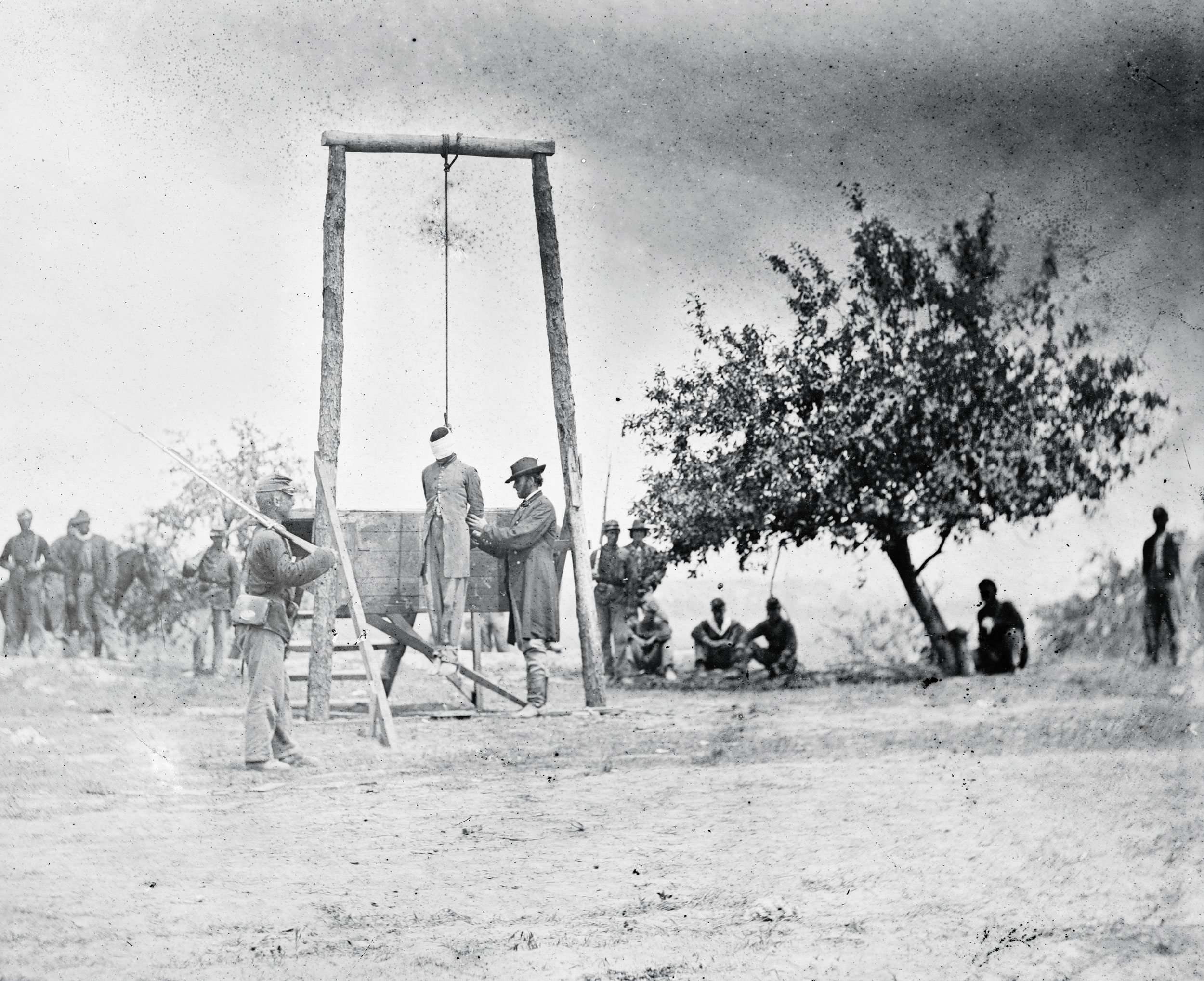
Private William Johnson of the 23rd USCT hangs after being sentenced to death by a court-martial for desertion and rape in 1864. Two years later, Private James Clark of the 128th USCT faced the same fate for his role in the Idea mutiny.
When the court returned, Clark’s hopes were dashed. The panel of judges sided with Hall and convicted Clark of mutiny. They also decided to exercise the full extent of the court’s power and sentenced Clark to death. The army planned to hang the former South Carolina slave at Castle Pinckney for the Idea mutiny. The execution was set for September 28, 1866.23
As he sat in his jail cell awaiting his fate, Clark continued to fight his case. He caught a break when his execution was suspended until November 1. That date came and went with the army taking no action. Finally, Clark decided to make an appeal. On December 14 he wrote to the general commanding the area and asked him to either explain why he had been in jail or to release him so that he might help his family in Charleston. “I have an old mother living in the city … who depends on me for support as well as my wife. I therefore would deem it a great favor of you to have me released, if possible, or let me know what I am confined for and how long I am to remain here,” he wrote. It is unclear whether Clark truly did not understand why he was incarcerated. He had testified at his trial, of course, but perhaps after sitting in prison for months with two scheduled execution dates passing, curiosity truly arose. It is also possible that he simply feigned ignorance to get the commander’s attention. Whatever the reason, Clark took the opportunity to explain his plight and earn sympathy. Five days later, upon reviewing his case, the commander stayed the executioner’s hand, stating that the court had acted illegally, yet did not provide further explanation. He advised that a new trial was necessary. Surprisingly, Clark’s military service record does not report what became of him after that, but he at least lived to fight for freedom another day.
The Idea melee was not the first confrontation sparked by differing ideas of freedom in the army. On September 30, 1863, African-American soldiers in the 54th Massachusetts Infantry had refused their wages in protest over being offered less pay than white troops. William Walker and other soldiers in the 3rd South Carolina Colored Regiment had gone on strike on November 19, 1863, over incidents of mistreatment and unequal pay. The frequency and varying causes of such conflicts suggest that black men did not always discover military service to be an ennobling experience or view the army as an institution that respected, much less guaranteed, their freedom.
These men’s experiences yield a stark contrast to the army experiences of black soldiers remembered for their valor. African Americans accomplished great things in the Union army. They not only helped turn the tide of war, but they also proved their manhood and their humanity in combat. Yet to see soldiers as merely fighting for freedom and embodying the passage of black life from bondage to liberty misses how black troops struggled for freedom within the army as well.
The army was an institution where black men, especially former slaves, attempted to build lives as they worked through the meaning of emancipation. Unlike most white enlisted Union men, who saw service as an adventure with a deeper purpose to be accomplished before they returned home, formerly enslaved men did not view service as temporary or as detached from their homes and families. To them, soldiering was inextricably linked with freedom: a means to earn a wage, improve their lives, and maintain relationships with their families. As freedpeople throughout the South adjusted to life after slavery, so too did the black troops of the 128th USCT. They were determined to live out their ideas of freedom, even as members of an occupying military force.
Jonathan Lande, who earned a Ph.D. from Brown University (2018), where he was the recipient of the Presidential Award for Excellence in Teaching, is the Irene and Bernard Schwartz Postdoctoral Fellow at the New-York Historical Society and the New School. In 2019, he will be heading west to begin a position as assistant professor at Weber State University. He is currently researching African-American soldiering and resistance within the Union ranks.
Notes
1. William T. Sherman, Memoirs of General William T. Sherman (New York, 1875), II: 289. For military service and recruiting, see William Dobak, Freedom by the Sword: The U.S. Colored Troops, 1862–1867 (New York, 2013), 81–82. For freedom celebrations in Charleston, see Ethan J. Kytle and Blain Roberts, “When Freedom Came to Charleston,” The New York Times, February 19, 2015.
2. Dobak, Freedom by the Sword, 487.
3. Gregory P. Downs, After Appomattox: Military Occupation and the Ends of War (Cambridge, 2015), 41.
4. Joseph T. Glatthaar, Forged in Battle: The Civil War Alliance of Black Soldiers and White Officers (Baton Rouge, 1990), 208–217.
5. Quoted in Dobak, Freedom by the Sword, 481.
6. Widow’s Pension Certificate No. WC 136174, Filed by Doll Bellinger, Mother of Soldier, Tedore Bellinger, Sergeant, Company C, 128th U.S. Colored Troops; Widow’s Pension Certificate No. 99490, Filed by Phillis Fleming, Wife of Soldier, William Fleming, Lieutenant, Company H, 128th U.S. Colored Troops, “Case Files of Approved Pension Applications of Widows and Other Veterans of the Army and Navy Who Served Mainly in the Civil War and the War With Spain,” Record Group 15, National Archives (hereafter cited as NA), Washington, D.C. Jim Downs, Sick from Freedom: African-American Illness and Suffering during the Civil War and Reconstruction (NY, 2012). For disease rates among white and black soldiers, see Margaret Humphreys, Intensely Human: The Health of the Black Soldier in the American Civil War (Baltimore, 2008), 11.
7. For the parties slaves threw, see Stephanie Camp, “The Pleasures of Resistance: Enslaved Women and Body Politics in the Plantation South, 1830–1861,” New Studies in the History of American Slavery, ed. by Edward Baptist and Stephanie Camp (Athens, 2006), 87–125.
8. Lester Hall Service Record, First Lieutenant, Company G, 128th U.S. Colored Troops, “Carded Records Showing Military Service of Soldiers Who Fought in Volunteer Organizations During the American Civil War, compiled 1890–1912, documenting the period 1861–1866,” Record Group 94, NA.
9. Nelson Hicks Service Record, Private, Company G, 128th U.S. Colored Troops, “Carded Records Showing Military Service of Soldiers Who Fought in Volunteer Organizations During the American Civil War, compiled 1890–1912, documenting the period 1861–1866,” Record Group 94, NA.
10. John D. Billings, Hardtack & Coffee or The Unwritten Story of Army Life (Boston, 1887), 146.
11. Courts-Martial Case File OO1785, Record Group 153, NA (hereafter cited as OO1785, RG153).
12. See also Steven Hahn, The Political Worlds of Slavery and Freedom (Cambridge, 2009), 57–72.
13. Chandra Manning, Troubled Refuge: Struggling for Freedom in the Civil War (New York, 2016), 206.
14. Adjutant General’s Office, Bureau for Colored Troops, Annual Report, 1865, October 20, 1865, in U.S. War Department, Adjutant General’s Officer, The Negro in the Military Service of the United States, 1639–1877, reel 4, vol. 6, 186501877, 3723.
15. Amani T. Marshall, “‘They are Supposed to be Lurking about the City’: Enslaved Women Runaways in Antebellum Charleston,” The South Carolina Historical Magazine 115, no. 3 (July 2014): 189.
16. James Clark Service Record, Private, 128th U.S. Colored Troops, Company G, “Carded Records Showing Military Service of Soldiers Who Fought in Volunteer Organizations During the American Civil War, compiled 1890–1912, documenting the period 1861–1866,” Record Group 94, NA.
17. OO1785, RG 153.
18. George James Stansfield, “A History of the Judge Advocate General’s Department United States Army,” Military Affairs 9, no. 3 (Autumn 1945): 219–237.
19. For more on how the courts-martial operated and formerly enslaved men’s trials, see Jonathan Lande, “Trials of Freedom: African American Deserters during the U.S. Civil War,” Journal of Social History 49, no. 3 (March 2016): 693–709.
20. OO1785, RG153.
21. Fred Harvey Harrington, “The Fort Jackson Mutiny,” The Journal of Negro History 27, no. 4 (October 1942): 420–425.
22. Ibid., 426, 430.
23. OO1785, RG153.
Related topics: African Americans