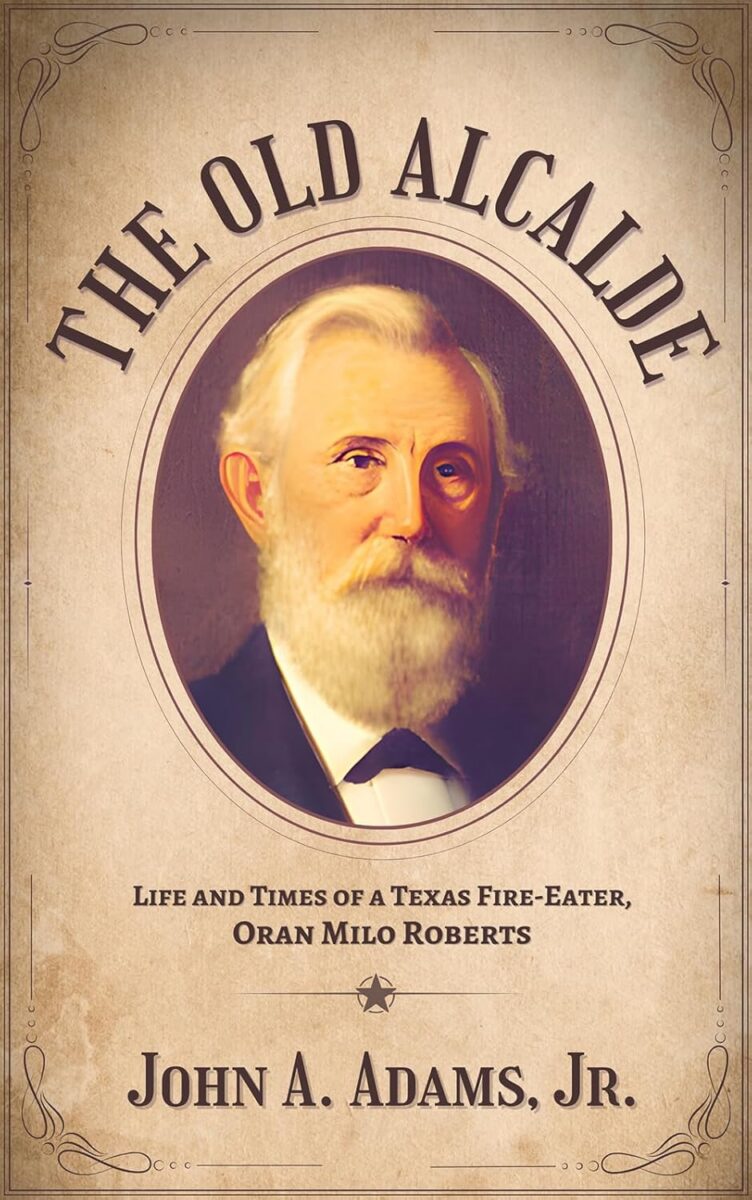
Oran Milo Roberts was born in South Carolina in 1815, the youngest of six children in a family that relocated to Alabama shortly after his birth, driven there in 1818 by crop failures and harsh winters. Roberts was educated at home by a family that strongly encouraged education as an escape from agricultural life. Roberts attended the University of Alabama, was admitted to the Alabama bar in 1837, and served a term in the Alabama state legislature before relocating to the piney woods of the Republic of Texas in 1841. In Texas, he served as a district attorney and state judge, but most importantly as a member of the state’s Supreme Court, a leader of its secession convention in 1861, and as a jurist and governor who reshaped Texas after the collapse of Reconstruction.
This biography of Oran Milo Roberts is authored by John A. Adams, Jr., who currently serves on the Dean’s Advisory Board of the George H.W. Bush School at Texas A&M University. Adams has authored over twenty books—primarily on subjects related to Texas history—and has been recognized by the Texas Historical Commission with its T.R. Fehrenbach Book Award. This is the first published biography of Roberts, though the author acknowledges a dissertation about Roberts written by Leila Bailey at the University of Texas in 1932. Additionally, Ford Dixon originally published an article about Roberts in the 1952 edition of the Handbook of Texas History, which was subsequently updated online as recently as 2022.
Throughout the book, Adams argues that scholars have largely ignored Roberts—perhaps, he speculates, to avoid confronting his outwardly racist views and support for secession. In ignoring Roberts, the author further contends, historians have missed the profound imprint that Roberts left on the post-Civil War state of Texas. He was perhaps the principal author of Texas’s secession ordinance. Owing to his reputation as a rather dull and uninspired public speaker, Adams characterizes him as an “unlikely” fire-eater. After the Civil War, he was selected to represent Texas in the U.S. Senate in 1866, but Republicans in Washington refused to seat him (or any of the Texas delegation) so long as the erstwhile state remained unreconstructed. Roberts, however, found his way back into the seat of power as Reconstruction collapsed in Texas, beginning with the contested election between Edmund Jackson Davis and Richard Coke in 1873 and 1874. When Coke prevailed, Roberts snatched an appointment to the state Supreme Court and was given free rein to rewrite Texas civil code. He cemented the new political and legal order with two terms as Governor of Texas (from 1879-1883). After politics, Roberts taught law at the newly opened University of Texas until 1893; then, he retired to write histories of the state and became one the founding members of the Texas State Historical Association.
While Adams makes a convincing argument for Roberts’s influence and importance during one of the most pivotal periods in Texas history, his argument that Roberts has been unduly overlooked or perhaps even avoided because of his controversial prejudices and political views at times falls flat. While indeed Roberts is not often mentioned alongside the most notable fire-eaters—men like Robert Barnwell Rhett and William Lowndes Yancey—that can largely be explained by the relatively minor role that Texas had to play in the formation of the Confederacy. It can further be explained by the fact that he found himself in the political wilderness during Reconstruction itself (and was perhaps too successful in his role as shaper of the Texas Constitution of 1876 in diminishing the powers and influence of post-Reconstruction Texas governors).
As for Roberts’s prejudices and views about race, slavery, freedom, and power, it is unfair to insinuate that historians are unwilling to grapple with them. To the contrary, historians have been systematically studying the post-Reconstruction South and the world that men like Roberts created according to their views of race and politics ever since C. Vann Woodward published The Origins of the New South in the 1950s. The Texas of Roberts’ creation—a place of diminishing rights and opportunities for Black Texans and Tejanos in the Gilded Age, a place of political spoils, of convict chain gangs, and of corrupt county judges—has garnered frequent attention from Texas historians.
Roberts himself does frequently get lost in that discussion, but only because the individual becomes less important than the gravity and consequences of his actions. In that spirit, author John A. Adams, Jr., has given us a welcome correction. With this thoroughly researched and exhaustive biography, he brings Oran Milo Roberts back into the discussion.
Aaron David Hyams teaches Texas history at Sam Houston State University.