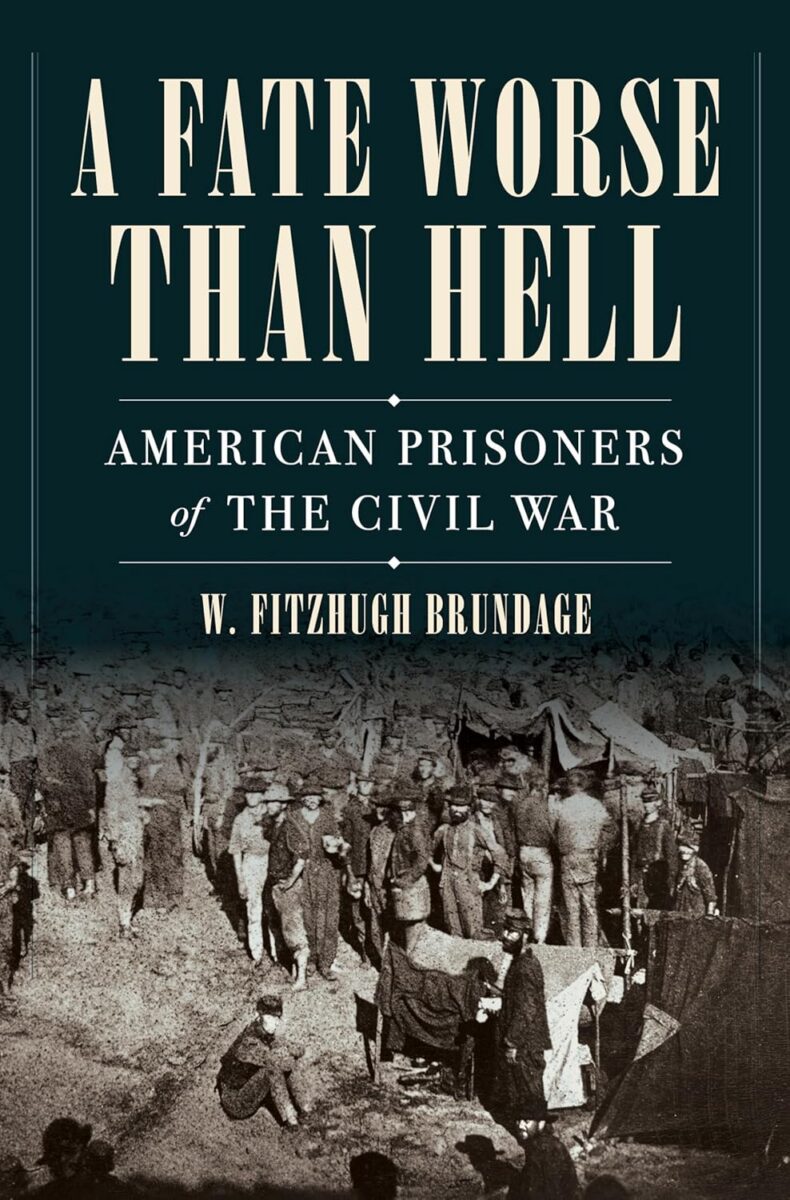
“The fate of prisoners of war,” writes the historian W. Fitzhugh Brundage, “was of far greater significance to the course of the Civil War than is commonly understood” (16-17). For decades, the cloying imperatives of sectional reconciliation effaced the awful realities of Civil War prisons. For decades, the wrenching tales of Andersonville survivors were scorned as the efforts of propagandists who desired only to fan the smoldering embers of sectionalism. Though Civil War aficionados are fond of passing out superlatives (Antietam was the war’s bloodiest single day, Gettysburg its bloodiest battle, and Spotsylvania Court House the site of its longest sustained combat), they have tellingly neglected the deadliest location on the Civil War landscape—that open-air stockade in southwestern Georgia where more than 12,000 Union prisoners died of malnutrition, medical malpractice, or disease.
While specific prison camps have enjoyed their devoted chroniclers over the years (Michael Gray on Elmira, John Derden on Camp Lawton, Dale Fetzer and Bruce Mowday on Fort Delaware), we have long needed a comprehensive history of Civil War prisons that considers the perspectives of captives and prisoners alike not as aberrant, but rather as “consonant” with the conflict: a holistic view that sacrifices nothing of the prison system’s complex human topography. A Fate Worse Than Hell is that book—the finest history of Civil War captivity ever written, and a sober reckoning with the meaning and conduct of the war.
Brundage’s argument inheres in the book’s structure: each chapter opens with a carefully drawn sketch of an individual historical actor whose lived experiences make legible a particular moment or evolution in the history of Civil War prisons. History is made by people, Brundage reminds, not impersonal forces. The human misery of Civil War prisons, too often explained away as the unfortunate consequence of a war propelled by its own logic, was, Brundage contends, “the consequence of the principles espoused by the warring sides” (19). No less than on the battlefield, in those squalid stockades and overcrowded tobacco warehouses where pestilence and disease held high carnival, ideas found articulation on the ground.
By locating the policies and practices of the Union and Confederacy in much longer histories of enemy captivity and wartime restraint, Brundage illumes “innovations” of Civil War prisons (17). “The Union and Confederacy demonstrated that internment on a massive scale was now not only imaginable but also feasible,” he writes. No mere curiosity, Civil War prisons “warrant attention for the role they played in the evolution of late-nineteenth and early-twentieth century restraints on armed conflict” (19).
During the war’s first summer, “respect for tradition and personal honor prevailed” in the care and treatment of enemy prisoners (43). But through “a combination of inept planning, bumbling administration, and cynical design,” Confederates abandoned convention (46). “Expediency and extreme economy,” the author writes, became the “watchwords” of Confederate policy toward enemy POWs (60). Even more precisely, Brundage finds that “Confederate officials never fully accepted the obligation to provide for prisoners of war in the absence of exchanges.” Though Confederates demonstrated their capacity for “innovation” on and off the battlefield in “myriad ways,” they tellingly displayed no such creativity when it came to military prisons (72).
Nor did a formal prisoner exchange cartel, the details of which were hammered out by Major General John Adams Dix and Major General Daniel Harvey Hill at Haxall’s Landing, Virginia, in the summer of 1862, do much to remedy the situation. Prisoner exchanges, Brundage writes, were distinguished by both an “absence of civility” and a “constant jockeying and sparring” between the belligerents (107). The Confederacy’s refusal to exchange prisoners after the enlistment of African American troops in large numbers meant that a white soldier could be exchanged for a black one, and it led to the collapse of the Dix-Hill cartel. But “even before the issue of Black prisoners of war arose,” Brundage clarifies, “the limits of Confederates’ commitment to reciprocity drove both sides to clarify what they were fighting for and to demonstrate the sacrifices they were willing to make to uphold their principles” (110).
The cessation of exchanges produced the “oppressive overcrowding and appalling squalor” that characterized the ghastly prison pens of the war’s final year (128), and ensured that despite their small numbers, Black Union prisoners played an outsized and significant role in the history of Civil War captivity. No longer temporary waystations where men awaited a formal exchange, enemy prisons became places that tested the captives’ “will and resilience” (153). Captors herded prisoners behind arbitrary “dead lines” (beyond which no prisoner could venture), stripped them of privacy through “continuous surveillance,” and subjected them to “degradation, deprivation, and isolation” (159, 182). In response, northern prisons for Confederate captives became sites of “calibrated retaliation” (173). In sum, Civil War prisons were the “most extreme total institutions of the nineteenth century.” (153).
While captivity levied physical, psychological, and emotional costs, prisoners bespoke their remarkable tenacity for life by finding ways to preserve “a measure of their humanity” (184). Just as Andersonville was neither inevitable nor a “military necessity,” so too were its prisoners something other than hapless victims. For the balance of their lives, these men would learn how to live with Millen and Libby, often greeted with the skepticism and incredulity that has stained our histories.
To the list of the Civil War’s innovations, Brundage adds one that we have preferred to ignore. “Both the Union and the Confederacy,” the author writes, “demonstrated that modern transportation networks and administrative capacities made it possible, indeed advantageous, to detain hundreds of thousands of humans for years at a time” (314). By asking us to confront head-on “acts of direct responsibility and acts of complicity,” Brundage rewrites not just the history of Civil War prisons, but the history of the conflict itself (367). A Fate Worse Than Hell is a landmark book that will engross the reading public and compete for the field’s top awards.
Brian Matthew Jordan is Chair of the Department of History and Co-Director of the Civil War Consortium at Sam Houston State University. He is the author or editor of six books on the Civil War and its era.
Related topics: prisons and prisoners