 Library of Congress
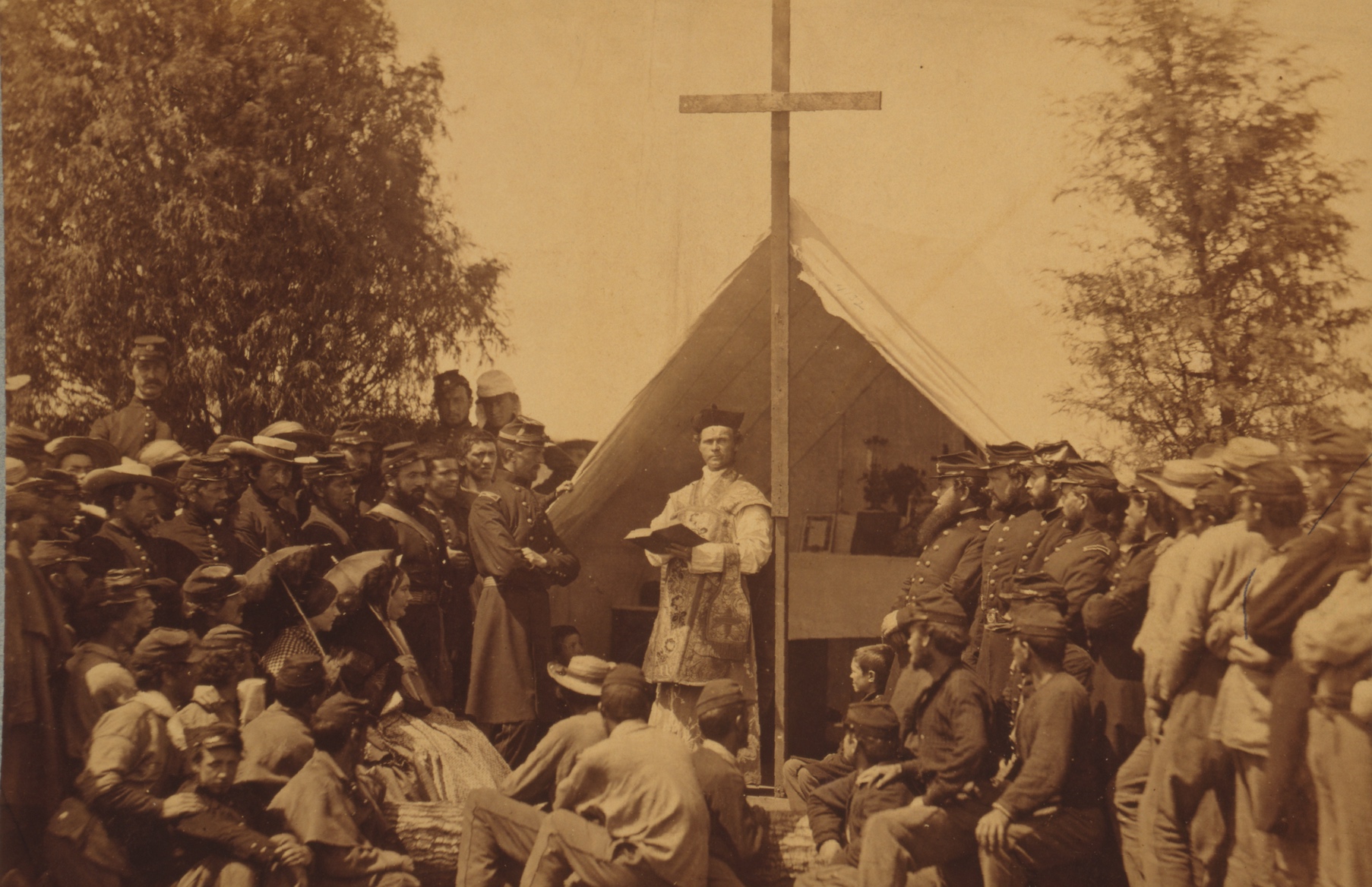
A priest conducts a religious service in a Union army camp during the Civil War.
In the Voices department of our Spring 2026 issue we highlighted quotes by Union and Confederate soldiers about the importance of religious faith in helping them navigate the challenges of war. Unfortunately, we didn’t have room to include all that we found. Below are those that just missed the cut.
“I have never seen more diligent Bible-readers than we had in the Army of Northern Virginia.”
—Confederate chaplain J. William Jones, in his reminiscences of the war
“Verily I believe that God has guarded and preserved me every hour. I firmly believe that he will save me harmless through this dread day of our country’s danger, or He will answer my constant prayer that I may be taken, if die I must, in the very midst of my country’s foes, and that my spirit may ascend amid the smoke of battles, a fit offering to liberty and truth, and my body rest among the brave where the dead lie thickest….”
—Texas soldier C. West, in a letter to his wife during the Chattanooga Campaign, October 9, 1863
“You ask if I ever feel discouraged. Seriously, I do not…. [L]ooking up to the brave old banner of our loves and hopes, and beyond it to Him who established us a nation, and who so long hath blessed us with more prosperity than any other people ever enjoyed, not excepting even His own chosen Israel, I recognize the fact that He is a God of justice, and that He will speed the right.”
—Will McLain, 32nd Ohio Infantry, in a letter home from Vicksburg, Mississippi, November 18, 1863
“Taking all the circumstances in consideration, truly the Providence of the Almighty was nowhere more strongly manifested in our behalf than in this battle.”
—J.J. McDaniel, 7th South Carolina Infantry, in an undated account of the Battle of Antietam
“My dear friend, whatever may befall me, my trust is firm in the Lord; and when I have seen my comrades fall on every side, and heard the mournful cries of the wounded, and shot and shell were flying close around my head, my thoughts were, and ever are, with my God and those whom I love at home. Oh, what bliss to feel that you are ready to fly to the world above without a moment’s notice! Now is the time that I find the value of secret prayer. Oh! The comfort I get from this source cannot be explained!”
—John R. Pillings, 86th New York Infantry, in a letter to a friend during the Overland Campaign, May 18, 1864
“It seemed almost miraculous that I was not hit, and I render thanks to Him who rules the destinies for my preservation.”
—H. Warren Howe, 30th Massachusetts Infantry, in a letter to his parents after the Battle of Cedar Creek, October 21, 1864
 Library of Congress
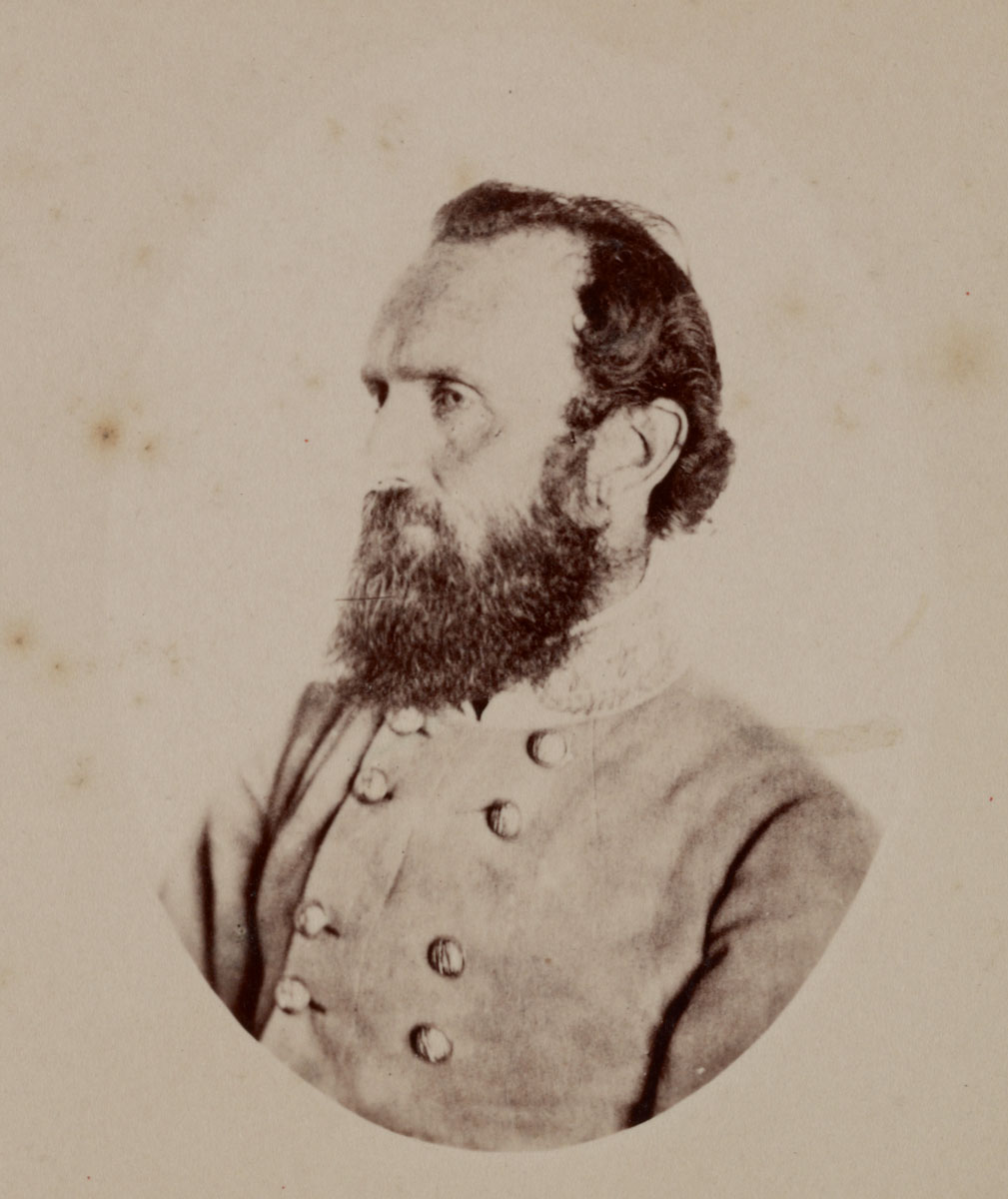
Thomas J. “Stonewall” Jackson
“A great calamity has befallen us. But God’s will be done! He will rise up another Gideon to do battle for us!”
—Virgil A.S. Parks, 17th Georgia Infantry, on the death of Confederate general Thomas J. “Stonewall” Jackson, in a letter to the Savannah Republican, May 11, 1863
“At one time our chaplain gave me up, and thanks be to God I felt ready to go or stay. I would not give up the hope I have for the whole world. I found my Saviour to be a great comfort to me in my hours of pain. I kept the Bible you gave me through all my troubles. The ball passed under it.”
—Union soldier Chester Hutchinson, on his recovery from a wound received during the Red River Campaign, in a letter dated May 2, 1864
“Thoughts of my family come to my mind while in the midst of battle, nerving me to nobly dare the dangers that surround me. I did not know how much I loved you; you must have then been praying for me. I felt the affections of my heart welling up as pure and warm as ever. Dangers are not yet past. Continue to plead with my Heavenly Father for my welfare. I have great hopes of returning safely to the bosom of my family; but if I never do, I know I shall not be forgotten away down in the vista of the future; when my body has mingled for years with the dust of the brave men who have fallen in battle, you will think of me.”
—Charles De Mott, 1st New York Artillery, in a letter to his wife after the Battle of the Wilderness in May 1864. De Mott was killed weeks later at the Battle of Cold Harbor.
“My object in writing is to inform you that I have enlisted in the army of the United States for one year; but having faith and confidence in my Father above, I live in hopes to get back home once more, when I expect to find my work and old customers waiting for their old whitewasher and house-cleaner to resume his old station.”
—Private Isaac Stokely, 6th United States Colored Troops, in an undated 1864 letter to a female acquaintance
“Through an all-wise Providence I am yet spared.”
—W.R. Snook, 68th Ohio Infantry, in a letter written during the fighting for Atlanta in 1864
“I tell you it was a terrible moment. I wouldn’t take a thousand dollars to pass another such. Still the good God was overseeing all, and he preserved me. Never did I utter a more fervent prayer of thanks than I did that night.”
—Will McLain, 32nd Ohio Infantry, on an incident during the fight for Atlanta, August 8, 1864. McLain, separated from his regiment, played dead for a time to avoid capture when Confederates temporarily overtook his position.
“Two or three times a week they hold prayer-meetings, which are always largely attended, and seem to attract much interest…. Some might imagine these meetings were held simply for the purpose of passing away time, while others would claim that these men were actuated by higher motives. To the latter view the writer is very strongly inclined, not believing they are all hypocrites.”
—Union soldier John Whipple, a guard at the Confederate POW camp at Elmira, New York, on a prayer meeting held among prisoners, in a letter from June 1864
 Library of Congress
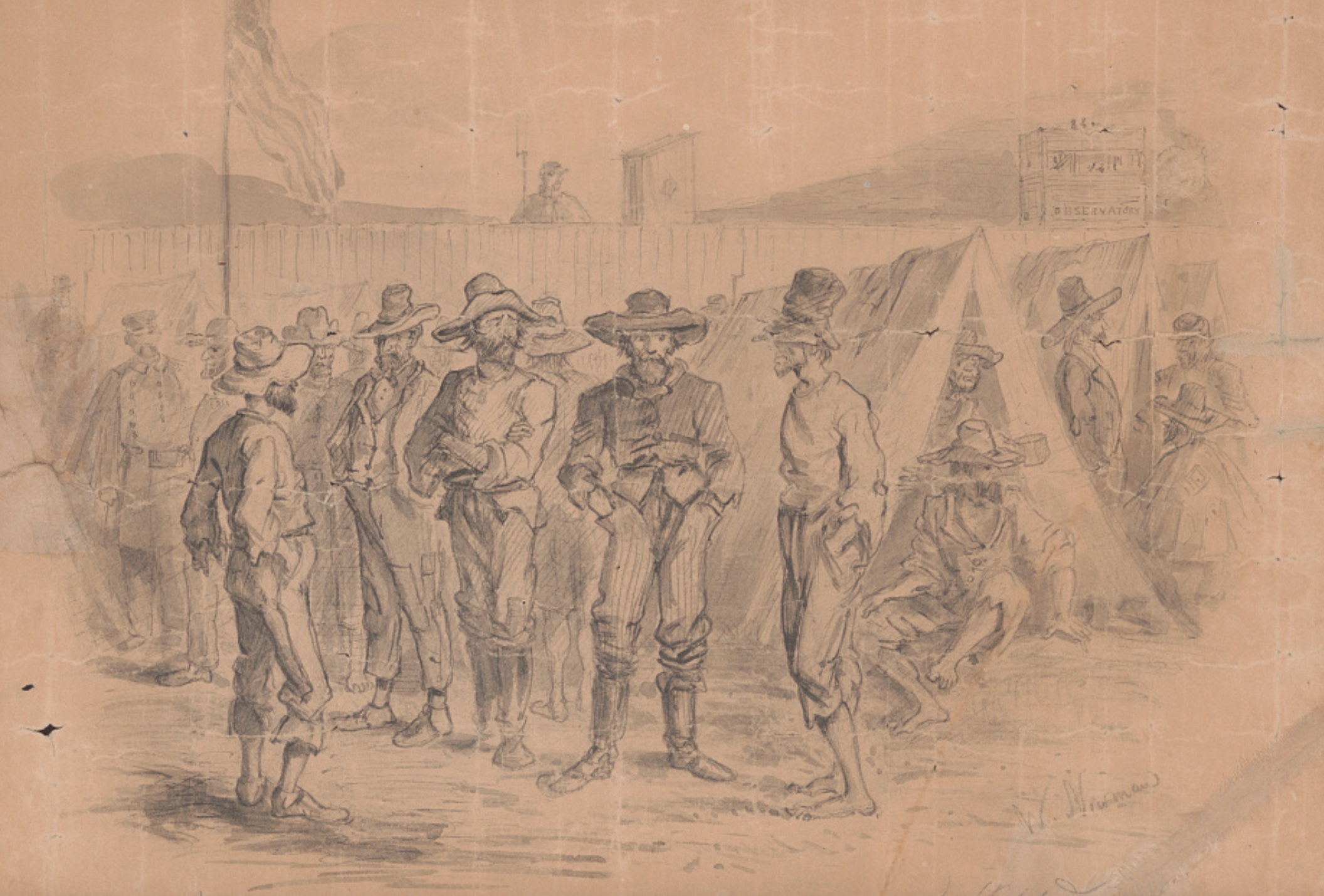
A wartime sketch of Confederate POWs outside Elmira Prison
“I told him I could do nothing for him, but I thought God would, and as I said this, he fell over dead.”
—Captain George W. Hooper, 6th Alabama Infantry, on an exchange with a comrade shot in the head at the Battle of Seven Pines, in a letter to a Georgia newspaper, June 2, 1862
“A gracious Providence has preserved me. I am forcibly reminded of a friend’s benediction when I left the State, his prayer that God would cover my head in the day of battle. Has it not been fulfilled?”
—Stephen Albert Rollins, 95th Illinois Infantry, in a letter detailing his experiences during the Red River Campaign, April 27, 1864. Less than two months later, Rollins, 22, was mortally wounded at the Battle of Brice’s Crossroads.
“Thanks to One, who is Ruler over all, it never had the opportunity of proving its usefulness.”
—Union officer Henry Munsell, on the personalized “medal” he had purchased to identify his body if he was killed in battle, in a letter to his “little cousins,” December 18, 1863
“We are having a glorious time right now…. Gen. Jackson (God Bless him) has given us the privilege to be exempt from Morning’s Drill in order that we may attend preaching…. [W]e have two sermons each day & although we have no church to worship in we all sit around on the ground and listen to the sweet sound of the Gospel.”
—Confederate soldier R.B. Hudgens, in a letter to his uncle, April 12, 1863
“We are now rejoicing over political victories at the ballot-box, and the horizon is evidently clear: soon the morning of peace will dawn; the Union will be re-established; the nation will be purified; the oppressed will all be free, and God will accomplish his vast designs, and make this now distracted people one of the greatest and most prosperous nations in the world.”
—J.G. Nind, 127th Illinois Infantry, in a letter written in the fall of 1863
“I am not squeamish, you know, and not very sensitive, and yet it is awful to hear the cold-blooded insults to God….”
—Union soldier H.H. Penniman, lamenting the “universal” and “sometimes dreadfully severe and heaven-daring” profanity in camp, in a letter to his wife, June 6, 1863
“Faithfully relying on the Good Being, who, while permitting, through his infinite wisdom, many reverses to befall us, has still wonderfully shielded our Young Republic, we will meet the foe again with renewed energies and conquer a lasting peace, and preserve our liberty and honor.”
—Colonel Clement A. Evans, in a circular published to the men of his brigade to help persuade them to reenlist, February 4, 1864
“It is the Sabbath-day. I tried hard to go to church, but could not, for all our boats were gone but the one belonging to the garrison; that ran on a snag and sprung a-leak as it was returning from town this morning, with a load of soft bread. So my attempts were useless. My pass ran till 9 p.m., and I could have heard two sermons if I had gone. So much for going to church in the army. When we do go, we must have our boots polished, brass bright, clothes brushed, dress-coat on, and side-arms, or we are not permitted to leave camp. Take it with the thermometer up to (as high as you please), and with heavy coats buttoned up to the chin, with belts on, it is not very comfortable, to say the least of it.”
—Union soldier John Whipple, in a letter to his family, May 31, 1863
“It now commenced to rain in torrents, and filled the pits. We stood in mud and water up to our knees; the water ran down our backs and chilled us through: it was getting light, and before long our pits must be discovered, and bring upon us the rebels’ guns and sharp-shooters. Officers and men would have given all they possessed to be out of that place. In the horrible moments of suspense, how I inwardly prayed for God to lengthen the morning and keep daylight from us!”
—Alfred Davenport, 5th New York Infantry, in a letter to his parents about his experiences at the Battle of Fredericksburg, December 17, 1863
 The New York Public Library
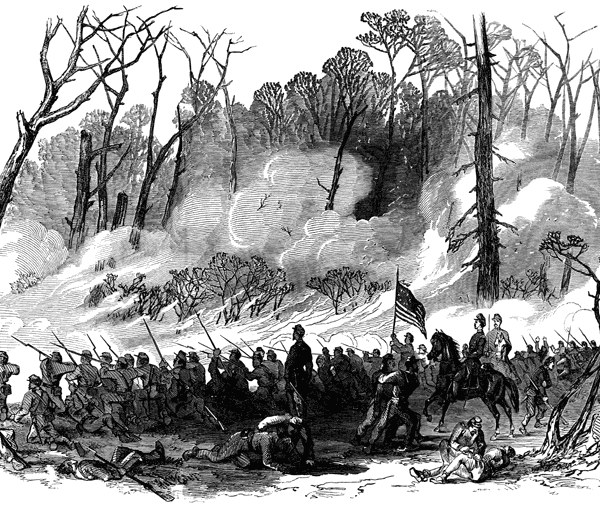
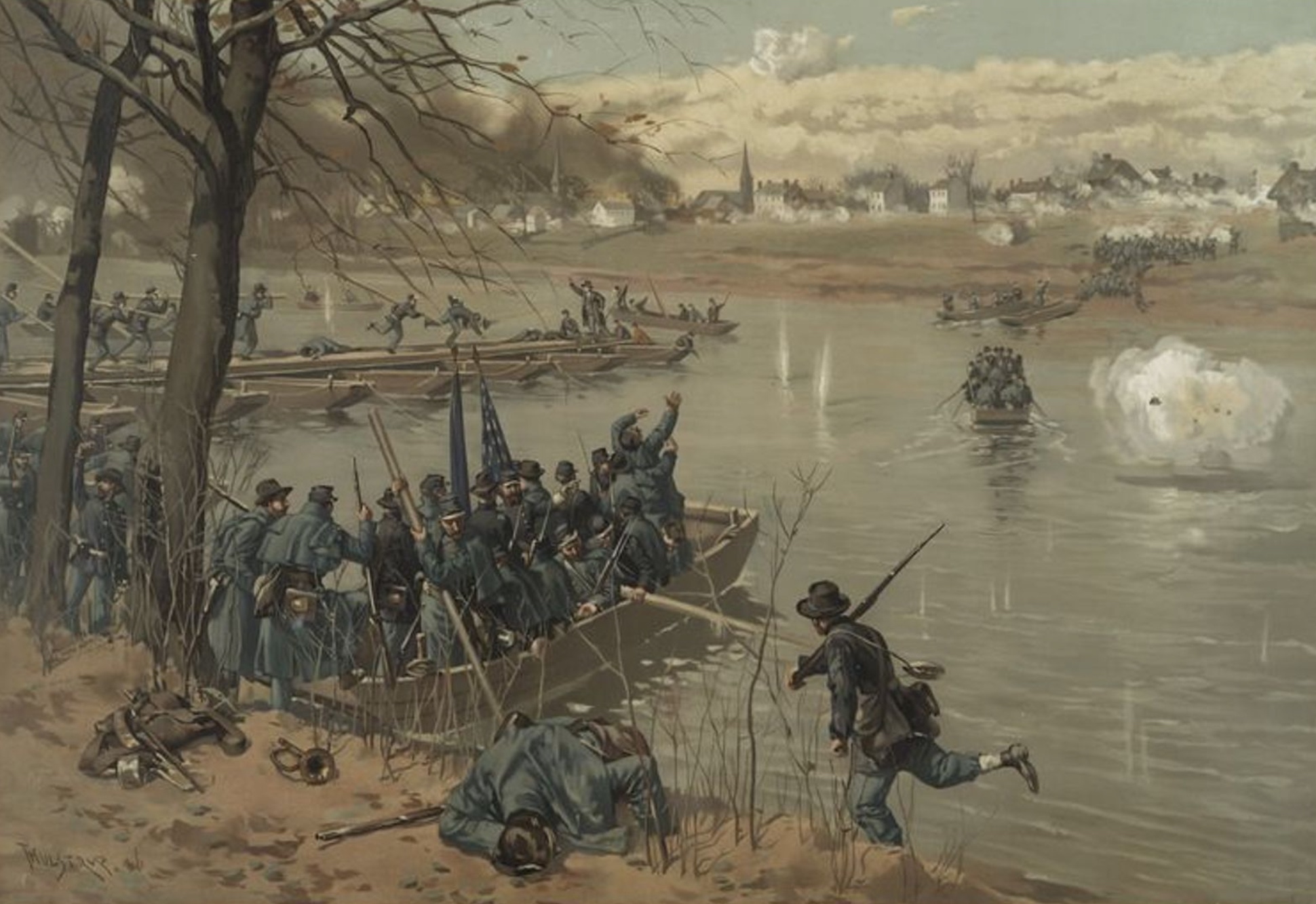
The Battle of Fredericksburg, as depicted by artist Thure de Thulstrup.
“That night the echo was resounding, and we made the field of battle ring with hymns of praise to God!”
—A Confederate captain, lying wounded on the battlefield at Shiloh, on how his singing was taken up by fellow wounded, in an undated letter
“I may too, like Henry, be shot down. If I die, I die in the faith of Christ, and have no fears as to what awaits me. I am happy wherever I am. I can lie down with as much ease … as I could at home upon my bed.”
—Sergeant S.P. Keeler, from Connecticut, referring to his brother Henry, who had been killed at the Battle of Antietam, in a letter home, October 6, 1862
“It was an eventful Sunday through which we had passed, and I sincerely thanked the Giver of life that I had been spared to see it brought to a close.”
—Sergeant John H. Bogart, 61st Virginia Infantry, on making it unscathed through the Battle of Chancellorsville, in a letter to the Savannah Republican, May 8, 1863
“I am as sanguine of success in the future as ever I was … for I believe there is a God greater than all, who is interested in the strife.”
—An officer in the 156th New York Infantry, in a letter home, February 5, 1863
“Death to the d—d Rebels and Jeff. Davis. So saith the Lord and Abe Lincoln.”
—Words written in large letters over the pulpit of an Episcopal Church in Centreville, Virginia, during the First Manassas Campaign, as related by Confederate surgeon Thomas A. Means, in a letter to an Atlanta newspaper, July 29, 1861
“If I am destined to be wounded, or fall beneath my foes, God wills it to be thus. Have confidence that the future will make all well, and have no fears for your loved boy.”
—George T. Magill, 104th Pennsylvania Infantry, in a letter to his mother in 1862. Magill was killed at the Battle of Fair Oaks later that year.
“A Christian spirit pervades the brigade to an unusual degree. The religious revivals are attended with flattering results—conversations and baptisms being of daily occurrence. Nightly meetings being held in the respective regimental camp grounds, and these contribute much towards the good work. Long may it continue.”
—A soldier in the 38th Georgia Infantry, in a letter to the Augusta Weekly Chronicle & Sentinel, August 28, 1863
“God guides the balls; and a man is really as safe in the front as in the rear. When his earthly mission is fulfilled, the shot will find him as quick as the bayonet. Then it is time for him to go.”
—A Massachusetts officer, reflecting on the deaths of Union commanders Nathaniel Lyon, Edward Baker, and Elmer Ellsworth, in an 1861 letter
“As I now write you, our camp is almost deserted, the soldiers, in squads, under charge of an officer, have marched in good order to the houses of worship, whilst, on our right, the Mississippians are having a sermon preached them, and hither they are scattered, seated on camp stools, whilst the beauties of the gospel is being unfolded to them.”
—Georgia officer Thomas D. Wright, in a letter to an Atlanta newspaper while his regiment was camped outside Lynchburg, Virginia, September 9, 1861
 Dale B/Findagrave
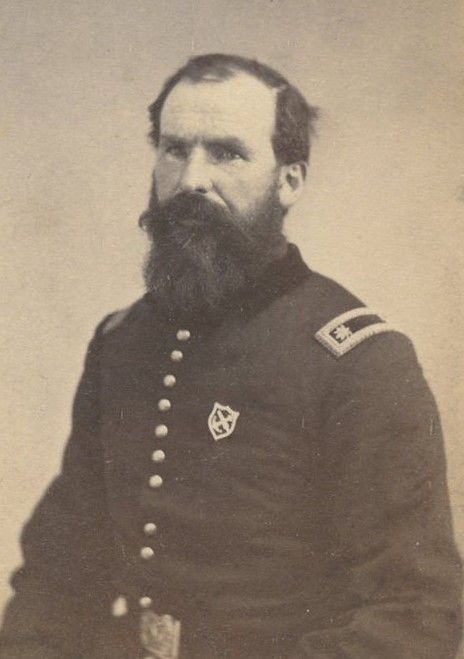
Jacob Roemer
“By this act, we placed ourselves unreservedly then and there in the hands of God.”
—Captain Jacob Roemer, 2nd New York Artillery, on passing his whiskey flask to his lieutenants before they entered the Battle of Cedar Creek, in his reminiscences of the war. Roemer told them the flask’s contents should “no longer be regarded as whiskey; it is the blood of Christ and we take it together as such, not knowing to how severe a test we shall be subjected before the day closes.”
“I feel as if it was in answer to the many prayers of my friends that I was saved at last through so many dangers.”
—Richard C. Derby, an officer in the 15th Massachusetts Infantry, reflecting on the close calls he had experienced during the Battle of Ball’s Bluff, in an undated letter to a former teacher
“I heard, one night, a soldier down the ravine singing … amid the firing and crashing of projectiles…. “I wonder. Lord, will I ever get to heaven—to the New Jerusalem?” came with the ending of every verse. I bowed my face in my hands.”
—Vicksburg resident Mary Ann Loughborough, in her account of life in the city during the Union army’s siege in 1863
“It is astonishing how quiet everybody is—all owing, I must believe, to an abiding faith in the goodness of God. Prayer-meetings are held in almost all the churches, and we take great comfort in them. It seems to me evident that the Lord is fighting our battles for us.”
—Richmond, Virginia, resident Judith McGuire, in her diary, May 11, 1864
“The crisis is fast approaching and it cannot be long ere we meet in deadly contest; of the final result I have but little doubt. I am confident in the ability of those contesting for the right. But alas! many must of necessity close their eyes in death. It is not for me to ask whom or when, but to trust to Him that noticeth the fall of a sparrow, and endeavor to do my duty. I pray that strength may be given me to meet my fate with courage.”
—Wisconsin artillerist Jenkin Lloyd Jones, on his thoughts on the coming battle for Chattanooga, Tennessee, in his diary, November 21, 1863
“God raised up Lee greater than Washington, to carry us through this struggle.”
—An Alabama artillerist, reflecting on the Confederate victory at Fredericksburg, in a letter to a Georgia newspaper, December 17, 1862
“All is well with those that have faith.”
—Lieutenant Colonel Wilder Dwight, 2nd Massachusetts Infantry, in a final note to his mother after he fell mortally wounded at the Battle of Antietam, September 17, 1862. “I trust in God, and love you all till the last,” he added.
“It was a beautiful sight to see hundreds of brave men gather promptly around the rural pulpit and, as the venerable chaplain entered the stand, reverently uncover their heads and evidence by the strictest propriety of behavior, their high respect for the solemn services before them.”
—A soldier in the 3rd Alabama Infantry, in a letter to a Georgia newspaper, June 7, 1861
Sources
Christ in the Camp, or, Religion in the Confederate Army (1904); A Texan in Search of a Fight (1901); Soldiers’ Letters, from Camp, Battle-field and Prison (1865); Diary of Battles, Marches and Incidents of the Seventh S.C. Regiment (n.d.); William B. Styple, ed., Writing and Fighting from the Army of Northern Virginia (2003); Passages from the life of Henry Warren Howe (1899); Bell Irvin Wiley, The Life of Johnny Reb (1943); Harrison Daniel, “Southern Protestantism and Army Missions in the Confederacy,” The Mississippi Quarterly 17, no. 4 (1964); My Cave Life in Vicksburg (1864); Diary of a Southern Refugee, During the War (1867); An Artilleryman’s Diary (1914); Reminiscences of the War of the Rebellion, 1861-1865 (1897); Life and Letters of Wilder Dwight (1868).
Related topics: religion