“To just what extent his services hastened the [war’s] desired end, it would be impossible to compute; but it is admitted by both parties to the war that they were invaluable.” So wrote Union veteran John D. Billings in Hard Tack and Coffee, his memoir of the Civil War, about the critical service performed by the army mule.
The forces on both sides required constant supplies of rations and forage, ammunition, camp equipage, and hospital stores—supplies carried to the front, and from camp to camp, primarily by wagons. And while horses were employed in large numbers by the armies’ supply and ordnance trains, mules were preferred from early on.
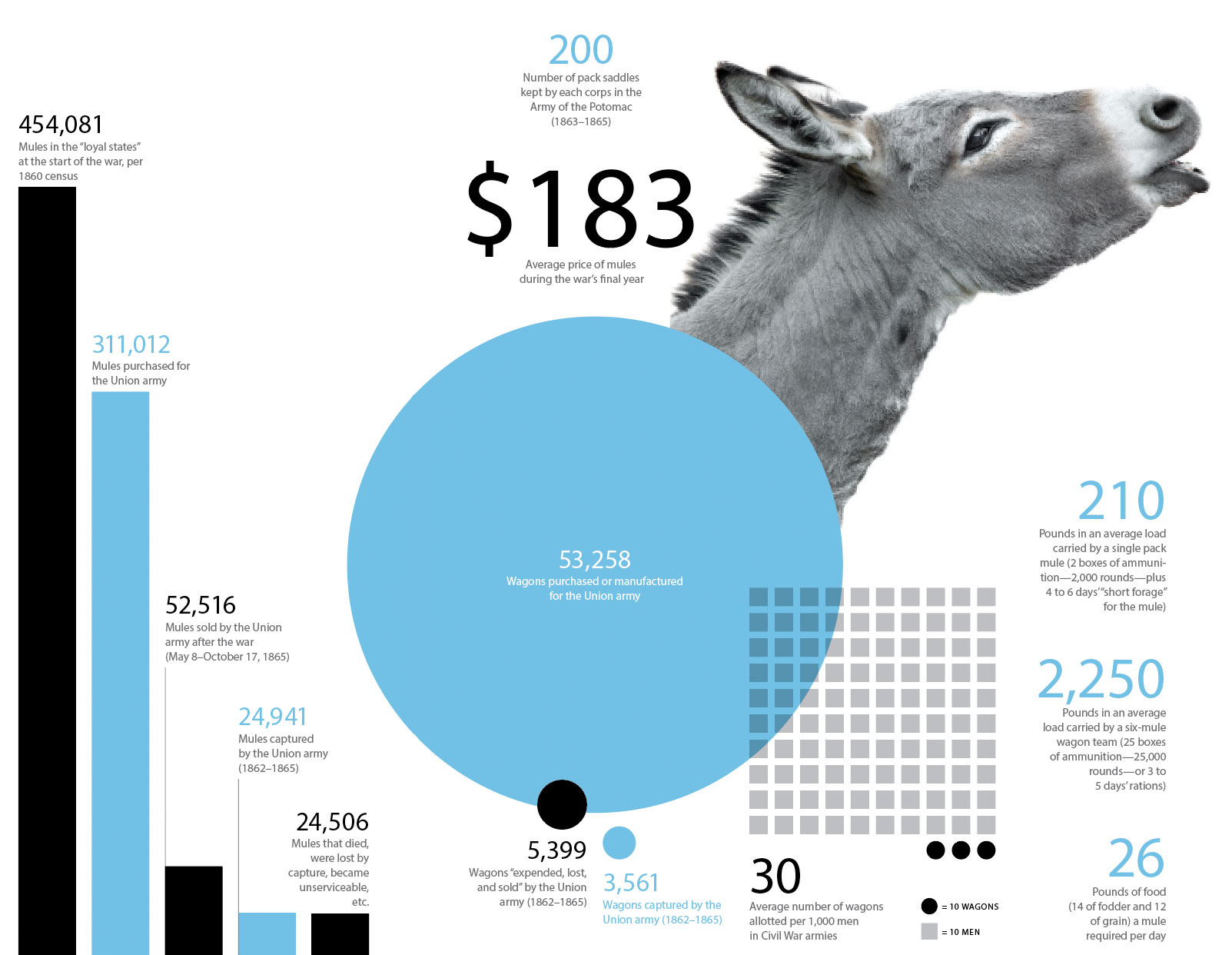
In the words of one Union officer, not only were mules able to “travel over rough ground unharmed where horses would be lamed or injured in some way,” they also had “a great advantage over horses in being better able to stand hard usage, bad feed, or no feed, and neglect generally.” Miles-long trains of six-mule wagon teams—as well as individual pack mules outfitted with special saddles—were a common sight toward the rear of an army on the move. Shown here are statistics associated with mules in the Union army.
Sources
John D. Billings, Hard Tack and Coffee (1887); Earl J. Hess, Civil War Logistics: A Study of Military Transportation (2017); United States War Department, The War of the Rebellion: A Compilation of the Official Records 129 vols. (1880–1901), Series 1, Vol. 25, pt. 1, Series III, Vols. 2, 3, 4 (pt. 2), 5.