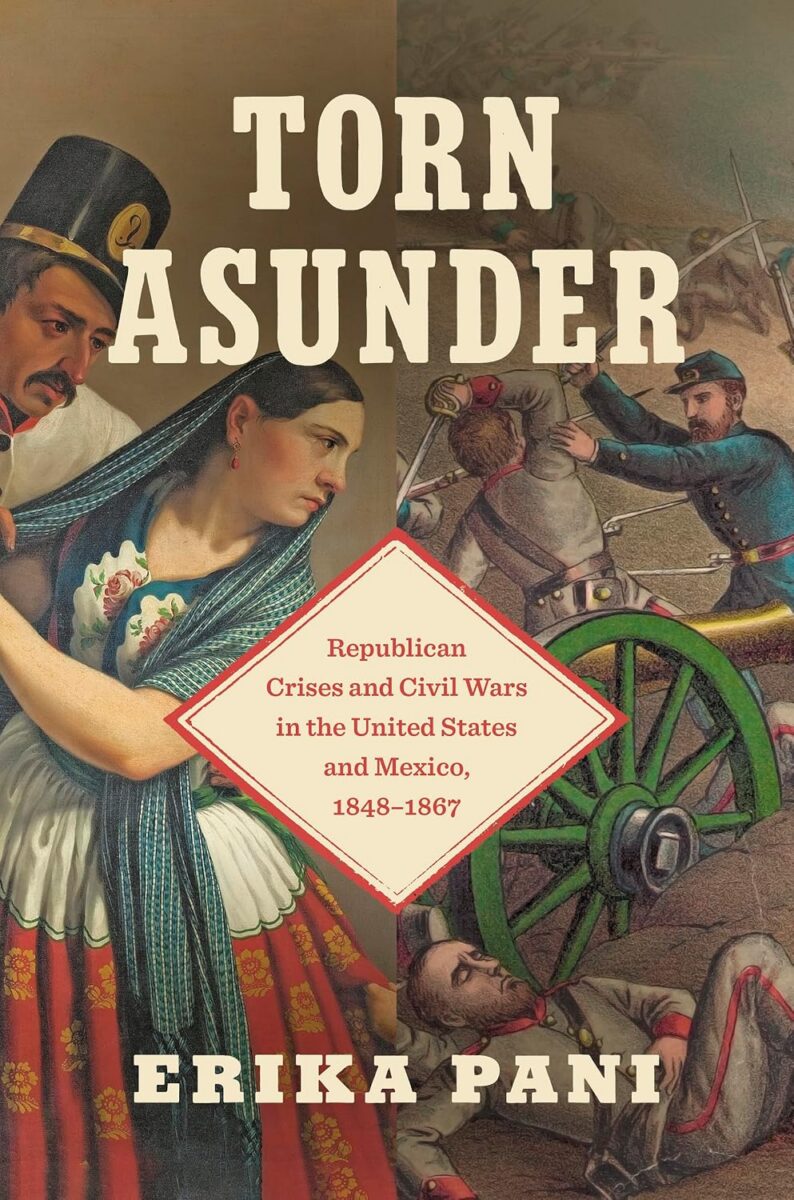
The history of the Civil War benefits from the current focus on comparative, transnational and regional studies of the conflict. In Torn Asunder: Republican Crises and Civil Wars in the United States and Mexico, 1848-1867, Erika Pani has set herself the difficult task of a comparison of the politics, lawmaking, and warmaking capabilities between the United States and Mexico. The exercise is worthwhile given geographic proximity, contemporaneous civil wars, and common experience of republican government in the two nations, despite the differences—so important from a mid-nineteenth-century perspective—of race, language, and religion. Torn Asunder is “about republican crisis, shared by two nations, that we insist have little in common, save the border that divides them” (238). Pani’s aim is ambitious in that she seeks to replace “self-contained, and complacent” national histories with something “messier,” which was “marked by contingency, conflict, and unanticipated consequences” (5). Her grasp of Mexican developments illuminates American exceptionalism when it came to the resilience of republicanism, recruitment, and finance.
Historians tend to take for granted that Americans inevitably both fought a civil war free from outside interference and it was a contest between two democratic republics both based on the shared inheritance of the American Revolution. Yet as Mexican experience demonstrated, such isolation and stability were “fragile by nature” (120). Mexico’s republican government collapsed into dictatorship during the War of Reform, a brief restoration in 1861 was then followed by French intervention from 1862 and the establishment of a monarchy in 1864. There were no wartime elections and continuity of institutions in Mexico as even for Liberal leader Benito Juarez, “war overcame republican practice and unmoored legislation from precedent and constitutional constraints” (143). It was true that in early 1865 some Confederates called for Robert E. Lee to assume an emergency dictatorship, but the general would never have accepted such a commission.
When it came to financing war, Pani’s comparative exercise with the Confederacy as well as the various Mexican sides shows the Union in a class apart as it organized the world’s first modern war economy. While everyone else chased the chimera of foreign investment and resorted to various forms of impressment and forced loans, the Lincoln administration’s financial operations “transformed citizens into stakeholders” through issuance of bonds and greenbacks together with progressive taxation (182).
Unlike the small armies fielded in Mexico, with even the French expeditionary force only composed of 30,000 men, both the Union and Confederacy built huge armies that fought for year after year overcoming setbacks with the ebb and flow of the conflict. “In hindsight, volunteer enlistments and local organization proved significantly more successful” than the Mexican practice of armies “put together through forced impressment. This explains their precarity” (183). In Mexico in the critical years of decision, 1860 and 1867, the loser was decided by desertion with the battles effectively a fait accompli once troops commanded by Conservative generals and later the Imperialists had melted away to just a few thousand men; whereas the Civil War, again unusually, had to be decided by a total, absolute, military defeat of one side. As late as March 1865, Lee had over 70,000 men in the Army of Northern Virginia alone, as many as the previous year.
Relations between the countries remained tepid in wartime as they had since the U.S.-Mexican War; the main area of collaboration was across the Rio Grande borderlands and there a boom proceeded apace as Confederates exchanged cotton for arms with whoever was in power across the river: whether provincial separatists such as Governor Santiago Vidaurri or Imperialists or the French or (even) Liberals. Commerce trumped any ideological affinity or conscience, and the economic boost left a legacy long after the war’s ended. Pani does not get ahead of the evidence in suggesting that Reconstruction witnessed a revolution in U.S.-Mexican relations. However, from a Mexican Liberal perspective, having in wartime “invoked Monroe’s spirit with rather poor results” seeking common cause with the Lincoln administration against the French, the fact that in 1868 a bilaterial claims commission was established to resolve outstanding issues looked like a great improvement, especially when compared with antebellum filibustering and expansionism (28). In conclusion, Pani’s command of Mexican history provides essential context for the U.S. Civil War.
Adrian Brettle is a Lecturer in the Department of History at Sam Houston State University. His book Colossal Ambitions was a finalist for the Lincoln Prize.