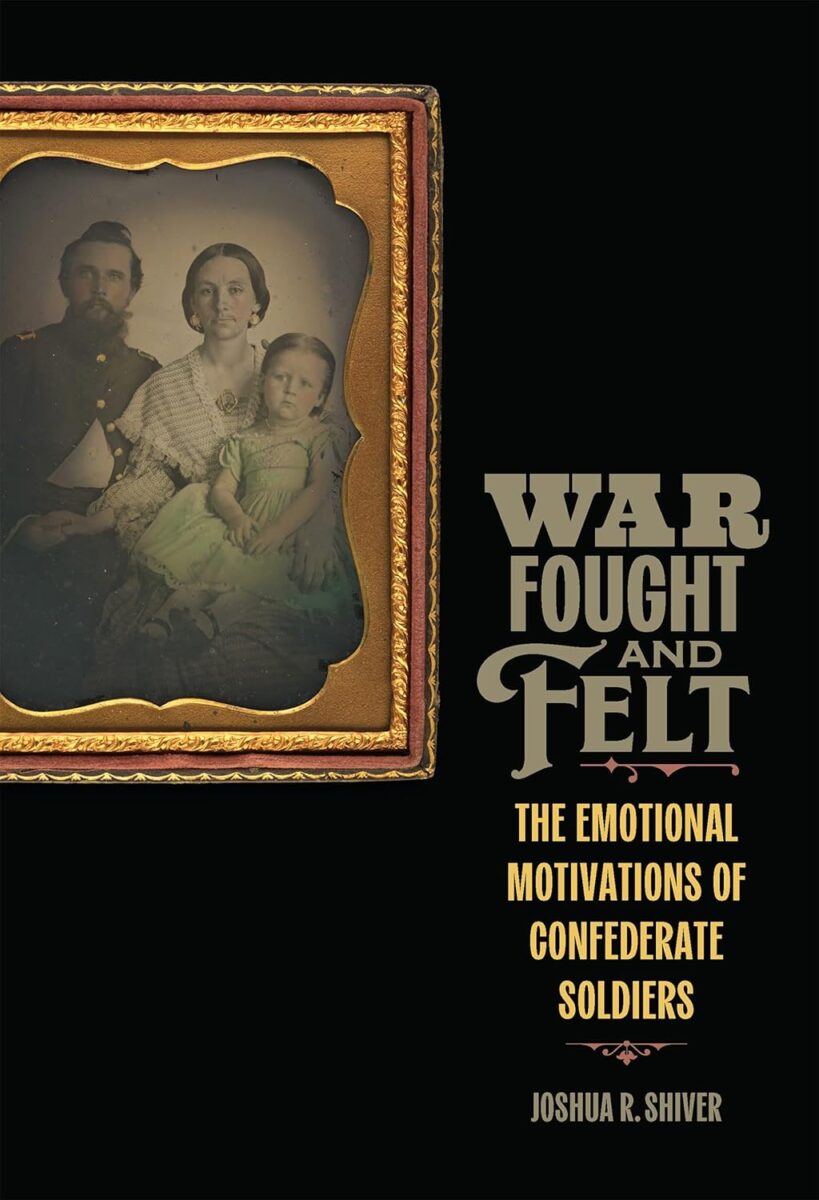
How did ordinary soldiers experience the Civil War, and what kept them fighting for so long? Over the years, studies of soldier motivation have argued “for the primacy of ideology, religion, politics, masculinity, knightliness, and more.” But the historian Joshua R. Shiver’s debut monograph contends that “the most potent factor tethered to all of these categories” was “primal human emotion” (7). Based on his scrutiny of the letters exchanged between a sample of two-hundred Alabama and North Carolina soldiers and their families and friends, Shiver argues that both “homosocial bonding” in camp and the relationships between soldiers and their loved ones back home—relationships nourished and sustained by the wartime exchange of letters—supplied “an emotional buffer that prevented a great collective psychological collapse among” the rebel rank and file (8, 14). “Deep bonds of human affection,” the author writes in a retort to the so-called “dark turn” in Civil War studies, “became one of the primary bulwarks against the erosion of a soldier’s meaning and purpose” and kept him in the ranks (61).
Shiver is hardly the first historian to take seriously the emotional worlds of Confederate soldiers (11). Books by historians Stephen W. Berry and James J. Broomall, for example, have peered behind the public displays of mastery and self-reliance to uncover a southern male world teeming with doubt, uncertainty, and self-consciousness. Shiver adds to this literature by reconstructing the intimate and personal relationships that Confederate soldiers maintained with wives, sweethearts, children, and friends through the shocks and stresses of war. The author’s analysis of emotional expression is informed by “modern psychological and sociological approaches,” and it borrows considerable insight from the late Peter S. Carmichael’s study of how common Civil War soldiers fought, thought, and survived (12).
War Fought and Felt identifies the Civil War as a pivotal moment in southern masculinity and emotional expression. Shiver notes a “growing trend toward sentimentalism” and more effusive “emotional ties between family members” in the decades leading up to the war. He attributes these trends, at least in part, to “the influence of Romanticism and the First and Second Great Awakenings” (30). When the war came, rebel soldiers were primed to cast off societal expectations, gender norms, and manly pretensions. Thrust into a new and violent realm—engaged in a struggle with the enemy and for their own survival—the Confederate rank and file “abandoned socially acceptable norms of emotional reticence in favor of emotional effusiveness on vast scale” (7). “Historians’ assertions of the preeminence of self-mastery and individualism during the war,” Shiver writes, “seem to be based more on prewar masculine norms rather than the period of the war itself, in which soldiers faced new stimuli and were forced to approach cultural norms with a greater sense of pragmatism” (105).
Rather than analyze particular emotions—homesickness, nostalgia, or grief—Shiver seeks access to the inner world of Confederate soldiers by reconstructing their relationships as husbands, sweethearts, parents, and messmates. He recovers these relationships through close readings of the letters soldiers exchanged with loved ones back home. Through the act of writing, soldiers not only sustained their relationships, but also found an outlet for their emotions. Writing against the grain of those who have argued that an “emotional gulf” emerged between soldiers and civilians, Shiver argues for a “symbiotic” relationship between the home front and battle front (51). While scholars like Drew Gilpin Faust have argued that letters from wearied wives on the Confederate home front sapped soldier morale by the end of the war, Shiver reminds that “families also provided a ‘push factor’ that encouraged Confederate soldiers to keep fighting” (143). “Soldier-fathers,” the author writes, “saw their military service as an extension of the masculine role that they had always placed as protectors of their families’ honor, health, security, freedom, religion, emotional health, culture, and economic wealth” (124). So it was that rebel soldiers “faced the war with one eye to the enemy and the other toward their homes” (42-43).
If families sustained rebel soldiers, then so too did the genuine relationships forged between men at the front “lessen the deleterious effects of combat” (110). Prowling about soldiers’ camps, Shiver notes that, “the intimacy that developed between men…reached levels that would have been surprising before the war” (89). The war became intensely personal.
While Shiver reveals how soldiers sustained meaningful relationships amid a disruptive war and suggests how those bonds sustained them through the ordeals of combat, his account may do too much to diminish ideology as a sustaining motivation. Shiver finds it remarkable that in letters to their families, rebel “soldiers wrote relatively little about manhood, honor, duty, or political ideology, focusing instead on whether or not their families were safe, news from home, explaining the humdrum nature of camp life, and sharing their feelings for their loved ones—often in case of their own demise” (41). But is this really all that surprising? The author’s reasonable and well-supported claim that war made men more self-consciously expressive of their emotions hardly sustains his supposition that men were “far less ideological than many historians may have previously supposed” (50). In the Civil War, the personal was very often political. War Fought and Felt is not always convincing, though it raises new areas and new questions for historians to explore.
Brian Matthew Jordan is Associate Professor of Civil War History and Chair of the History Department at Sam Houston State University. He is the author or editor of a half dozen books on the Civil War and its era.