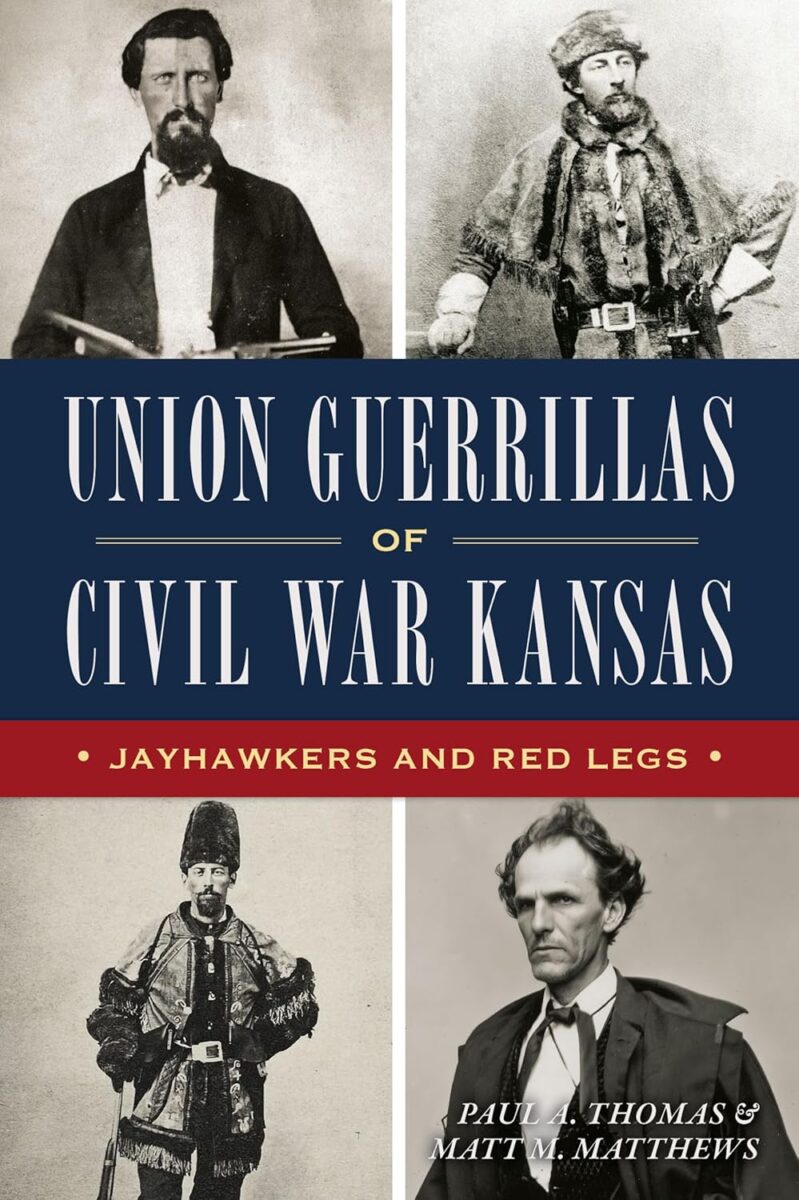
Over the last two decades, a renewed interest in the “irregular theater” of the U.S. Civil War has moved asymmetrical warfare and the exploits of guerrillas from the historiographical periphery to the scholarly mainstream. Continuing in that vein, Paul A. Thomas and Matt M. Matthews’s Union Guerrillas of Civil War Kansas recalls the little-studied actions of the Jayhawkers and Red Legs along the Kansas-Missouri border during the U.S. Civil War. Highlighting six key figures in the guerrilla warfare that notoriously roiled the region, Thomas and Matthews provide an informative work on the foundations of Kansas’s Jayhawker identity.
While the term’s precise origins remain up for debate, “the Jayhawker label was used to designate rough-and-tumble Kansas militants who fought proslavery forces before and during the Civil War” (11). Continuing in this semantical vein, the authors note that the Red Legs—a label that, in some accounts, has been used interchangeably with the term Jayhawkers—were a wholly unique band of guerrillas.
The authors narrate the exploits of the Jayhawkers through the lives of protagonists James H. Lane, Charles R. Jennison, James Montgomery, George Henry Hoyt, Marshall L. Cleveland, and William Sloan Tough. Providing thumbnail biographies of each figure, the authors focus primarily on their exploits during the Civil War. Relying heavily on contemporary accounts and period newspapers, Thomas and Matthews reach beneath the legends and myths that have shrouded these characters.
The conduct of these men during the U.S. Civil War was nothing less than controversial. James Montgomery was a devout abolitionist and believer in the Union Cause. He helped to defend his adopted state from Confederate incursions and offered to recruit a battalion of Kansans that included Black recruits. Eventually, he received permission to raise the 2nd South Carolina Volunteers, an African American Union regiment. But his method of warfare often targeted the civilian populations of proslavery communities. Today, Montgomery is perhaps best remembered for his sacking and burning of both Osceola, Missouri, and Darien, Georgia. While many have heaped scorn on Montgomery for his actions at Osceola, the authors contend that “the brutality of the sack has been overstated” (77). Montgomery, the authors conclude, was a “complex figure whose actions helped shape the Kansas we know today” (83).
No less complex was George Henry Hoyt, the leader of the Red Legs Scouts. Though the authors describe Hoyt as mild mannered, he went on to serve as the leader of one of the most aggressive guerrilla bands to emerge in Kansas. Hoyt had served as an attorney to the abolitionist John Brown. When the war erupted, he enlisted in the Seventh Kansas Volunteer Cavalry. By late 1862, Hoyt resigned from the outfit and formed the Red Leg Scouts. Shrouded in secrecy, the group was organized to combat Bushwackers on the Kansas-Missouri border. However, as the authors make clear, this organization soon began to terrorize the countryside. While Hoyt’s punitive expeditions and raids were ultimately successful, his service powerfully demonstrated that notions of “valor and villainy” can co-exist within one individual (100).
Throughout their slender tome, Paul Thomas and Matt Matthews provide a balanced perspective on their protagonists—tracing how these controversial Union guerrillas ultimately played outsized roles in the creation of modern Kansas. Anyone interested in the “irregular theater” will read this book with profit.
Riley Sullivan is a Ph.D. candidate in the Department of History at the University of Houston.