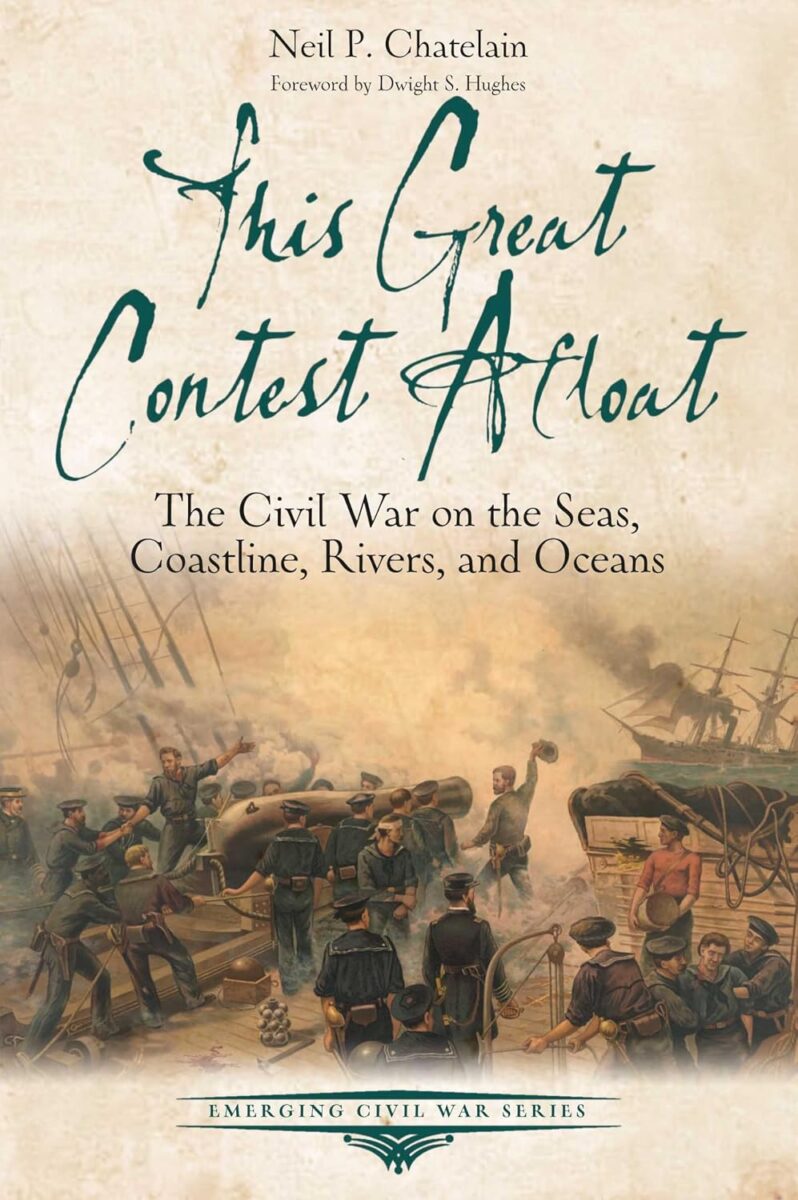
In This Great Contest Afloat: The Civil War on the Seas, Coastline, Rivers, and Oceans, the latest entry in Savas Beatie’s Emerging Civil War series, Neil P. Chatelain shows that the naval theater of the war was essential to the aspirations of both the United States and the Confederacy. Attempting to summarize all facets of the naval war in a brief work might seem like an impossible task. Chatelain proves it is a formidable but not impossible one, effectively portraying the vast, interconnected theaters of the naval war. While the book’s length limits the author’s ability to address in detail some of the most fascinating events of the naval war, Chatelain makes tantalizing comments for the curious reader to pursue.
Rather than a traditional chronological approach, Chatelain organizes This Great Contest Afloat by zones of activity. The fluid nature of the naval war lends itself naturally to this organization. The Union blockade of Confederate ports, intended to prevent the importation of military supplies, blended into the littoral theater. Along the coasts, naval warfare could both close ports and support land invasions of major cities. Once contested cities were claimed, the riverine theater was available, cutting a path through the Mississippi River Valley and its numerous tributaries, preventing supplies from being delivered. The open-ocean battles and economic war at sea was the counterpoint to the blockade as Confederates raided commerce vessels to prevent supplies from reaching the Union. If the supplies could not be run through the blockade, at least they did not reach federal hands. The economic theater on the open seas makes a natural conclusion, as the final surrender of the war was that of the commerce raider CSS Shenandoah.
Iterating through the theaters allows Chatelain to build a layered image of the complexities of the overlapping land and naval theaters. Some recurring themes include the rapid advancement of technology in a few short years, the cultural differences between soldiers and sailors, the lack of coordination between the leadership of the armies and the navies, and the significance of international relations. Maintaining an effective blockade was essential to limit foreign interference in the war. Attempts to regain control of coastal Texas was as much about sending a message to France regarding their intervention in Mexico as it was the direct effects on the Confederacy (52). While some of the military strategists working on the land war bristled at what they viewed as a sideshow, Chatelain makes a compelling case for the importance of each facet of the naval war. While geography matters in any theater of war, the mercurial nature of rivers and oceans made the naval war particularly unpredictable. Storms interfered with the Union’s attempt to block the port of Charleston (9) and exhausted the officers of the Monitor (31). The seasonality of the rivers (79) and unpredictability of water levels (92) hampered the riverine campaigns. Manmade interference with the rivers—such as intentionally felling trees to block ships (99) or building dams to tamper with water levels downstream (108)—further undermined the military strategies for the waterways. Although some influence over the natural environment was possible, it could not be fully controlled.
At times, This Great Contest Afloat is almost frenetic, densely packing into each chapter what could easily be its own volume’s worth of information. Some of the tantalizing topics barely addressed include brief mentions of the Trent Affair (120-121), issues of international arbitration related to the CSS Alabama (146), and the importance of the Panamá route (134-137). Chatelain rounds out the volume with appendices on the unique opportunities that naval service provided for African Americans, an overview of the numerous naval organizations involved, and a guide to which sites of interest may still be visited.
The naval theater of the war provides a fascinating entry point to the Civil War, especially for those with interests in diplomatic relations, international trade, and maritime technology. Those already familiar with the war will likely be surprised by how different naval warfare was from the traditional theaters of war, yet how essential it was to the success of what was planned on land. This Great Contest Afloat will whet the curiosity of the reader—and hopefully inspire more work on the war’s naval theater.
Melissa Kenfield is a graduate student in the Department of History at Sam Houston State University.