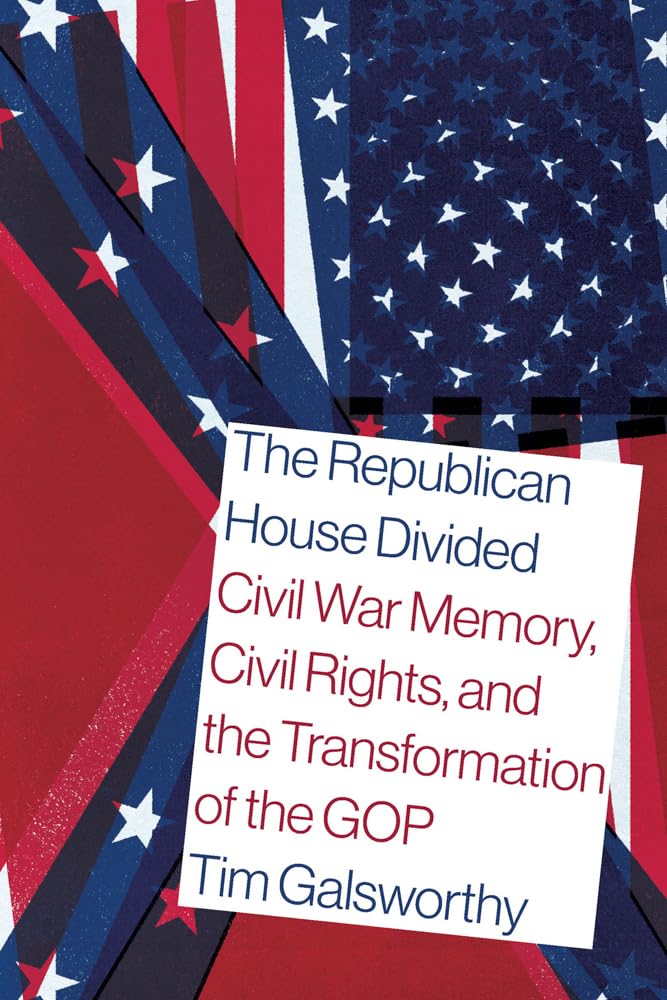
How did the party of Lincoln also become the party of Lee? This is the question at the heart of the historian Tim Galsworthy’s first monograph, a history of “Republican engagements with Civil War memory between 1960 and 1975” (12). The author contends that “existing scholarship has overlooked the role Civil War memory played in the emergence of a two-party South,” a finding that confirms the enduring emotional power of the conflict more than a century after Appomattox (101). Across six chapters, the author tracks how the Republican Party “turned to the past to shape the present,” wielding Civil War memory not only as a weapon in intraparty debates, but as an effective tool for “promot[ing] realignment in the former Confederacy” (127, 9). “By focusing on Civil War memory,” Galsworthy contends, “we can enrich our understanding of the roots of contemporary Republicanism” (199).
Galsworthy begins his account with the celebrated presidential campaign of 1960—the closely fought contest between Republican Richard M. Nixon and Democrat John F. Kennedy. “While Civil War memory had long been part of Southern Republicans’ arsenals,” the author writes, “the 1960 campaign witnessed an upsurge in historical references because of the impending Civil War centennial, mounting anger at Democratic liberalism, and genuine optimism about Nixon’s chances” (38). Though often associated with Nixon’s second bid for the presidency in 1968, Galsworthy locates the origins of the so-called “southern strategy” in 1960. Central to GOP’s attempts to reach white southern voters that year was a deft use of Civil War memory. “Nixon deployed utilitarian historical memories to underscore his cold warrior credentials, signal support for token racial progress, and court white southerners” (41).
During the years of the civil rights movement, which coincided with the Civil War centennial, the Republican Party “was a house thoroughly divided” (73). Republican factions debated “their party’s approach to civil rights, the Cold War, and white southern voters” (15). Galsworthy finds that “Black and white GOP liberals routinely cited memories of Lincon and the early GOP to passionately champion civil rights” (21). New York’s Nelson Rockefeller, for instance, “employed Republican-emancipationist memories habitually and instrumentally to articulate his pro-civil rights vision” (65). White southerners, meanwhile, used “Lost Cause and Tragic Era narratives” to promote the presidential candidacy of Arizona Senator Barry Goldwater who, for his part, laid claim to Lincoln as a conservative champion of “law and order” (102).
After Goldwater’s crushing defeat, white southern Republicans continued to deploy “Lost Cause and Tragic Era” narratives to unburden their party of historical baggage and invite into its folds racially conservative voters (103). Like Goldwater, “Nixon invoked the sixteenth president to cast himself as a law-and-order champion” in the 1968 presidential campaign (125). “Pro-Confederate imagery” became increasingly “common in Southern Republicanism,” as candidates spoke from stages draped in rebel flags (147). But perhaps nothing better illustrated the GOP’s new willingness to whistle Dixie than Vice President Spiro T. Agnew’s “full-throated praise of Lee, Jackson, and Davis” during remarks at the dedication ceremony for Georgia’s Stone Mountain in May 1970 (169).
The Republican House Divided joins titles by Robert J. Cook and Jill Ogline Titus on a growing shelf of books assessing how Americans contested the Civil War’s memory and legacy in the late twentieth century. Galsworthy’s study might have done more to make legible Republican uses of the “reconciliationist” strain of Civil War memory, which, as Titus and others have shown, factored prominently in Cold War-era invocations of American brawn. In this period, Civil War memory did much more than persuade southern voters of the GOP’s conservatism. President Gerald R. Ford, who restored Robert E. Lee’s citizenship in a ceremony at Arlington House, called on Civil War memory in the nation’s search for healing after Vietnam. So too did his Democrat successor Jimmy Carter, who gave Jefferson Davis his citizenship back. President Carter’s full-throated support of the Lost Cause (including a visit to a celebrated outpost for Confederate exiles in Brazil) remind that the period’s Democrats appealed powerfully to the Civil War past, too—and that memory, like politics, can sometimes make strange bedfellows.
Brian Matthew Jordan is Associate Professor, Chair of the Department of History, and Co-Director of the Civil War Consortium at Sam Houston State University. He is the author or editor of six books on the Civil War and its era.