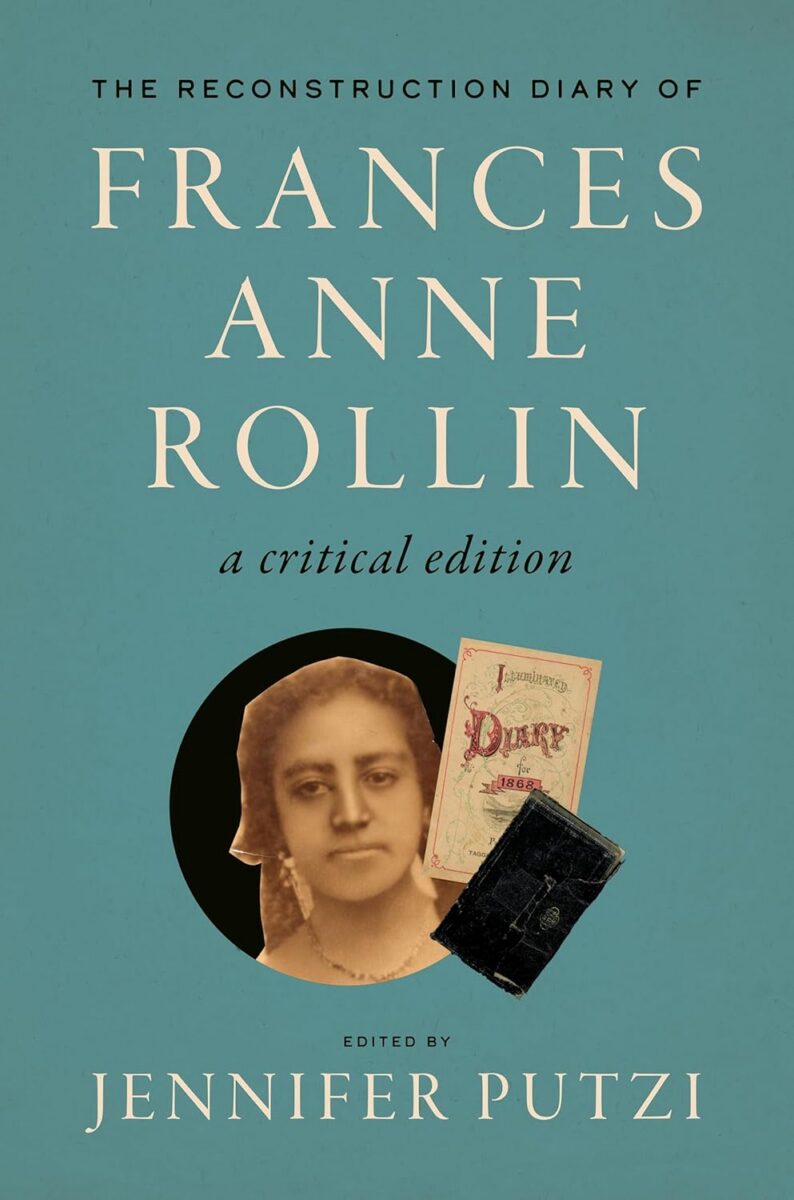
Jennifer Putzi’s annotated release of the 1868 diary of Frances Anne Rollin, a free-born Black writer from South Carolina, does two things very well. First, it preserves and contextualizes a remarkable piece of post-Civil War Black writing. By publishing Rollin’s diary for a wide audience, Putzi has offered readers the chance to engage with an important piece of postbellum intellectual history. Second, it uses Rollin to discuss the larger importance of life-writing to Black Americans—and particularly Black women—in the years immediately following the war. Consisting of a lengthy introduction and a full reprinting of the diary itself, the volume combines rigorous secondary scholarship with a fascinating piece of primary material; in doing so, it creates an excellent resource for scholars of both Reconstruction and nineteenth-century print culture.
Composed while Rollin was working on the autobiography of Black writer, activist, and Civil War veteran Martin Delany, Frances Anne Rollin’s personal diary offers fascinating insight into the intellectual life of its creator. Those with an interest in book history will appreciate that Rollin recorded everything she read while keeping the diary; historians of postbellum religious practice will certainly find value in her recorded church attendance. In her introduction, Putzi offers a comprehensive historiography of both Black life writing and Reconstruction, building upon the work of authors like Thulani Davis to rebuild the post-emancipation world in which Rollin lived. She also includes a significant amount of original primary research, much of which helps to flesh out the history of Frances Rollin’s family and the free Black Charleston community in which they lived.
Putzi’s lengthy introduction—more than one hundred pages—is excellent. It seems unfair to characterize The Reconstruction Diary of Frances Anne Rollin merely as an annotated volume, considering the scope and depth of original research included. Rather, it is a comprehensive reconstruction of the world and family that created a woman and writer like Frances Anne Rollin. By investigating Rollin’s relationship with Martin Delany and her participation within the broader Black intellectual sphere, Putzi is able to build an image of a postbellum discursive and literary world that not only contextualizes Rollin’s diary, but also uses that diary as evidence for a broader investigation of the intellectual networks that sustained upper class Black activism during the period.
As excellent as Putzi’s introduction is, it is difficult not to wonder what a full-length monograph on the Rollin family—and the Black Charleston intelligentsia more generally—might look like. Frances’s diary and the material included in the book’s appendices testify to the wealth of primary source material surrounding the period and family, while the hundred or so pages of introductory material and brief biographical vignettes, included alongside the text of the diary, are testament to both the viability and value of such an exploration. As useful as The Reconstruction Diary of Frances Anne Rollin is, and as undoubtedly important as Rollin’s own words are, one comes away from the book hoping that Putzi plans to continue her work on the Rollin family, with the aim of eventually producing a full-length study on the topic.
That said, this book is an excellent combination of original secondary research and a fascinating piece of primary material. Combining the quotidian and the profound in the way only a talented diarist can, Rollin’s experiences in the postbellum United States provide excellent insight into the public and printed world of Black Americans in the aftermath of emancipation. Putzi’s analysis, likewise, enhances the reader’s experience with the diary, and does a masterful job of placing Rollin and her diary within the broader context of the Reconstruction-era Black intellectual sphere.
Lincoln Hirn is a Ph.D. candidate in the Department of History at the University of Connecticut. He studies the literary memory of slavery, the Civil War, and Reconstruction.