 Wikimedia Commons
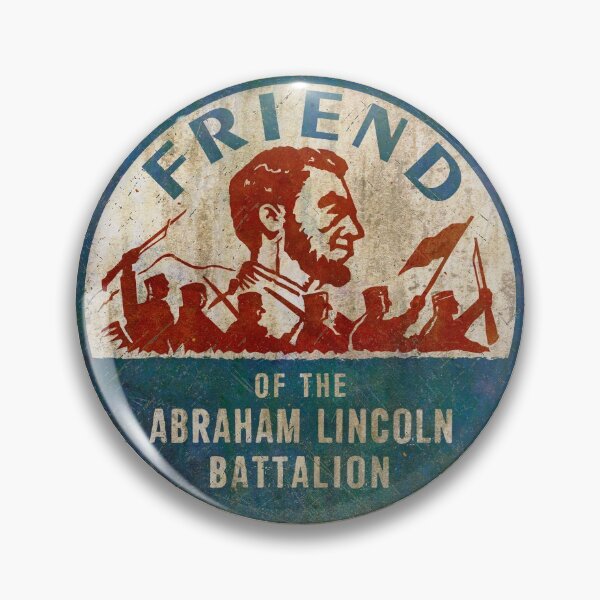
This Abraham Lincoln Battalion badge would have been worn by supporters of the unit during its fight in the Spanish Civil War of the 1930s.
The Spanish Civil War (1936–1939) was a brutal struggle for control of Spain, pitting the democratically elected Second Republic against a nationalist military uprising led by General Francisco Franco. Franco and the nationalists were supported by Hitler and Mussolini, and the conflict became a training ground for World War II—an early international fight pitting nations against Nazism and fascism—attracting nearly 40,000 volunteers from over 50 nations to the International Brigades. Among them was the Abraham Lincoln Battalion, a volunteer force of about 2,800 Americans—roughly the size of a full Civil War brigade—who risked their lives to defend a democracy 3,000 miles from home.
I never would have guessed that my recent trip to Barcelona would serve as a way to connect me back to the American Civil War. Strolling La Rambla and standing in the middle of Plaça de Catalunya—places in Barcelona where, in the early 20th century, American volunteers arrived to cheers as they joined a fight for freedom—I see no remnants of civil war but rather the results of growth and unity through bustling shopping, dining, and industry. Beneath the surface of this modern growth, however, lies the history of those who first arrived at these very plazas to serve. While Americans entered multiple units within the Spanish Civil War International Brigades, they largely made up the 17th Battalion, known as the Lincoln Battalion.
Echoes of the American Civil War
The decision to name the largely American unit after Abraham Lincoln was a conscious act of historical alignment. By invoking the Great Emancipator, the volunteers positioned the fight against fascism as a direct continuation of the fight against slavery, the preservation of democratic unity, and the defense of universal freedoms. As one member of the Lincoln Battalion put it, “If I’m really serious about making a new society in this world and in this country, I’ve got to be able to show that I can take it and can participate in the actual dirty work of building, of doing it.”1 This fight for human rights can even be seen as carried forward from the American Revolution (another battalion of the International Brigades in the Spanish Civil War was named after George Washington), which was also a civil war of sorts—British subject against British subject. For the Americans in Spain, these high-minded ideals of a new kind of governance were put into immediate, and radical, practice.
The First Integrated Force
Perhaps the most significant legacy of the Lincoln Battalion lies in its internal structure. A decade before the United States military officially desegregated (through President Harry Truman’s executive order in 1948), the Lincoln Battalion was the first military unit where black and white American soldiers fought side-by-side in fully integrated ranks: In all, an estimated 100 black men served.2 This was unseen in the American Civil War, where black units like the 54th Massachusetts Infantry were segregated and led by white commanders. Black Lincoln Battalion veteran James Yates claimed that “the equality that he felt he had experienced in Spain was still decades away in the United States.” A fellow black unit member told him, “Spain was the first place that I ever felt like a free man.”3
The Lincoln Battalion’s commitment to universal equality was not merely a namesake tribute; it was an active pursuit of Lincoln’s ideals. Nowhere was this commitment more evident than in the rise of Oliver Law. An African-American U.S. Army veteran, Law served from 1919 to 1925 as a private in the 24th U.S. Infantry—a segregated black unit stationed on the Mexican border. Driven by a proclivity for activism and the desperate conditions of the Great Depression, Law volunteered for the Spanish cause. In Spain, he proved himself capable and was promoted to commander of the Lincoln Battalion, becoming the first black American to lead white troops in battle. Steve Nelson, a white member of the panel chosen to help select the unit’s commander, stated that “ours was a very democratic army,” and Law “had the most experience and was best suited for the job.” Nelson further stated that Law was “the most acquainted with military procedures on the staff at the moment…. [H]e was … calm under fire, dignified, respectful of his men and always given to thoughtful consideration of initiatives and military missions.”
 Abraham Lincoln Brigade Archives
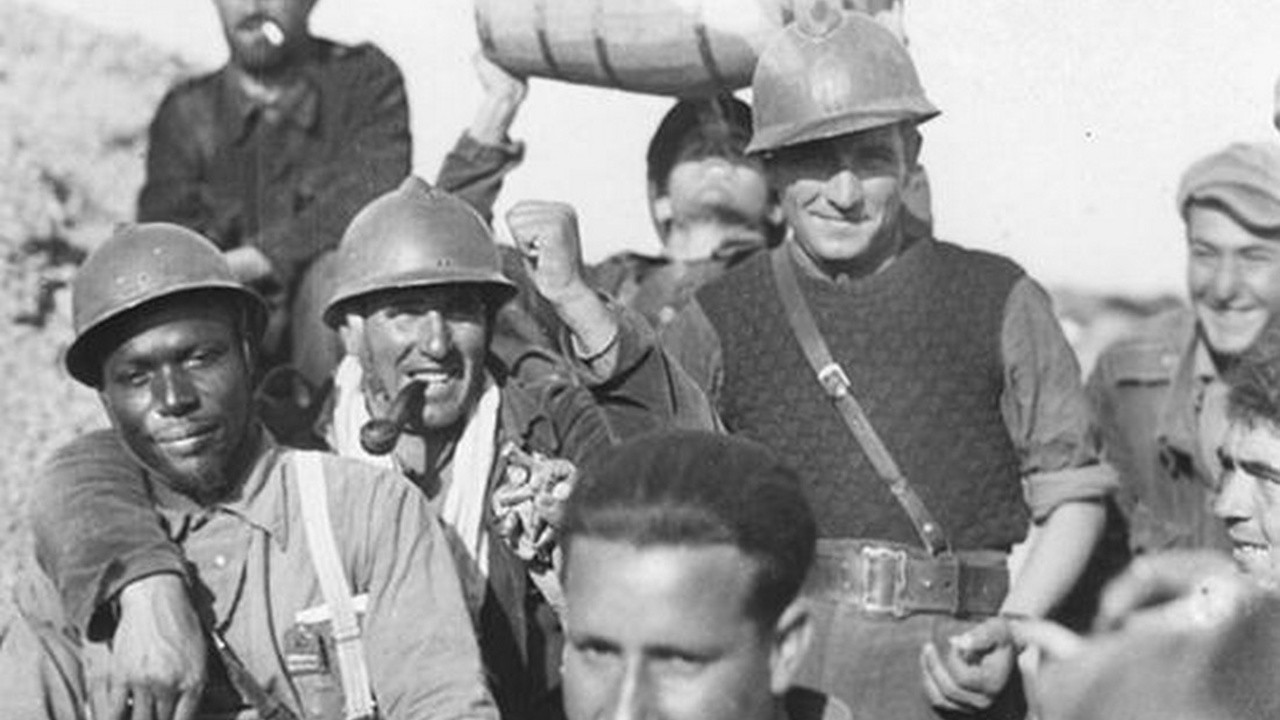
A group of Lincoln Battalion members includes Oliver Law, the African-American U.S. Army veteran selected to lead the unit.
In a period when Jim Crow laws enforced strict segregation back home, Jarama and Brunete—battlefields just outside Madrid—stood as testaments to living with racial equality, enabling Law to claim, “I can rise according to my worth, not my color.”
The Significance of the Connection
The existence of the Lincoln Battalion helps reframe the Spanish Civil War as part of the American story. The Lincolns were not just “interventionists”; they were testing the American—perhaps human—promise of equality on foreign soil. It can be argued that for the battalion’s black volunteers, fighting for Spanish democracy was an extension of the struggle for civil rights in the United States and across the world: They believed that if fascism could be defeated in Europe, it could weaken the foundations of racism at home. Jamaican-born American resident Canute Frankson wrote in a letter from Spain about why he fought: “Because we are no longer an isolated minority group fighting hopelessly against an immense giant…. if we crush Fascism here we’ll save our people in America, and in other parts of the world from the vicious persecution, wholesale imprisonment, and slaughter.”
Speaking 50 years after the conflict at an anniversary event, Nelson noted: “We were integrated from top to bottom, and we want the world to share in the pride we all feel.”4 The battalion’s dedication to universal freedom was invoked two years after the war, in 1941, in America’s decision to join the fight against Nazism and fascism. In requesting war declarations against Germany and Italy on December 11, President Franklin D. Roosevelt (who remained neutral during the Spanish Civil War) said: “The forces endeavoring to enslave the entire world now are moving toward this hemisphere.… Rapid and united effort by all of the peoples of the world who are determined to remain free will insure a world victory of the forces of justice.” The call for freedom from enslavement rang as true then as it had during the American and Spanish civil wars.
 Zethyn McKinley
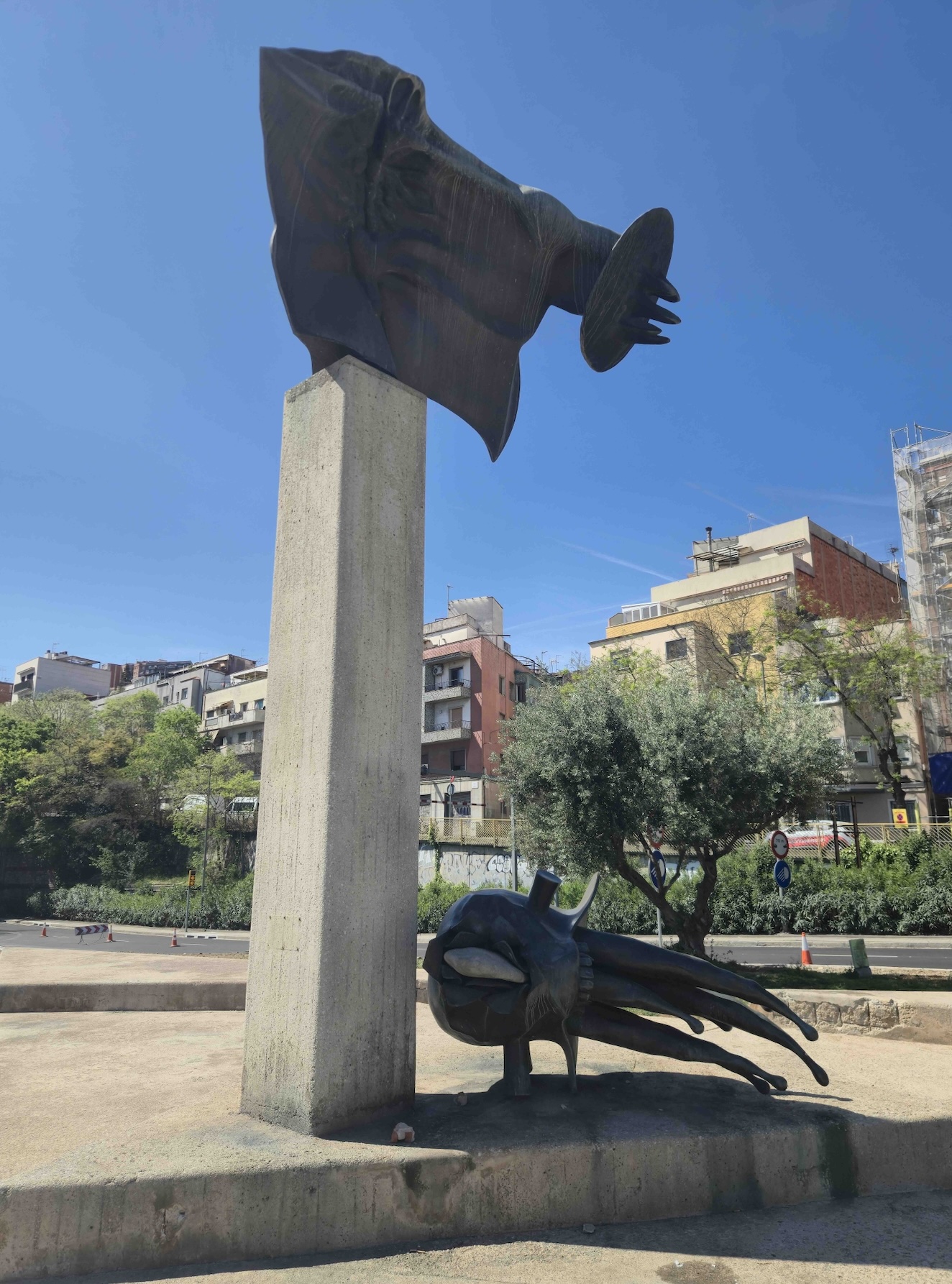
The David and Goliath sculpture by American Roy Shifrin in Barcelona
Today, when we look at monuments like the David and Goliath sculpture by American Roy Shifrin in Barcelona commemorating the fiftieth anniversary of the departure of International Brigades from Spain, the physical experience mirrors this message. To reach the sculpture, one must go up through a dark tunnel, emerging in light only at the summit—an ascent that serves as a metaphor for the struggle for freedom and universal rights. For the volunteers of the Lincoln Battalion, the “light” at the end of the tunnel was a vision of a world where race and class did not determine one’s worth. Though the Second Republic for which they fought ultimately fell and Spain lived under the dictator Franco for 36 years, the Lincoln Battalion’s precedent of integration became a guiding light for the American Civil Rights Movement and the eventual desegregation of the U.S. Armed Forces. It also perpetuated the idea that the struggle for human rights extends beyond borders and is worth fighting for—a tenet of American foreign policy to this day.
On November 1, 1938, in Barcelona, La Pasionaria—Dolores Ibárruri, a Spanish Republican politician—bade farewell to the international volunteers who fought for their cause:
For the first time in the history of the peoples’ struggles, there was the spectacle, breathtaking in its grandeur, of the formation of International Brigades to help save a threatened country’s freedom and independence…. Comrades of the International Brigades: Political reasons, reasons of state, the welfare of that very cause for which you offered your blood with boundless generosity, are sending you back…. You can go proudly. You are history. You are legend. You are the heroic example of democracy’s solidarity and universality in the face of the vile and accommodating spirit of those who interpret democratic principles with their eyes on hoards of wealth or corporate shares which they want to safeguard from all risk.
In all, more than 1,600 of the 2,800 members of the Lincoln Battalion, including Law in 1937 at Brunete, were killed in action in the Spanish Civil War, and later, an another 400 were lost as they continued their fight in various branches of World War II.5 Despite their groundbreaking role as the first fully integrated American force, the story of the Lincoln Battalion was largely obscured from our national narrative for decades. Labeled “premature anti-fascists,” these volunteers were often viewed with suspicion rather than celebrated as pioneers of civil rights. Though no veterans of the American Civil War fought in the Spanish Civil War, there is a thread that connects the two conflicts. Civil Wars do not occur in a vacuum. They reflect broader changes—regionally, if not globally—in the ideological landscape. The American Civil War resulted in the abolishment of slavery and the recognition of racial inequalities—first steps on the slow and uneven path to real and lasting social and legal change. The Spanish Civil War illustrates the brewing shifts in democracy versus authoritarianism, the latter proving victorious, setting the stage for a continuation of the fight in World War II. In short, civil wars are not contests that affect only those in the country in which they occur—they are fundamental shifts in beliefs and governance that can spark movements that reverberate far beyond their borders. In Barcelona today, the lack of visible scars illustrates how effectively a city, and a country, can rebuild from such a conflict. For the volunteers of the Abraham Lincoln Battalion, the stakes of this Spanish struggle were a direct continuation of the American fight for universal equality and liberty.
Zethyn McKinley is a freelance writer and editor with an interest in history, technology, and politics. Beyond her research and writing, she is a certified yoga teacher and blogger at 360 Yoga, where she shares insights on finding physical and mental balance. She resides in California’s Central Valley.
Notes
1.William Loren Katz and Marc Crawford, The Lincoln Brigade: A Picture History (New York, 1989), 15.
2. Katz and Crawford, The Lincoln Brigade, 77.
3. Adam Hochschild, Spain in our Hearts: Americans in the Spanish Civil War, 1936-1939 (Boston, 2016), 349.
4. Katz and Crawford, The Lincoln Brigade, 77.
5. Arthur H. Landis, The Abraham Lincoln Brigade (New York, 1967), xviii.
Related topics: Abraham Lincoln

Congratulations on getting published in the CW Monitor!