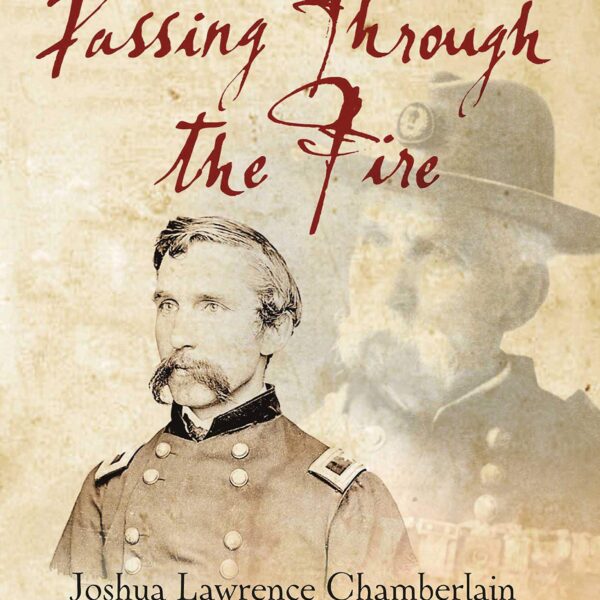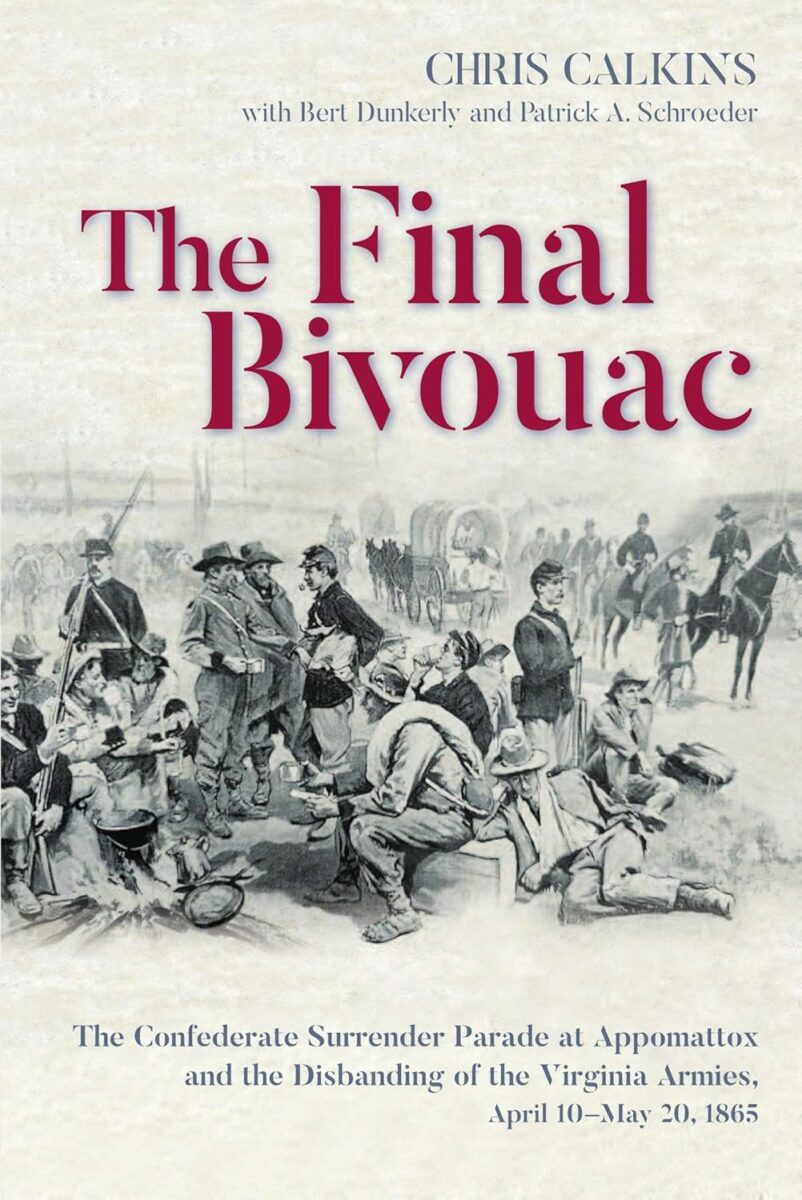
On April 9, 1865, General Robert E. Lee formally surrendered the Army of Northern Virginia to Ulysses S. Grant at Appomattox Cout House. Lee’s troops would not disband for several more days; the formal surrender parade took place on April 12. Anyone familiar with Joshua Lawrence Chamberlain’s stirring memoir The Passing of the Armies knows the episode was filled with emotion. However, the weeks that followed proved difficult for both Confederate soldiers returning home, and for Union troops yet awaiting the end of hostilities in other theaters.
Focusing on this singular episode, The Final Bivouac—the second volume of Chris Calkins’ study of the Appomattox campaign—documents the “end” of the war in Virginia. Drawing primarily on memoirs, regimental histories, personal correspondence, and official orders, Calkins sheds light on the beginning of the transition from wartime to peacetime for Union and Confederate soldiers.
At Appomattox, the proverbial fog of battle that bedeviled so many soldiers throughout the war finally began to lift. Still, those who survived could not fully comprehend what was happening. Those in the Confederate army began to realize the gravity of the situation; “demoralization and depression were settling in on a grand scale” as “an uncertain dawn broke” (1). Across the way in the federal bivouac, sentiments were markedly different; “exhilaration” and “relaxation” began to prevail. Even so, the federal troops remained on active duty for weeks and months to come.
Calkins documents in detail the preparations made for the surrender ceremony. “The conduct of the men of both armies, on this, one of the most exemplary days in the history of our country, was surely ‘honor answering honor,’” he writes (42).
The author also trains significant attention on the actions of the Army of the Potomac, then anxiously awaiting news from North Carolina regarding the surrender of Confederate General Joseph E. Johnston’s army. Even as Confederate soldiers were beginning to return home, elements of the Army of the Potomac received orders to occupy Lynchburg, reconcentrate at Burkeville, and eventually push as far south as the Dan River, along Virginia’s border with the Tar Heel State. While some VI Corps pickets reached even farther south into North Carolina, Johnston’s surrender on April 26th ensured that their services would not be required. Most of the federal troops began to return north—ultimately winding their way to Washington, D.C., where they participated in the Grand Review.
Perhaps most importantly, The Final Bivouac demonstrates that for the men of the Army of the Potomac, military operations in Virginia continued for weeks after Lee’s surrender. Author Chris Calkins’s tightly written narrative enriches our understanding of the first steps that soldiers on both sides took as they transitioned from an unprecedented war to an uneasy peace. Publisher Ted Savas and his team at Savas Beatie are to be applauded for making this classic study, first released by H.E. Howard in 1988, accessible to a new generation of students and scholars alike.
Riley Sullivan is a doctoral student in the Department of History at the University of Houston.