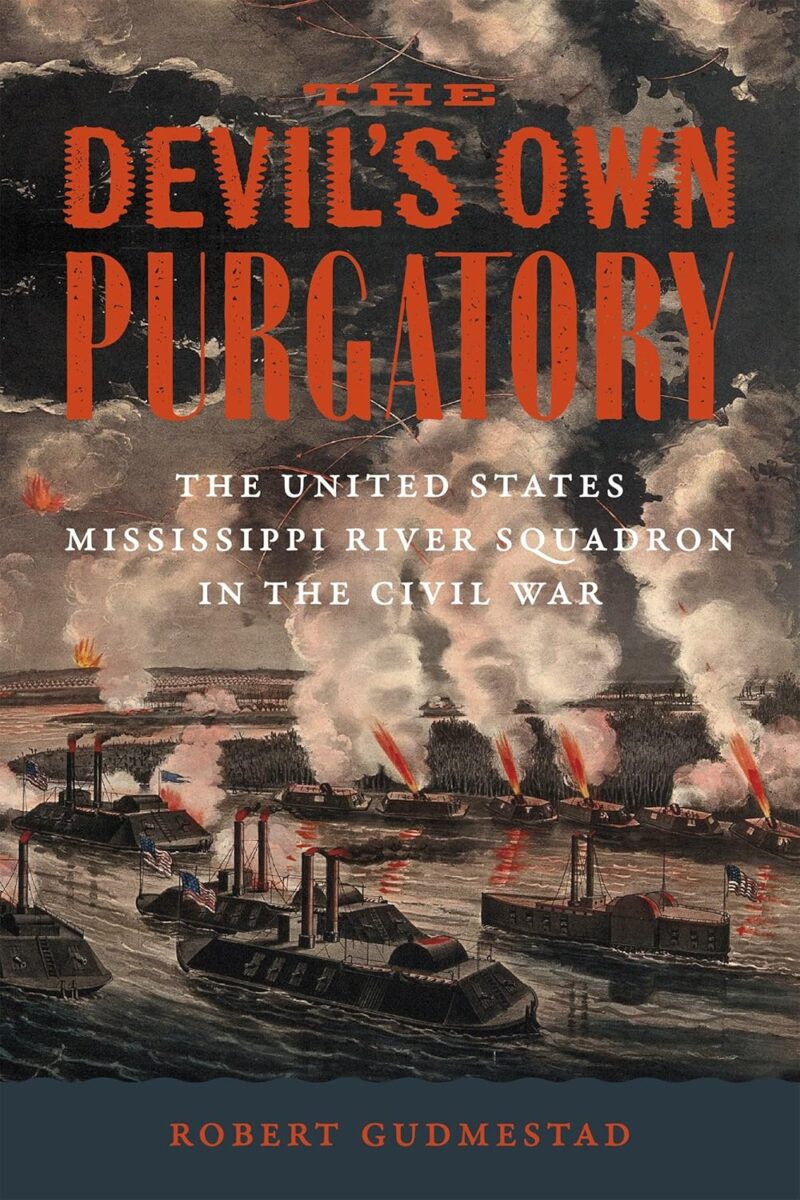
“The Mississippi Squadron was unlike anything in American military history before or since the Civil War,” writes the Colorado State University historian Robert Gudmestad in his important new book, a compelling blend of social and military history that supplies the “first full history” of the brown-water fleet (3). Recent historians such as Lesley J. Gordon, Susannah J. Ural, and James Marten have reimagined the unit history, illuming larger themes and engaging historiographical debates through their finely grained biographies of Union and Confederate infantry outfits. The Devil’s Own Purgatory extends the reach of this genre to the federal navy, offering a biography of the Western Gunboat Flotilla and the men who plied the Civil War’s western waters.
The book is built on the author’s exhaustive datasets, constructed from U.S. Navy muster rolls, the Official Records of the Union and Confederate Navies, and the Official Records of the Union and Confederate Armies. These statistics permit the most careful analysis to date of how enlistment patterns in the Union’s brown water navy changed over time. Beginning in July 1862, for instance, the “proportion of formerly enslaved men” inducted as sailors on the Western Gunboat Flotilla “increased sixfold” (21).
Gudmestad’s datasets not only sharpen his analysis but enhance his formidable narrative talents. He divides the Mississippi Squadron’s Civil War into four distinct “phases”: a first phase, which entailed “a regular war against Confederate forts” like Henry and Donelson; a second phase, during which “a change in Confederate strategy forced the squadron to protect Union supply lines”; a third phase, which “made Grant’s victory at Vicksburg possible and facilitated military emancipation”; and a final phase, marked by “high turnover” and “reduced aggressiveness” in the face of a “Confederate resurgence” in the spring of 1864 (4-5, 203).
The Devil’s Own Purgatory tallies the many challenges faced by the men of the Mississippi Squadron, from environmental hazards and rebel irregulars to gluttonous mosquitoes and a “cotton mania” that marked the Yankees’ error-riddled expedition up the Red River (196). Gudmestad makes legible the “complex and contradictory nature” of a fleet that shoved off for a “conventional” war, but instead “spent most of its time protecting supplies and fighting” insurgents (212). As such, the book will be of interest to anyone interested in the irregular theater—or in the turn from conciliation to “hard war.” As the author notes, the Mississippi Squadron “anticipated the actions of Union soldiers in Georgia and in Virginia’s Shenandoah Valley” by a more than a year when its sailors visited pillage and plunder on southern plantations in early 1863 (165).
Of course, the book will also be read with much profit by scholars interested in the wartime destruction of slavery. “When sailors sheltered salves and handed out food to refugees, they were nurturing what some historians have called the largest slave revolt in history,” Gudmestad writes (181). The author quarries his sources to recover the navy’s important if unforeseen role in emancipation—lending more ballast to Joseph Reidy’s argument about the serpentine road that led from slavery to freedom (177). Log books, Gudmestad notes, provide “a rich and unusual source of information about enslaved people” who sought refuge on federal vessels (174). One of the most striking scenes in the book involves the Lafayette. When the federal vessel could no longer accommodate the density of freedom seekers, its sailors “created a temporary, floating contraband camp” on “a coal barge” (175).
Given how little we know about the Civil War’s naval veterans, one wishes that the author would have followed the men of the Mississippi Squadron home. A brief epilogue suggests the richness of the topic. Nonetheless, Robert Gudmestad has written a definitive history that at last recovers the integral role of the brown water navies in winning the Civil War and destroying slavery. It merits a wide readership and the many accolades it is sure to receive.
Brian Matthew Jordan is Associate Professor of History, Chair of the History Department, and Co-Director of the Civil War Consortium at Sam Houston State University. He is the author or editor of six books on the Civil War and its era.