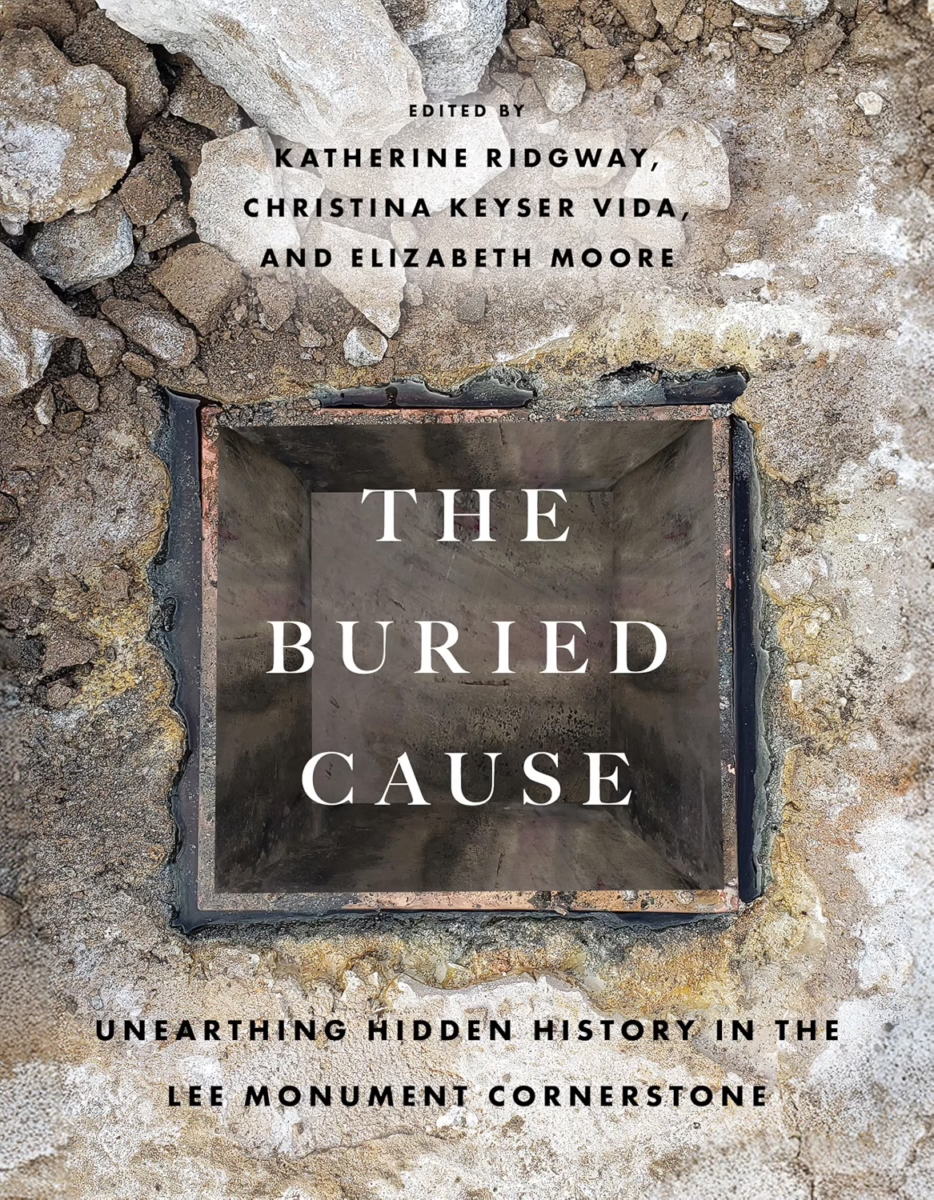
During the summer of 2020, racial unrest in the United States resulted in the removal of scores of Confederate monuments from prominent perches across the nation. Not surprisingly, Richmond, Virginia, became the epicenter of this latest battle over Civil War memory. In September 2021, after a year of litigation, the dismantling of the iconic (or infamous) statue of General Robert E. Lee on Monument Avenue began. Some watched with joy as a monument to a traitor would no longer occupy the limelight; others watched with sorrow as they felt history was being erased. Still others watched with anticipation, eager to learn what secrets may have been buried beneath this larger-than-life statue. Unearthed was a “cornerstone capsule”: a copper box containing seventy objects. The livestream of the capsule opening captivated the nation, offering a raw, material portal into the post-Reconstruction South.
The Buried Cause: Unearthing Hidden History in the Lee Monument Cornerstone reveals that the true significance of the capsule was not the inventory of items found, but rather what those items exposed. Co-editors Katherine Ridgway (State Archeological Conservator at the Virginia Department of Historic Resources), Christina Keyser Vida (Curator at Richmond’s Valentine Museum), and Elizabeth Moore (State Archaeologist) gathered an exemplary interdisciplinary team of historians, archivist, and conservators to produce this book. Each contributor uses the actual capsule to dismantle the “Lost Cause” mythology, offering readers an excellent blend of material science and cultural history.
The beauty of The Buried Cause lies in its structure. Rather than presenting a singular narrative, the book is divided into three thematic parts. The first section explores the location and physicality of the Lee monument, describing how the Richmond landscape was designed to turn the city into a grand stage for Confederate reverence. The second section investigates the civilian items recovered from the copper box, including local directories, Masonic calling cards, and business pamphlets. The third section focuses strictly on military artifacts, like Confederate currency, muster rolls, and uniform buttons.
Most chapters read as “artifact autopsies,” in which individual experts guide the reader to the origins of a single recovered item. By studying who donated each item, why, and what message it was meant to convey to a distant future, the authors reveal a vital truth: public memory is never accidental; it is very carefully and intentionally created.
One of the book’s most satisfying feats is how it compares the grand, mythic expectations of the capsule with its modest reality. For decades, rumors swirled that the box held a rare photograph of Abraham Lincoln in his coffin (as was listed in the 1887 Richmond Dispatch inventory). Instead, conservators pulled out a common wood engraving from an issue of Harper’s Weekly depicting Lincoln’s coffin. This exposing of myth is central to the book’s goal: demonstrating that the Lost Cause was a cheap public relations campaign built on mass-produced propaganda.
The collection is sharp when exposing the internal power struggles behind the monument’s creation. The editors highlight a turf war between male-dominated Lee Monument Association, led by Confederate General Jubal A. Early, and the more successful and better funded Ladies’ Lee Monument Committee. As Katherine Ridgway points out, women spearheaded the fundraising efforts that made the monument a reality. Yet, in an ironic twist of archival erasure, the historical record remains inundated with portraits of the men who co-opted the project, while women leaders like Sarah Randolph were pushed to the side.
Importantly, the authors do not limit their investigation to only the contents of the box; they also look at the vast silences surrounding it. While elite white Richmonders were burying relics to immortalize a slaveholding republic, Black workers were the ones physically hoisting the massive bronze statues into place. The book gives voice to dissenters like John Mitchell, Jr., the Black editor of the Richmond Planet and member of the city council, who aggressively and openly opposed the monument from its beginning. By highlighting these voices, The Buried Cause demonstrates that the capsule did not represent a unified civic identity, but rather the enforced consensus of the Jim Crow era.
For those who are interested in the work occurring in the museum and archival fields, the book does an excellent job of leading its readers through the science of conservation work. Sue Donovan and Ridgway both describe in detail the elements that threatened the items within the capsule, namely water and humidity. Their recollection of stabilizing the waterlogged items reads very much like a scientific report, with the preservationists concluding that the best way to ensure a time capsule survives is to never bury it in the first place.
The attention to physical detail extends to a moving chapter on “witness trees,” small keepsakes whittled by veterans from trees that survived heavy artillery during battle. Ironically, these items were carved from a Princess tree near Stonewall Jackson’s grave. As the authors note, the Princess tree is an aggressive, invasive species that disrupts local ecosystems (an appropriate metaphor for how the invasive ideology of the Lost Cause choked the social and political life of the postwar South).
The Buried Cause is a masterpiece of design, filled with illustrations and photographs of objects from the capsule, as well as images of key players, newspaper articles, and more. The editors do not pretend to be detached observers of history. Their goal is to disarm the symbolic power these monuments held for over a century, and they do so with a thorough, systematic investigation. Overall, this book is an essential contribution to the study of the U.S. Civil War, public memory, and material culture. Ridgway, Vida, and Moore have created a volume that demonstrates that statues do not just teach us about history: they expose the anxieties, biases and power dynamics of those who built them.
Nancy Hill is a graduate student in the Department of History at Sam Houston State University.