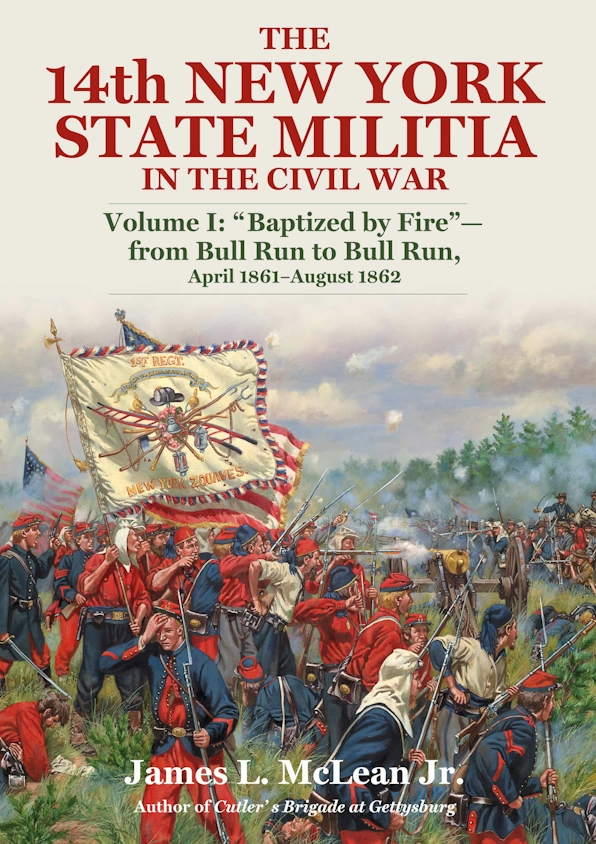
Although undoubtedly proud of their military service during the Civil War, some veterans pondered the usefulness of regimental histories. Alfred Seelye Roe, a veteran of the 9th New York Heavy Artillery and author of the 9th’s regimental history, doubted that anyone aside from veterans and their families cared about a particular unit’s service during the conflict. Because of their narrow focus, regimental histories were, in Roe’s estimation, akin to “local history.” While regimental histories—whether penned by veterans or modern historians—can indeed be narrowly focused and therefore of limited value, James L. McLean Jr.’s study of the 14th New York State Militia offers an exemplar of how regimental histories can benefit those whose interests extend beyond a particular unit.
McLean, a retired educator and award-winning author, has written a stunningly detailed account of the first fifteen months of the 14th New York State Militia’s service. Impressively researched and engagingly written, this study explores topics customarily found in regimental histories. The author describes in detail the regiment’s formation, traces the 14th’s part in engagements from the First Battle of Bull Run through the Second Battle of Bull Run, and chronicles the challenges these New Yorkers faced in camp, during the march, and on the battlefield. However, McLean’s brilliant history offers much more than a chronicle of one regiment’s service.
The author’s exhaustive research and sharp analysis, for example, highlight much about the relationship between the soldiers and the communities from which they trundled off to war. For example, McLean notes that various businesses in Brooklyn, such as the Union Ferry Company, offered to continue paying the salaries of those who enlisted. Other organizations, such as the Washington Division of the Sons of Temperance, offered to provide financial support to wives and children left behind. This powerful connection between the soldiers and the community, McLean clearly argues, never faded. At Christmas, various groups, including police and church organizations in Brooklyn, collected blankets and mittens for the 14th. Children collected socks and towels. McLean’s efforts to highlight the important work of community groups supporting the Fourteenth’s soldiers are commendable and amplify this volume’s significance.
Additionally, McLean’s analysis of the 14’s service offers valuable insight into war’s transformative impact on soldiers. While the regiment’s soldiers might have enlisted to fight for the lofty ideals of Union in 1861, just one year later, revenge became a motivation for some. In the spring of 1862, some of the regiment, while encamped near Centreville, Virginia, visited the Bull Run battlefield, the place where the unit received its baptism under fire. They were shocked to see how the remains of some of their comrades, buried in shallow graves or not at all, appeared to have been abused by Confederates. Although this treatment of the dead, as Drew Gilpin Faust’s pathbreaking study This Republic of Suffering has shown, was not uncommon, it stirred soldiers to seek revenge for what they regarded as blatant disrespect for comrades they loved so dearly.
By the late spring and early summer of 1862, battling the rebels and the natural environment took its toll on some of the 14’s soldiers. Some deserted, shirked duty, or simply refused to obey orders. Sometimes tensions escalated into violence. For instance, after Private Patrick Flaherty referred to Sergeant John Oliver in derogatory terms in early July 1862, a fight broke out between them. While occurrences such as these are not unique, McLean’s decision to include these stories can be regarded as somewhat exceptional. Regimental historians sometimes have a propensity to exclude those things that might disparage a regiment’s reputation. While McLean clearly admires the 14th, the author is indeed balanced in his approach.
Aside from those interested in the 14th New York State Militia and the war in Virginia, McLean’s volume, the first in a planned multi-volume history of the regiment, will be valuable to anyone looking to deepen their understanding of the complexities of soldier life and the war’s transformative effects. I highly recommend McLean’s study and eagerly anticipate the next volume.
Jonathan A. Noyalas holds the Hugh & Virginia McCormick Chair in Civil War History at Shenandoah University and is director of the university’s McCormick Civil War Institute. He is the author or editor of seventeen books, including, most recently, General Philip H. Sheridan: Life, War, and Memory (Routledge).