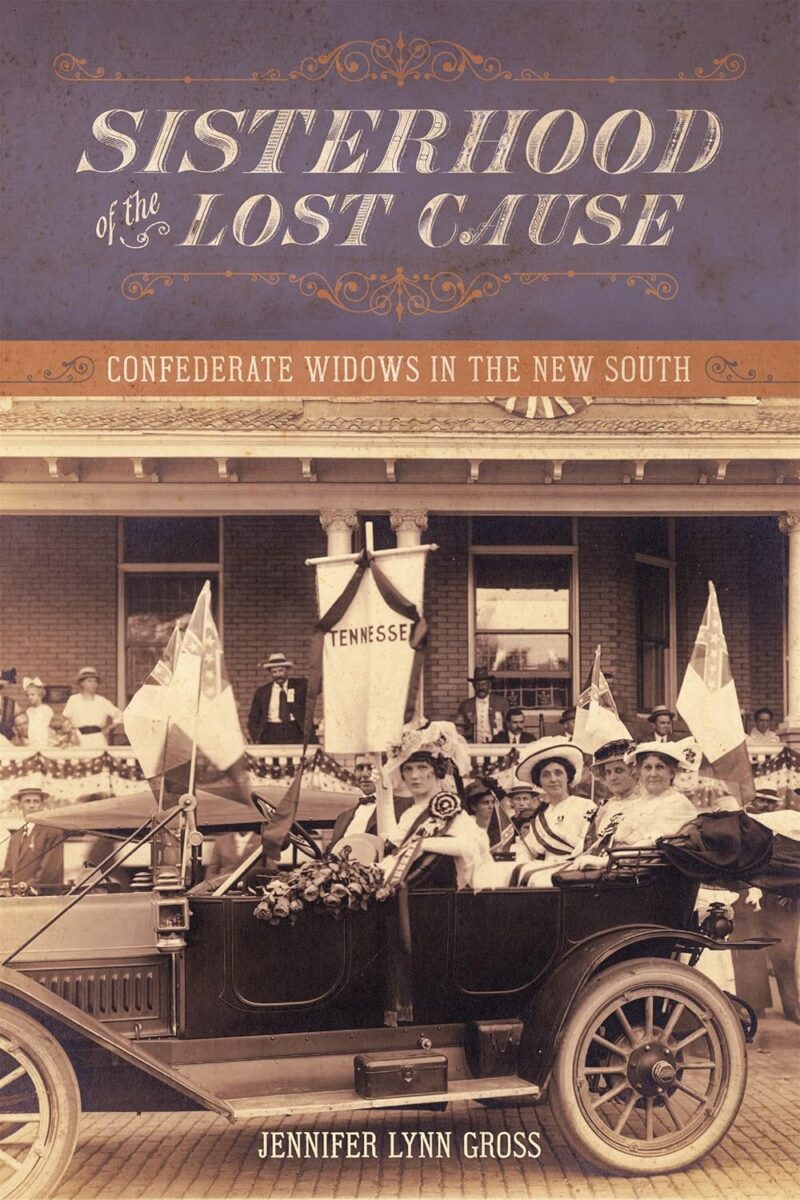
Confederate widows were legion in the post-Civil War South, their presence testifying eloquently to the scale of mobilization and the scope of killing that took place between 1861 and 1865. But Jacksonville State University professor of history Jennifer Lynn Gross argues that more than just their number and visibility recommend Confederate widows as subjects meriting fresh historical analysis. “[Confederate widows’] role in southern white society’s efforts to rebuild the postwar South in the image of the Old South,” Gross contends, calls out for serious scholarly scrutiny (3).
While historians like Angela Esco Elder, Karen Cox, and Caroline E. Janney have written much about Confederate widows, Gross contends that her book affords “a more complete description of what it meant to be a Confederate widow,” focusing on what that label meant “both for the women themselves and for white southern society” (9).
The author divides her book into two parts. Part One considers the lived experiences of Confederate widows (11). No two widows’ experiences were alike, of course, and yet somehow, all Confederate widows had to learn how to “[navigate] a complex reality of manlessness in a war-torn community governed by estate laws that often worked to their disadvantage” (59). Gross inventories the “different strategies” that Confederate widows used to cope with their personal loss and express their grief.
Such efforts were often difficult because so many Confederate widows lacked either the financial means or the practical ability to obey nineteenth century mourning conventions (the ars moriendi practices rendered so legible by historian Drew Gilpin Faust) (40, 49, 81). White civilians in the postwar South seem to have intuited the dilemma, for Gross finds that when a Confederate widow failed to mourn “appropriately,” she was not reviled, but rather related to (52).
In Part Two, Gross widens her lens to consider “how other southerners perceived Confederate widows and their plight” (11). Military defeat and emancipation menaced white southern men with the threat of emasculation; so too did the large number of women living beyond the confines of a “proper patriarchal home.” Impatient to “reclaim their role as patriarchs,” Confederate veterans sought to “reassert traditional gender roles” in the wake of war’s dislocations (4, 8, 82). Confederate widows, Gross argues, became integral to this project.
Gross shows how Lost Cause poets and writers enlisted their pens and re-made Confederate widows into specimens of white southern womanhood. Grieving widows became self-abnegating figures who, many Lost Cause writers reminded, placed everything upon what Augusta Jane Evans called the “altar of sacrifice” (101). In popular culture, Confederate widows became the “ultimate icons” of the conflict (146). The strategy was two-fold: the widows, by lauding the heroism and valor of white southern men, reaffirmed the traditional gender order and applied a soothing balm to Confederate defeat; moreover, the social “threat” seemingly posed by so many “manless” widows in the postwar South was contained by rewarding (through pensions and widows’ homes) Confederate women for their loyalty to the cause.
In a brisk conclusion, Gross suggests promising avenues for future research: what of the women deserted by husbands who refugeed themselves to Brazil or Mexico? What might a focused study of religion add to our understanding of how widows came to terms with the meaning of the war? To this list, we might add some questions provoked by Gross’s own book: why were Confederate widows—women who found themselves thrust into previously unthinkable and independent roles during the war (as Drew Faust and others have shown)—willing to play such a carefully scripted role in the reconstruction of white southern masculinity? Did they find the experience of war disillusioning, and thereby retreat from its radical possibilities (as Gerald F. Linderman once suggested of white Union veterans)? What happened to the agency that many historians have assigned to those white southern women who registered war weariness, rioted for bread in the streets of Richmond, and refused to bow to mourning conventions? If widows did not embrace society’s prescribed role for them, how did an inability to express their feelings toward the war contribute to their suffering?
Indeed, despite a recent flood of scholarship on Confederate widowhood—to which we can now add Jennifer Lynn Gross’s well-researched book—students of the Civil War era still have much to learn about what it meant to live on in the shadow of the dead.
Brian Matthew Jordan is Chair of the Department of History at Sam Houston State University, where he also co-directs the SHSU Civil War Consortium. He is the author or editor of six books on the Civil War era.