Garry Adelman discusses his role as a Gettysburg Licensed Battlefield Guide, including what it takes to become one and the questions he’s most frequently asked by visitors.
Transcript
Terry Johnston: Thanks for joining me again, Garry. Our question for you is pertaining to your role as one of Gettysburg’s Licensed Battlefield Guides. An anonymous listener asks, “What are the most common questions you get from battlefield visitors and what are some of the biggest misconceptions they have about the fighting and its participants?” And I guess before you dive in and answer that, can you explain to our listeners exactly what a licensed battlefield guide is and what it takes to become one?
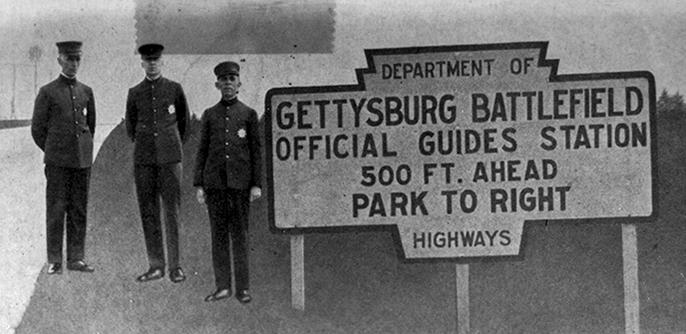
Garry Adelman: Yes. Thanks, Terry. So first of all, the Licensed Battlefield Guide Service at Gettysburg started more than a century ago. There were problems with just people in town convincing people to hire them to go around the battlefield together. They weren’t charging specific rates. There were hygiene issues with some of these guides. And eventually the federal government too, through the War Department at the time, decided to license them. And you’re going to have to pass a test. And you are going to give a tour of a certain length for a certain amount of money. And you have to be licensed for it. And that’s been going on for a long time. I took the very rigorous—then two-and-a-half part, now three- or four-part—examination to become a guide. I passed the written test in 1994 and became a guide in 1995. And as long as you give the certain number of tours that you’re supposed to every year for your category, there are people that do it more or less, you can keep renewing. And I’ve been renewing ever since 1995. I just sent in my information for this coming year. And I’ll say it’s one of the things I’m most proud of having done in the history field. It’s very hard to become one and it’s very hard to stand out among other guides who are also very well trained and well prepared.
 National Park Service
Early Gettysburg Licensed Battlefield guides
Terry Johnston: Well, we ran an article about this process back in the magazine in 2013, and it remains one of the most popular features we’ve ever published. And I will say though, Garry, that I think you’re being modest here. It’s really a rigorous process they put you through. Give our listeners a sense of exactly what you need to know to be able to pass this thing.
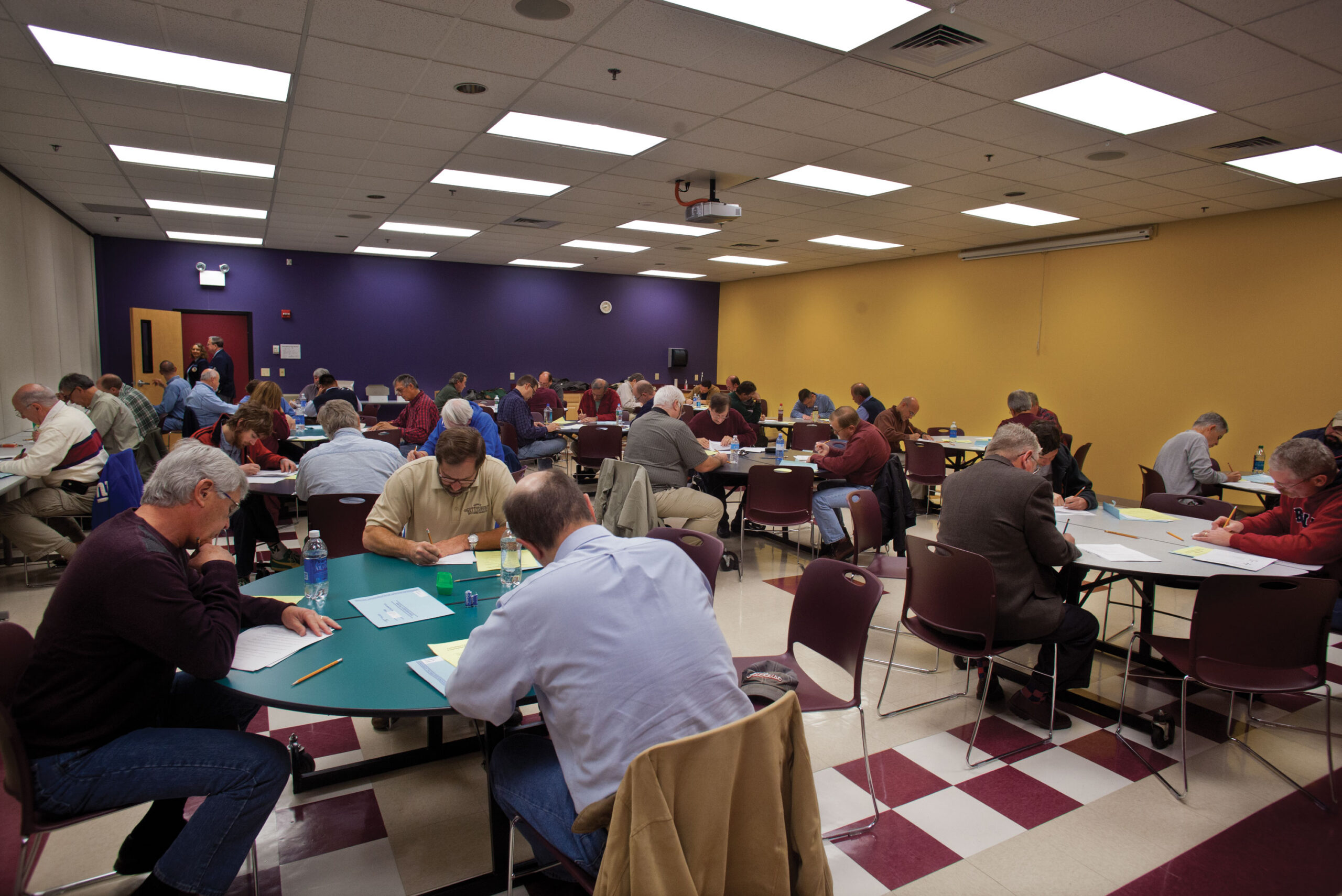
Garry Adelman: Yeah, it is amusing to see people come in and take the test and just have no idea what they’re in for. Even most battlefield guides don’t know both armies by which regiments make up which brigades and which one makes up which division and corps. I mean, it’s an extraordinary amount of information to actually know. So it basically consists of two main things, and that is a written test, which is very difficult—I’ve never prepared for anything so hard in my life—in which it’s not the model about knowing the details of the battle, it’s do you know about the battle, the battlefield, the characters there, the election of 1860, and the monuments, and all these things together. Like, do you have that breadth of knowledge? Then if you’re in that roughly, usually about 10–20% of the people who take the test pass that—they only give it every three to five years, you have to wait in order to do it. If you don’t pass, you wait three or five more years and do it. If you do pass, you go into a class, so to speak. There’s some training. There’s also an interview, like a panel, to make sure that you can converse with the public. There are a whole lot of people, the very people who can pass the written are often very ill-suited to be able to transfer that knowledge in a narrative fashion while you’re moving across time and space.
So at the end of the process, you get two tries to take a guide and a ranger around the battlefield and give a two-hour tour of the whole battlefield. There’s certain things you have to cover. And they act like tourists and try to throw you off a little bit. And if you don’t pass on one of those two times, you start back over again. So it is very rigorous. I’m glad I don’t have to do it again. I wonder to this day whether I would pass again. I know I’d do well on the oral. How well would I do on the written? Harder to say.
Terry Johnston: You’d do fine, Garry. But, I mean, it’s really interesting because it’s almost like you’re really getting a PhD in Gettysburg.
Garry Adelman: Yes. People have no idea. Because what you find is that the written test is just a symbol for, can you demonstrate that you know enough about it to move on to the next step? But, in the end, you don’t need to know one-fiftieth of that to give a two-hour tour of the battlefield. The key is, is that any good guide is going to ask for and be able to respond to questions. And that can be as broad as anything. Because, and that might be a good segue for you, Terry, because people ask and pontificate upon a wide variety of things. And that’s my favorite part about being a guide, is impacting people and telling them the things that they want to know, even if they didn’t know they wanted to know it.
 Tom Wolff
Test-takers huddle over their papers during the 2012 written exam.
Terry Johnston: Yeah, we’ll get to that. But I think it’s important and interesting to reinforce what you just noted, that you’re not just learning about the X’s and O’s of the battle and what unit did what and moved where, and who commanded it, and what monument was dedicated where and when, but also the larger context of the battle itself. I mean, you alluded to the election of 1860. So you’re more than just Gettysburg fact nerds here, for lack of a better way to put it. I mean, you really have to put these things into the broader context of the campaign for one, but the larger war as well.
Garry Adelman: Yeah. And into the context of material culture and everything else. People ask about buildings, birds, books, beer, where to eat. Like it is all over the map. And to me it takes some skills that are outside of what they can test. You either know how to read people or you don’t. It’s hard to teach, okay? And it could be that you could develop an affinity for working with the public, something that you would enjoy. Do you enjoy this type of work? And that’s largely, you either do or you don’t. Much like being able to read people, they might go hand in hand. You might like it because you understand it a little bit better. It’s what keeps it interesting.
Terry Johnston: Well, and these tours run on average, what, several hours?
Garry Adelman: Yeah, the standard battlefield tour is two hours, which is a challenge for any guide, because there’s no script. At least not in my case. I don’t know any great guide who uses a script because people from Rhode Island are going to get a different tour than people from Louisiana, if you’re a good guide. So there’s no script and you have to keep moving and people inevitably, and unintentionally throw you off. They ask questions, right when you’re trying to tell a story. They want to see things that are way out of the way and they still want to see other things. So it’s a challenge. Now, after you’ve been a guide for long enough, you only do requests. You don’t line up at the park for the next people to show up. And so then your tours get longer because everybody knows a tour of three or four or five hours is going to be better than one that’s two. And now that I do all my tours via American Battlefield Trust events, or most of them, they’re four to eight hours usually.
Terry Johnston: I see. So there are different kinds of tours, in other words. When you were in your earlier days of guiding, you would stand at the kiosk, or the equivalent thereof, and a group would come by and want to sign you up. It’s like the taxi queue, right? You’re the next up.
Garry Adelman: Correct. But, you know, the park still, ever since I’ve been a guide, still maintains a list on people’s specialties and capabilities. Can you give a bike tour? Can you give a hiking tour? Do you speak Spanish? Are you good on the II Corps? Are you really good on, you know, Anderson’s Georgia Brigade? I mean, there’s a list of things where the Gettysburg Foundation, who administers a lot of the booking of guides for the National Park Service, maintains this list on trying to match people with the right guide. Can you give an eight-hour tour? Are you willing to give a multi-day tour? Things like that.
Terry Johnston: And so people can show up and at least request, Hey, I want to follow a certain unit’s experiences through the battle. And they might match you with a guide who can do that for you.
Garry Adelman: Yes, but those people shouldn’t just show up. If you have a special request, you should book that days, weeks, or months in advance, depending on the time of the year. Because on any given day in January, there might be three guides waiting for tours. Midsummer, there might be 14 or 20, but that doesn’t mean your Wheatfield specialist is there and available that day. Most guides have other jobs.
Terry Johnston: Yeah, that’s a good point. I like, too, that there’s a Wheatfield specialist, so that’s pretty cool.
Garry Adelman: There are a few and they popped into my head when I said it.
Terry Johnston: Oh good. Okay. Well let’s get back to then to the original question. What are some of the most common questions you get from visitors?
Garry Adelman: So, first of all, I’m going to turn this on its head, because, and I hope I’m not judging other guides too harshly, but, to me, you shouldn’t get questions very frequently. If I get a question early on in 30 or 40 or 50% of my tours, it meant that I was not delivering the information properly, and I have done away with the common question that I haven’t addressed. You know, let’s say that I’m spitting out a lot of information and speaking quickly as I’m known to do and they don’t catch everything, that’s okay. But usually somebody else in the car or van or walking tour will say, “No, he already covered that.” And they’ll sort of save me. So, to me, if you’re getting the same question with any frequency, you have failed to incorporate that information into your tour, because obviously a lot of people want to know about it, okay? Now, when I was early on, I can’t even remember all the things that I was leaving out. I clearly wasn’t explaining the reinforcements of a gallant charge at Gettysburg, known as the charge of the 1st Minnesota. I wasn’t explaining that very well. I really wasn’t getting into a good way to tell people about the collapse of the Union army on the first day and why it happened, because I started getting questions about it. It in the end, sometimes just tweaking a few words or a sentence, you address that question before they ask it so that they can focus on other things that they might find interesting, whether it be where were the towers made, the big tall observation towers, or are those the trees that were there during the battle? Because you’ll never cover it all. But you don’t want to be in the position where you’re getting these similar questions overall.
 Bruce Guthrie
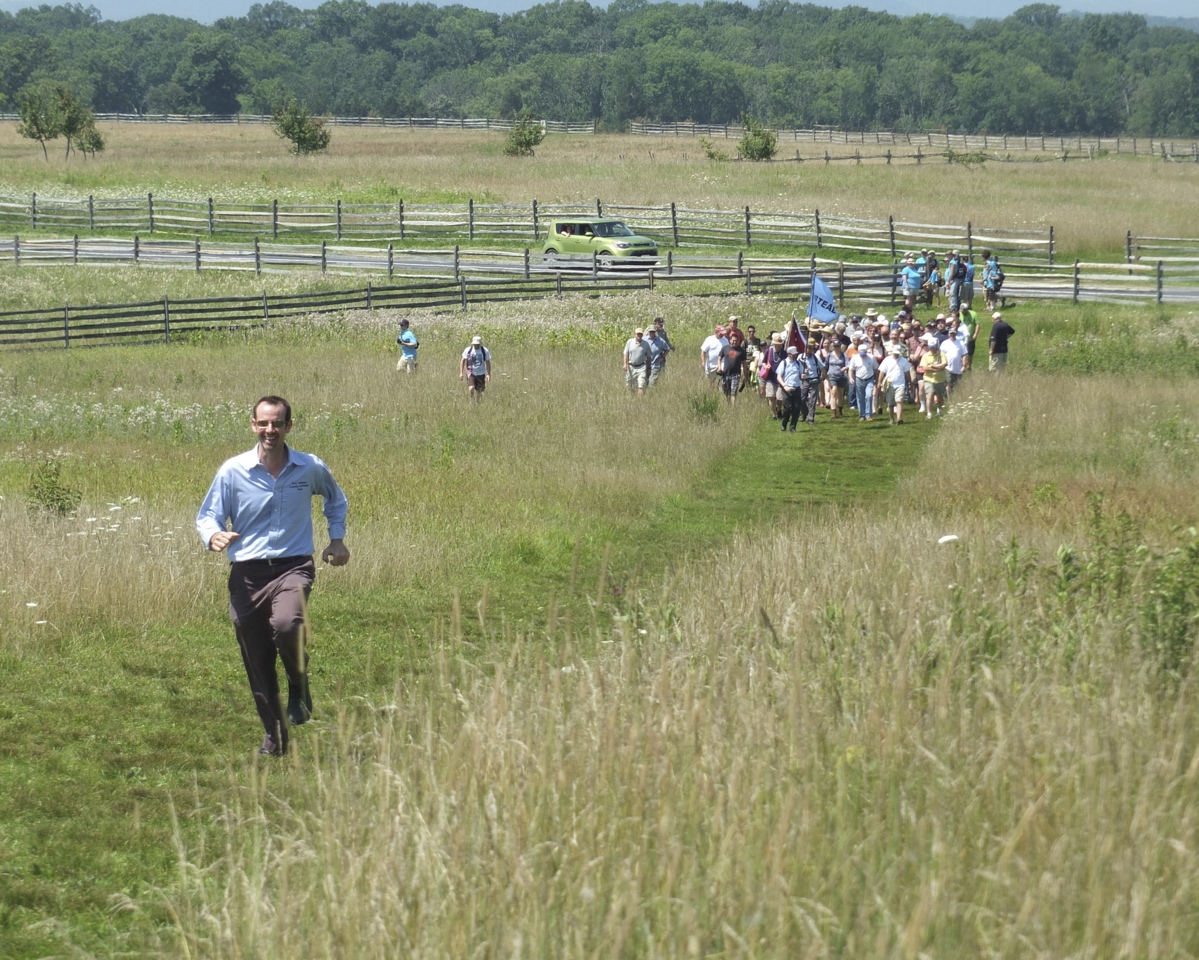
Garry Adelman charges ahead of his group during a battlefield tour.
The thing that I have been powerless to change, though, even though I address it on every single tour, is the propensity of humans—you, me, everybody—who can’t help but think that they simply know better than people who have done things before them. So, you know, kids think they’re smarter than their parents. We think we’re smarter and better coaches than the football players that did stupid things a few days earlier. And we can’t help but think that just if we were there, we would’ve come up with a better way to fight than them. We’d have had a better way to do everything. Those idiots didn’t even know about microbiology. While I’d go back to the past and tell them to wash that saw, even though they would probably lock you up if you started talking about invisible things that live on you, some of which are bad. So this idea that the people of the Civil War were either stupid or had a death wish is the most pervasive thing that I have trouble undoing, that is until I try once and then they ask me about it and I say it more convincingly, and I usually have a way of doing that. That’s the number one thing I’ve been unable to dispense with, this idea that we’re not like them and that we’re smarter or better.
Terry Johnston: Yeah. Well, that kind of dovetails with the second part of this question, which is about the misconceptions about the battle that visitors express. Are there any of those really that stick out in your mind?
Garry Adelman: I mean, yeah, that’s obviously one of them. I would say the second category of misconceptions comes from what their preconceived notions are based on what they have seen or read. They may have been told by their grandparent that, you know, Texans always move ’em, or that, one that drives me crazy, that Robert E. Lee escaped from Gettysburg and that was General Meade, the commander of the Union army’s fault. That’s a completely wrong paradigm, wrong sort of structure, if you ask me. So people come with preconceived notions that, you know, Richard Ewell should have captured Culp’s Hill, that it would’ve been easy because all he would’ve needed is a wounded cook, and he’d have captured that hill because they saw it in a movie. Or that somehow the bayonet charge was a textbook maneuver practically invented by Joshua Chamberlain from the Gettysburg movie. So people have these notions of things and that’s what drives the category of misconceptions more than anything else. They could be familial or they could be from popular media.
 Library of Congress
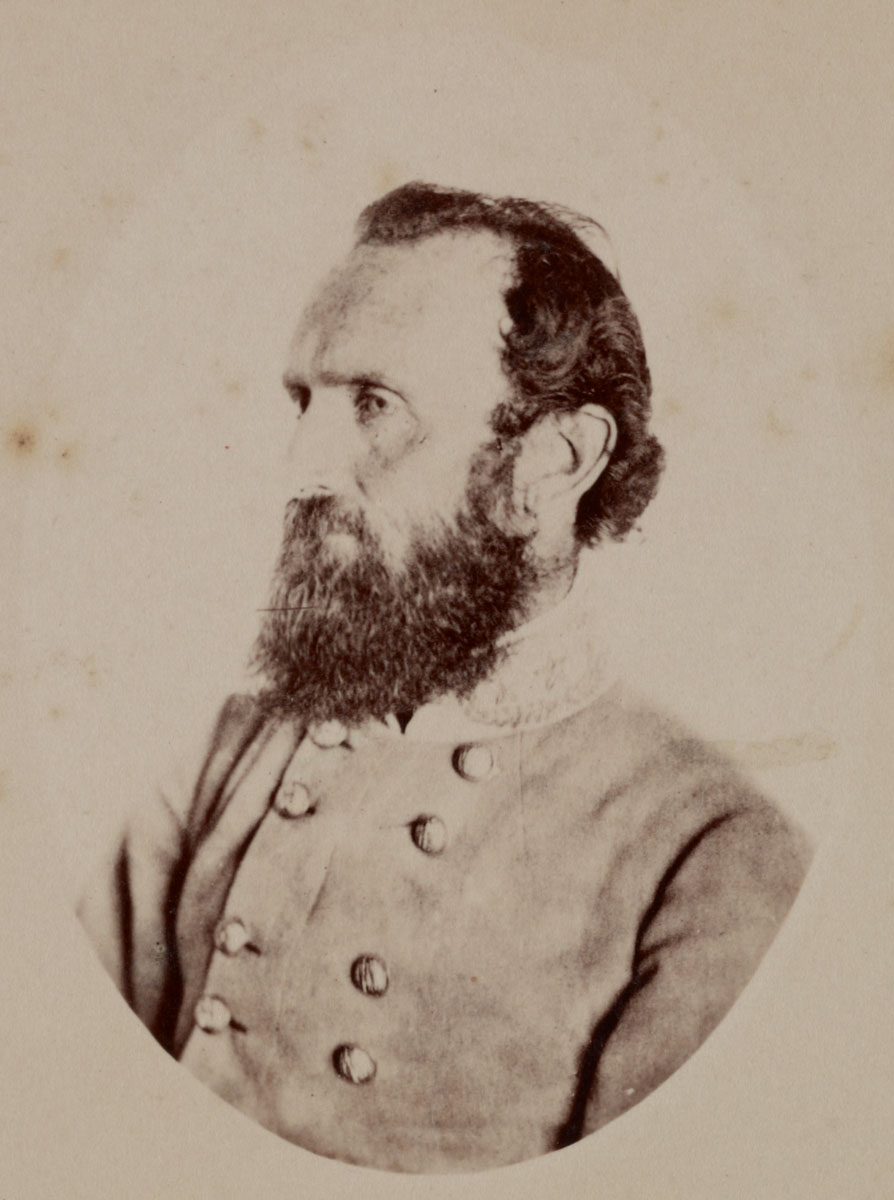
Confederate general Thomas J. “Stonewall” Jackson
Terry Johnston: Yeah. And this goes with something that I was wondering too about “what if” questions. One that I receive from time to time is, and this is a biggie, what might have happened differently at Gettysburg if Stonewall Jackson hadn’t been killed at Chancellorsville? Actually, by the way, any thoughts on that one in particular, Garry, while we’ve got you?
Garry Adelman: Yeah, I mean, so as a guide you learn to answer that one. And it depends what a smarty pants mood you might be in that day. The smarty pants version is, of course, well, Stonewall Jackson was here, he’d have smelled real bad because he was already dead for seven weeks and things like that. And then people feel a little odd about it. It depends what their notions are. To me, Stonewall Jackson was far from perfect. He had actually probably fewer high points than low points, namely Chancellorsville and the Shenandoah Valley. But if you look at the peninsula at his operations in western Virginia and maybe even Fredericksburg, where he got penetrated by the Gettysburg commander George Gordon Meade’s soldiers, you look at an imperfect Stonewall Jackson. But in death and in popular media, he’s almost right up there with Robert E. Lee levitating off of the ground. I can’t tell if Jackson would’ve been more aggressive than Richard Ewell at that time, but there’s no doubt that the first day’s battle wouldn’t have even gone that way if the whole army wouldn’t have been reorganized upon Jackson’s death. So, to be able to talk about that “what if,” it’s certainly farther away from what people think Jackson still would’ve done. People have started to equate Jackson’s living for a couple more months with, Confederates win the whole Civil War, which is like misconception upon misconception. So I tend to push back on that. And depending on the people, you know whether they can take a joke or not.
If I can go back to this thing about people having a death wish, I bring people full circle where I ask them what they would’ve done. And they, some of them, the ones who get a smug look I’m ready for and say, “Well, I’m glad you asked, because instead of sending all these people across the field, I would do it this way and that way.” And then I ask them enough questions until they eventually have to conclude verbally that the only good way to break the position was to send a whole lot of guys across the field at once, shoulder to shoulder. So, if you’re good at working with the public, you eventually learn how to deal with some of these things, misconceptions or “what ifs.” Now “what ifs” are fun, it’s just a matter of how certain you are about what would’ve happened.
Terry Johnston: Yeah, yeah. And by the way, I want to circle back to something you said earlier. Your point’s well taken that, if you’re getting a lot of questions from your tour attendees that maybe you’re doing something wrong. But as a reflection of their interests, what aspects of the battle do you find that people are most interested in, or personalities who they’re asking about? Are there common denominators there?
Garry Adelman: So first of all, just to be clear, I only think that you’re not doing your job right if you get the same questions over and over again, not just questions. You want a lot of questions and it’s great. And let me just diverge, and I might need you to restate the question a little bit, that when I first started guiding, there were no smartphones. You could say anything. And not that I took advantage of it, but people couldn’t fact check you in real time. Now, on the way back to the car, they might be checking the information that you’re providing. And if they ask a question that I don’t know how to answer, and it happens on most tours, as long as I’ve been doing this, people ask questions that you could have never thought you’d would’ve needed that particular piece of information. But the good thing is, is I look that up. Some guides might get mad or interpreters at other parks might get mad when people zing them or ask them questions they don’t know the answer to. To me, it’s a great learning opportunity when somebody asks a question that I don’t know the answer to, and by the way, your customer feels much better because then they feel special for asking a question that guy didn’t know the answer to. So, I diverged, what was the question again?
Terry Johnston: Are there particular aspects of the battle or participants in the battle, whether individuals or units, that seem to be among the more popular that visitors are looking to learn about?
Garry Adelman: Well, yeah. I don’t think I have any surprises for you here, but it does ebb and flow with what’s available and out there. I think General Meade is more popular than he’s ever been in my guiding career, and I’ve watched over time Robert E. Lee, who is always of interest, but I’ve had to stop talking Robert E. Lee down off a pedestal and actually explain to people, because he’s not as popular in some of the country nowadays, I’ve had to explain, no, no, he really was capable. He is the one guy you don’t want to face. He’s the best the Confederacy had. So people ebb and flow, not only with popular media, but they tend unfortunately to take their opinion of a person from the past and apply that to how good they think they were, which I reject wholesale. If Robert E. Lee did things that you agree or don’t agree with, it doesn’t make him any better or worse at his core job. And I would say the same thing about running backs who do stupid things later, or boxers, or anybody, or actors and actresses. If somebody does something stupid later in life, do you suddenly hate the movie you used to profess to love? Maybe you don’t pay for that movie anymore, but you still should recognize that the person did a capable job at that point.
So, being a guide and an interpreter, you deal with sort of these things. So Lee is popular. Winfield Scott Hancock, commander of the Union’s II Corps and sometimes more at Gettysburg, is popular. The movie characters like John Buford and Joshua Chamberlain remain very popular, as does General Armistead, about whom we just don’t know as much as you would about some of the others. So, it really ebbs and flows with popular culture. And like I said, Meade and people like U.S. Grant, who wasn’t at Gettysburg, despite what a lot of visitors say about it, are riding a much better wave than they would’ve in the nineties.
Terry Johnston: Some of our listeners will know, but some certainly won’t know, that you are a bona fide expert in Civil War photography. And I wonder how, if at all, do you incorporate images from the time in your tours?
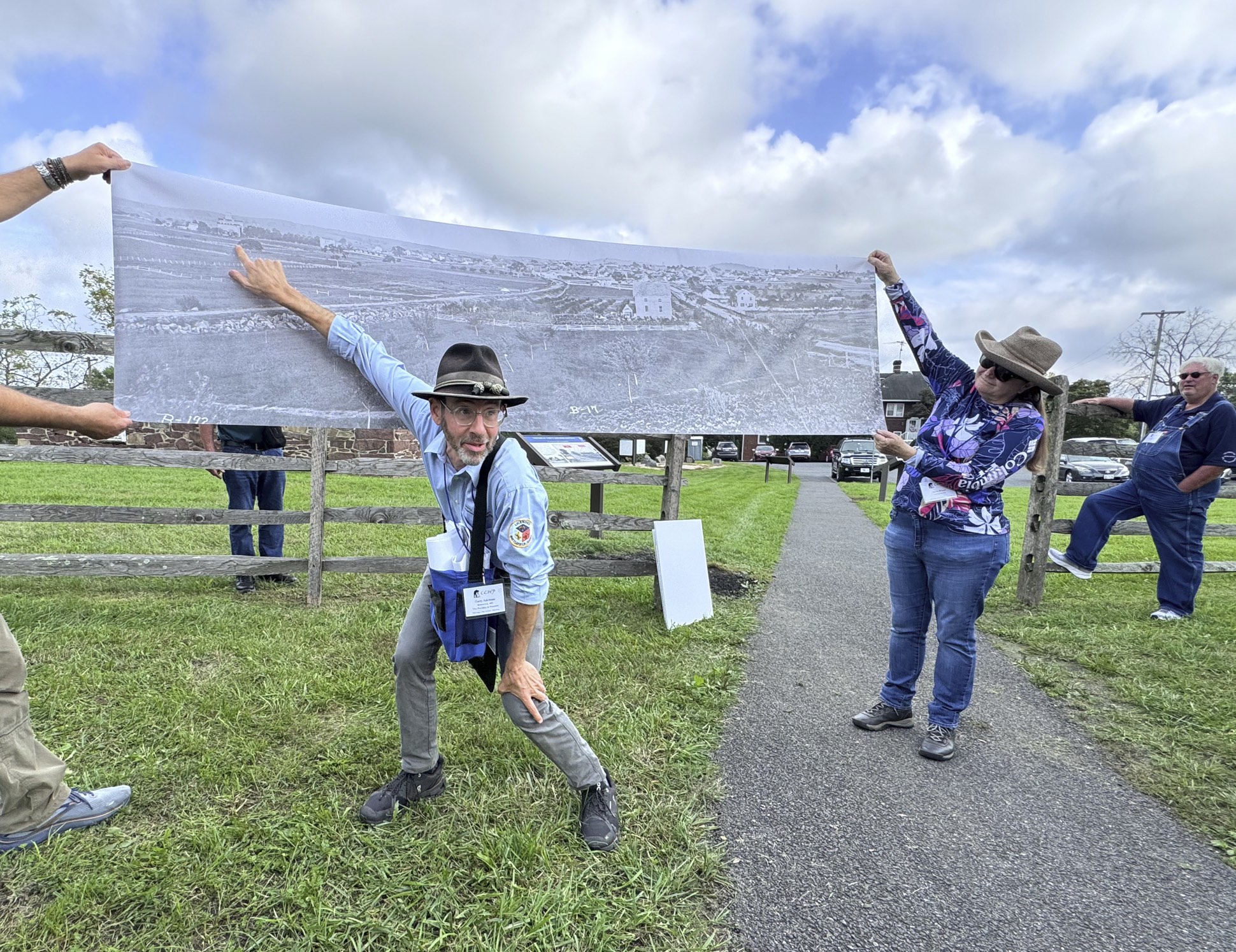
Garry Adelman: Yes. I’m by no means unique in that respect. There are other guides that might bring around a picture of the Trostle Farm that you could see the artillery shell hole on that part of the battlefield in a photograph taken a few days after the battle. So other guides are bringing them around. But I don’t think there’s another guide who totes as many around. I will bring around 8 x 10 or 11 x 17 photos. I’ll bring by two- or three-foot 3D boards created by the Center for Civil War Photography and hand out 3D glasses because most photos in the Civil War were recorded in stereoscopic or 3D format. So that’s the way they were meant to be seen. And I think photography’s very visceral for people. I think it’s evocative and it results in a whole different set of questions. And I think it humanizes people, especially when you can see them close up, which is another thing I do on tours. I’ll show a photo, then I’ll show a blowup of one-fiftieth of that photo and you can see somebody smirking or somebody holding something or a child with a pet or something like that.
 Melissa Winn
Garry Adelman uses an enlarged photo on a tour of the Gettysburg Battlefield.
And, in the end, I’m wanting to open up windows on tours. Like I want that tour to not only be insightful for them, but I want it to be the highlight of their day. And I want it to be transformative for them. And I’m not kidding. Every tour I give, that’s what I want. That’s the goal, is to inspire somebody to change some sort of a behavior, ideally to visit more battlefields and historic sites and to finally say, think about how often this happens for you, probably not too often with a guide: “Aha. Now I get it. That’s what it was like.” That’s what I’m going for every time, whether it be with photography or narrative storytelling or pointing at things, which guys are good at.
Terry Johnston: Do you find—by the way, I love the idea of you handing out 3D glasses, that’s really cool—but do you find you’re getting repeat customers, so to speak, that you see familiar faces? They were so impressed by the guy who gave them the 3D glasses that they had to come back for more and learn more from him?
Garry Adelman: Whatever the element is, yeah. I mean, I haven’t queued up and waited for a tour since probably 1998. So yes, if you’re a guide, and then if you’re a good guide, and then if you’re a guide who also has a book, who also speaks to round tables, who also might show up in some documentaries. I have been unbookable for at least a decade. I mean, I have kids and a wife at home and, so, I’m a busy dude. So I only have time for a certain number of tours and most of those are taken up with American Battlefield Trust events. So I’m basically unbookable, which is a great problem to have, but it means I have to reject a whole lot of people, sometimes a couple a week on average, who know I’m a battlefield guide and want to book, you know, it’s flattering, but I just can’t do these round tables and tours like I used to, so it creates the best type of monster.
Terry Johnston: Alright, Garry, well before we close here, any final words on Gettysburg guiding that you’d like to share? Something that we haven’t brought up that you think is important to point out?
Garry Adelman: Yes. If you’re listening, because like I was, when I first started coming, I sort of came to Gettysburg for the first time with a little bit of a swagger and thought I knew what I was doing. Well, a lot of Civil War and history people are a little arrogant about their knowledge, and I certainly fit into that category when I first started coming as a tourist. And then I met licensed guides like Tim Smith and Wayne Motts and Dave Richards and Charlie Fennel, and realized that I was still in kindergarten. I just, I had no idea how little I knew until I met people like that. And I think that if you’re thinking about coming to Gettysburg, especially for the first or second or third time, hire a guide as the first thing you do, because the guide will set that table for you, probably teach you a whole lot of things, even about a battle you might know about, right off the bat. And then you could spend the rest of your time there enjoying the place and seeing the things you want to explore on your own. I’m not just pitching for the guides, I mean this for almost anywhere. You know, use the experts who are on site at your historic sites because even the worst guide is better than the best tour tape.
About the Guest
 Garry Adelman is the chief historian at the American Battlefield Trust, the vice president of the Center for Civil War Photography, and, since 1995, a Licensed Battlefield Guide at Gettysburg. He has written, co-authored, or edited over 75 books and articles about the American Civil War.
Additional Resources
Sponsored By