Historian Anne Sarah Rubin discusses the significant and enduring impact of William T. Sherman’s March to the Sea.
Transcript
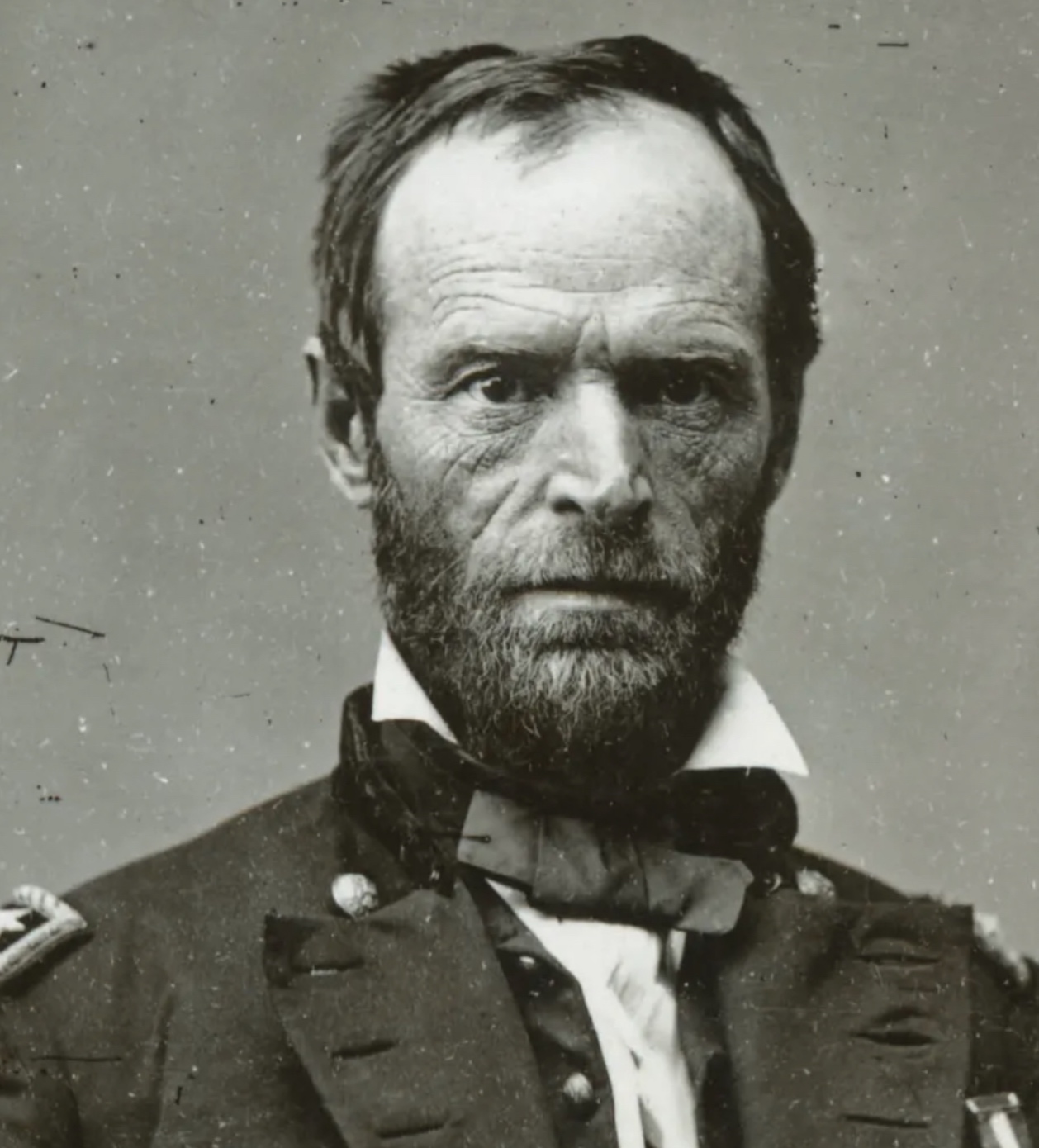 Library of Congress
William T. Sherman
Terry Johnston: Thank you very much for joining me today, Anne. We’ve got two questions for you, both pertaining to William Tecumseh Sherman’s famed—or infamous—March to the Sea. The first was submitted anonymously. It reads, “In what ways did the March to the Sea impact the Confederacy?” Perhaps the best way to start is to provide readers who might not know much about the March with some background. So, what exactly was the March to the Sea and what were Sherman’s goals for it?
Anne Sarah Rubin: Well, first of all, thank you so much for having me. And that’s actually a big question. So the March to the Sea takes place from the middle of November 1864 until middle to late December 1864. Sherman and his army took control of the city of Atlanta in September 1864. And they’re there for about six weeks. And then the next basic step, or what Sherman comes up with, is this idea, as he put it, to “make Georgia howl,” to march his army, which is about 62,000 men, across Georgia to get to Savannah. He does this for a couple of reasons. One is because this area of central Georgia has been relatively untouched by the war, so there’s a lot of, frankly, food and supplies. And so Sherman, by marching across and ordering his men to “forage liberally on the land,” to basically live off of Confederate production, both saves him from having to have a long supply line and also, and arguably more importantly, deprives not just Confederate civilians, but also the Confederate army, of all of this bounty of food. So that’s the kind of broad outline. The idea then is he’ll get to Savannah, then he’s on the coast, and he can move in a couple of ways from there and we can talk about that when he gets there.
The March itself, he breaks his army into two wings, and then each wing is further subdivided, so it’s actually four columns of troops marching. And, you know, there’s these apocryphal stories, right? It’s 50 miles wide. It’s like it’s 50 miles wide from the edge of the furthest column to the edge of the furthest column. They do march across. They wreak considerable havoc on farms and they burn cotton gins and barns and things like that. They take the capital, Georgia’s capital of Milledgeville, and they’re faced with very little opposition, almost none. There’s just some Confederate cavalry under Joseph Wheeler, really, that they’re fighting against. They get to Savannah. He takes the city of Savannah on December 22. He famously offers it as a Christmas gift to Lincoln. That’s the end of the March to the Sea.
But then there is a second half to this, which is that in the end of January 1865, the army moves out again and they march up through the Carolinas. First they take Columbia, South Carolina, the capital, and then they march up and they are roughly ultimately heading towards Virginia, where the ultimate goal is, if necessary, they’ll help Grant outside of Petersburg. So then they weave through North Carolina, they take Raleigh, North Carolina, and by that point, Lee’s army has surrendered. A couple days later, Lincoln is assassinated and Joe Johnston’s Confederate army, who’s been opposing Sherman at this point—now we’re into April 1865—surrenders to Sherman on April 17, outside of Durham, North Carolina.
Terry Johnston: Well, and the actual March itself through Georgia was—and you can explain this for folks—really a bold idea. I mean, didn’t It make Lincoln and even Grant nervous when Sherman was sketching out these plans? He’s going to cut loose from his supply lines and communication lines, and as you say, he’s just assuming he’s going to be able to support this massive army by foraging alone.
Anne Sarah Rubin: Yes. It’s very bold. It’s not unprecedented, but it is bold. So yes, Lincoln and Grant are both a little bit skeptical. Grant really has to convince Lincoln to let Sherman do this. He is cut loose from his supply lines. He is cut loose from his communication lines, I think more importantly. And so, there are periods of time where no one in the Union really knows exactly where he is. And he deliberately does a faint towards Augusta, Georgia. He does a faint towards Macon, Georgia, to keep everybody guessing. It’s not the first time that a Civil War army has done this. Sherman and Grant did this, for example, in Mississippi as part of their Vicksburg Campaign in 1863. And even the level of destructiveness is not unprecedented. You’d had Sheridan’s Valley Campaign a couple months earlier that similarly really destroyed farms and destroyed food and carried away food. But I think it’s the scale of it and the sort of inherent drama of it that has given Sherman’s March so much of a kind of lasting cultural impact.
Terry Johnston: Well, we’re definitely going to talk about that, which is fascinating in and of itself. But let’s get back to the original question. So, in what ways did the March impact the Confederacy, not just in Georgia, but outside of the state’s borders?
Anne Sarah Rubin: So it has a huge impact on the Confederacy in a couple of ways. One way, of course, is just the supply question, right? That the Confederacy has been losing territory and losing territory, and each time the Confederacy loses territory, they lose access to food. And so the inability to take all of this agricultural bounty out of central Georgia, and it’s November and December, it’s right after the harvest, so there’s a lot of food. I was really struck by that when I was doing my research, was how much food people had and as they were cataloging it. And so that’s a huge piece of it.
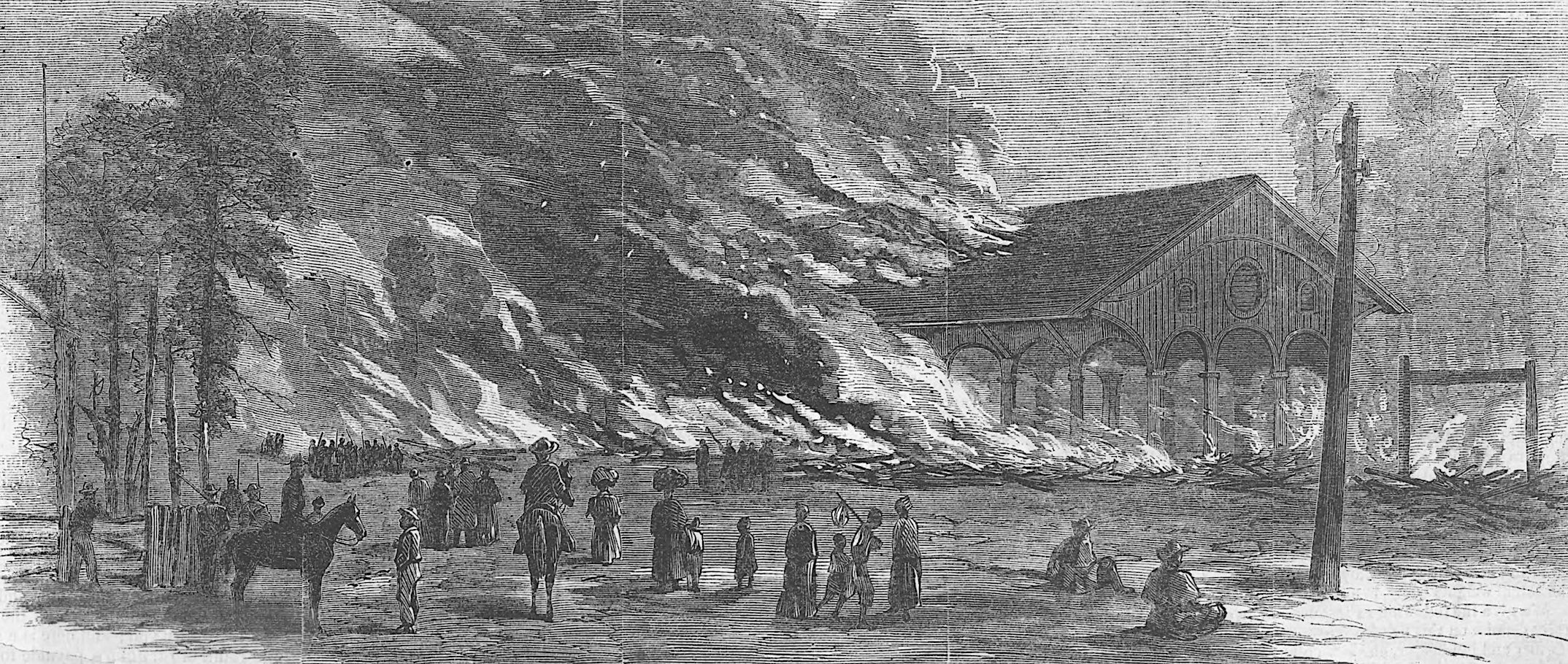 Harper's Weekly
Enslaved men and women look on as a plantation building, set afire by Union soldiers, burns during Sherman’s March.
It’s a morale destroyer as well, because he is largely unopposed. And so the stories that come out, the fact that this army is just marching 10 miles a day, there’s really only one kind of battle on the Georgia campaign, which is Griswoldville, which is not far from Milledgeville. And when the smoke from this relatively small battle clears, Union soldiers are sort of shocked to discover that really they’re fighting the remnants of the Georgia militia, which is teenage boys and old men.
The other impact that the March really has on the Confederacy, I think, is that it is also a march of liberation. Sherman doesn’t want that. Sherman himself is not a huge supporter of black equality, and he does not really want to be followed by thousands upon thousands of African Americans. But his army is an army of liberation, and as they pass through Georgia, enslaved people literally walk away from their homes, walk away from their enslavers, and follow Sherman’s army until they get to Savannah. It’s the greatest emancipation event over the course of the Civil War.
Terry Johnston: Well, and that must have been, in its own way, extremely disruptive to life in Georgia for Georgians, right?
Anne Sarah Rubin: Absolutely. It’s completely disruptive to Georgia and there’s also the element, I think, of fear and of not knowing, right? Because it’s not a straight path. It’s inconsistent, right? Is he going to go to Augusta? What’s his objective? So there’s just so much uncertainty for white Georgians and then for black Georgians also, you know, it is a risky move still to pick up and follow his army. But it is a choice that literally thousands make, maybe 40,000 or 50,000, I think, wind up following his army directly.
Terry Johnston: The physical disruption itself to warehouses and mills and railroads, famously, you see photos of Union soldiers heating and bending rails, the so-called Sherman’s neck ties. That was really, again, a big part of this mission, wasn’t it? And are they indiscriminately destroying or selectively destroying things like railroads and warehouses and even personal property? How does that play out?
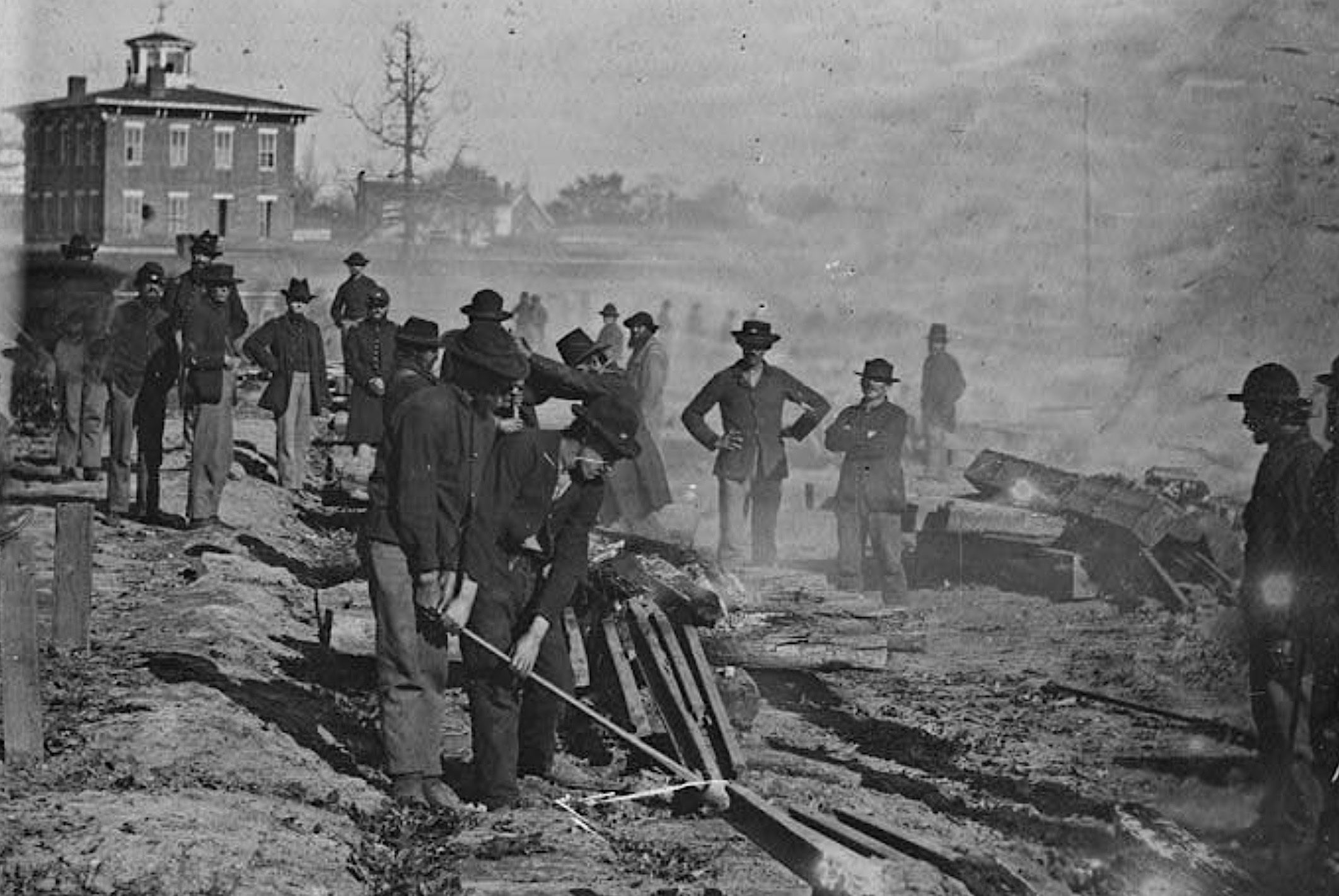 Library of Congress
Union soldiers are shown destroying railroad track in Georgia.
Anne Sarah Rubin: So the level of destruction and the degree to which that destruction is controlled or uncontrolled is, I think, a really fascinating issue with Sherman’s March. So, Sherman famously offers a set of orders about how the foraging should be done and that it should be done by regular parties. And he actually injects this really interesting note of kind of social class into this saying, you know, “You should forage from the wealthy but not from the poor because they actually maybe really support the Union.”
There’s also a question of authorized and unauthorized. Beyond what’s supposed to be happening, which is this kind of regularized foraging, you have what they call Sherman’s “bummers,” which are kind of unauthorized. And there’s a real element to the March where these men who have been fighting, who have been in really dangerous conditions, are kind of let loose because the March is not dangerous for them. So they tend to remember it as a kind of fun lark, and a lot of the destructiveness comes from those impulses. So on the one hand, yeah, you have the systematic destruction, say, of railroads and the twisting of the ties into Sherman’s neck ties so that you can’t reuse them, and the burning of trestles and things like that.
Then you have somewhat systematic destruction of property like the cotton gins, the barns, storehouses. In Georgia, not that much destruction of residences, not that much destruction of actual homes. But then you also have not just the taking of food, but any food or livestock that the Union soldiers can’t carry away, they will destroy often just so that Confederates can’t have it. And then you have what Catherine Clinton famously described once as ethnocide also, which is this going into people’s houses and just taking their jewelry or taking their silver, dressing up in women’s clothes, this kind of gratuitous looting. So all of that is happening in Georgia. I will say that one of the ways that you can see that Sherman has some elasticity or some control, is that as bad as it is in Georgia, it is worse in South Carolina.
Terry Johnston: Right. The “cradle of secession.”
Anne Sarah Rubin: Right. And Sherman writes in his memoirs, he is so disingenuous, he says, somehow, you know, our men had gotten in their head that South Carolina was the cause of all of this. And he says he doesn’t want to restrain them because otherwise if he does that, they’ll lose their fighting edge. So he kind of lets them take the gloves off more in South Carolina. Then he wants them to put the gloves back on when they get to North Carolina because North Carolina did have more Unionists. But it’s pretty hard, to mix all of my metaphors, to put the genie back in the bottle.
Terry Johnston: You alluded to those orders that Sherman issued before the March, outlining the conduct he expected from his soldiers. I vaguely recall, and correct me if I’m wrong, that when it came to the burning of, say, personal residences, that was something that was authorized in areas where Sherman’s troops were “harassed” or there was guerrilla activity.
Anne Sarah Rubin: Right.
Terry Johnston: Did the bummers you alluded to—we do have that image of the bummers just being turned loose, but that wasn’t officially authorized. Did Sherman and his officers just turn a blind eye to that? They must obviously have known it was going on. Or were they okay with it?
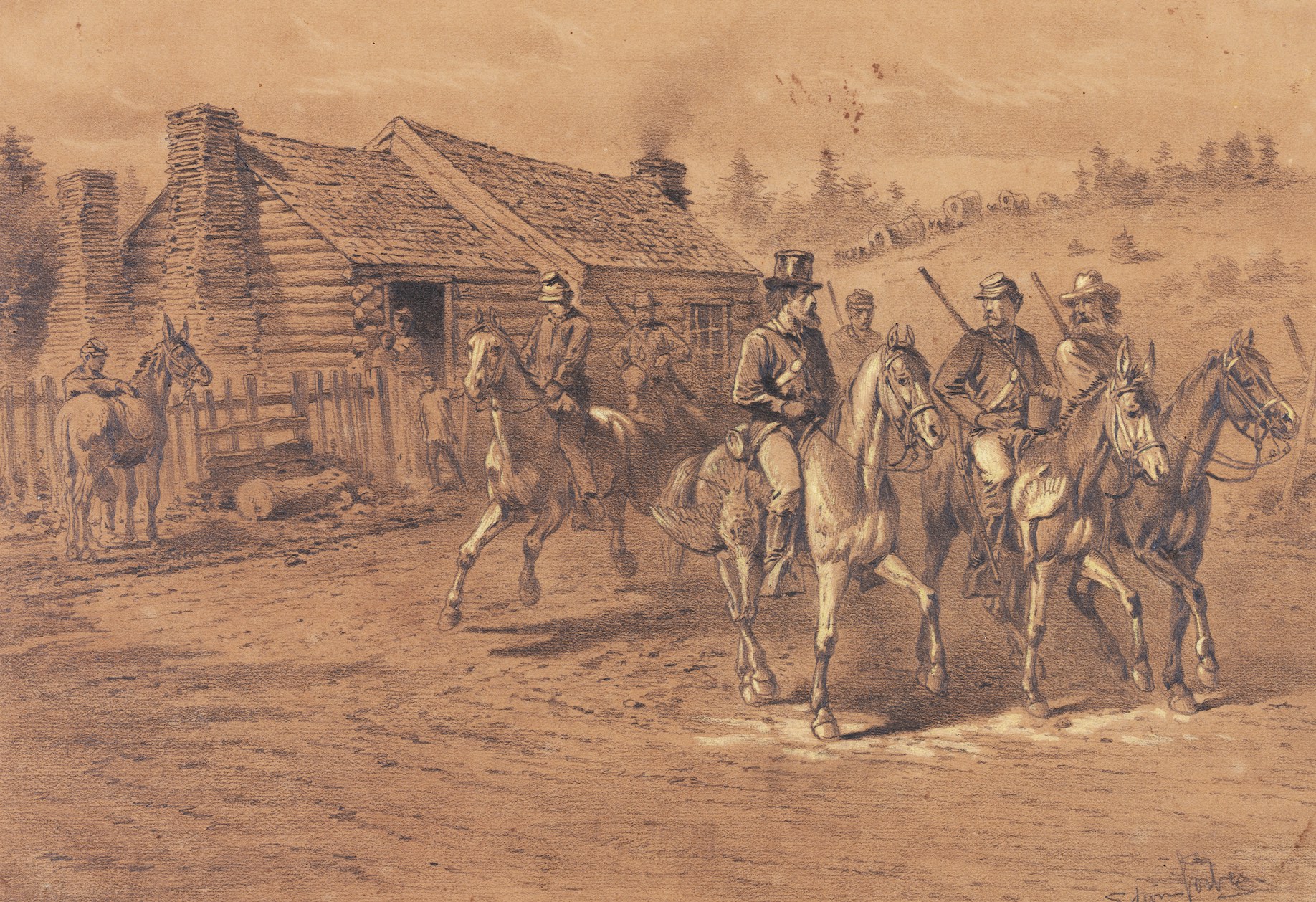 Library of Congress
Artist Edwin Forbes’ depiction of Sherman’s “bummers.”
Anne Sarah Rubin: I think they’re okay with it. So one of the things I realized when I was doing research for my book on Sherman’s March is that there are a lot of stories of homes that were spared in Georgia and for various reasons. Oh, they were Masons or, you know, one story that people always tell is like, oh, Sherman had once courted a girl who lived in this house. And part of the reason I realized that there are so many stories of homes being spared by Sherman is because so many homes survived the March, right? Not necessarily, again, not necessarily the outbuildings, that’s not to say they weren’t touched, but the physical residences were often not destroyed.
And I do think there’s still that vestige of control. I think also Sherman is someone who knew the laws of war and felt very comfortable pushing his men right up to the line, but keeping them from crossing over the line. And so he felt very strongly that everything he was doing, everything his men was doing, was within their rights to treat Confederates as belligerents and always with the implicit promise that, as soon as the Confederacy surrendered, this hard war would stop.
Terry Johnston: Well, before we get to the second question, I just want to come back quickly to the idea of the March’s impact on Confederate or Georgia’s morale. Did the March, as Sherman intended, discourage Georgians and other Confederates, or did it actually anger them and steel their resolve to fight on?
Anne Sarah Rubin: Yeah, I think it really varies. I think that Confederates would have you believe that it steeled their resolve a little bit, which is to say that, you know, you tried to destroy us and you committed this, what they would maybe argue as a war crime. They might not have used that language exactly, but made war on civilians and we still will fight on. But the fact of the matter is that, in a practical sense, it’s hard to fight on and it’s hard to keep your morale up when you’ve lost all of your supplies right before winter starts. And when you’ve seen the enslaved people on your plantation or in your neighborhood just take off and leave. So it’s complicated. I think it certainly hastens the end of the Civil War. I think that Sherman’s soldiers, in retrospect, believed that they had brought the war to a close, that they had had this really significant impact and that they were really the heroes, that at the same time all of this is happening Grant’s army is just stuck in the trenches outside of Petersburg and there’s really nothing happening there. So I think that that is important. I think if you want to argue the real turning point, I would say it would be earlier when Sherman takes Atlanta, because that really helps cement Lincoln’s victory in the 1864 election. And that certainly just dashes a lot of Confederate hopes.
Terry Johnston: Well, okay, let’s move on to our second question, which has to do with how the March has come to be remembered. Dave in New Hampshire asks, “Are the still-prevalent, mostly in the South, criticisms of Sherman’s destruction through Georgia justified?” Well, now, this is where we try to separate myth from reality.
Anne Sarah Rubin: Right.
Terry Johnston: In many parts of the country, mainly in the South as Dave suggests, Sherman is remembered as a villain, his soldiers as plunderers and thieves, or even worse. Could you talk some about how and why the March is remembered in the South the way it is, and what, if any, enduring criticisms about the March are, as Dave asks, justified?
Anne Sarah Rubin: Yeah, that’s a great question. Sherman, I think, has become the great villain for the Confederacy or for southerners, white southerners, which is that he becomes the symbol of all the kinds of evils of the war, of all the destructiveness of the war. And it’s not entirely fair, which is to say, of course, he was not unique. He was clear-eyed and pretty eloquent about his rationales for things. But he was a great friend of white southerners. He loved the South. He had been stationed there before the war began. He always maintained that the cruelty of his methods was designed to shorten the war. And he wanted a soft peace. He offered very generous surrender terms. He was not a supporter of black equality. He did not want black troops fighting under him because he did not believe that they would be capable.
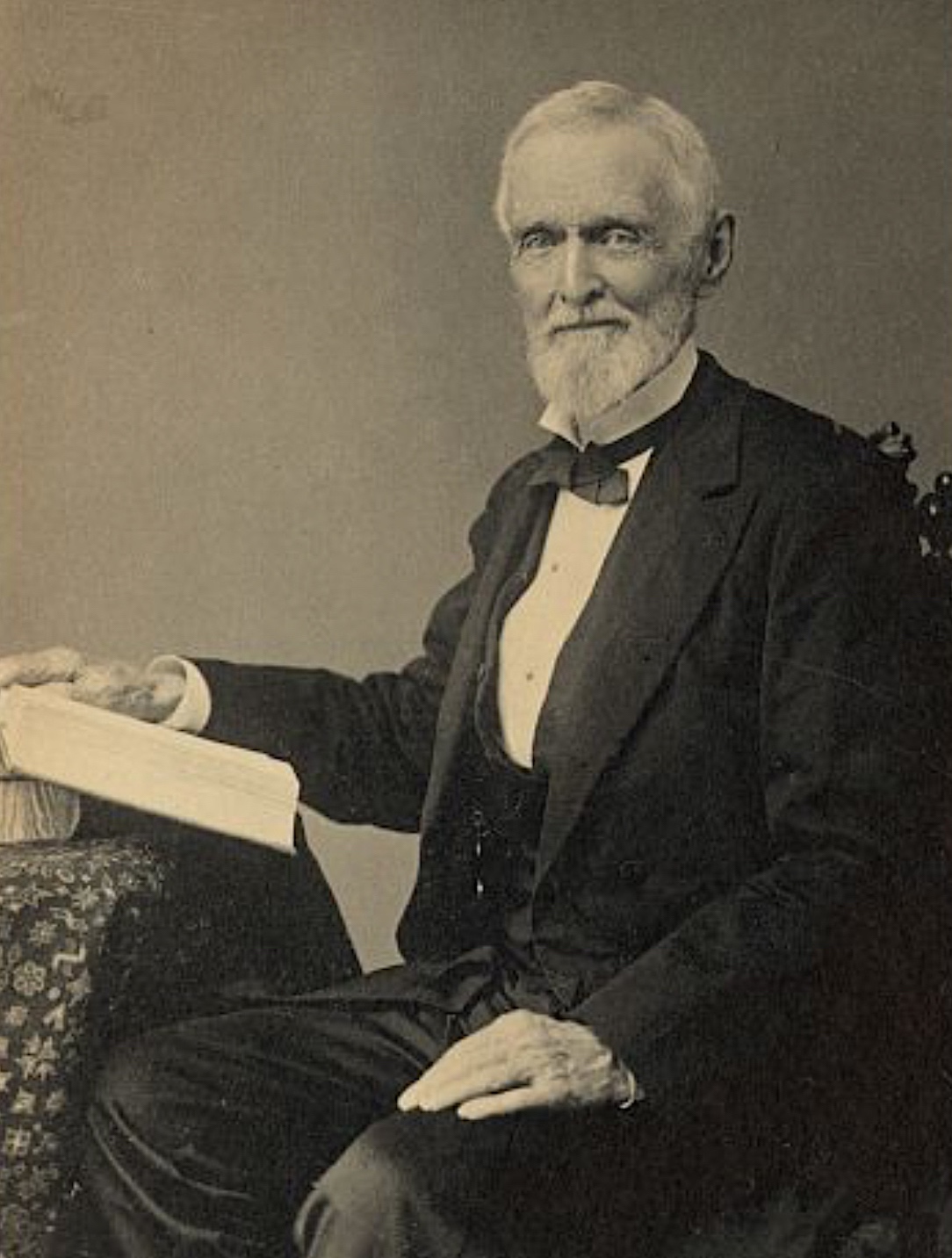 Library of Congress
Former Confederate president Jefferson Davis in the 1880s.
And so it’s interesting that he becomes the great villain. And I think he doesn’t really become that until after the war is over. I argue in my book that it’s really after Jefferson Davis writes his Rise and Fall of the Confederate Government, where he attacks Sherman, and also after Sherman in his own memoirs talks, not actually about Georgia, but talks about Columbia and the burning of Columbia and blames it on Wade Hampton, but also says I blamed it on Wade Hampton because I knew it would upset white southerners. So that’s where he takes on this kind of larger-than-life imagery. I also think that a huge contributor to this mythic Sherman is actually Gone with the Wind, first the novel and then the film, where Sherman is the villain and the driver of so much of the action. And yet it’s fascinating to me because you never see him. He’s always off screen. But so much of that then seeps into the culture.
The other thing I would say is that there’s different ways that places and people have responded to the March. So Atlanta, which Sherman famously orders burned, well he orders everything of military value burned and the fire gets a little bit out of control, takes that burning as a kind of badge of honor. And by the 1870s or the 1880s, I can’t remember the date exactly, they actually put on their seal, their city seal has a phoenix rising from the ashes. So they take from Sherman burning them this chance to be bigger and better and bolder. And then you compare that, I would say, with the city of Columbia, South Carolina, which really still holds onto that anger, that sense of victimization that their city was burned and how dare Sherman have done that.
Terry Johnston: You remind me, years ago in the Monitor we actually ran an article called “Birth of a Demon,” and it was how Jefferson Davis in his memoirs was, like you wrote about in your book, really the spark that started to turn southerners against Sherman. This is decades after the March was over.
Anne Sarah Rubin: Yeah. Sherman goes back to Atlanta as part of his job as general-in-chief of the army. He goes back to Atlanta. I want to say it’s 1879. And he’s welcomed with open arms. And he, you know, it’s so funny because, I mean, they do have articles and like little squibs in the paper where they’re like, “Oh, hide the matches. Sherman’s coming back.” But he’s welcomed with open arms. And then he comes back again for the Cotton Exposition in 1881 in his capacity—I believe he gives a speech in the capacity of Mexican War veterans or something like that. I can’t remember quite. But again, he’s welcomed with open arms. So it definitely comes later.
Terry Johnston: Yeah. Well, let’s dive in a little bit more into the cultural significance. I know in your book you outline how the March has become this powerful symbol of devastation and destruction, of war against civilians. And just as a relevant aside, I mean, I know that my Romanian immigrant grandmother would use the phrase “like Sherman through Georgia” when she was referencing something that was moving fast. So it really has taken on, in many ways, a deeper cultural significance. How did you examine that? What did you find? Any interesting takeaways there?
Anne Sarah Rubin: Yeah, it’s everywhere. Once you start looking for it, I mean, and that’s part of the reason I wrote the book, right? It is everywhere. I remember coming across references to the destruction of the South Bronx in the 1970s as a kind of Sherman’s March. James Reston Jr. famously wrote a book called Sherman’s March in Vietnam, where he tries to make this argument that there’s a kind of through line from Sherman’s idea of total war to the My Lai Massacre. I don’t think he makes that argument very successfully, but again, I think there’s just, there’s such inherent drama to it. And because it’s been refracted again in literature, and not just Gone with the Wind, although that is kind of the huge one. But even more recently E.L. Doctorow book The March, where he uses a great metaphor of the March as almost like this insect or this caterpillar just munching along.
So I think that, again, it does symbolize everything that happens in the war. And there’s another strand which I didn’t investigate as much in my book, but I’ve seen also, which is this idea of Sherman as some kind of avenging figure, avenging angel of justice. That you see these references, you see it a lot like on social media or whatever. It’s like, oh, you know, a state does something, a southern state like passes some discriminatory law or something, and all these people chime in and say, “Oh, we should go all Sherman on them.” Or like, you know, “We should go Sherman on this or that nation.” So I think that there’s that strand of Sherman himself as this personifier of righteousness, which of course is completely at odds with him, and also completely ignores his postwar career as a killer of, massacrer of Native Americans. So it’s tricky.
Terry Johnston: Yeah. What about how, specifically, African Americans have remembered the March? One of the things you do in your book is looking at the actual writings of southerners and Union soldiers and African Americans and how they were processing and remembering things. But looking at, as you were talking about earlier, thousands of enslaved families used the March as an opportunity to try to escape from bondage. And some folks who are listening might be familiar with the tragedy at Ebenezer Creek that happens. How did you find that African Americans themselves view the March, in history and memory?
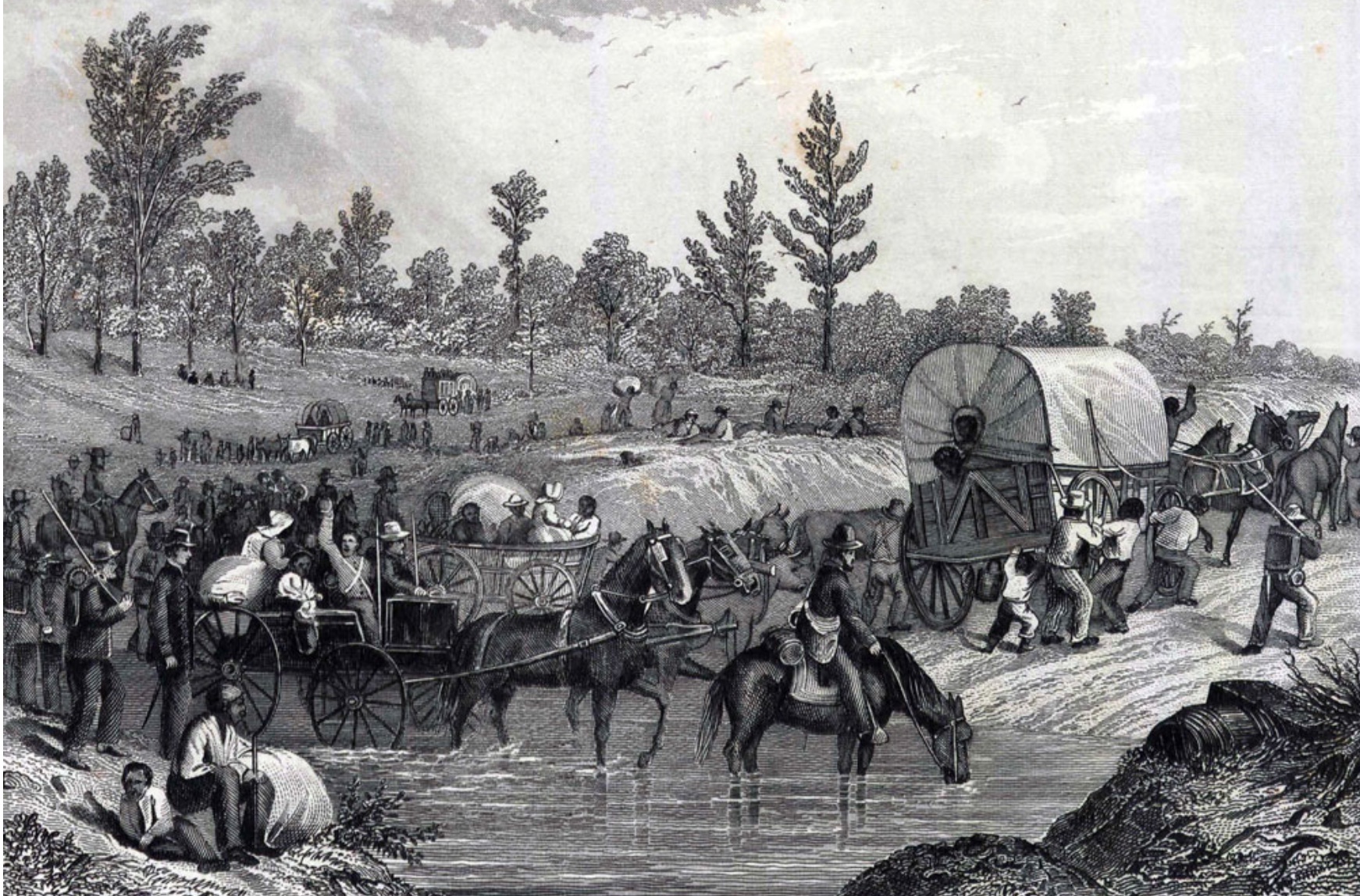 USAHEC
Slaves are depicted seizing their freedom by following Sherman’s army as it advances through Georgia.
Anne Sarah Rubin: I think for African Americans, it’s a complicated incident because on the one hand, yes, this is an army of liberation and there are apocryphal stories of Sherman himself coming onto a plantation and freeing people and seeing Sherman as this kind of liberation figure. On the other hand, if you followed Sherman’s army, they weren’t necessarily going to feed you. If you stayed put and all the food on your plantation was destroyed, you’re starving too. So striking at white southerners also strikes at black southerners. Union army troops were not uniformly abolitionists or emancipationists and certainly were not always kind to African Americans, would exploit them. There’s instances of sexual assault and sexual violence against black and white women. So it’s a more, I think, nuanced and ambiguous and complicated set of stories that African Americans tell about the March.
The other piece of this is that, what Sherman tried to do when he was in Savannah was not have all these people following him. And so you have this situation where he proposes that land that had been “abandoned” by white southerners along the Georgia coast be set aside and given to African Americans to settle. This is the origin of the expression “40 acres and a mule” in this area called the Sherman Reserve. And the federal government does start to put this into place, actually. But within a few months after the end of the war, when Andrew Johnson pardons most of these white southerners and gives them back their land, and African Americans are then thrown off this land, Sherman doesn’t say anything about it. He doesn’t care. It’s not his problem anymore. So it’s a fascinating story for African Americans. But like everything in the Civil War, it’s not all good or all bad.
Terry Johnston: Well, and I realize now that I referenced Ebenezer Creek earlier, the tragedy there. Can you just, for people who are unfamiliar, briefly tell us what that was?
Anne Sarah Rubin: Yeah. So, Ebenezer Creek is about, I don’t, I can’t think of how many miles it is, but it’s about 45 minutes now outside of Savannah. It’s a big swamp area. And the story is that one of the wings of Sherman’s army under the command of a Union general actually named Jefferson Davis, no relation, they were being pursued by some of Wheeler’s Confederate cavalry. They set up their pontoon bridges, their portable bridges, to get themselves across the swamp. And then between them and Wheeler’s cavalry were all of these African American followers, thousands and thousands of people. And rather than allow them to use the pontoon bridges to cross, they pull up the pontoon bridges, leaving this population, some of whom went into the water and tried to swim across, and many of whom drowned or died from exposure. It was December. Others were left to be captured by Wheeler’s cavalry. And it’s really, it’s kind of an atrocity. And a couple of Union soldiers wrote to their congressmen, actually, about what happened.
Sherman never condemns Davis for what happened, but it does lead to Secretary of War Edwin Stanton coming down to Savannah to meet with Sherman. This is when Sherman comes up with this Sherman Reserve plan. They have a meeting with several, it’s about 15, African American ministers, where they talk about what they want. Sherman comes up with this Sherman Reserve plan, partly because he thinks it’s so outlandish that Stanton won’t accept it. And then Stanton accepts it. But Ebenezer Creek, it’s really, it’s tragic. And it was not actually until 2011, finally, that the state of Georgia put up a historic marker there, discussing what happens there. Actually, you can get to it. It’s a boat ramp now into this Cypress Swamp.
Terry Johnston: Before we wrap this up is there anything about the March or its memory that we haven’t touched on that you think is important to mention?
Anne Sarah Rubin: I think it’s important to see it as a whole, so including the Carolina and the Georgia pieces. And the other piece that I think is really important to remember about it is we talk about it as the birth of total war, but it’s very much not total war in the 20th-century sense. Which is to say it is a war against property and possessions. It’s not war directly against civilians in the same way that, like, it’s not the firebombing of Dresden, right? It’s not using the atomic bombs. It’s not the kinds of missions against civilians that you see in the Vietnam War. It’s a different kind of total war. It’s more of a kind of a Napoleonic total war than it is a 20th-century war. And I think that’s a really important distinction to be made.
About the Guest

Anne Sarah Rubin is a professor of history at the University of Maryland, Baltimore County, where she teaches courses on the Civil War, American South, and the 19th-century United States. Her most recent book is The Perfect Scout: A Soldier’s Memoir of the Great March to the Sea and the Campaign of the Carolinas. In 2014 she published Through the Heart of Dixie: Sherman’s March and American Memory, a study of the significance of Sherman’s March in American culture.
Additional Resources
- Jefferson Davis, The Rise and Fall of the Confederate Government, Volume 1 and Volume 2
- Margaret Mitchell, Gone with the Wind
- Thom Bassett, “Birth of a Demon”
- James Reston Jr., Sherman’s March and Vietnam
- E.L. Doctorow, The March: A Novel
- “Forty Acres and a Mule”
Sponsored By