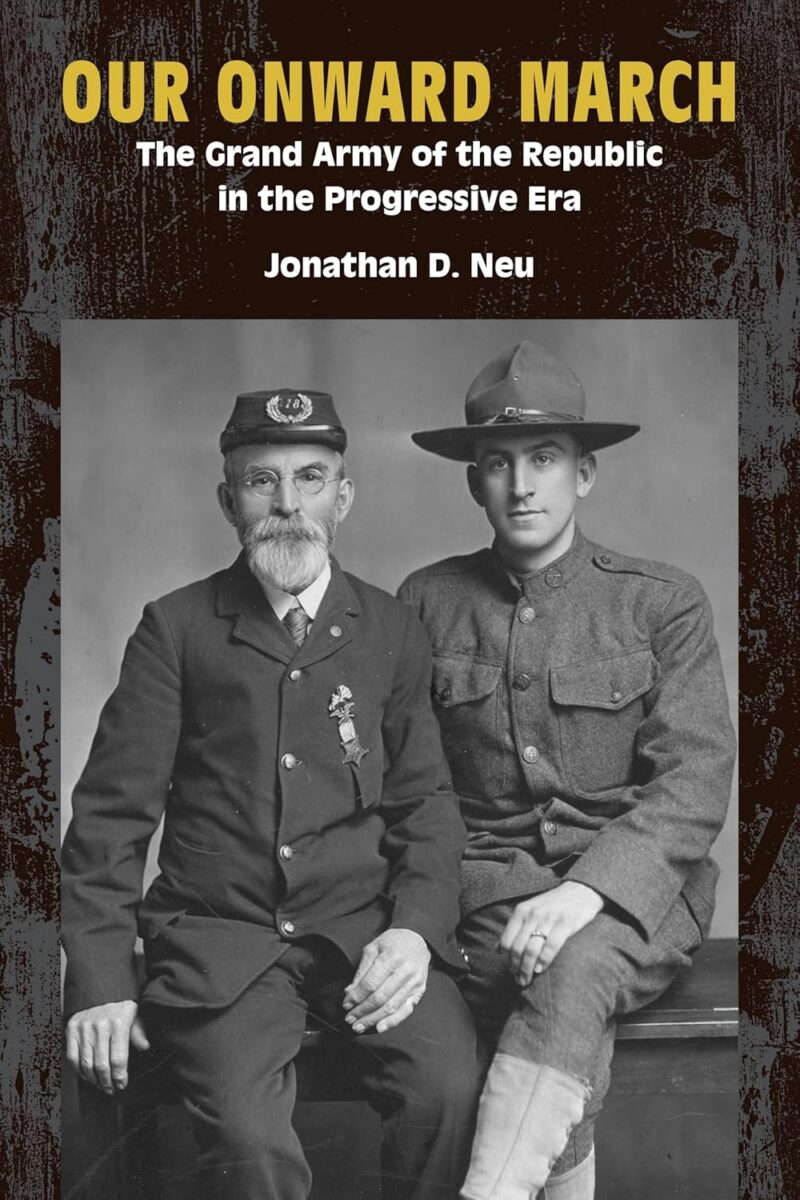
Following the Civil War, hundreds of thousands of Union soldiers returned home as veterans. But those who thought their service had come to an end were sorely mistaken. Many Union veterans joined fraternal organizations like the Grand Army of the Republic (GAR) to gain agency in the postwar period.
Historians like Stuart McConnell, James Marten, Barbara A. Gannon, Brian Matthew Jordan, and others have documented the GAR and its cultural, political, and societal impacts in detail; however, most of these narratives conclude with the passage of the Dependent and Disability Pension Act of 1890. Enter Jonathan Neu, who demonstrates that 1890 was hardly the end of the GAR’s influence. Examining individual local newspapers and various GAR post documents, Neu claims that the GAR was “an active and assertive community fixture during the Progressive Era” (3).
Dividing his work into five chapters, Neu addresses how the GAR played a fundamental role in promoting progressive reforms at the local level. He highlights the themes of education, public programs, community centers, and supporting America’s global ambitions as integral to the GAR.
Neu dispels the assumption that the GAR post room was an exclusive—even secret—meeting area for veterans. Neu demonstrates that “veterans threw open the doors of their post halls and hosted public entertainments designed to instill patriotic sentiment among their guests” (23). By allowing movie screenings, local events, and other festivities within these halls, veterans served as vital pillars for their community and ultimately influenced reform policies through their involvement in these events.
But the GAR’s work was in no way confined to the post hall. As Neu outlines in his second chapter, the GAR also played an active role in supporting funds for colleges and universities that would promote a form of citizenship aligned with the veterans’ values. As Neu argues, “GAR veterans were active participants in reforming American higher education as it underwent significant changes as a result of the Civil War” (53). Investing in public education and short-lived universities like Grant Memorial and Lincoln Memorial Universities, the GAR attempted to promote its values in communities across the nation. Through education, the GAR hoped to instill civic virtues and pass on the history of the war to future generations.
Neu next discusses how the GAR’s influence expanded into the South and West. Given the relationship between the GAR and the Republican Party, the organization failed to have a lasting impact on reform in the states of the former Confederacy; however, it experienced more influence in the West. On the Great Plains, the GAR members became influential members of their communities. On the West Coast, GAR posts experienced more challenges. With the rise of labor issues and Chinese immigration into states like California, GAR posts responded in a way that did not necessarily align with popular sentiments in the region. As a result, these posts fared almost as badly as those in the South.
The final two chapters shift their attention to the GAR’s influence in global affairs. As the United States became involved in the Spanish American War, and later the First World War, veterans quickly worked to promote the righteousness of the nation’s cause, “viewing the conflict as the global projection of their Union victory” (131). While many veterans supported the war efforts at home, a few GAR veterans offered up their services to once again press forth their ideal of Union.
By organizing each chapter around the progressive ideals pursued by the GAR, Neu offers a compelling account that helps to fill a gap within the literature on Civil War veterans. Neu’s work demonstrates effectively the cultural and social legacy that the GAR sought to leave through its support of many Progressive Era causes. He shows how GAR posts actively participated in the betterment of their communities—and as such how the war, at least for Union veterans, went on.
Riley Sullivan is a doctoral student in history at the University of Houston.